6 Ways Your Sober Coach Changes Focus From Week One to Month Six
October 31, 2026

The numbers behind the first six months:
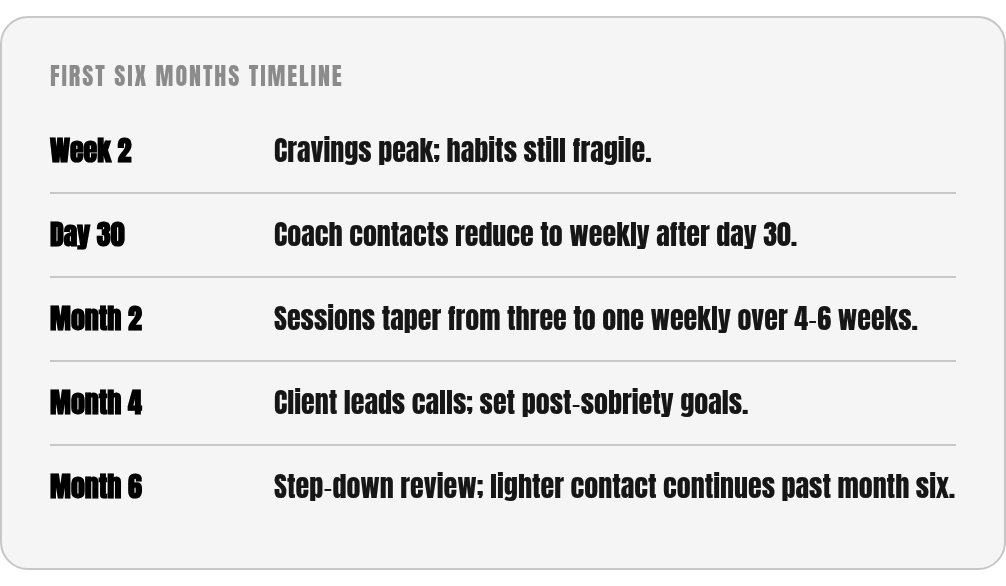
- New habits often take time to become automatic. A routine started in week two is still forming when day 30 arrives.
- Recovery coaches typically schedule two to three contacts a week in month one, and many move to one weekly meeting after day 30.
- Cravings tend to peak in weeks two and three, which is when new daily routines are least settled.
- Early sober companion support can run 24/7, then gradually shifts to ongoing coaching, where the client makes the decisions and the coach checks in.
- One tapering model steps sessions down from three a week to one over four to six weeks.
- The Addiction Policy Forum identifies boredom and unstructured hours as common triggers for people leaving active addiction.
- Schedules for weeks two through four cover four areas: sleep, responsibilities, recovery activities, and leisure. Sleep times get fixed first.
Why your coaching should change shape after discharge
Discharge is where treatment ends and everyday decisions begin. The first stretch home is often the hardest. Without structured aftercare, people end up managing their own routines at the exact moment that's most difficult to do. So our view is simple: a sober coach after rehab should be support that changes shape over time, not a service that stops at the door. Intensity should come down when your routines and your network can carry the weight, not when the calendar says so. For the signs that point to stepping down, see our guide to tapered coaching.
The early gap is mostly practical. One transition model builds the first days around arrival, appointments, household expectations, routines, and the first handoff. A referral list doesn't drive anyone to an appointment. Nonmedical coaching fills that space alongside clinical care. It never replaces it.
How does a sober coach after rehab shift support?
Early support is coach-led: frequent contact, shared planning, and real-time help when things get hard. By month six, the goal is client-led. You make the calls, and your coach checks in. One companion provider describes it as moving from 24/7 intensive support to ongoing coaching as you get stronger.
Most coaches recommend two to three contacts a week in month one, often dropping to weekly after day 30. We'd hold that drop loosely. This routine-building overview puts habit formation at about 66 days, so a routine you started in week two is still fragile at day 30. The taper makes sense once your routines hold up without prompting and you've built support beyond your coach.
Handoffs carry their own risk. One school of thought says every change of provider opens a gap. Another says companion support needs a defined end. Both have a point. That's why clients can work with a single dedicated coach or a coordinated team, depending on the care they need. The plan adjusts as they progress.
Weeks 2–4: Filling the empty hours before they fill themselves
Idle time is one of the most common triggers in early recovery. The Addiction Policy Forum notes that boredom and empty hours can pull people off track, and that people coming out of active addiction often struggle to keep any schedule at all. Most people do add good habits after treatment. They just don't put them where the day goes hollow. The 3 p.m. slump on a Tuesday with no work and no meeting is where a lot of early trouble starts.
Closing that gap is the main job of a sober coach in weeks two through four. We help you design and repeat a schedule covering sleep, responsibilities, recovery activities, and leisure, with the open blocks planned on purpose. Sleep anchors everything else, so wake times, meals, and bedtimes get set first. If you already have a discharge plan, we can help turn it into daily routines.
Contact frequency should match how your routine is holding
Weeks two and three are when cravings typically hit hardest. A routine that looks solid on paper still needs repetition before it holds on its own, and this is the window where it gets tested. That said, more contact isn't automatically better. If your days already run on steady work and consistent sleep, three check-ins a week may be more than you need.
Accountability should move into your hands
Early on, we carry more of the structure. We confirm wake times and make sure that empty afternoon has a plan. Each week, you take over more of the planning and we verify less. That gradual handoff is what makes tapering realistic by month six.
Months 2–3: From getting through cravings to building steadier days
Cravings often feel strongest in the early weeks and get more manageable with practice. By month two, the hardest stretch may be behind you, but the skills that got you through it are still new. Coaching can shift to match. We become less the person you call mid-craving and more the person who helps you build habits that keep the day stable.
To be clear about our role: our coaching is nonclinical, and we don't provide therapy. We help you put practical guidance to work in daily life. That means routines that reduce stress and eating habits that support physical and emotional healing. Repetition turns a skill you remember into one you use without thinking.
Contact drops as your skills hold
Check-ins can get lighter in this period, but a date on the calendar shouldn't make the decision by itself. One approach steps sessions down gradually, from three a week to one over four to six weeks. We like that kind of measured step-down for clients who still benefit from accountability. It leaves room for the plan to respond to missed routines, a job change, or a rough week.
Readiness is a gate, not a date
One commonly cited readiness sign is 90 days of continuous sobriety, which can signal that a baseline routine holds up under normal stress. A sober companion provider pushes back on fixed 30/60/90-day windows, arguing they mostly reflect insurance coverage and that high-stress professionals often need support much longer. Both points hold up. If your schedule is unpredictable, you may reach readiness later than someone with a nine-to-five, and the taper waits until you do.
Month 4: Making your own calls and setting goals past abstinence
Around this stage, coaching usually starts to look different. Early on, the focus was structure, safety, and getting through the day. Now the aim is self-sufficiency. A coach who keeps making every decision at month four risks what one tapering guide calls learned helplessness, where every choice defaults to the coach. That's not recovery. That's outsourcing.
The contact schedule should reflect demonstrated independence, not just elapsed time. The same guide describes moving from intensive daily touchpoints toward weekly check-ins as behavioral markers are met. We use meetings to review your decisions, not to make them for you.
Readiness comes from evidence
The tapering guide treats 90 days as a checkpoint, which usually lands somewhere in months three to four. Treat it as a minimum you've met, not proof that you're ready. Month four is also a good time to set goals beyond staying sober: a work target, a steady sleep or exercise routine, rebuilding trust with a family member. Write them down with your coach, then track them yourself between sessions.
The proof should come from you. The guide points to self-monitoring as one sign. A trigger log you keep on your own says more than one someone has to remind you to fill in. Because our coaching is customized, your coach can help you sort out which signs of stability matter most in your situation.
Your support has to reach past us
Before contact drops, check your network. Can you name sober people you'd call in a hard moment? Is there someone outside recovery who knows your plan? If your coach is the only name on the list, hold the taper.
Month 6: Stepping down without stepping away
By month six, most clients have put together enough steady weeks to ask whether daily contact still fits. The tapering guide describes a systematic step-down tied to behavioral markers. In practice, those markers look like using your own coping tools when cravings show up, keeping routines without reminders, and calling for help before a bad day turns into a crisis. If you can point to recent examples of each, it's a good time to review where you stand.
It's a checkpoint, not a finish line. A review of sober companion timelines makes the case that the right length of support depends on the person's circumstances, not a preset schedule. The step-down itself is gradual. Daily texts might become a few calls a week, then a weekly session, with a review after each change. If you slip during a step, we go back to the previous level for a while. That isn't failure. It tells us the timing was early.
Your plan has to outlast the taper
The tapering guide puts it plainly: build the new system before you reduce the old one. That means knowing your recovery supports, your sober contacts, a non-sober ally who knows your plan, and how you'll handle future stressors like a job change or a hard holiday. Helping clients build a plan for ongoing recovery is the point of coaching. This is the stage where that plan has to stand on its own.
Lower intensity still means support
A continuing care review takes on a question every family eventually asks: what works, and when is enough enough? Other research on continuing care looks at how aftercare affects recovery from substance use disorder over time.
Tapering isn't disappearing. The safety net stays, even as dependence on it shrinks. Because coaching is available both virtually and in person, lighter contact can fit around work, travel, and family life. If something changes, reach out and we'll talk through what level of support makes sense now.
Your next move for the first six months home
The two schools of thought on handoffs don't fully agree. "Each transition creates a gap, and gaps in recovery are where relapse finds room to take hold," warns one review of companion timelines, which argues for one person from day one. A planning model for the return home pulls the other way. It favors time-bound assignments with a set review date, and no next service treated as automatic.
Each side is right about a different risk. Changing providers loses context. Open-ended supervision goes unexamined. Our answer is continuity of person with defined phase boundaries: one coach or coordinated team whose role changes at agreed review points. Our coaching stays nonclinical throughout. If medical or psychiatric needs shift, that goes to qualified professionals, not more coaching hours.
The horizon is also longer than most people expect. There's no universal timeline. Months or even years in, many people keep support available for high-risk situations like business trips, holidays, or major life changes. Month six is a review point, not an exit.
A six-month checklist for your transition home
- Home transition: transport, appointments, household boundaries, and update permissions are confirmed, not just listed.
- Routines: sleep, meals, recovery activities, and open hours are scheduled and repeated.
- Contact cadence: frequent check-ins in month one, matched to your real exposure level, with a written plan for stepping down.
- Support network: people beyond your coach are in place before contact drops.
- Taper and continuing care: a gradual path to lighter coaching that can extend past month six.
Intensive coaching isn't right for everyone. If your home already runs on solid structure and your treatment team hasn't recommended added support, a lighter check-in plan may fit better. If two or more boxes are still empty, we'll help you build the plan from there.
References
[1] How Long Should You Work With a Sober Companion? - ALYST Health - https://www.alysthealth.com/sober-companion-timelines/
[2] 3 Signs You're Ready for Tapered Coaching After Rehab - https://blog.thosethatmadeit.com/3-signs-youre-ready-for-tapered-coaching-after-rehab-c737
[3] Sober Companion Support After Rehab | The Firm - https://www.thefirmaddictionconsulting.com/sober-companion-after-rehab/
[4] The First 30 Days with a Recovery Coach: What to Expect - https://allthewaywell.org/first-30-days-with-a-recovery-coach/
[5] Effective Routine Building in Addiction Recovery for Lasting Growth - https://windwardway.com/rehab-blog/routine-building-in-addiction-recovery/
[6] (PDF) Impact of Continuing Care on Recovery From Substance Use ... - https://www.researchgate.net/publication/348845588_Impact_of_Continuing_Care_on_Recovery_From_Substance_Use_Disorder
[7] (PDF) The Continuing Care Model of Substance Use Treatment - https://www.researchgate.net/publication/262422106_The_Continuing_Care_Model_of_Substance_Use_Treatment_What_Works_and_When_Is_Enough_Enough
[8] Treating Substance Use Disorders with Adaptive Continuing Care - https://www.researchgate.net/publication/232556563_Treating_Substance_Use_Disorders_with_Adaptive_Continuing_Care
Quick Questions, Straight Answers
1. What does a sober coach do that a therapist or doctor doesn't?
A sober coach handles the practical side of recovery that clinical care doesn't cover day to day: getting to appointments, keeping wake times and meals on schedule, and planning empty hours. MADE Recovery's coaching is nonmedical. It works alongside your clinical providers, and changes in medical or psychiatric needs go to qualified professionals.
2. What happens if I struggle after my coaching contact is reduced?
A difficult stretch calls for a review rather than judgment. Your coach can examine what changed, identify which part of the plan failed, and decide whether more frequent contact is appropriate for a time. If life shifts later, you can reach out and adjust.
3. Does hitting 90 days sober mean I'm done with coaching?
The milestone alone does not answer that question. Readiness shows up in behavior: using coping tools on your own, keeping routines without reminders, and asking for help early. Some providers argue fixed 30/60/90-day windows mostly reflect insurance coverage, and people in high-stress jobs often need support longer.
4. Do I need intensive sober coaching if my home life is already stable?
Intensive coaching may be more than you need if your home already runs on solid structure, you have steady work and consistent sleep, and your treatment team hasn't recommended added support. A lighter check-in plan can fit better. What decides it is whether your routines and support network hold without someone verifying them.
5. Is it better to keep one coach or switch providers as recovery progresses?
Each option protects against a different risk. Switching providers loses context at every handoff, while open-ended support from one person can go unexamined. MADE Recovery addresses both: one coach or a coordinated team stays with you, and their role changes at agreed review points instead of handing you to someone new.