6 Sober Coach Models After Rehab That Target Different Relapse Triggers
November 1, 2026

What the research says, before we start:
- A 2025 systematic review of 28 studies and 12,601 participants found consistent evidence that peer coaching helps keep people engaged in care.
- The same 2025 review rated the evidence on substance use itself as preliminary and inconclusive, even after adding 17 studies published since the 2019 review.
- The 2019 review listed reduced relapse among peer coaching's benefits, but the evidence was mixed.
- Peer recovery support services emerged in the 1990s. They adapted patient-navigator models that had coordinated cancer care for decades, then added peers with lived experience.
- The six coach models in this article are our own working categories. No study has compared outcomes between them or tested matching a model to a trigger.
What Changes the Day You Leave Treatment
Discharge trades a structured day for an open one. The schedule, the staff and the peer group all go away at once. For a lot of people, that is exactly when structure, connection and accountability count the most. A sober coach after rehab can fill part of that gap with practical, day-to-day support from someone who knows recovery life up close.
The role is older than most families expect. Peer recovery support services grew out of patient-navigation work and became their own category of substance use support. That review draws a clear line between this work and 12-Step sponsorship. It describes peer support as neither formal treatment nor mutual help. A coach doesn't replace your sponsor or your home group. It's a different job.
Our recommendation for anyone weighing this: choose support around the trigger most likely to trip you up in the next few months, hire for staying connected to care rather than for a promise, and plan to scale contact down as your routines hold.
Retention Has the Evidence; Relapse Prevention Doesn't Yet
Peer coaching has its clearest research support in keeping people connected to care. The 2025 systematic review of peer recovery support and recovery coaching found that results on engagement and retention have grown more consistent. Results on substance use are still unsettled.
The 2019 review did report some positive relapse findings, and it also told readers not to lean on them too hard. Some studies showed improvement. Others didn't. Anyone selling a sober coach as relapse insurance is getting ahead of the evidence.
So read the trigger matching below as reasoning about fit, not a proven effect. That applies to our sober travel companion work too. Its best case is keeping your support in place while you're away from home. It can't promise that a trip will be free of relapse risk.
Six Sober Coach Models Matched to Everyday Triggers
These six categories are our own working groups, not an industry standard. This first set sorts coaching by delivery: who shows up, where, and how often.
| Model | Trigger Focus | Delivery Mode | Typical Intensity | Ideal Situation | Core Benefit | Best Fit |
|---|---|---|---|---|---|---|
| Live-in companion | Isolation | In person, at home | Around the clock | First days home | Constant presence | High-support transitions |
| Sober travel companion | Routine disruption | In person, on the road | Full trip days | Required travel | Support continues away from home | Early recovery trips |
| Daily accountability coach | Unstructured time | Phone or video | Daily check-ins | Back at work | Concrete daily tasks | Self-directed clients |
| Social reentry coach | Social pressure | In person | Scheduled outings | Weddings, work events | Rehearsed exits | Drinking-heavy circles |
| Family-inclusive coach | Stress at home | Sessions with family | Weekly | Tense households | Shared expectations | Families seeking guidance |
| Recovery navigator | Disconnection from care | Mixed | As needed | Gaps between appointments | Links to outside treatment | Long-term maintenance |
Routine runs through most of these rows for a reason. It turns open hours into daily tasks you can check off, which is a lot easier to hold onto than a vague intention to "stay busy." If you're already working, getting to meetings and calling your sponsor, skip the live-in model. It's more support than you need.
The Six Sober-Coach Models by Focus: What They Cover and When They Fit
The research on peer recovery support and recovery coaching doesn't sort support into the categories we use. This second set sorts coaching by what the work focuses on rather than how it's delivered. Treat these as practical labels for how a sober coach after rehab may spend time with you. They are not validated categories, and no study compares outcomes between them.

Each model starts from a likely pressure point and plans around it. Tying a model to relapse risk is our reasoning from coaching work, not a measured result. The 2019 review and its 2025 update studied peer support broadly. Neither tested a trigger-based matching system.
Which Model Fits Your First Months Out?
| Model | What it covers | Example scenario | Trigger it targets | Intended benefit |
|---|---|---|---|---|
| 1. Trigger Identification & Management | Spotting high-risk people, places and feelings, then planning responses | First family dinner home | Old tensions, alcohol on the table | A plan before you walk in |
| 2. Emotion & Coping Strategy | Preparing for hard emotions and choosing coping actions | Returning to a high-stress job | Pressure, anger, shame | Coping steps chosen in advance |
| 3. Lifestyle & Routine Building | Mornings, meals, meetings, sleep, exercise, recovery tasks | Building a morning routine | Unstructured time | Fewer empty hours |
| 4. Peer Support & Accountability | Lived-experience check-ins and companionship | Daily sober companionship at home | Isolation | Someone who notices drift |
| 5. Mindfulness & Stress Management | Grounding and staying present | Sober travel companion at a wedding | Open bar, distance from home supports | Support that travels with you |
| 6. Crisis Management & Rapid Response | Short-notice help with cravings or conflict | Sudden craving on a weekend outing | Unexpected exposure | A fast response |
Model 3 is often where we start. A discharge plan written in treatment only does its job once it becomes a schedule someone follows on a Tuesday morning.
Where Does a Sober Travel Companion Belong?
A sober travel companion belongs where the main risk is disruption. That means airports, hotels, client dinners, weddings, family events, or any trip that pulls a person away from familiar recovery anchors. The companion's job is to help the plan travel with the client: meals, sleep, check-ins, meetings, grounding tools, and a way out of high-pressure rooms.
You don't always need one. If the event is local and sober friends will be there, Model 4 phone check-ins may cover it.
Model 6 is nonmedical support. If someone shows withdrawal symptoms or signs of an overdose, call emergency medical services first.
MADE Recovery's Integrated Coach Model
Research on recovery coaching is still young. The 2025 review went back to questions earlier work had raised and still couldn't settle all of them. Our integrated model sits inside that evidence base. If you hire a sober coach after rehab, you're joining a field where practice is expanding while the research catches up.
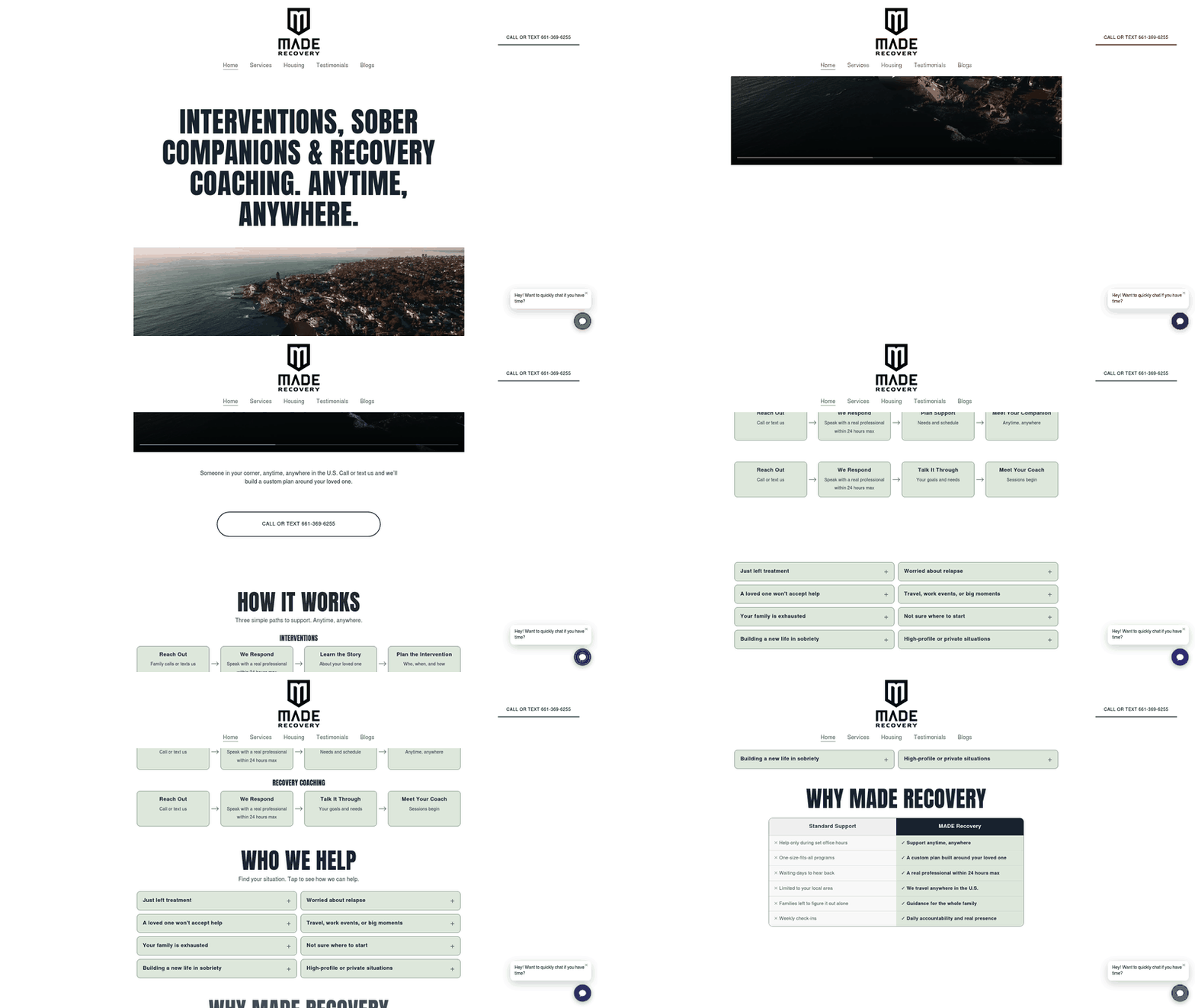
Our team brings coaching, companionship, sober living and intervention support under one roof. We are nonmedical. Detox, medication and clinical treatment come from outside professionals and facilities. Bundling services raises a fair question about which part is helping. The 2019 review noted that studies often can't separate a coach's effect from other recovery support activities, and an integrated model makes that even harder to untangle. We'd rather say so up front.
What Does the Evidence Support for an Integrated Sober Coach After Rehab?
| Claim | What the reviews support | How we frame it |
|---|---|---|
| Keeps you engaged with care | Consistent finding | We say this with confidence |
| Reduces substance use | "Preliminary but inconclusive" | We don't promise it |
| Matches a model to your trigger | Not studied | Our reasoning only |
| Travel companion prevents relapse | No study tests it | We don't claim it |
That table keeps our service promise modest and practical. We focus on contact, structure, recovery planning, communication and accountability. We don't tell clients that any one coach model has been proven better than another, and we don't present reduced relapse as a guaranteed outcome.
How We Handle Travel Companionship
We treat travel companionship as continuity. A person from your support team stays with you while you're away from your treatment setting and your home supports. The trip won't become risk-free. The aim is to shrink the gap between the support you lean on at home and what life on the road actually looks like.
For a short trip, meetings plus phone check-ins with your coach may be enough. For a longer stretch away, we'll help you build a routine that comes with you.
Picking a Coach Model for Yourself or Someone You Love
No study can tell you which coach model fits you. The 2025 update says researchers still need to define when and where this support helps most. The 2019 review was asking the same questions.
That leaves the choice where it probably belongs: matching support to your actual life. Every plan we build starts with an initial consultation about your needs. Thinking through the questions below beforehand makes that conversation more useful.
Six Questions Settle Most of the Fit
- Trigger. Name the main pull first. It might be evenings alone, family friction, work stress or a trip away from home.
- Contact. Decide whether you want calls, video sessions or someone physically with you.
- Intensity. Ask whether you need daily check-ins, a few sessions a week, or someone you can reach quickly when a day goes sideways.
- Budget. Raise cost in the first consultation so the plan fits what you can keep paying for, not just what you can afford for one month.
- Family. Decide whether your coach should talk with family, and about what.
- Scope. Choose between one focused support style and several coordinated ones. If a single coach already feels stretched thin, read these signs that one sober coach isn't enough.
Travel shows how the answers combine. A sober travel companion means in-person, high-intensity support for days away from your usual people and routines. Daily accountability coaching may be enough when the trigger is unstructured time at home. Family-inclusive coaching makes more sense when the hardest moments come from conflict, expectations or unclear boundaries.
Virtual and In-Person Coaching Differ in Logistics
| Factor | Virtual | In-person |
|---|---|---|
| Convenience | Fits around work and time zones | Requires scheduling and travel |
| Privacy | No visitor at your home or office | Others may notice a companion |
| Immediacy | A call can start in minutes | Depends on the coach's location |
| Companionship | Voice and screen only | Shared meals, events, trips |
| Logistics | Needs a device and a quiet space | Needs coordinated time and place |
We know of no evidence that one format works better than the other. Choose based on your daily routine and your triggers.
Families can help most by clarifying needs early and agreeing on what the coach will share with them. Support accountability without checking up on your loved one constantly. The structure they choose is theirs to own, and respecting it matters more than monitoring it.
Once routines hold and coping plans feel steady, we reduce contact gradually. That tapering is our working practice, not a research-backed timeline. If the first step is just figuring out which of these models fits, that's what the consultation is for.
References
[1] Lived Experience in New Models of Care for Substance Use Disorder - https://pmc.ncbi.nlm.nih.gov/articles/PMC6585590/
[2] (PDF) Peer Recovery Support Services and Recovery Coaching ... - https://www.researchgate.net/publication/390092484_Peer_Recovery_Support_Services_and_Recovery_Coaching_for_Substance_Use_Disorder_A_Systematic_Review
Frequently Asked Questions
1. Is a sober coach the same thing as a 12-Step sponsor?
No. A sponsor usually supports someone through a mutual-help program, while a sober coach is hired support focused on structure, accountability and practical recovery planning. Many people keep both. If you already go to meetings, work with a sponsor and hold a job, you probably need lighter coaching, such as phone check-ins, rather than a live-in companion.
2. Can a sober coach help with withdrawal symptoms or medication?
MADE Recovery's coaches do not manage withdrawal, handle medication or provide clinical treatment. Our coaching, companionship, sober living and intervention services work alongside outside clinical care and do not replace it. If someone shows signs of withdrawal or overdose, call emergency medical services first, then contact the coach.
3. Will hiring a sober coach guarantee I don't relapse?
No. A sober coach cannot guarantee sobriety. A coach's main value is keeping your support active and your recovery plan in daily use: calls happen, routines get reviewed, high-risk plans are rehearsed and gaps in care are easier to notice. MADE Recovery does not promise relapse prevention.