4 Signs One Sober Coach Isn't Enough After Rehab
September 30, 2026

Sign 1: Why One Sober Coach May Fall Short Matters
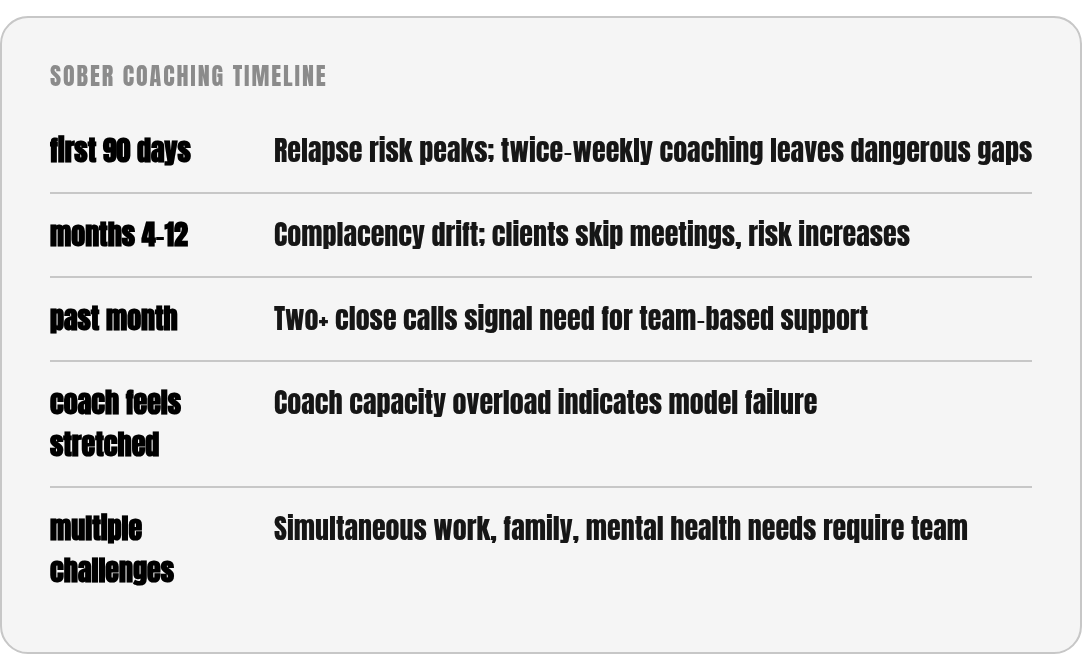
Most people leave treatment with a plan: regular check-ins, a list of meetings, maybe a therapist lined up. The assumption is often that adding one sober coach to that list will close the gap between the structured routine of rehab and the unstructured pace of real life. That assumption can break down quickly after discharge, especially in the period some recovery resources describe as the first 90 days after rehab, when residential structure falls away and relapse risk may be highest [1].
The problem isn't that coaches lack skill. It's that the job can exceed what one person can cover. A coach scheduled for set days may not catch warning signs that show up on other days—the skipped routine, the unanswered message, the quiet drift that can precede relapse. In our experience, clients who need frequent accountability can end up with gaps between sessions, and those gaps can become the danger zone.
Why Single-Coach Models Run Out of Bandwidth
A sober coach's scope often includes accountability check-ins, routine building, companionship during high-risk situations, and crisis response when cravings spike. That is a round-the-clock set of needs compressed into a few scheduled sessions. If a client's trigger occurs at a time the coach is unavailable—for example, the end of a workday—the single-coach system may already have a gap.
We work with families who describe feeling stuck after hiring a coach. The coach shows up, does useful work during the session, and leaves. Then the client may be alone late at night when a craving hits, or during a weekend afternoon with an old routine. Relapse can happen in unsupervised hours when no formal support is available.
The other issue is specialization. A coach trained in accountability and routine-building may not have the skills needed for every situation. MADE Recovery addresses this through coordinated team-based support—a dedicated coach or multiple coaches working together, with on-call backup for crisis moments. One person may not be able to cover every need.
The Later-Stage Drift Problem
Early recovery can demand intensive support: frequent check-ins, crisis management, and acute craving intervention. Clients who make it through that early window may assume they have graduated from risk. In our experience, the opposite can happen: complacency becomes a bigger threat later in the first year, when clients may start skipping meetings, missing calls, and assuming they no longer need the same level of help. A single coach may not catch this drift early because contact is limited, and some clients learn to present well during sessions.
Clients who relapse during this phase often describe a similar pattern: a slow drift away from supports in the weeks before use. The coach may not have failed; the coverage model may have. When contact is infrequent, small behavioral changes—sleeping in, avoiding family calls, isolating on weekends—can be missed.
Team-based sober coaching changes the equation. MADE Recovery puts coordinated support in the client's daily life, with a primary coach for scheduled check-ins and on-call backup for high-risk hours. Support is tailored to the client's needs and schedule, covering the moments when risk is highest. As clients gain independence, support is intentionally reduced to encourage self-sufficiency. The result is a safety net designed around when real life happens, not just during scheduled sessions.
What you need to know:
- Relapse risk may be highest in the first 90 days after rehab, a window some recovery resources describe as high-risk [1], when residential structure disappears and scheduled coaching sessions may leave gaps.
- A single coach may not be able to cover the full scope of accountability, crisis intervention, and high-risk moment support that early recovery demands.
- Complacency can become a bigger threat later in the first year as clients skip meetings and present well during sessions while drifting between check-ins.
- Team-based sober coaching assigns different companions to work, home, social events, and travel rather than relying on one scheduled relationship.
Sign 2: Gaps in Daily-Life Coverage
A single coach works on a schedule. Daily life doesn't. That's the core problem we see with sober coaching after rehab when it rests on one person's calendar: the hardest moments rarely land during a booked session.
Relapse pressure shows up in specific places. A tense meeting at work. A family dinner that stirs old dynamics. A wedding with an open bar. A work trip that drops someone into a hotel room alone at night. These are different domains with different triggers, and no single coach can be physically present across all of them.
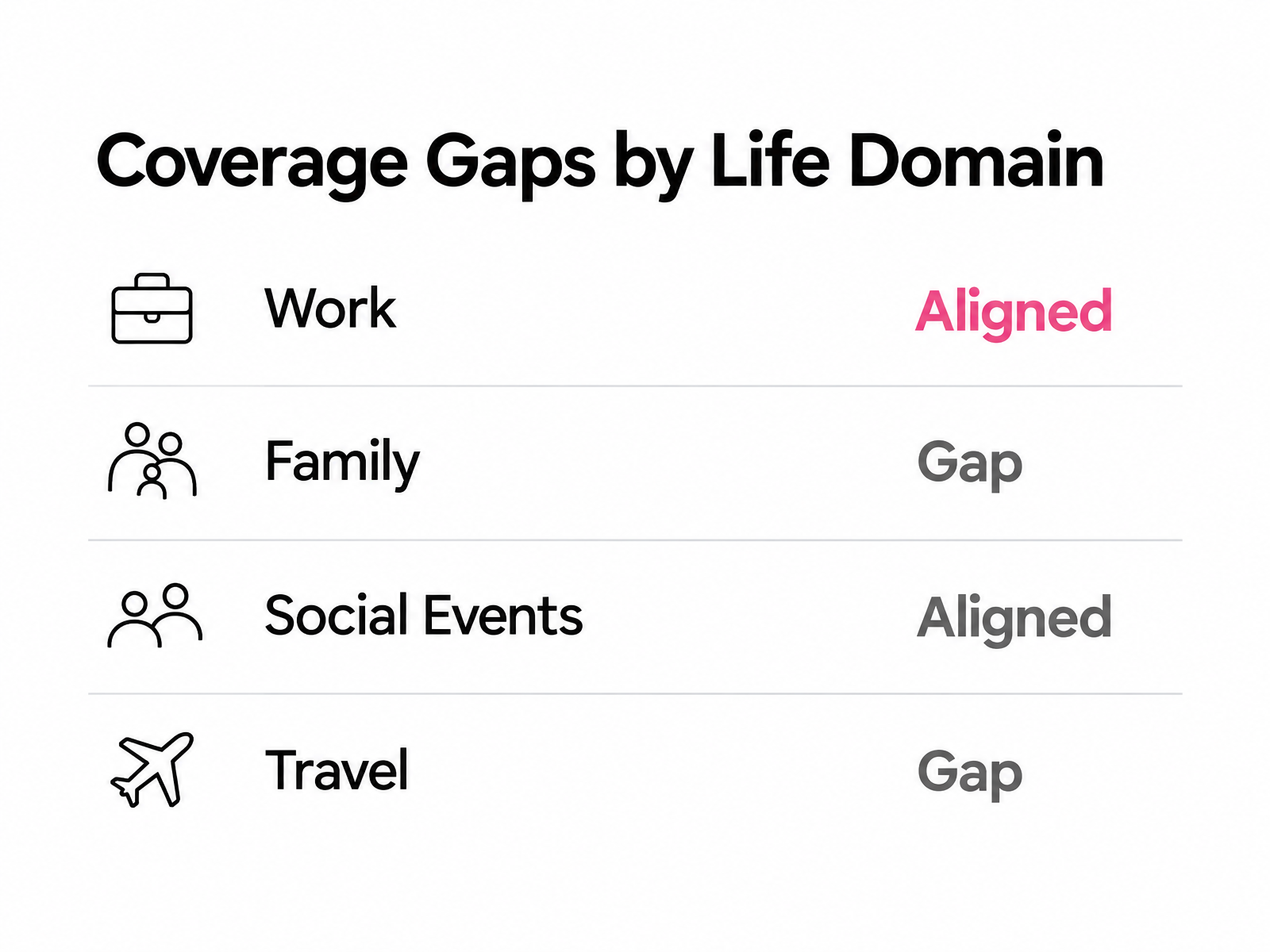
Where does a solo coach run out of hours?
A solo arrangement starts to strain when the client's week is spread across too many environments. Home may require one kind of support, work another, and social settings another. The client feels the difference most when structure disappears and they're expected to carry the plan alone.
That's the case for building coverage around life domains instead of a single relationship. Our approach assigns different companions to different parts of a client's week.
- Map the high-risk domains first. List work, home, social events, and travel separately, then rank which ones carry the most trigger weight for this specific person. Coverage should follow the risk, not a generic template.
- Assign a routine companion for the everyday. Someone who covers the ordinary weekday rhythm catches the quiet warning signs early. The skipped meal or the withdrawn afternoon may not appear on a session day.
- Add a social-event companion for the hard nights. Weddings, parties, and reunions carry their own pressure. Having a companion present at the event itself beats debriefing it two days later.
- Plan explicit coverage for work and travel. Job stress can be a trigger for many people, and travel may remove familiar anchors at once. Decide in advance who is reachable during a trip.
How can families ask for more coverage?
Families often hesitate here. They worry that requesting an in-home team will feel like they're smothering the person they love. That fear keeps coverage thinner than it should be.
Frame it as matching support to the week ahead, not policing the client. A busy stretch with travel or a big social event is a reasonable trigger to expand the team temporarily, then scale back. Support can be tailored to the client's needs and intentionally reduced as independence grows, without becoming surveillance.
Sign 3: Lack of 24/7 or On-Demand Emergency Support
A single coach keeps office hours. Crises don't. Some of the hardest relapse moments happen outside the neat boundaries of a scheduled session—late at night when isolation sets in, on a weekend when old friends resurface, or during a work trip that drops someone into an unfamiliar city with no accountability structure in place.
Many recovery coaching arrangements operate on a calendar: weekly check-ins, maybe a few texts between sessions, and an understanding that the coach is available "if you need me." That sounds reasonable until you map it against the reality of how urges show up. They don't wait for a convenient appointment. They arrive when you're alone after a difficult client meeting, or when you walk past your old bar on the way home from the gym, or when a family argument spirals and you need someone to talk you down in real time.
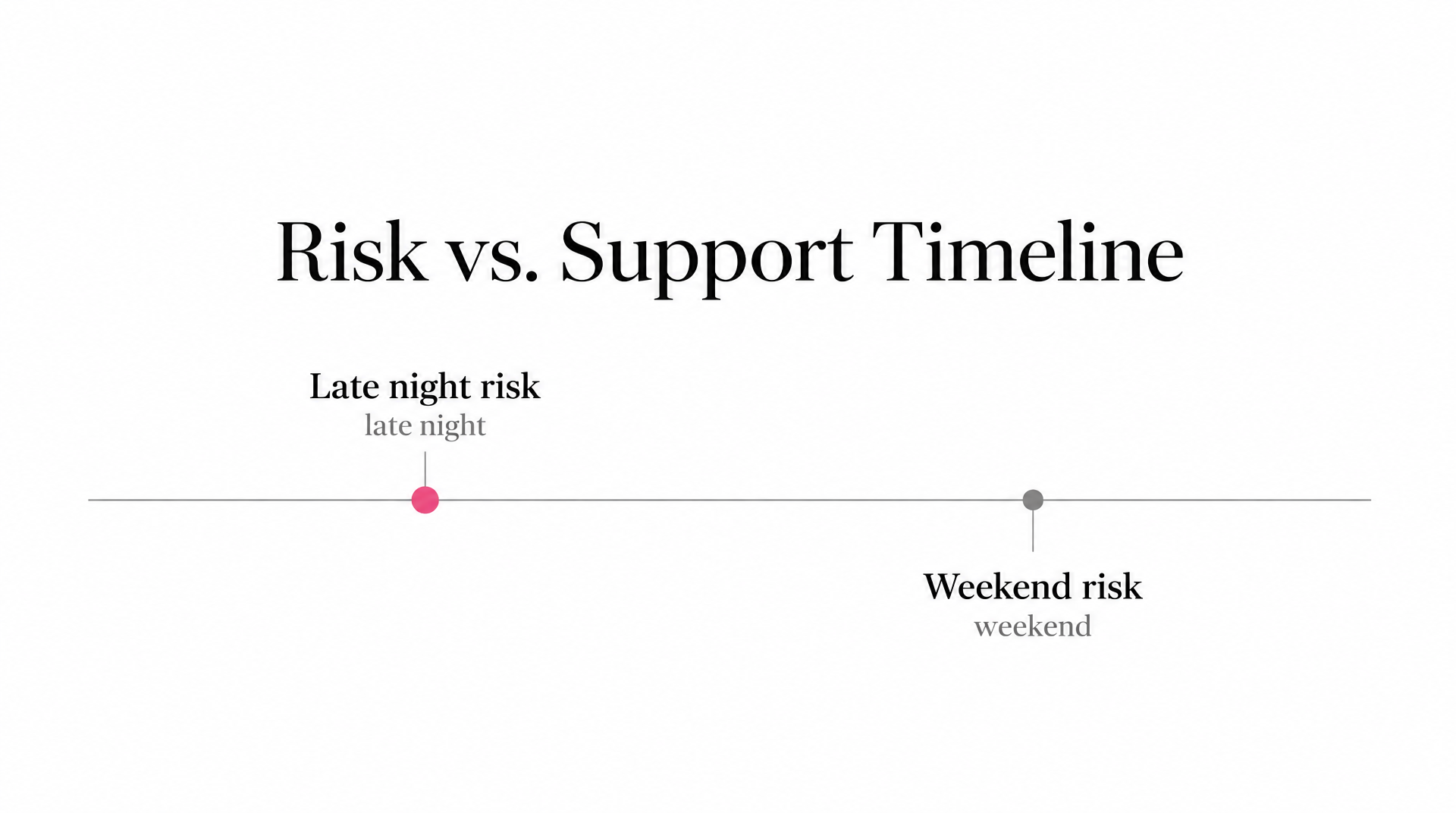
When does a single coach's availability break down?
The standard coaching model assumes that structure during scheduled sessions will carry forward into the unmonitored hours. We've watched that assumption fail when the stressor is immediate and the support is delayed. A client may leave a session feeling grounded, then encounter an argument, a memory, or a sudden wave of restlessness before the next contact. If the system isn't built for real-time response, the client is left to improvise.
This isn't a criticism of individual coaches. It's a capacity problem. One person cannot be available to every client at every vulnerable moment. When someone needs immediate support and the coach is unavailable, the gap can become dangerous. Some clients white-knuckle their way through those moments, or decide not to reach out at all because they don't want to "bother" their coach outside of session time.
What does on-call coverage actually require?
A 24/7 support system isn't just about having a phone number to call. It requires infrastructure: rotating availability so someone is always reachable, peer backup when one team member is unavailable, and protocols for escalating a situation quickly if a client is in acute distress. It also requires knowing the client well enough to recognize when an "I'm fine" text actually means "I'm not fine but don't know how to say it."
Our team-based model means clients can receive assistance from a single coach or a coordinated team, depending on their needs. When a client travels for work, our sober travel companions provide support during vulnerable moments. Our approach to companionship gives clients access to practical support and accountability during critical times—not constant supervision, but human connection when it matters most.
Sign 4: Need for Specialized Expertise (Trauma, Co-Occurring Disorders, Nutrition, etc.)
When someone leaves rehab carrying both a substance-use disorder and untreated depression, or a trauma history that shows up as hypervigilance and avoidance, a single generalist coach may not be able to address the full picture. One person, working alone, can only stretch so far: they may be strong on accountability and routine, but no single coach can be expected to catch every warning sign, coordinate around complex needs, and hold the daily structure at the same time.
The gap isn't about effort. It's about scope. A coach can help you build a meeting schedule and avoid old haunts. But if you are also managing PTSD triggers that intensify cravings, or chronic pain that complicates recovery, you may need support that understands how those layers interact—and knows when to loop in a therapist or physician.
When does one skill set run out?
Co-occurring mental health issues are not uncommon among people entering recovery. Anxiety, depression, bipolar disorder, and PTSD can overlap with substance use, and those conditions do not pause while someone works on sobriety. They can feed each other. A panic attack may feel similar to early withdrawal. Unresolved trauma can make group settings difficult, which may lead someone to skip meetings and thin out their support network.
A team model lets us match the right person to the right need. Someone on our crew might focus on daily check-ins and routine accountability. Another can provide companionship and connection during the vulnerable moments when isolation sets in, without stepping into clinical therapy. If nutrition has collapsed during active use, guidance on meal structure may be added because erratic eating can destabilize mood and make cravings harder to manage. When needs run past coaching, we coordinate with your clinical providers.
What stays in the coach's lane, and what doesn't?
We don't diagnose. We don't prescribe. We don't replace your therapist or psychiatrist. When a client shows signs of severe depression, active suicidal ideation, or symptoms that suggest a condition we're not equipped to address, we refer out immediately. Our role is to coordinate with clinical providers, not substitute for them.
What we can bring is continuity across domains that licensed professionals may not cover. A therapist may see you once a week for a defined session, while a coaching team may notice that you've stopped showering or that you're isolating in your apartment instead of attending the family dinner you committed to. We can flag those patterns to your treatment team and adjust the daily structure before a slide turns into a crisis.
When to Expand: Moving to a Team-Based Coaching Model
Most people leave treatment with one coach on the calendar and the assumption that weekly check-ins will hold the structure together. That works for some clients—usually the ones whose lives are stable, whose triggers are predictable, and whose support system is already strong. But when someone is juggling work stress, family tension, co-occurring mental health issues, and a calendar that changes week to week, a single coach may hit a coverage ceiling fast. The question isn't whether your coach is skilled. It's whether one person, no matter how skilled, can cover the range of situations where you need support after leaving rehab.
When does the single-coach model run out of capacity?
One sign is gaps in the week. If you're seeing your coach on fixed days but the hardest moments land in between, you're operating without coverage when it matters most. We see this in predictable ways: the work trip where no one is checking in, the family event where old dynamics flare up, the weekend stretch when isolation sets in and there's no structured touchpoint until Monday. A coach can't be in two places at once, and they can't cover every domain—work, home, social events, travel—without burning out or cutting corners.
Another indicator is role overload. When your coach is expected to handle accountability, crisis intervention, skill-building, family communication, and logistical coordination, something slips. If you also need trauma-informed support or help managing a co-occurring disorder like depression or PTSD, you're asking one person to hold expertise across multiple clinical domains. That's not realistic, and it's not fair to either of you. Research on relapse prevention makes this clear: more than 75% of people in alcohol treatment relapse within a year, and the determinants span interpersonal conflict, social pressure, negative emotional states, and high-risk environments. One coach can't address all of those simultaneously.
What does team-based coaching look like in practice?
We offer team-based support that lets you work with a single coach or a coordinated team, depending on what your care level requires. One team member might handle morning check-ins. Another focuses on work-related triggers and professional re-entry. A third provides in-home companionship during high-risk hours—evenings, weekends, the stretch after work when cravings tend to spike. When multiple team members are involved, they coordinate to ensure consistent support across contexts.
This isn't about adding more sessions for the sake of it. It's about matching support intensity to risk level. Early support should be based on actual instability, not on a generic weekly cadence. If someone is missing meetings, avoiding family, losing routine, or showing relapse signals, the schedule should tighten. As stability builds, the frequency can step down—but that decision should come from data such as attendance, sleep, communication, and reliable follow-through rather than from a calendar. A team model lets you scale support up or down based on what's actually happening, not on what a single coach's schedule allows.
How do you know it's time to expand?
- You've had close calls where you nearly relapsed and support wasn't available to intervene in real time
- Your coach has mentioned feeling stretched or unable to respond as quickly as they'd like during high-risk periods
- You're managing multiple challenges simultaneously—work stress, family conflict, a mental health diagnosis—and your coach can only address one area per session
- You need physical presence in environments where temptation is high, like social events, business trips, or time alone at home, and remote check-ins aren't enough
- Your schedule is unpredictable and you need flexible, on-demand support rather than fixed weekly appointments
If you checked even one of those boxes, a team model is worth discussing. The goal isn't to replace your current coach—it's to build the level of support your recovery requires, especially during the stretch when complacency sets in and people drift away from their supports without realizing it. Families often notice the need before clients do: communication gaps widen, old patterns re-emerge, and the single coach can't catch every warning sign because they're not there every day. That's when we recommend bringing in a team.
How to Make the Transition with MADE Recovery
If you've spotted one or more of the four signs, the fix isn't a bigger effort from a single person. It's a plan that spreads coverage across a coordinated team. We move clients from a solo arrangement to team-based sober coaching after rehab by protecting continuity while adding coverage where the current setup is thin.
We start with an assessment, then build the team around what it finds. The goal is to put support in the hours and places where triggers actually live, especially at home.
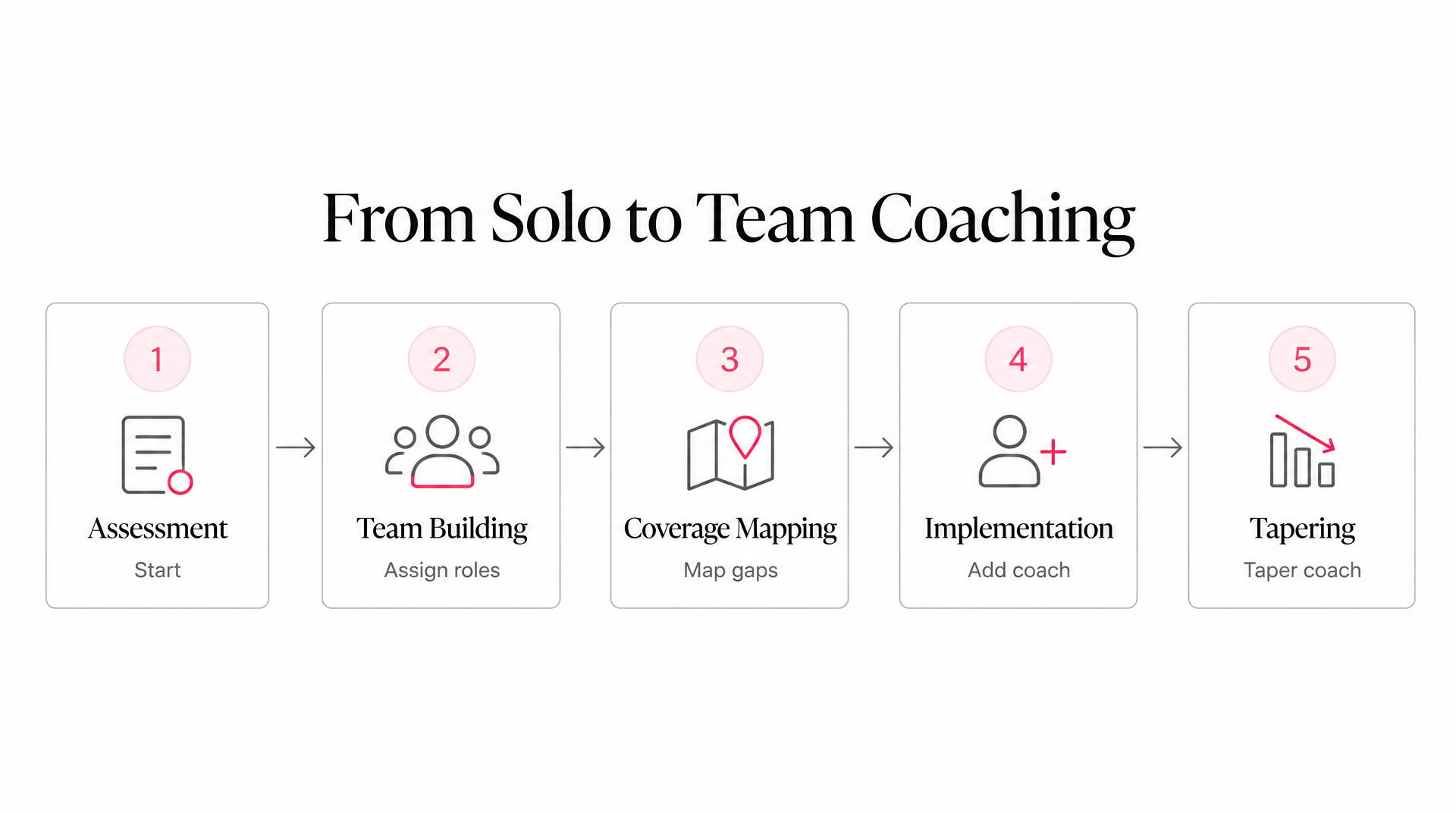
What does the initial assessment cover?
Before we add anyone to your team, we map where the current setup is thin. This assessment is the difference between guessing and knowing.
- Identify high-risk times, places, and relationships that have come up recently, so gaps get named instead of discovered mid-crisis.
- Rate your current coverage against those moments, marking which ones a single coach cannot reach.
- Note the types of support that matter most to you, so we can tailor the team to your needs.
How do you build and coordinate the team?
Once the gaps are clear, we assign roles and set the rules for how everyone talks to each other. A team without a communication protocol just creates confusion.
- Name a primary coach for scheduled contacts, then add in-home companionship for the daily hours where relapse pressure peaks.
- Establish contact methods that work for you, so you can reach support when you need it.
- Define measurable milestones with your team: weekly check-in targets, routine-building goals, and honest relapse-signal reporting.
How does the original coach's role taper?
Continuity matters. We don't swap one person out cold. The original coach stays central while new support layers in, then their frequency steps down as your independence grows. That deliberate taper is baked into how we work, the same way we handle it in your first week home.
If you recognize these signs in your own recovery, we can help you build the plan. Schedule a consultation with our team to map your gaps and set up coverage where it counts.
References
[1] How to Stay Sober After Rehab: The First 90 Days and the Year After - https://www.youareaccountable.com/guides/how-to-stay-sober-after-rehab
[2] Recovery Coaching for Early Sobriety Support - https://lionheartbehavioralhealth.com/blog/5-ways-recovery-coaching-can-help-you-stay-sober-during-your-first-year/
[3] Relapse prevention - PMC - NIH - https://pmc.ncbi.nlm.nih.gov/articles/PMC5844157/
Frequently Asked Questions
1. Can a single sober coach cover crisis moments that happen outside scheduled sessions?
Not reliably. A solo coach can be highly effective during planned contacts, but crisis coverage depends on a system, not goodwill. If after-hours response is part of the care plan, there needs to be a defined backup process and clear instructions for what happens when the primary coach is unavailable.
2. How do you know when to scale down from a full team to fewer touchpoints?
Scale down when daily behavior shows stability. Look for follow-through on recovery commitments, predictable routines, honest communication, and fewer unplanned escalations. The reduction should be gradual so the client practices independence without losing the safety net all at once.
3. What happens if your sober coach lacks expertise in trauma or co-occurring mental health conditions?
The coach should stay in the coaching lane and coordinate with qualified clinical providers. A team can still help with structure, transportation, accountability, meal rhythm, and companionship while therapists or physicians handle diagnosis and treatment. The important point is that complex needs should not be hidden inside a general coaching relationship.
4. Does team-based coaching mean you lose the relationship you built with your original coach?
No. In a well-managed transition, the original coach remains part of the plan while additional team members cover specific gaps. The relationship is preserved, but the burden no longer sits on one person.