6 Signs You're Ready to Taper After-Rehab Coaching to Weekly
September 23, 2026

Key Takeaways
- In McKay's continuing care review, every study that delivered active support for 12 months or more produced significant treatment effects.
- None of the models that worked relied on passive, client-initiated contact where people had to show up on their own.
- Telephone check-ins outperformed group counseling in that data, mostly because coaches did active outreach instead of waiting.
- Tapering safely means cutting how often you meet while keeping the multi-month support window. Duration drives outcomes more than contact intensity.
- Readiness you can actually observe: 30- and 90-day milestones held, stable routines, coping under stress without crisis calls.
- A sudden push to taper right as a deeper pattern surfaces usually signals avoidance, not stability.
- Pace depends on risk. Clients with prior treatment episodes or high recent stress stay at frequent contact longer.
Why Stepping Down Isn't Stepping Away
Moving from daily coaching to a weekly check-in isn't pulling support away. It's matching support to where you actually are. After-rehab coaching was never meant to keep you tied to a phone call. It was meant to build the internal structure that makes the call less necessary.
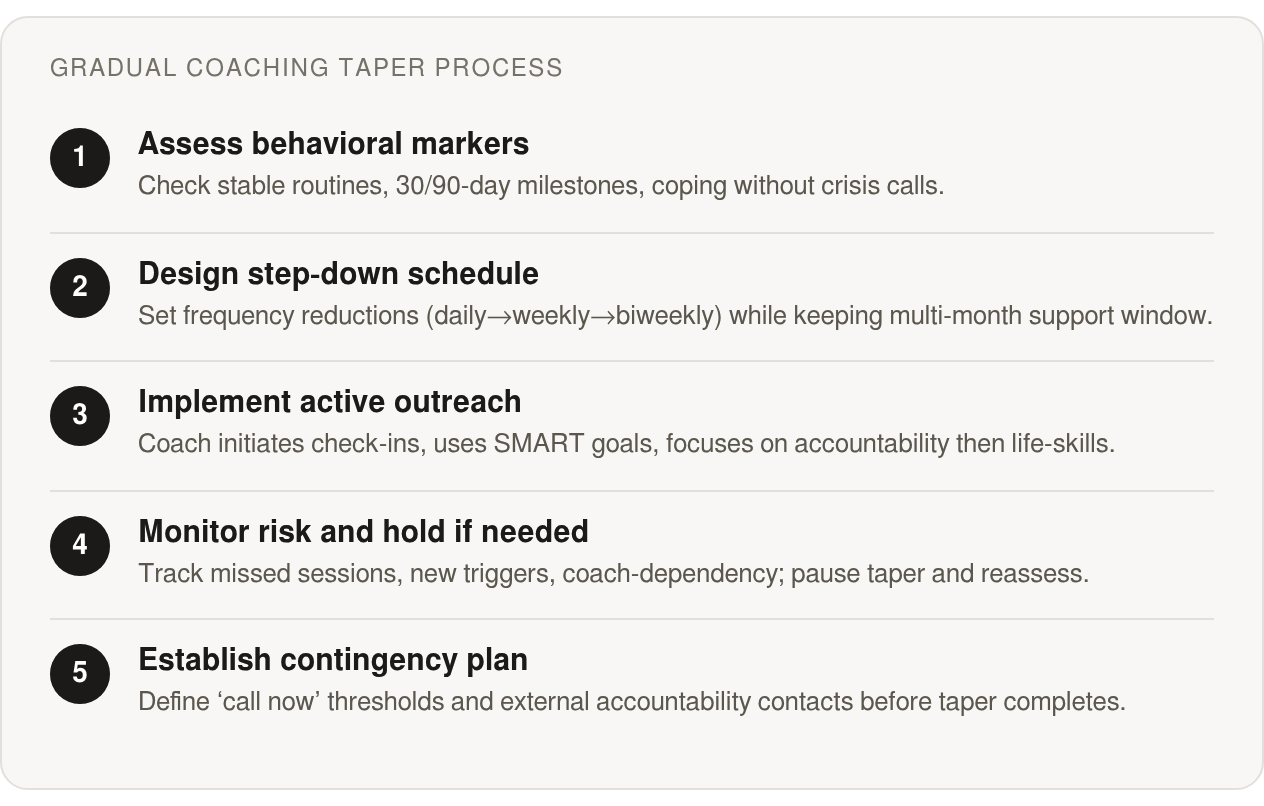
There's a real tension every time a client asks to taper. The continuing care research favors longer, active care. In McKay's review of continuing care, every study that ran support for 12 months or more produced significant effects, and none of the ones that worked left people to show up on their own. So how do you reduce contact without cutting the part that made it work?
You separate frequency from duration. Tapering how often you meet is safe when the markers support it. Shortening how long you stay connected, or switching to passive, client-initiated contact, is where relapse risk creeps back. That distinction drives every decision about when a taper makes sense.
Tapering Cuts Frequency, Not Your Support Window
A graduated step-down (daily to weekly to biweekly) usually reads as coaching doing its job. The signs you've outgrown intensive coaching tend to line up with real capacity, not just comfort. But the research pushes back on doing this passively. The models that worked stayed active rather than waiting for people to call in.
- Confirm the taper cuts session frequency, not the total length of your support window. The evidence favors staying connected for months, just less often.
- Keep contact active at the weekly mark instead of switching to passive, client-initiated check-ins. Telephone check-ins beat group counseling in the continuing care data, and the active outreach was part of why.
- Watch that your engagement holds after the step-down. Structured aftercare consistently produces higher engagement than passive models, so a drop in your own participation is a warning flag.

Readiness Shows in Signs, Not Just a Feeling
The honest question we ask clients: does reducing contact reflect real stability, or a wish to escape harder work that's surfacing? Both can feel like "I'm ready." Observable markers turn that gut sense into something you can check.
Two inputs matter most. Lower-intensity care works best for people showing genuine early progress, per McKay's findings. And long-term recovery tends to show steady agentic growth, moving from reliance on support toward independent decisions. Together they turn "do I feel ready" into something measurable.
- Look at demonstrated progress: a stable routine, coping under stress, milestones like the 30- and 90-day marks held without crisis calls.
- Check self-direction. Are you handling triggers first and reporting them as context, rather than asking what to do?
- Screen for avoidance. If the urge to taper spikes right as a deeper pattern gets close to the surface, that's a reason to hold cadence, not reduce it.
If you want a plainer starting point, three signs you're ready for tapered coaching maps to these same signals.
Planning the Taper: From Daily to Weekly
The first question isn't "are you ready to go to weekly?" It's "what do the behavioral markers tell us right now?" Your history of high-risk situations, your current stress load, and how consistently you've used the tools from treatment. That's what drives the taper design, not the calendar.
The Milestones Are Anchors, Not Deadlines
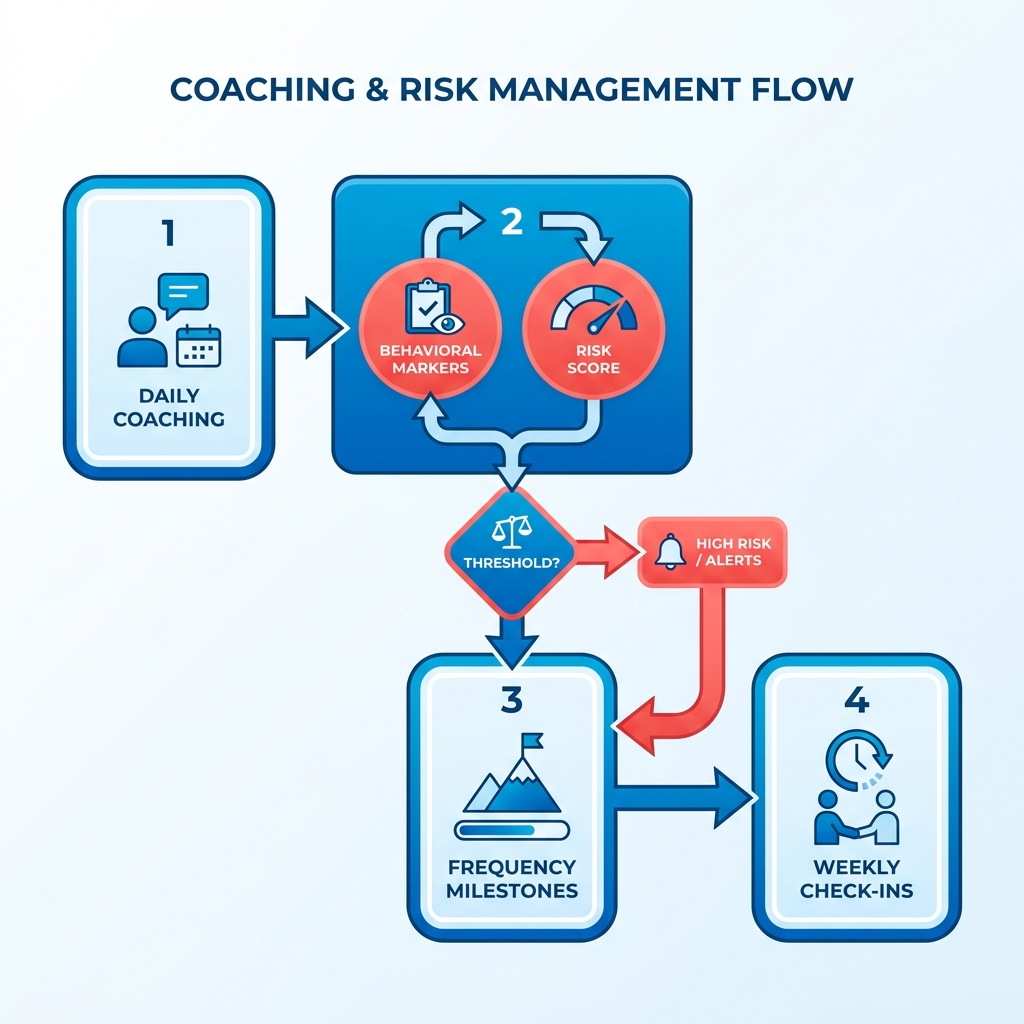
Support tapers on purpose as you gain independence, moving from more intensive contact toward less frequent check-ins. Each step down is a deliberate test of how much of your support structure has actually internalized. But the pace between steps varies a lot.
Someone with multiple prior treatment episodes, thin outside support, or recent high-stress life events may stay at frequent contact longer before we're confident dropping further. Someone with a solid home environment and a broader support network might move through the same phase faster. We set the pace to where you actually are.
- Read your current behavioral markers before designing any schedule. Without them, a taper timeline is guesswork.
- Assign a specific "hold condition" at each frequency level. If a warning sign appears, the protocol is to hold. Not automatically retreat to the prior level, but hold and reassess.
- Set one measurable SMART goal per phase. Not "maintain sobriety." That's an outcome, not a behavior. Something like "complete three planned social interactions this week without pre-contact with a coach" is trackable and tells us something real.
What Sessions Focus on at Each Stage
Early on, when contact is more frequent, sessions are mostly accountability and triage. We're watching for early warning signs and reinforcing the habits from treatment.
As contact eases, the focus shifts to life skills that work without us. Conflict resolution, managing unstructured time, rebuilding relationships. These aren't bonus topics. They decide whether less frequent contact is sustainable. For a closer look at what those warning signs look like in practice, this piece on spotting early relapse signals walks through what our team watches for.
At weekly, the session becomes a structured review: how the markers look this week, which SMART goals were met, what's coming up that could raise the threat level. A recovery journal or habit-tracking tool works well here. Not as homework, but as the data source that makes the weekly conversation actually useful. You're not reporting in. You're analyzing your own week with someone who knows your history.
Common Pitfalls During Taper and How to Avoid Them
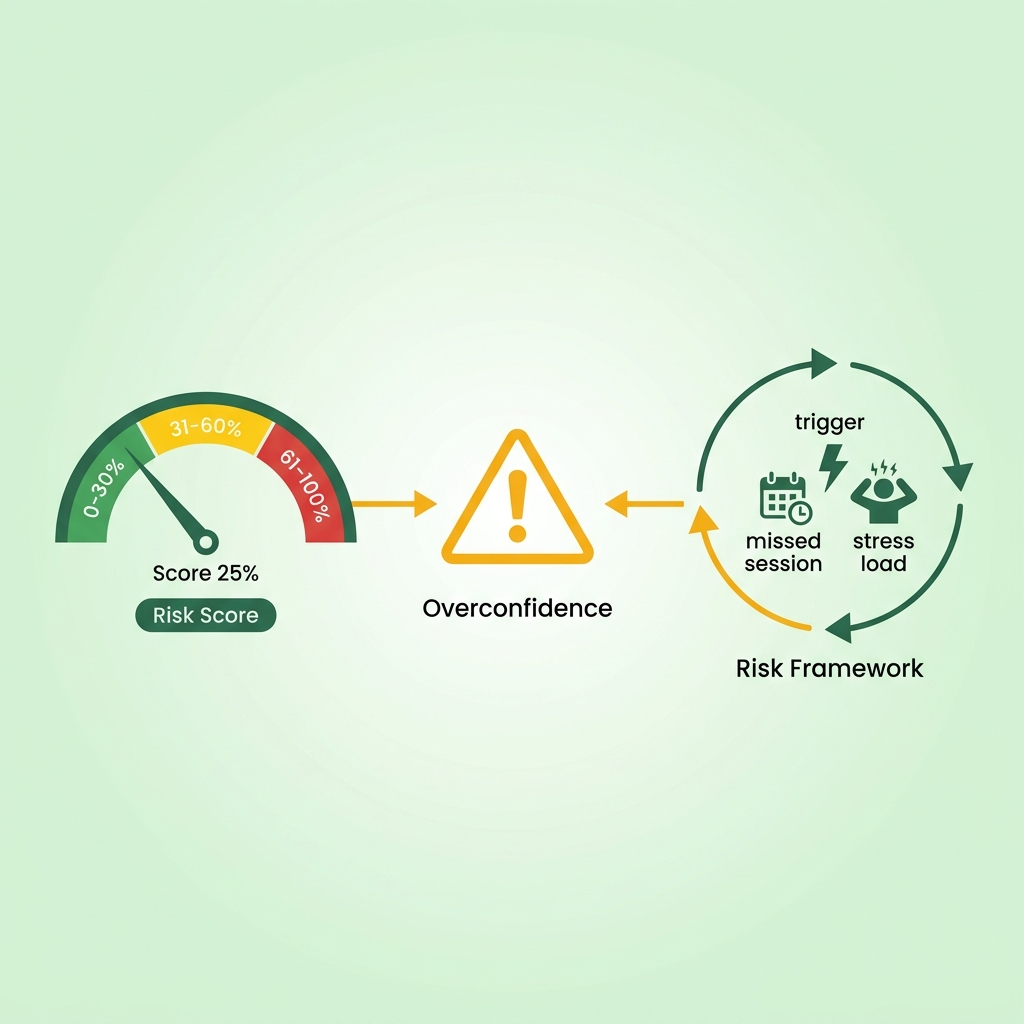
The most common pitfall isn't a dramatic relapse. It's a quiet drift. A client hits a good stretch, the risk score drops, and they read that as "I'm done" instead of "I'm stable for now." Overconfidence is the single biggest reason a taper goes sideways, because it talks people into stopping their risk scoring at exactly the moment scoring still matters.
The fix is to keep the risk framework running even when things feel easy. A low score is data, not a graduation certificate. When you stop tracking triggers, missed sessions, and stress load, you lose the early signal that tells you to step back up before a slip.

The Traps That Push Your Risk Score Back Up
These are the ones we watch most closely once contact gets less frequent. Each is a reason to re-score, not to panic.
- Watch skipped or rescheduled check-ins. One missed weekly session is a scheduling issue. A pattern of them is usually avoidance, and avoidance is where risk climbs fastest.
- Name new triggers out loud. A job change, a breakup, or a family conflict can spike anxiety and reset your risk profile overnight. Report it early instead of waiting for the next scheduled call.
- Flag coach-dependency in reverse. If less contact leaves you unable to make decisions alone, the internal structure isn't built yet. We'd rather slow the taper than let independence become isolation.
Build the Contingency Before You Need It
As contact gets less frequent, it helps to have a plan already in place. You should know exactly who to call, and under what conditions, before a high-risk moment arrives.
- Agree on a "call now" threshold. Define the specific situations, like a craving that lasts past a day or a return to an old high-risk setting, that trigger an off-schedule check-in.
- Keep one accountability contact outside the coaching relationship. Weekly contact leaves gaps, and a trusted person fills them between sessions.
How MADE Recovery Supports the Hand-Off
Behavioral markers tell you when to step down. Our services are how you actually do it without losing your footing. That's the piece most after-rehab plans miss. They treat tapering as subtraction when it's really a hand-off from one kind of support to another.
Here's how our structure maps onto a taper. Early on, you might work with a dedicated coach through daily virtual or in-person contact. As your stability grows and the markers hold, that single-coach intensity can shift to a coordinated team model, where check-ins spread out but the people around you multiply. The frequency drops. The support base widens. That trade is what keeps a step-down from feeling like a cliff.

When Does a Sober Living Home Fit the Taper?
Not everyone needs one. If you're returning to stable housing and a sober social network, our companionship and coaching can carry the weight. But if your home environment carries active triggers that keep destabilizing your progress, a sober living home changes the math. It lets you taper coaching contact while keeping the environmental structure your situation still calls for.
The two levers move independently. You can reduce sessions and hold the housing, or hold sessions and step out of sober living first. Your markers and your living situation tell you which lever to pull.
How Do You Start the Conversation?
You raise it. In our experience, the clients who bring up tapering themselves are usually the ones whose progress already backs it up. Here's what to have ready before that call.
- Bring the pattern of how you've been doing over recent weeks, not a single good week, so we're reading a pattern instead of a mood.
- Name which routines have stuck without prompting. Steady sleep, meal prep, and nutrition habits point to the independence a taper depends on.
- Flag the support you'll lean on between check-ins, so we can plan the team hand-off before contact drops.
We build the plan around what your markers show, then adjust as you go. If you're weighing whether the timing is right, our three signs you're ready to taper walks through the checkpoints we watch. Help starts with a conversation.
References
[1] Continuing Care Research: What We've Learned and Where We're ... - https://pmc.ncbi.nlm.nih.gov/articles/PMC2670779/
[2] What Happens When You Outgrow Your Recovery Coach - https://allthewaywell.org/what-happens-when-you-outgrow-your-recovery-coach/
FAQ
1. Does reaching weekly check-ins mean I'm almost done with coaching?
Reaching weekly contact signals stability, not completion. The continuing care research shows duration drives outcomes, so the goal is staying connected for many months, just less often. The most common taper mistake is reading a good stretch as "I'm done" instead of "I'm stable for now," which is why the risk framework keeps running even when things feel easy.
2. What should I do if I want to taper right as a hard issue surfaces?
Hold your current cadence and treat the urge as a signal, not a green light. When the push to reduce contact spikes exactly as a deeper pattern gets close to the surface, that usually points to avoidance rather than genuine readiness. Reducing sessions in that moment removes support right when you need it most. Name what's surfacing with your coach and reassess from there.
3. Why does active coach outreach matter more than just being available if I need it?
Active outreach is what made continuing care work in the research. Telephone check-ins actually outperformed group counseling, largely because coaches reached out rather than waiting for people to show up on their own. Switching to passive, client-initiated contact is where relapse risk creeps back in. A safe taper keeps contact active at the weekly mark, cutting how often you meet, not who starts the conversation.
4. How do I know if I need a sober living home or just less frequent coaching?
Your living situation decides it, not your coaching progress. If you're returning to stable housing and a sober social network, companionship and coaching can carry the weight. But if your home environment carries active triggers that keep destabilizing progress, a sober living home lets you reduce coaching contact while holding the environmental structure. The two levers move independently, so you can reduce sessions and keep the housing.
5. Why might my taper move slower than someone else's at the same stage?
Taper pace tracks your risk profile, not a calendar. Someone with multiple prior treatment episodes, limited outside support, or recent high-stress life events stays at more frequent contact longer before dropping further. Someone with a solid home environment and broader support network may move faster through the same phase. Behavioral markers, your history, and current stress load drive the schedule, so identical timelines rarely make sense.