Which Family Support Format Owns Each Recovery Decision in the First 90 Days
August 24, 2026
Key Takeaways
- No single family support format covers everything in early recovery. Most families end up running two or three at once.
- Al-Anon and Nar-Anon carry the emotional load for free, helping you detach with love and stop coping alone.
- Structured family therapy rebuilds communication and trust. Cost varies by provider, and it often qualifies for insurance.
- Team-based sober coaching handles the daily transition home: $75 to $400 hourly, or $1,000 to $4,000-plus per day for live-in.
- Family education programs, free to moderate in cost, help relatives understand addiction and spot warning signs early.
- The most common mistake is defaulting to one format for everything instead of matching each one to a specific decision.
- Matching support to the decision in front of you beats ranking formats. Each owns a different slice of the first 90 days.
The quick version
Every early-recovery decision has a family support format that fits it best. The mistake we see most is families defaulting to one for everything: a weekly meeting, a single therapist, or nothing at all. What fits depends on the decision in front of you.
Below is how we map the main groups for families of addicts against the decisions they actually handle well. Read it as a starting grid, not a ranking. Most families end up using two or three at once.
Which format fits which decision
Peer groups handle the emotional load. Structured family programs handle communication rebuilding. A dedicated coaching team handles the day-to-day logistics of the first 90 days. No single format covers all three.
| Format | Owns this decision | Cost | Best for |
|---|---|---|---|
| Al-Anon / Nar-Anon peer groups | "How do I stop carrying this alone?" | Free | Ongoing emotional support, learning healthy boundary setting |
| Structured family therapy | "How do we talk without it blowing up?" | Varies by provider, often insurance-eligible | Rebuilding trust, communication patterns |
| Family education programs | "What am I actually dealing with?" | Free to moderate | Understanding addiction, spotting warning signs |
| Team-based sober coaching | "Who handles the daily transition home?" | Out of pocket; hourly $75–$400, live-in $1,000–$4,000+/day | Coordinating routines, crisis planning, tapering support |
What actually sets them apart
The difference is scope. Peer groups and education programs support the family. Coaching supports the person in recovery while lifting the monitoring job off the household. That distinction matters most in the first weeks home.
Peer groups win on cost and staying power. Free, and they run indefinitely, which makes them the backbone for long-term family sanity. They won't build a morning routine or coordinate with nursing support, though.
Coaching sits at the opposite end. It costs the most and it's rarely covered by insurance, so plan for it out of pocket. What you get is coverage during the exact window where relapse risk peaks. Our approach is to pair the format to the decision, then taper the paid support as the household stabilizes. For the handoff into daily life at home, coaching can include coordinating with nursing support, grocery runs, meal prep, and general day-to-day management.
Skip the daily-coaching tier if housing is stable and follow-through is already strong. Pay for it when the first weeks feel genuinely unsafe.
Why these options are worth your time
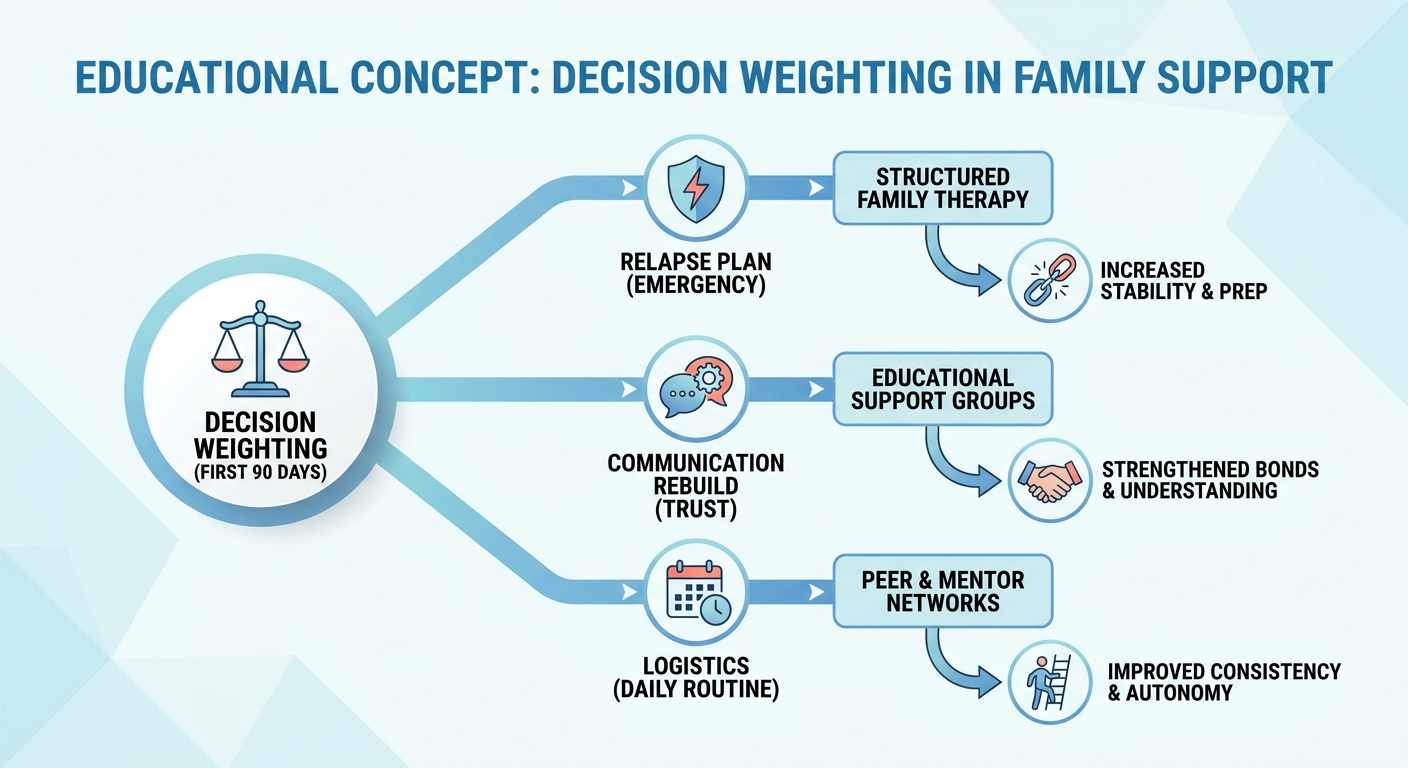
The first 90 days after treatment are a series of decisions, not a single event. Each one carries a different weight, and matching it to the wrong support format wastes time you don't have.
Most families reach for one option and stop there. But the groups for families of addicts that ease your anxiety are rarely the same ones that rebuild trust or manage a relapse plan. Sorting by decision beats sorting by popularity.
What should drive your choice
The main factor is the specific decision on your desk this week. Are you managing your own fear, rebuilding communication, or handling logistics like housing, work reentry, and daily accountability? Different jobs, different tools.
Here's how the three main formats sort against the needs we see most often early on.
| Need | Peer Family Groups | Structured Family Programs | Sober-Coach Team |
|---|---|---|---|
| Emotional load on the family | Strong | Moderate | Moderate |
| Rebuilding communication | Weak | Strong | Moderate |
| Day-to-day logistics (first 90 days) | Weak | Weak | Strong |
| Availability outside scheduled hours | Varies | Low | High |
| Cost | Usually free | Moderate to high | Paid service |
Peer family groups carry the emotional weight well. When you need people who understand the fear without an explanation, this is the format. Widely available, often free.
Structured family programs handle communication rebuilding. If honesty has broken down and you keep having the same fight, a facilitated program gives you a script and a referee. This is the one that earns its keep when the goal is restoring trust, one honest conversation at a time.
When you actually need a coaching team
Skip a coach for pure emotional processing. A peer group does that better and cheaper. Reach for a team when the decisions turn logistical: home transition, accountability structure, and the messy first weeks back under one roof.
That's the gap we fill. We pair each early decision with the format that owns it, then handle the daily execution, managing schedules, setting household boundaries, and overseeing medication compliance, that most groups aren't built to touch.
Feature by feature
Here's what each format actually does, one feature at a time. Not to crown a winner. To show you which tool handles which decision, so you stop asking one format to do a job it was never built for.
Four features matter in the first 90 days: emotional support, communication repair, daily logistics, and clinical depth. Here's how the main groups for families of addicts compare.
| Feature | Peer Support Groups | Structured Family Programs | Dedicated Sober-Coach Team (our model) |
|---|---|---|---|
| Emotional load | Strong | Moderate | Moderate |
| Communication repair | Weak | Strong | Moderate |
| Daily logistics | None | Weak | Strong |
| Clinical depth | None | Strong | Moderate |
| Speed to help | Slow (weekly) | Slow (scheduled) | Fast (on-call) |
| Cost | Free | High | Mid |
What peer groups do best, and where they stop
Peer groups own the emotional load. You sit with people who understand the fear without needing it explained. That's real, and free, and available almost everywhere. It's the right first call when you feel isolated.
But peer groups stop at the door of your house. They won't help you set up a relapse plan, coordinate a work reentry, or referee a hard conversation. Don't lean on them as your only support if the decision in front of you is logistical. They're built for shared feeling, not shared planning.
Where a coaching team pulls ahead
A coaching team owns the first-90-day logistics. Housing decisions, accountability check-ins, sober-support scheduling, the awkward first week back at work. Our approach pairs each of those decisions with the right format instead of leaving families to guess.
We don't replace peer groups or clinical family therapy. We sit between them and handle the day-to-day so those other formats can do their real jobs. When a communication problem needs deeper work, we point families toward it. And when someone comes home, we handle the practical follow-through, setting daily routines, organizing local support meetings, managing household logistics, so family members can step back from the supervisor role and go back to being supportive relatives.
The honest limitation: we're mid-depth on clinical work. For diagnosed trauma or severe family dysfunction, a structured program with licensed therapists goes deeper than coaching should. Match the decision, not the brand.
Speed and scale
Speed and scale are where most families get burned. Peer groups scale infinitely but move slowly. A coaching team moves fast but scales one household at a time. That tradeoff decides which format handles which decision in the first 90 days.
The support groups for families of addicts that meet weekly are built for endurance, not urgency. If your loved one relapses on a Tuesday, a Thursday meeting is three days too late. That gap is why fast-response coaching and slower community formats serve different jobs.
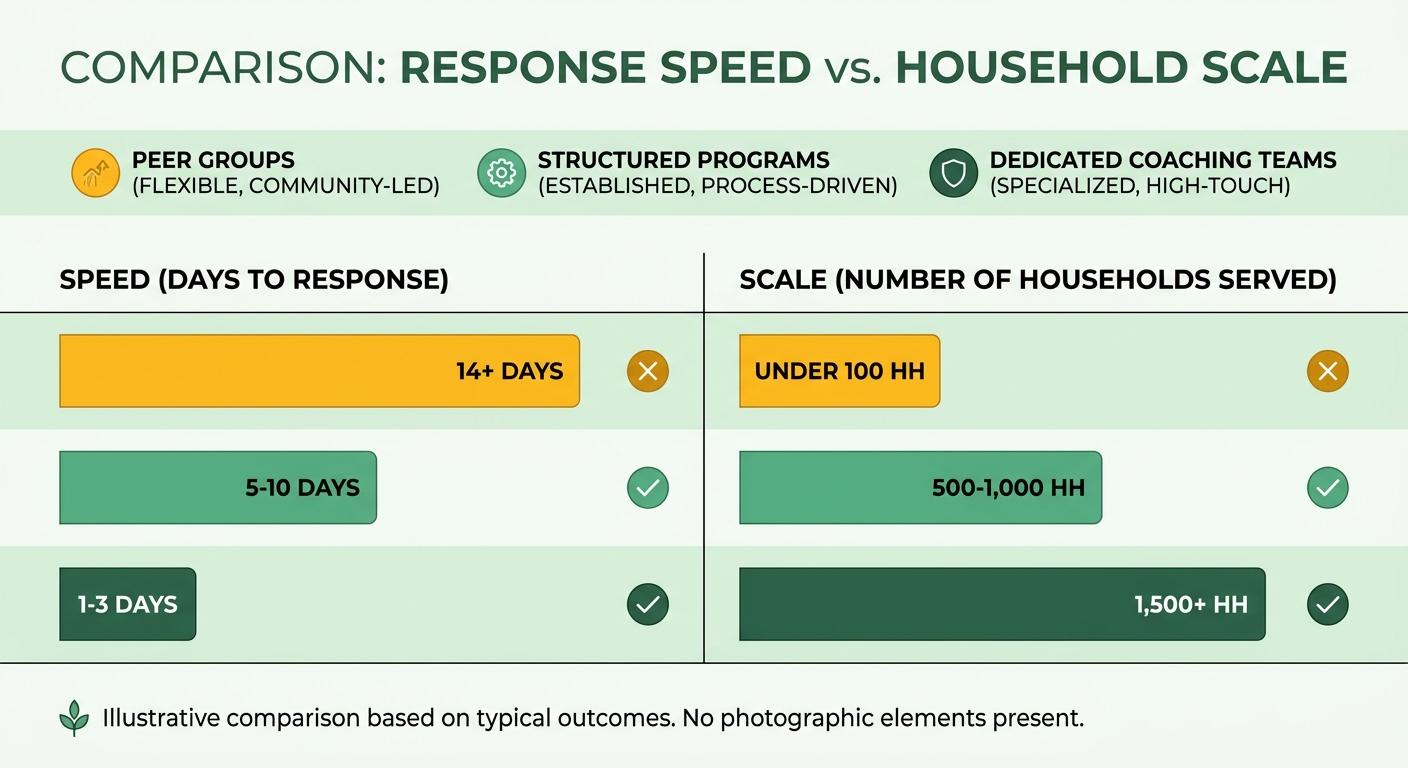
Which format responds fastest
Coaching responds in hours, structured programs in days, peer groups in weeks. Speed matters most during logistics decisions like housing, work reentry, and relapse triggers, where waiting for the next scheduled meeting means the moment has already passed.
| Metric | Peer Support Groups | Structured Family Programs | Dedicated Sober-Coach Team (our model) |
|---|---|---|---|
| Response speed | Weekly cadence | Scheduled sessions | Same-day, between sessions |
| Scalability | Very high (open enrollment) | Moderate (cohort-based) | Low (one family at a time) |
| Cost to family | Free or low | Moderate | Higher, concentrated |
| Best decision fit | Ongoing emotional support | Communication rebuilding | Daily logistics and crisis response |
Where each format's cost lands
Peer groups cost you time and consistency. Structured programs cost money and scheduling. Coaching costs the most per household but returns the highest speed. You pay in a different currency for each.
Peer groups are free to scale because the room absorbs new members without extra strain. That's their strength for the long haul and their weakness in a crisis. No one in that room is on call for you Friday night.
Our model runs the opposite way. We provide customized, team-based support tailored to each household, with a single dedicated coach or a coordinated team depending on the level of care needed. For the daily-logistics decisions of early recovery, that concentration is the point.
Use all three. Let the peer room carry the emotional weight over months, let a structured program rebuild communication, and lean on coaching for the home transition steps that can't wait a week.
Pros and cons
Every format has a job it does well and a job it fails at. The trick is knowing which is which before you commit your time. Here are the honest trade-offs for each of the main groups for families of addicts, so you pick by fit instead of by hope.
No format is all upside. Peer groups give you community but move slowly. Structured programs rebuild communication but cost hours you may not have in week one. Our coaching model moves fast but works one household at a time.
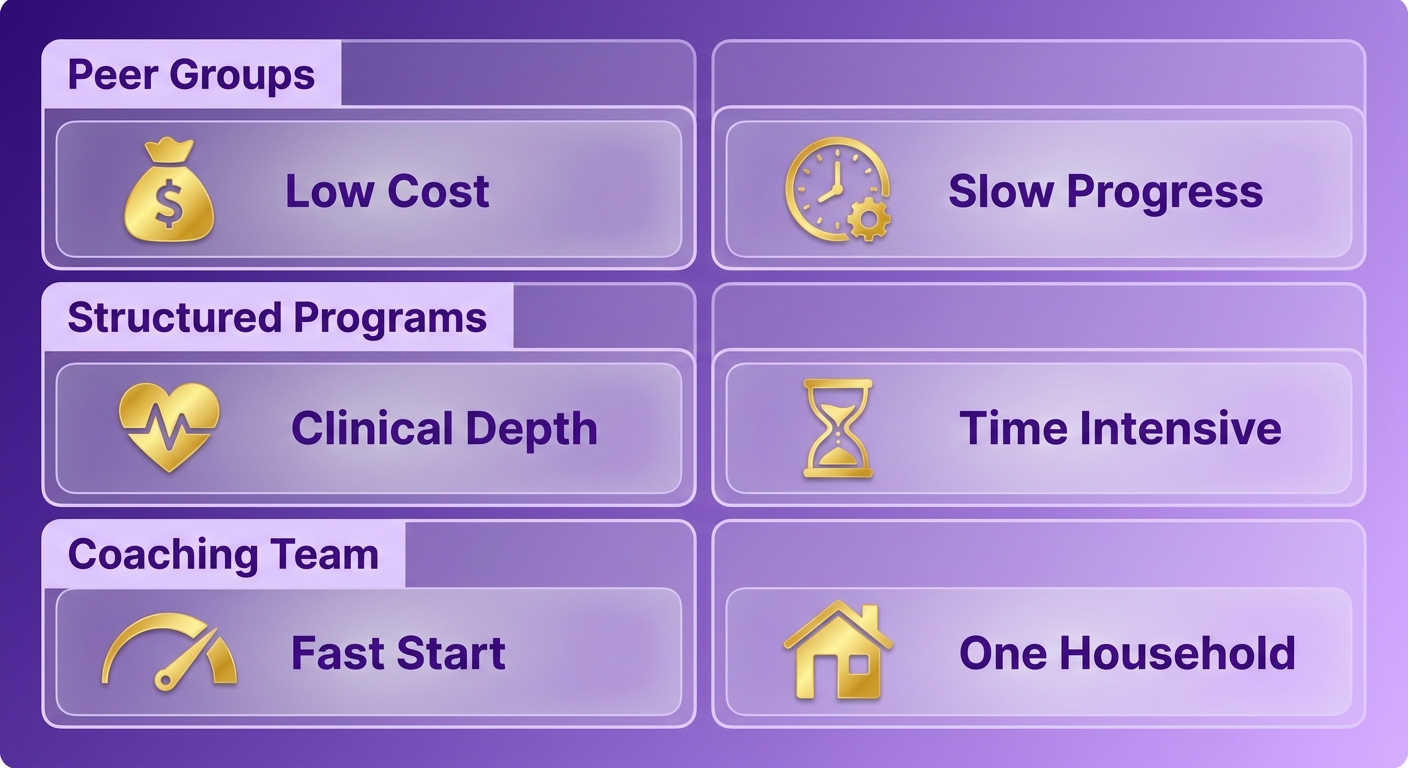
The trade-offs, format by format
Peer groups win on cost and emotional relief. Structured programs win on clinical depth. A coaching team wins on speed and logistics. Each loses exactly where the others win.
| Format | Biggest Strength | Biggest Weakness |
|---|---|---|
| Peer support groups | Free, always available, real emotional relief | Slow response, no logistics help, no accountability |
| Structured family programs | Clinical depth, real communication repair | Scheduling load, slow to start, limited crisis response |
| Dedicated sober-coach team (ours) | Fast response, owns daily logistics | Scales one family at a time, costs more than free peer groups |
Peer groups are the easiest entry point. They cost nothing and you can walk in this week. The weakness shows up when a housing plan falls apart or a routine slips. The room can hold your fear, but it can't make a phone call for you.
Structured family programs earn their place when trust is the problem. They teach families how to talk without relapsing into old scripts. Rebuilding that trust takes patience, which is part of why our coaching also helps families plan detox and treatment pathways and supports them as their loved one reintegrates into daily life. The trade-off with structured programs is time. They run on a calendar, not on the crisis in front of you.
Our team-based coaching is built for the logistics nobody else owns: the first-90-days schedule, the reentry to work, the Tuesday-night call. If your primary need is a safe space to share with others who understand, peer support is the better choice. We earn our keep when a decision can't wait for the next meeting.
Who each format is for
The right format depends on who you are and what week you're in. A parent three days post-discharge has a different job than a spouse six weeks into rebuilding trust. Here's how specific profiles match up.
Most families use more than one at once. The point isn't loyalty to a single option. It's picking the tool that owns the decision in front of you today.
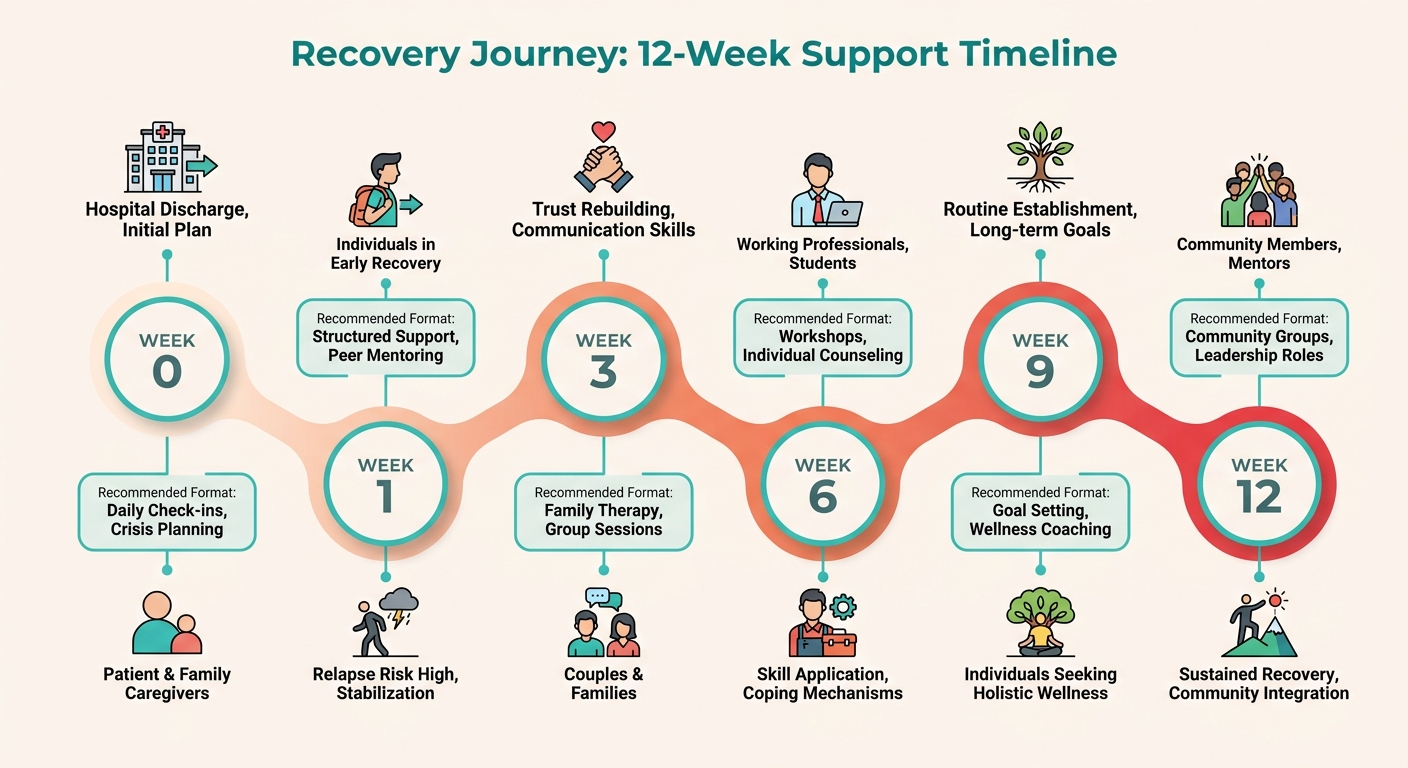
Who benefits most from each
Peer groups fit the isolated caregiver. Structured programs fit the family rebuilding communication. Our coaching team fits the household managing the first-90-day logistics of housing, work reentry, and daily accountability.
| Profile | Best Format | Why It Fits |
|---|---|---|
| Isolated parent carrying shame alone | Peer support group | Community and shared experience ease the emotional load |
| Couple stuck in the same old fights | Structured family program | Clinical depth rebuilds communication patterns |
| Household juggling day-one logistics | Dedicated sober-coach team (our model) | Fast response and practical structure for the first 90 days |
| Family bracing for relapse risk | Coaching + peer group together | Rapid response paired with ongoing emotional support |
When to skip a format
Skip the peer group as your only tool if your loved one just came home this week. You need same-day answers about boundaries, house rules, and accountability, not a meeting three days out. That's the gap our team fills, and it's why we pair coaching with the slower community formats rather than replacing them.
Skip solo coaching if the real problem is a broken conversation between two people. Logistics support won't fix a trust rupture. A structured family program does that work better. Our guide on rebuilding trust one conversation at a time walks through where that repair actually happens.
The families we see thrive treat these formats as a rotating toolkit. The isolated parent starts with a group. The couple adds structured work. The household in week one leans on daily coaching. For a practical breakdown of those first steps at home, our home transition guide maps the moves that matter most.
What I'd actually recommend
Match the format to the decision in front of you. That's the whole framework. Peer groups carry the emotional weight, structured programs rebuild communication, and a coaching team handles the first-90-day logistics. Most families need two or three of these running at once, not one doing every job.
The mistake we correct most often is loyalty to a single option. The groups for families of addicts that quiet your fear at 9pm are rarely the same ones that manage a Tuesday relapse or a housing deadline. Sort by the job, not by what you found first.
Which format for your scenario
Here's how we'd match each common moment to its best-fit format.
| Your Scenario | Best-Fit Format | Why |
|---|---|---|
| Carrying shame, feeling alone | Peer support group | Community and shared experience, low cost |
| Trust is broken, talks keep exploding | Structured family program | Clinical depth for communication repair |
| Managing housing, work reentry, daily accountability | Dedicated sober-coach team (our model) | Fast response, one household at a time |
| Relapse risk is high this week | Coaching team | Responds in hours, not the next meeting |
If you only have room for one this week, choose by urgency. A weekly meeting can't provide the immediate intervention you need when a safety issue hits mid-week.
When to skip our coaching model
Our coaching model isn't built for therapeutic venting or emotional processing. If you're looking for a community to share the load and find mutual comfort, peer-led spaces are more effective and more accessible.
We also don't try to be your family therapist. When the core problem is broken communication, a structured program owns that repair. Our team pairs with it. And for families working through those pathways, our crisis and treatment planning support, along with the companionship our coaches provide in the moments that matter most, can help you take the first steps together. Help starts with a conversation: call us at 661-369-6255.
Pick by the decision. Use more than one. That's how the first 90 days get easier.
References
Frequently Asked Questions
1. Can I combine free peer groups with paid coaching to lower costs?
Combining formats is common and recommended. Let a free peer group carry the emotional weight over months while you lean on paid coaching only for the first-90-day logistics. As the household stabilizes, taper the paid support, keeping the free peer room running indefinitely for long-term sanity.
2. Does insurance cover any of these family support formats?
Structured family therapy often qualifies for insurance coverage, with costs varying by provider. Team-based sober coaching is rarely covered and typically runs entirely out of pocket, representing a significant financial investment compared to clinical therapy. Peer groups like Al-Anon and Nar-Anon are free, so coverage isn't a concern.
3. My loved one has diagnosed trauma. Is coaching enough on its own?
Coaching focuses on behavioral accountability and daily logistics rather than therapeutic intervention. When dealing with deep-seated psychological issues or complex family dynamics, a licensed therapist is necessary to safely navigate and treat those conditions. Coaching pairs alongside that clinical work, handling daily logistics while therapists address the deeper repair.
4. What does day-to-day coaching actually handle when someone comes home?
Coaching covers the practical follow-through most groups can't touch, such as establishing daily routines, organizing local support meetings, and managing household logistics. It also handles accountability check-ins, sober-support scheduling, work reentry, and crisis planning—removing the burden of constant supervision from family members so they can focus on their own recovery and relationship repair.
5. How fast can each format respond during a crisis?
Coaching responds same-day, between sessions; structured programs respond in days through scheduled sessions; peer groups respond weekly. A crisis occurring early in the week cannot wait for a scheduled weekend group session. For logistics decisions like housing or relapse triggers, fast-response coaching fills the gap slower formats leave open.
6. When should I skip paid coaching entirely?
If your loved one has a highly structured living environment, clear personal accountability, and a reliable local support network, intensive coaching may be unnecessary. Additionally, if you are primarily seeking a space to share feelings and reduce isolation, peer-led support groups offer a more appropriate and cost-effective environment. Similarly, if the primary challenge is repairing damaged communication channels or resolving deep-seated interpersonal conflicts, structured family therapy is the correct tool.
7. How should a family member dealing with intense isolation and stigma begin their recovery journey?
Start with a peer support group like Al-Anon or Nar-Anon. These are free, widely available, and let you connect with others who share similar experiences. They ease the emotional load and offer staying power for the long haul. Add other formats later as logistics or communication needs arise.