Rebuild Family Trust One Honest Conversation at a Time
August 5, 2026

Key Takeaways
- A systematic review of 46 studies found that 85% showed a clear link between family support and better addiction treatment outcomes.
- Family therapy produced more drug-free participants at both six and twelve months than standard methadone treatment on its own.
- Trust comes back through consistent, observable behavior over time, not through sobriety milestones or apologies delivered by themselves.
- Families who face the original breach together, instead of stepping around it, are the ones who turn a functioning household back into a connected one.
- Predictability, not perfection, is the real foundation of trust in a family recovering from addiction.
- Teenagers who hide failures like bad grades are usually reacting to a pattern of harsh parental responses, not just keeping secrets for the sake of it.
- Regular family groups build the accountability recovery needs, but only when the conversations inside them stay genuinely honest.
Why rebuilding family trust is the actual work
When families come to us after someone finishes detox, we hear the same question often: Can we ever trust each other again? The honest answer depends on one thing. Is everyone willing to sit down for hard conversations, where people say what actually happened instead of the tidier version? Surface-level check-ins will not get you there. Structured, honest dialogue will.
The research points in the same direction. When families stay involved through therapy, structured conversations, or steady check-ins, people stay in treatment longer and relapse less. That involvement acts as a buffer during early recovery, giving someone a built-in safety net when a high-risk moment shows up. The catch is that the contact has to be real. A wellness call that both sides dread does nothing.
Trust is built on predictability, not perfection
We tell families that a verbal promise is a starting line, not a finish line. The real work lives in daily actions. If someone promises to attend meetings and does not, or if a family member blows up every time the person in recovery admits a struggle, secrecy just continues. You need a room where the truth can be spoken without immediate punishment. Otherwise, the truth stops coming.
Repair runs on predictability. So we focus on small, repeatable moments where people do exactly what they said they would do. Show up to a weekly coffee. Call before a high-risk situation, like they promised. A qualitative study of adult children whose parents went through rehab found that recovery often restored the family's structure. Parents returned to provider roles. Routines stabilized. But deeper emotional trust lagged behind. Families mistake a functioning home for a healed one. Guided honest conversation closes that gap.
Honest conversations do two separate jobs
Something we've learned coordinating aftercare: recovery reliably restores structural trust. People show up, pay bills, stay sober. Emotional trust is different. It rebuilds only through vulnerable dialogue. You can track sobriety milestones and watch consistent behavior all year, but if no one ever says "I'm scared you'll relapse" or "I don't know how to forgive you yet," the distance stays exactly where it was.
One study noted that listening to family members' feelings without getting defensive is central to mutual healing. That means the person in recovery sits with anger, disappointment, and grief without shutting it down with excuses. It also means the family accepts that addiction is a health condition, not a moral failure, which makes room for self-compassion on both sides.
This part is genuinely human, and genuinely uncomfortable. People bring unprocessed hurt into the open. The early conversations are rough. Someone cries. Someone shuts down. Over time, though, the conversations shift. People start talking about what they want to build, not just what went wrong. As one family coach puts it, "What you focus on grows." If every conversation rehashes the same betrayals, that's all the relationship becomes. Honest conversation also has to launch forward-looking moments: shared activities, low-stakes check-ins, and small new memories that do not orbit the past.
How long this takes depends on the breach
People ask us for a timeline. The truth is that it depends on the severity of the breach and how emotionally ready everyone is. A small misunderstanding might repair in weeks. Infidelity, or years of addiction-fueled lies, can take much longer. For families dealing with substance use, trust rebuilds through consistent, accountable behavior held over time, not through a quick fix. Some families move faster. Others need a lot longer. Steady follow-through matters.
What speeds it up is honest communication, early and often. Research shows that 40% to 60% of people relapse after treatment, but aftercare, especially family-centered aftercare, lowers that risk considerably. When families commit to regular honest conversations with a coach or therapist in the room, they catch warning signs earlier and build the safety net that makes relapse less likely.
Deciding whether this relationship is ready to rebuild
Not every relationship is worth rebuilding right away, and pretending otherwise sets families up for a harder fall. Before anyone reopens a hard conversation, it is worth asking whether the relationship is safe, honest, and wanted by both people. When families come to us after detox, we start with a conversation about their situation, and the right coaching program grows out of that.
Here is the distinction that shapes our whole approach. Structured family work has been shown to improve household functioning and reduce substance use, but the internal dynamics need separate attention. Assessing readiness means looking at both the external stability of the home and the willingness of both people to go deeper.
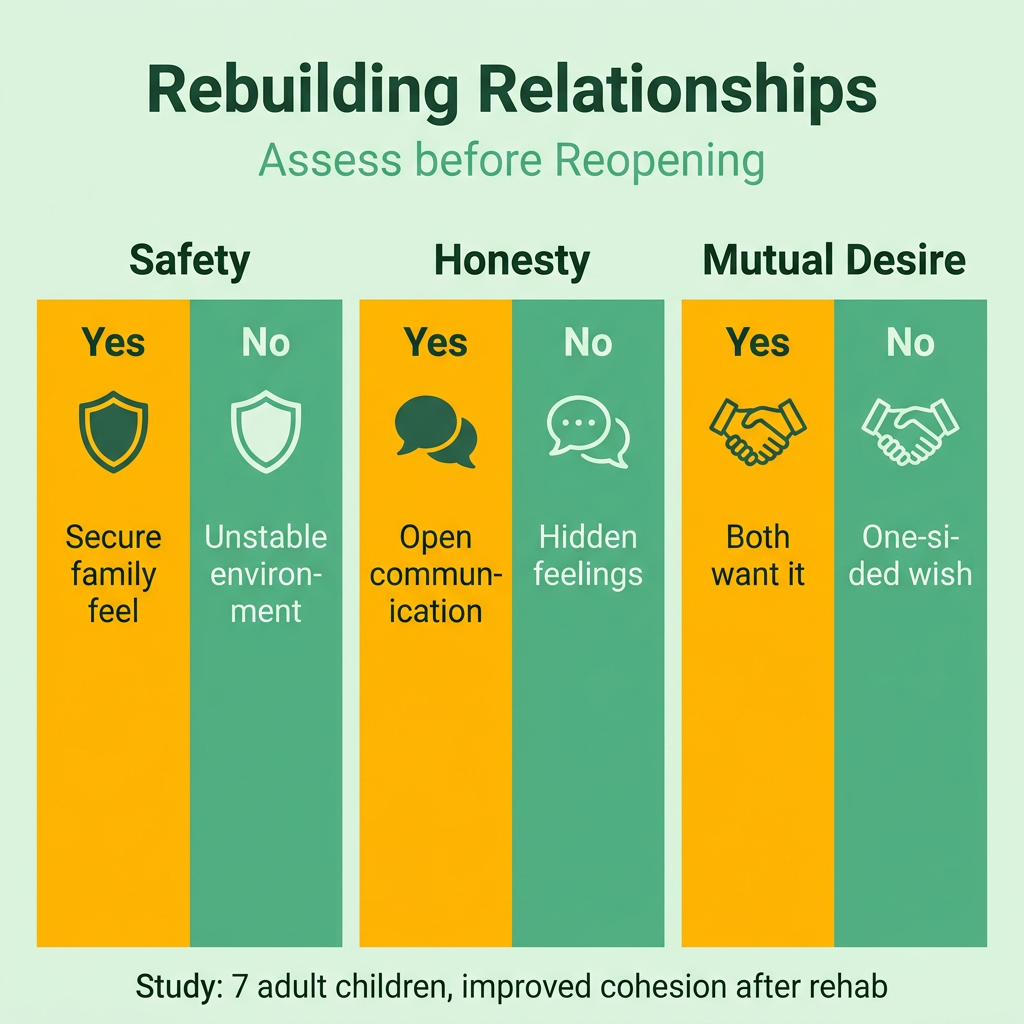
Is this relationship safe enough to rebuild?
Start with safety, not history. A relationship worth rebuilding is one where both people can speak honestly without fearing retaliation. If the old patterns ran on secrecy, harsh reactions, or dismissiveness, those patterns have to be visibly changing. Not just promised.
Focus on patterns, not promises. Predictability is exactly what routine building and consistent support create. Look at the last few months, not the apology speech. Repeated emotional outbursts train people to withhold information, so if the outbursts continue, the honesty you need cannot survive. That is a signal to pause, not push.
What to sit with before reopening the conversation
Do your own inventory first. Assessment is not only about the other person. Ask yourself what you contributed, what you actually want from the relationship, and whether you can offer reliability yourself.
Two forces can quietly cap emotional change even when behavior improves. In that same adult-children study, gender norms and parental reverence limited how far families could go emotionally. Name your own version of that ceiling. If unspoken rules keep certain truths off the table, the honest conversation stalls before it starts.
Where boundaries and self-care fit
Boundaries protect the assessment. They do not sabotage it. Deciding to rebuild does not mean unlimited access on day one. Trust reassembles through repeated low-stakes contact: a coffee, a shared task, not one dramatic confession, as recovery groups describe.
If the other person refuses accountability, or if contact leaves you unsafe, pausing the process is a healthy boundary, not a failure. When both sides can commit to observable change and safe conversation, structured coaching gives families the framework to start small and stay consistent, bridging the gap between behavioral compliance and real connection.
Starting the honest conversation about the breach
When a family sits down after detox to talk about what actually happened, the conversation usually stalls within five minutes. Someone gets defensive. Someone else drags up a decade-old grievance. The person in recovery shuts down because the list of wrongs feels bottomless. We see this constantly, and not because families lack goodwill. It is because no one knows how to open the conversation without it turning into a blame session. That is where guided facilitation changes the outcome, giving the room a neutral third party who keeps things constructive.
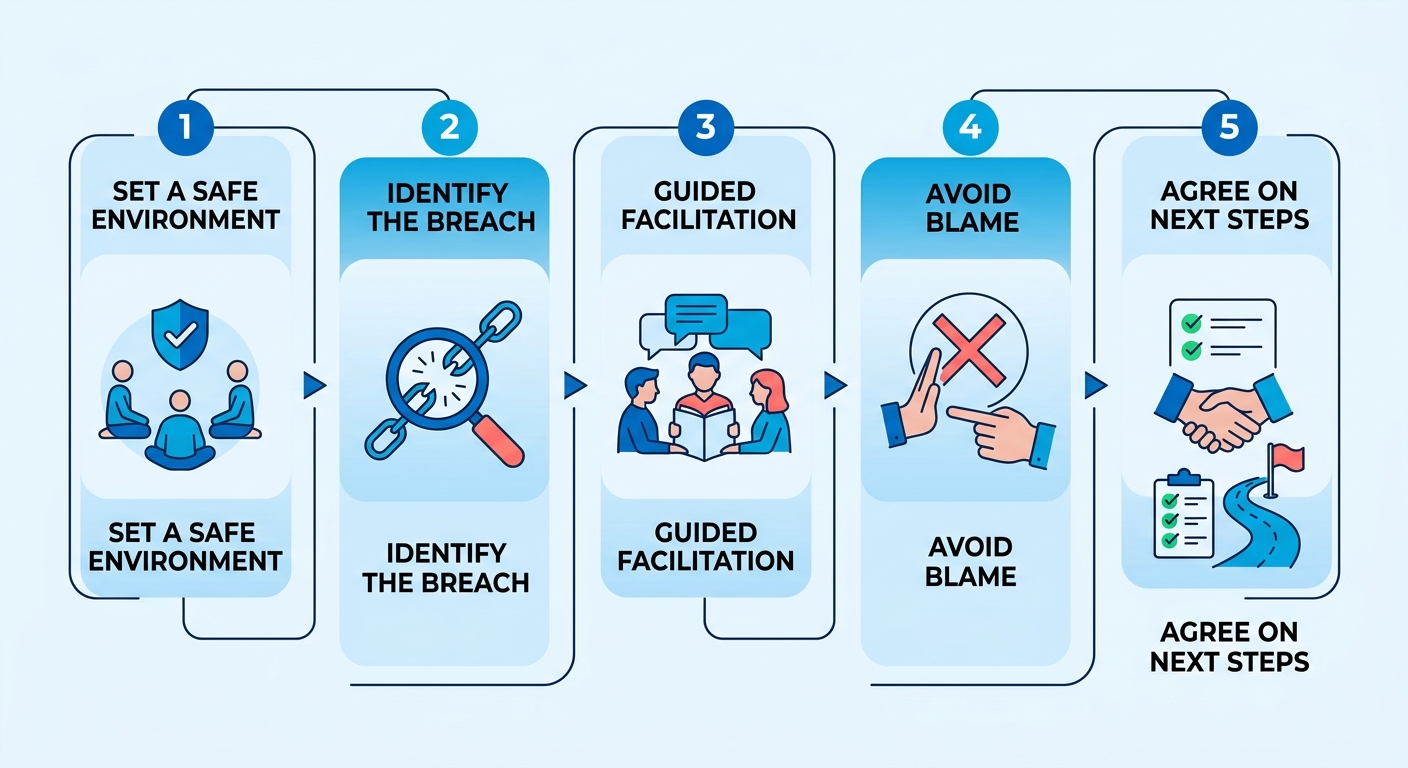
The most effective family conversations run on relational warmth and humor, not clinical credentials alone. A recent study on family recovery support groups found that facilitators who connected through soft skills, relatability, warmth, and humor were far more effective than those who leaned only on years of SUD experience. Technical expertise matters, but the person guiding the conversation has to make the room feel safe first. That is why our coaching centers on real human connection, the kind of accountability and guidance that makes an honest conversation safe enough to work.
Set the room before you open the topic
Start by naming what the conversation will not be: a courtroom, a cross-examination, or a chance to catalog every past betrayal. Setting the parameters up front lowers defenses. You cannot ignore the breach. Ignoring it is what keeps the wound open. But you also cannot let the conversation become an endless loop of accusation and apology.
A simple opening frame helps: "We're here to name what happened, hear how it felt, and decide what comes next." That is it. No hidden agenda. No surprise revelations. The person in recovery knows they will be asked to take responsibility. Family members know they will be heard. Everyone knows the conversation has an endpoint. Without that structure, people either overexplain defensively or clam up entirely.
If the whole conversation rehashes betrayal, you are growing resentment. If you name the breach honestly and then pivot to forward-looking goals, you are growing a path forward. That pivot does not erase history. It just stops families from treating every conversation like an archaeological dig through old wounds.
Use "I-statements" to avoid the accusation spiral
The classic communication technique still works because it sidesteps the reflex to defend. "I felt scared when you didn't come home" lands differently than "You lied to us again." The first opens dialogue. The second opens a fight. Build the statement in three beats: what happened, how it felt, what you need now. Stop there. That is the full frame.
The place most conversations derail: the person in recovery tries to explain or justify, and a family member interrupts with a fresh example. In practice, the facilitator steps in to hold the structure. "Let them finish. You'll have your turn." It sounds almost too simple, but it is the intervention that keeps things from collapsing into chaos.
Active listening in recovery contexts means repeating back what you heard before you respond. A useful phrasing: "What I'm hearing is that you felt abandoned. Is that right?" That pause, that confirmation, short-circuits the escalation. It proves someone was actually listening instead of waiting for their turn to talk.
Name the breach without relitigating every detail
Apologies that work in recovery are specific and observable. The person in recovery names what they did, what it cost the family, and what behavior will change. Generic apologies like "I'm sorry for everything" do not rebuild trust because they show no accountability. They sound like someone trying to end the conversation, not repair it.
Acknowledging the past without getting stuck in it is the balance to hit. One recovery center notes that recovery doesn't erase history, but it gives you a framework for writing the next chapters of your relationships. That forward look keeps the conversation from becoming a repeating cycle of blame.
Hold space for both sides to heal
The trap families fall into: assuming the person in recovery is the only one who needs to change. Both parties usually need to heal. Family members may need to grieve what they lost during active addiction. They may need to let go of the role they played, protector, enabler, fixer, and learn how to relate to someone who is no longer using.
Research on family communication patterns shows that families who use structured support, like CRAFT (Community Reinforcement And Family Training) or Al-Anon, report better communication and coping. These programs teach families how to support recovery without enabling, and how to set boundaries without cutting off connection. The honest conversation works best as part of a larger support system, not a one-time event.
We also watch families struggle with the timeline. Experts recommend at least six months of consistent, accountable behavior before full trust restoration, calibrated to how bad the breach was. That is a floor, not a ceiling. For families coming out of years of addiction-related chaos, six months is just the start. The guided conversation sets the baseline. The months of follow-through prove it was not a performance.
Practicing vulnerability and transparency in family dialogue
When we help families rebuild after treatment, vulnerability feels like the riskiest conversation they could have. The person in early recovery worries that admitting fear or temptation will confirm everyone's worst suspicions. Family members worry that naming their hurt will wreck fragile progress. So everyone defaults to safe updates, "I'm doing fine," "We're glad you're home," and then wonders why the emotional distance never closes. Honest, vulnerable dialogue is what closes it, but only when both sides feel safe enough to risk it.
Vulnerability in family groups does not mean confessing every intrusive thought. It means naming the hard feelings out loud instead of performing optimism. Someone might say, "I'm scared I'll let you down again," instead of promising they won't. A parent might say, "I don't know how to stop bracing for bad news," instead of pretending everything's back to normal. Those admissions sound small. They shift the conversation from performance to reality.
Separating structural trust from emotional trust
Reliable routines are a necessary step, but they do not automatically heal the emotional distance. A family can run smoothly on the surface and stay disconnected underneath. Real reconciliation means addressing the emotional dynamics directly, not assuming behavioral compliance will resolve the pain on its own.
We treat these as two parallel tracks. Behavioral accountability, the tracking, the check-ins, the visible commitment, proves you're reliable. Emotional transparency, the fears, the regrets, the honest talk about how hard this is, proves you're present. You need both. One without the other leaves families functioning but hollow.
Some family therapy approaches use a structured reset to move relationships forward. The goal is to acknowledge past harm honestly, then deliberately turn the family's focus toward future goals. That is not pretending the past did not happen. It is keeping the relationship from being defined only by past mistakes.
Families move forward best when they have steady accountability, guidance, and real human connection to lean on, the kind of support a dedicated coach or coordinated team can provide. As that foundation holds, everyone can orient around one idea: we're moving forward from here. Over time, vulnerability shifts from rehashing old wounds to sharing present struggles, today's fear, this week's temptation, the moment someone felt unheard.
Building transparency through low-stakes interactions
Connection comes back gradually, through shared daily experiences. Our coaching leans into neutral shared activities, cooking together, staying active, walking, a shared project, that give families natural, low-pressure moments to reconnect. These are the same everyday routines we help clients build, where being transparent about small things comes before the big ones surface.
During those everyday moments, a grocery run, meal prep, a plain errand, honesty about a small struggle alongside a small win gives the family observable proof of growth. "I felt triggered at the grocery store yesterday, but I texted my sponsor instead of acting on it" is exactly the kind of disclosure that reassures. Over time, these small disclosures build a baseline where emotional honesty feels normal instead of catastrophic. Consistent routines and open communication help set that baseline, so honesty becomes a regular part of daily life.
Validating hurt and showing empathy toward family members
When family members sit down after detox, the conversation usually unravels in the first few minutes because someone tries to explain what happened before anyone has acknowledged how much it hurt. Validation is not agreement. It names the emotional reality family members lived through while addiction was active. That is the difference between a conversation that repairs and one that re-traumatizes.
The hardest part is accepting that hurt does not need to be justified to be real. A family member who hides financial strain because they are bracing for a harsh reaction is a good example. The fear of conflict drives the secrecy, and the secrecy erodes trust, as this look at rebuilding trust after hurt describes. The same dynamic plays out in families affected by addiction. When people describe feeling abandoned, lied to, or financially drained, the instinct to defend yourself derails the conversation before it starts. Structured support helps you stay grounded when that hurt surfaces, so you can absorb it without spiraling into blame.
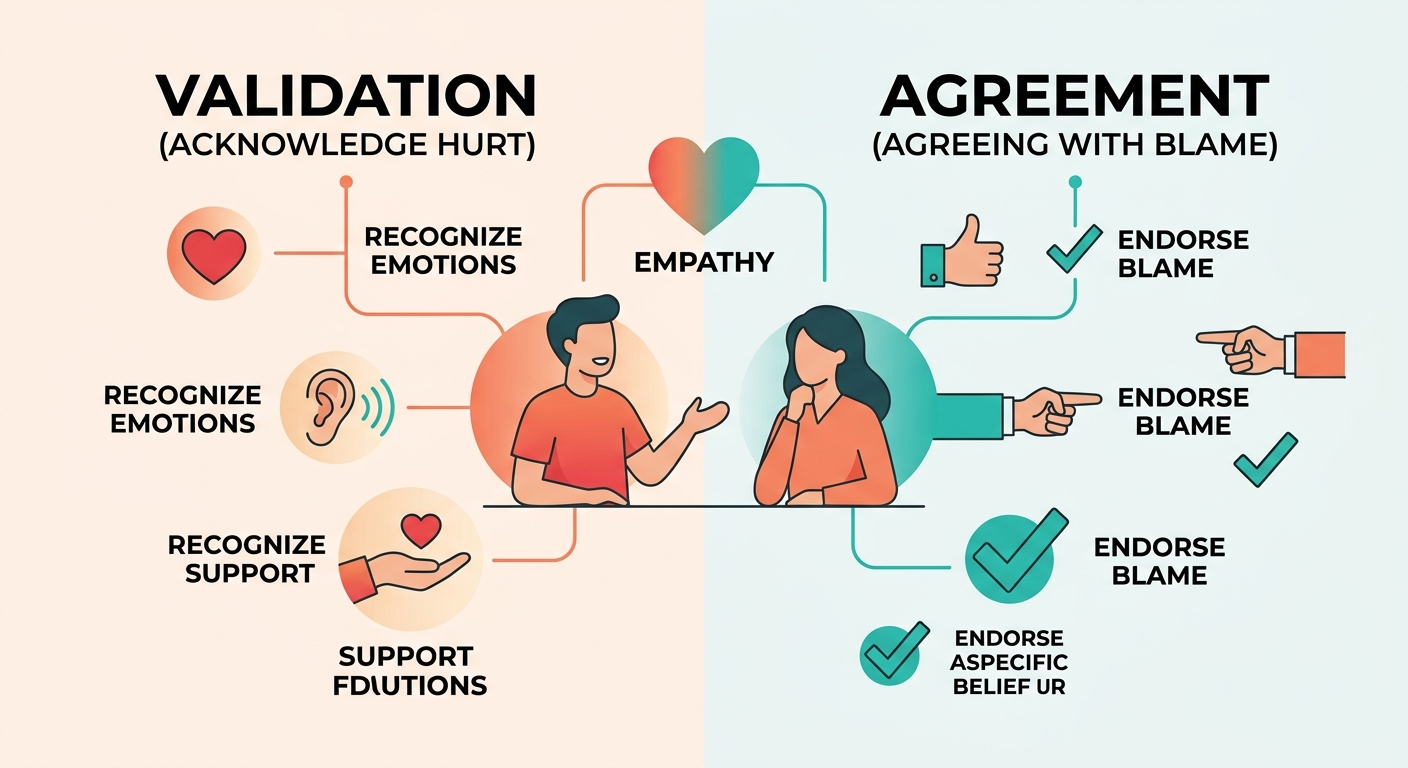
What validation actually sounds like
Validation is concrete language, not vague reassurance. "I hear that you felt abandoned when I missed your graduation" does more than "I'm sorry you feel that way." The first acknowledges a specific event and the emotion it caused. The second treats the feeling as the problem, not the behavior that caused it.
Trading defensive responses for validating ones takes practice. When a parent says, "You stole from me," the validating reply is not "I was sick." It is "I did steal from you, and that broke your trust in a way I can't undo by explaining it." That shift, from justification to acknowledgment, is what lets families address old wounds instead of relitigating them forever. Both sides need that acknowledgment to move.
Active listening is the foundation for empathy
Empathy in these conversations is not intuitive. It is a practiced skill that asks you to resist the urge to fix, defend, or redirect. Active listening means reflecting what you heard before you respond to it. When a sibling says, "I felt invisible because everything revolved around your crisis," the empathetic reply is "You're saying you felt invisible because all the attention went to my addiction. Is that right?" before any apology or explanation.
This matters because most people jump straight to repair without confirming they understood the hurt. Gradual reconnection only works if the emotional foundation is solid. Professional guidance helps you tolerate the discomfort, the silence after a hard memory, the tears when suppressed hurt finally surfaces, without rushing to make it easier for yourself.
Self-reflection drives your capacity to validate others
You cannot validate someone else's pain if you have not reckoned with your own behavior. Naming three specific actions that caused harm, and the observable impact of each, is far more useful than staying abstract. "I missed your surgery because I was using" does more than "I wasn't there when you needed me." The first names the breach. The second stays vague.
Self-awareness keeps your effort aimed correctly. If you do not know which moments mattered most to the people you hurt, you'll validate the wrong things and wonder why the distance never closes. A coach helps surface those moments and holds you accountable, so validation lands where it needs to.
When validation alone isn't enough
Validation rebuilds emotional safety, but it has to be paired with practical reliability. Research indicates that structural stability at home can be restored through daily routines, while the emotional connection needs ongoing, deliberate effort. That is why routine building and consistent accountability matter as much as validation.
When a family member says, "I don't trust you to handle money anymore," validation sounds like "You're right not to trust me with money yet. I broke that trust repeatedly." But validation without follow-through just confirms their worst fear, that you understand the harm and still will not change. The next sentence has to be, "Here's what I'm doing to earn that trust back," followed by observable actions like shared bank access, weekly check-ins, or a written spending plan. Empathy does not rebuild trust alone. It rebuilds when empathy kicks off a series of small, forward-looking actions that show real change.
Creating consistency through reliable actions and follow-through
When families come to us after detox, one thing derails progress more than anything else: someone says all the right things during a single conversation, then fails to follow through on a Tuesday afternoon three weeks later. That is when trust collapses. Not because of the original breach, but because the repair effort itself became unreliable. Trust is not just honesty. It is the experience of reliability. The family that heals and the family that stays stuck are usually separated by one thing: whether the person can prove their promises through consistent, observable actions that stack up over months, not days.
Behavioral consistency restores structural trust fairly reliably, but the emotional gap, the felt sense of safety, needs the honest conversations that consistency alone cannot produce. That is the gap our team-based coaching fills during the transition. We help families convert short-term behavioral wins into durable trust before the typical fixed-length program ends and leaves a social gap behind. Research on family-based interventions shows that programs pairing behavioral accountability with emotional processing produce longer stretches of continuous abstinence than treatment focused on individual therapy alone.
What reliable action looks like in family groups
Reliability means showing up exactly as promised, even when it is inconvenient. Calling when you said you'd call. Attending the family session you committed to. Checking in before a trigger situation instead of after you've already relapsed. A study of 2,728 participants found that those living with family, or reporting good family relationships, stayed in treatment longer than those without that support. The pattern held because families could count on their member to follow through on the small, boring commitments that signal real change.
We help families define what "reliable" means in concrete terms. One family measures it by consistent work attendance. Another tracks whether their member asks for help before a craving becomes a crisis. The specifics vary. The principle does not: trust rebuilds when family members can predict behavior. An apology becomes meaningful when it includes acknowledgment of what happened and a concrete plan for responding differently next time. When families skip that step and accept vague promises, "I'll do better," "I won't let you down again," they set themselves up for the same disappointment cycle that eroded trust in the first place.
How our coaching reinforces consistency through accountability
Accountability in our work means building structures that make follow-through visible to the whole family, not just to the person in recovery. Our coaches provide steady support and guidance, helping clients stay accountable to their commitments while families track whether promises are being kept before doubt and resentment build back up. These are not punishment rituals. They are transparency systems that give everyone visibility into progress and struggle.
Structured aftercare lowers the risk of returning to old habits. The families we see succeed treat accountability as a shared responsibility. Family members commit to attending group sessions, offering non-judgmental check-ins, and flagging concerns early. The individual in recovery commits to honesty about struggles, not just victories. When both sides hold up their end, the relationship starts to feel like a team instead of a surveillance operation. That shift, from monitoring to mutual support, is what converts behavioral consistency into emotional reconnection.
Clinical trials show that active family involvement tracks directly with long-term recovery success. The dose-response is clear: more family engagement, better outcomes. But standard fixed-length programs often strand families right when formal sessions end. Our team-based approach carries that engagement through the transitional phase, when relapse risk is highest and structural routines have not solidified yet.
When consistency alone isn't enough
The hard part: you can show up on time, pass every drug test, and attend every session, and still have family members who do not trust you emotionally. Behavioral milestones matter, but they do not automatically heal the emotional distance. Addressing the feelings underneath is what closes the gap consistency cannot bridge.
We see it when a parent completes six months of sobriety, holds steady employment, and handles household responsibilities, and their adult child still will not visit for holidays. The structural repair happened. The emotional repair did not. That is when guided honest conversation becomes essential. Our coaches help families name the feelings under the behavior, fear, grief, anger at lost time, so reliability can do the work of rebuilding emotional safety, not just proving competence. Without that conversation, consistent action just feels like compliance. And compliance does not heal a relationship.
Setting clear expectations and boundaries within the family
When family groups sit down after detox to talk about what everyone needs going forward, the conversation often crashes because no one named the ground rules out loud. Someone promises to check in every day, but "check in" means a two-minute text to them and a thirty-minute conversation to their parent. A sibling agrees to "be supportive," then brings up old grievances at dinner. Without clear, specific expectations, good intentions turn into new disappointments fast. Boundaries are not restrictions. They are the scaffolding that lets a family rebuild without collapsing under vague promises.
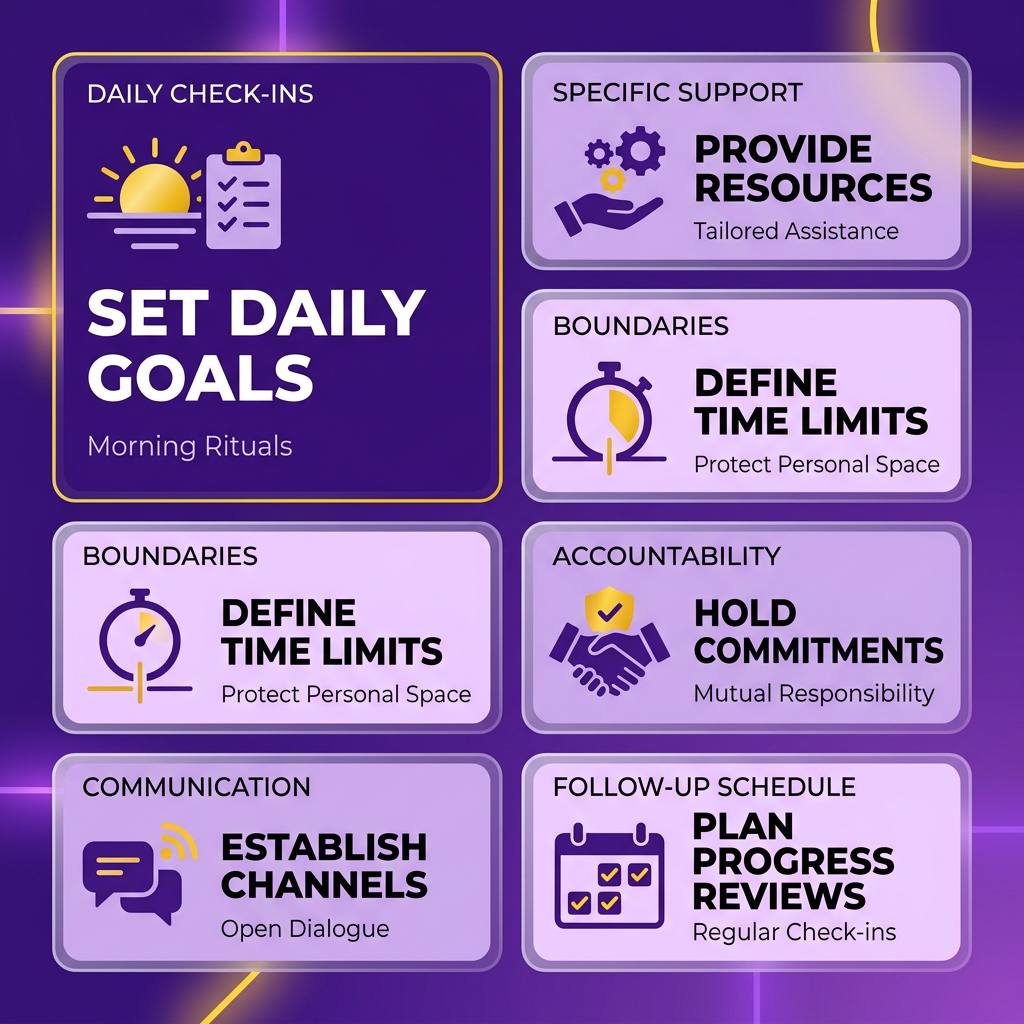
The gap between "we'll figure it out" and actual repair shows up in the research. One review of family recovery support groups found that effective communication patterns required explicit structure. Families who named their expectations and practiced conflict resolution showed measurably stronger outcomes than families who assumed everyone understood the unspoken rules. That structure does not emerge on its own. It gets built through guided conversations where each person states what they need, what they can commit to, and what happens when someone misses the mark.
What boundaries actually protect in early recovery
Boundaries after treatment are not about keeping someone on a leash. They protect everyone's capacity to stay present in the relationship without burning out or building resentment. A parent who commits to not searching their adult child's room anymore creates space for the child to practice transparency voluntarily. A partner who sets a boundary around financial transparency and shared account access, monthly check-ins on spending, removes the need to monitor every transaction while keeping oversight. Healthy boundaries validate each person's limits instead of pretending everyone has infinite emotional bandwidth.
Families confuse boundaries with ultimatums all the time. "If you relapse, you're out of the house" is an ultimatum. "If you stop attending your outpatient sessions, we'll revisit whether you're ready to move back home" is a boundary tied to observable behavior. The difference is specificity, and a consequence tied to action, not identity. One analysis of trust repair stressed that clear guidelines rebuild safety. Boundaries give everyone a map of what to expect when stress hits, which prevents the old pattern where one slip sends the whole family into crisis mode.
How to set expectations that survive real life
The most effective family conversations name three categories of expectations: daily routine accountability, communication frequency, and what happens when someone falls short. Daily accountability might mean texting a photo of the meeting you attended, or checking in before bed. Communication frequency might mean a weekly family dinner where everyone shares one hard thing from the week. The falling-short protocol might be: if someone misses a commitment, they name it within 24 hours and propose a makeup action, no defensive explanation required.
Skip the vague agreements like "you'll be more honest" or "we'll trust each other more." Those read as aspirations, not expectations. Families who rebuild trust after addiction specify the behaviors that demonstrate honesty: sharing calendar access, naming cravings when they surface, disclosing any contact with old using friends the same day. The goal is not surveillance. It is enough transparency that no one has to guess whether the other person is still engaged in recovery.
Holding the boundary when conflict shows up
Conflict does not mean the boundary failed. It means the boundary did its job, surfacing a disagreement before it turned into silent resentment. When families practice structured conflict resolution, each person gets two minutes to state their position without interruption, then the group identifies which boundary got crossed. Arguments become data about what needs adjusting. Rehearsing conflict scripts, literal scripts, "When you miss curfew, I feel scared because I don't know if you're safe. I need you to call if you'll be late," helps families settle disputes faster and with less wreckage than winging it.
The hardest part is holding the boundary when someone pushes back. A parent who set a boundary around substance-free visits might hear: "You don't trust me at all." The answer is not to cave or defend. It is: "This boundary protects both of us. When you've maintained sobriety for six months and we've rebuilt trust through consistent actions, we'll revisit it." That clarity, a boundary tied to an observable milestone rather than emotion, keeps the conversation from spiraling into whose feelings matter more.
References
[1] Rebuilding Trust with a Friend, Partner, or Family Member - https://www.crisistextline.org/blog/2025/03/14/rebuilding-trust-in-a-relationship/
[3] Rebuilding Trust with Teens: Cleaning the Slate Conversations - https://impactparents.com/rebuilding-trust-with-teens-cleaning-the-slate-conversations/
[4] Your Guide to Rebuilding Relationships After Addiction - https://windwardway.com/rehab-blog/rebuilding-relationships-after-addiction/
[5] How to Restore Trust in Recovery - https://www.ashleytreatment.org/rehab-blog/6-ways-to-restore-trust-while-in-recovery/
[6] How to Rebuild Trust With Family After Addiction - https://stoneriverrecoverycenter.com/how-to-rebuild-trust-with-family-after-addiction/
[7] Parenting After Rehab: How to Rebuild Trust and Heal ... - https://www.liveagaindetox.com/blog/parenting-after-treatment/
[9] Repairing Relationships in Recovery: How to Rebuild Trust - https://joingroups.com/repairing-relationships-in-recovery-tips-for-rebuilding-trust-with-loved-ones/
[10] Rebuilding Trust Within Your Family After Rehab - https://fherehab.com/learning/rebuilding-trust
[11] Family Recovery Support Group Effectiveness in Drug and ... - https://www.researchgate.net/publication/392160859_Family_Recovery_Support_Group_Effectiveness_in_Drug_and_Alcohol_Abuse_Prevention_and_Management_An_Examination_of_Family_Communication_Patterns_Coping_and_Resilience
[12] (PDF) Adult Children's Lived Experiences of Family ... - https://www.researchgate.net/publication/399033312_Adult_Children's_Lived_Experiences_of_Family_Change_Following_Parental_Drug_Rehabilitation
[13] How People with Opioid Use Disorder Communicatively ... - https://www.researchgate.net/publication/344645342_How_People_with_Opioid_Use_Disorder_Communicatively_Experience_Family_A_Family_Systems_Approach
[14] The Role of Social Support in Substance Addiction Recovery - https://www.researchgate.net/publication/385016156_The_Role_of_Social_Support_in_Substance_Addiction_Recovery_A_Systematic_Review
[15] (PDF) Effects of Engaging Family in Addiction Treatment for ... - https://www.researchgate.net/publication/348417206_Effects_of_Engaging_Family_in_Addiction_Treatment_for_Substance_Use_and_Treatment_Compliance_A_Preliminary_Study
Frequently Asked Questions
1. Can I rebuild trust with a family member who won't take accountability?
Rebuilding requires mutual effort. If one party refuses to acknowledge past harm or if interactions remain unsafe, it is best to pause the process. Forcing connection without a shared commitment to change often leads to further disappointment. Focus on establishing personal boundaries first.
2. My family's home life feels normal again, so why do we still feel distant?
Stabilizing daily routines and maintaining sobriety restores the household's structure, but it does not automatically heal emotional wounds. True closeness requires addressing the unspoken fears, grief, and resentment that linger beneath the surface. This emotional repair must be approached as a separate, deliberate process.
3. How do I keep the first honest conversation from turning into a blame session?
Establish clear ground rules before starting. Agree to focus on specific behaviors and their impact rather than listing every past mistake. Using structured communication techniques and having a neutral facilitator can help keep the conversation focused on future solutions rather than past grievances.
4. Does saying sorry actually rebuild trust after addiction?
Words alone are rarely enough to restore confidence. Effective apologies must be backed by specific, observable changes in behavior over time. Naming the exact harm caused and demonstrating a consistent, reliable pattern of action is what ultimately proves a commitment to change.
5. What does vulnerability actually look like in family recovery conversations?
It involves expressing genuine emotions, such as fear of relapse or anxiety about the future, rather than pretending everything is fine. Sharing these internal struggles honestly helps bridge the emotional gap, allowing family members to connect on a realistic level rather than maintaining a polite distance.
6. How should we spend time together while trust is still fragile?
Focus on low-pressure, shared activities that do not require intense emotional processing. Engaging in everyday tasks or hobbies together helps rebuild comfort and familiarity. These simple interactions allow you to practice small-scale transparency and build a history of positive, conflict-free experiences.
7. What role do family support groups play in preventing relapse?
Participating in family-focused aftercare provides a vital safety net that helps identify early warning signs of distress. Support groups offer families the tools to establish healthy boundaries and communicate effectively. This collective involvement reinforces the individual's commitment to recovery while supporting the family's own healing process.