What to Ask Before Signing a Sober Living Home Lease
November 2, 2026

Quick Summary
Get the written resident agreement and house rules together before you sign anything or pay a deposit. Most disputes in sober living stem from expectations that were only discussed verbally. You need both documents in hand before you commit to move-in dates or fees.
What categories should every lease cover?
| Category | What to confirm | Red flag |
|---|---|---|
| Costs and payment timing | Weekly or monthly fee, deposit amount, late-fee policy, what the fee covers | Vague "program fee" with no itemized breakdown; no written late-payment grace period |
| Written agreement | Signed document stating you're a resident, not a guest or tenant | No written agreement before you pay; verbal promises only |
| House rules | Posted curfew, testing schedule, chore chart, visitor policy, employment expectations | Rules exist but aren't posted; you receive them on move-in day |
| Recovery supports | Required IOP attendance, peer meetings, one-on-one coaching frequency | No structured recovery programming; "optional" meetings with no accountability |
| Grievance process | How you file a complaint, who reviews it, timeline for response | No posted grievance path; operator says "just talk to me" |
| Termination and eviction | What conduct triggers discharge, how many warnings you get, appeal rights | Immediate eviction for any rule break; no written discharge policy |
| Personal property | What happens to belongings you leave behind, storage limits, liability for theft | No personal-property clause; house "isn't responsible" for loss |
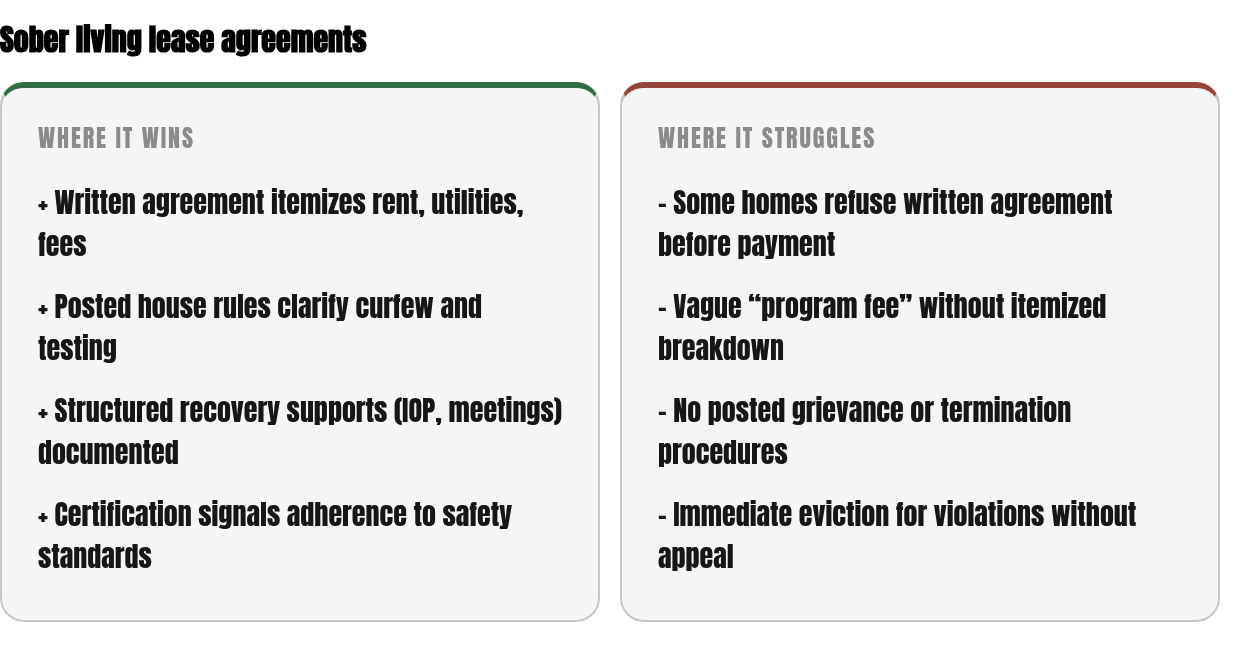
If the operator can't explain fees in writing, you'll face surprise charges later. Look for itemized costs that break down rent, utilities, fees, and any penalties or additional charges.
Red flags that signal a weak agreement
Walk away if the home refuses to provide a written agreement before you pay. If something important isn't in writing, ask for it to be added before you commit. A legitimate residence welcomes questions and sees them as commitment to recovery, not a hassle.
Higher-quality features worth asking about
Strong agreements include a written resident contract, posted rules and grievance procedures, a clear fee schedule, documented curfew and testing expectations, and structured recovery supports like required IOP participation or weekly peer meetings. Ask how the home handles setbacks. Relapse response should focus on safety and next steps, not shame. Find out whether you're referred to additional treatment or simply discharged.
Key Takeaways
- One study found community services supporting sustained recovery receive far less attention than clinical treatment despite housing instability directly threatening long-term sobriety.
Why the Questions You Ask Matter
When someone leaves detox or residential care, they're at their most vulnerable. The transition from a highly structured treatment setting to independent living is where relapse risk spikes. Research shows that community services supporting sustained recovery have received far less attention than clinical treatment itself, even though housing instability directly threatens long-term sobriety.
In our experience, a resident sometimes signs based on verbal promises, moves in, and discovers the house rules don't match what they were told—or the testing policy changes, or fees appear that were never discussed. The wrong environment can create confusion, stress, or jeopardize sobriety.
Asking the right questions before signing protects both your recovery plan and your family's financial investment. Sober living homes bridge the gap between treatment and independence, but quality varies widely. Knowing what to look for helps you identify whether a home offers genuine structure and accountability or just a bed.
What a clear lease protects
A written agreement clarifies rent, deposits, curfews, visitor policies, chore schedules, drug testing protocols, and consequences for rule violations. Never rely on verbal promises. If something important isn't in writing, ask for it before committing or paying.
We recommend vetting lease details upfront. Residents who request the full agreement and house rules together—before discussing move-in dates—catch red flags early. Homes that refuse to provide written terms, or only share them after payment, often lack the oversight and transparency recovery requires.
Research shows structured environments support accountability, but only when expectations are documented. A clear contract means residents know exactly what's required (employment expectations, meeting attendance, testing frequency) and can plan their recovery around those commitments rather than discovering shifting rules later.
Lease & Financial Terms: What to Verify
We recommend every prospective resident request the written agreement and house rules together before committing to a move-in date or paying any fees. When financial terms are only verbal, disputes arise the moment someone remembers the conversation differently.
What the agreement should break down
The document should state every charge by name and amount, not lump them into a vague "program fee." Fee structures vary widely from home to home, so ask what applies to the home you're considering.
- Confirm the base fee, due date, and accepted payment methods so you know exactly when and how much to pay each period
- Ask what the fee includes (utilities, recovery programming, drug testing, transportation) and which services carry separate charges
- Clarify any upfront costs such as admin fees, entry fees, or deposits, and ask which portions are refundable under what conditions
- Check the late-payment and arrears policy including grace periods, daily penalties, and when nonpayment triggers discharge
What the legal structure means for you
The arrangement may be weekly, monthly, program-based, or a tenancy, and your rights depend on which category applies. California law addresses rent increases and requires the landlord to provide a signed rental agreement. Other states have different frameworks. The home should explain which framework applies and what notice and deposit rules follow.
- Ask whether the arrangement is a lease, license, or program agreement and what renewal or continuation process applies
- Verify local rent-increase, notice, and deposit rules with a tenant-rights organization rather than relying on broad national claims
- Request a signed copy of the agreement before you pay or move in to confirm you have the same version the operator enforces
House Rules & Daily Structure: Does the Environment Support Recovery?
In our experience, some residents tour a house, hear promises about structure and accountability, then move in and find the rules weren't what they expected. Before you commit to fees or a move-in date, ask for the written house rules alongside the resident agreement. Both documents should be in your hands before you sign anything.
Clear rules protect you. They tell you what happens if you're late on rent, what the curfew is, how drug testing works, and what the discharge process looks like. A home that can't produce these documents in writing is a home where enforcement will be inconsistent.
What daily expectations should the rules spell out?
The written rules should cover curfew, overnight passes, employment or job-search requirements, meeting attendance, chores, guest policies, and testing protocols. Sober living homes set their own standards for daily structure, and those standards vary widely. Some use phased systems that gradually relax restrictions as residents demonstrate stability. Others maintain consistent expectations throughout a resident's stay. Some require participation in outside recovery programming; others leave that choice to the resident.
If the home requires employment, ask what happens if you lose a job or need time to search. If it requires participation in outside recovery support, ask whether that means 12-step meetings, IOP, individual coaching, or something else. Vague expectations create confusion. Documented ones let you know whether you can meet them before you move in.
How are violations handled?
Ask how rules are enforced and what the consequences are. Documented consequences range from fines for minor violations to immediate discharge for positive or refused drug screens. Some homes charge daily late fees and terminate residency after a short period with no communication. Others discharge immediately for a positive test with no secondary appeal process.
These aren't red flags if they're documented and explained before you move in. They're red flags if you find them after.
Safety, Health & Legal Compliance: Are You Protected?
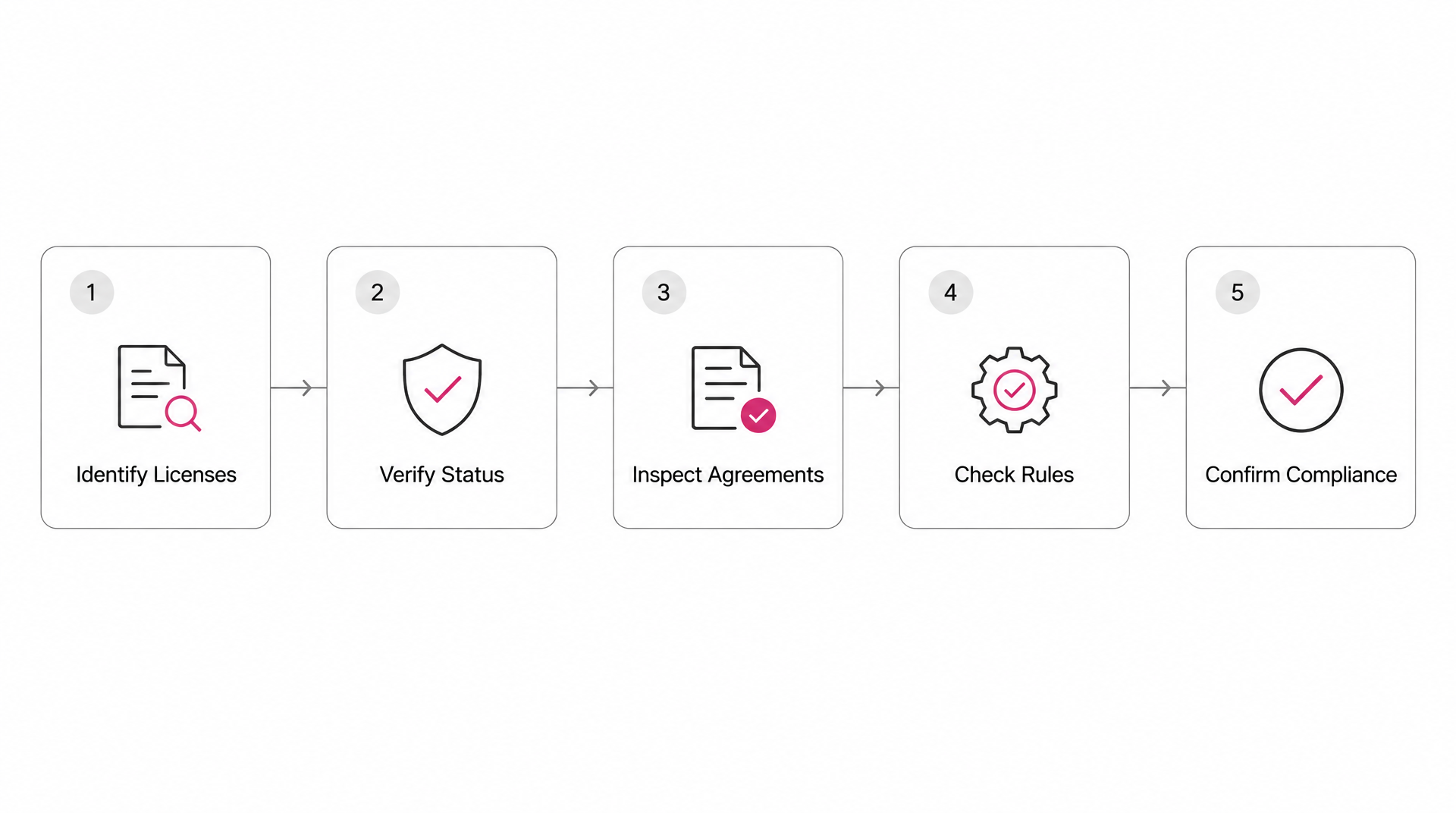
We recommend asking every prospective home which license, certification, or recovery-housing standard applies to them, then verifying it independently before you commit to fees or a move-in date. Recovery housing falls under state and local rules that vary widely, and the consequences of moving into an unlicensed or unregulated home often appear only after a dispute arises. NARR certification requires written agreements, posted grievance processes, and documented house rules, but not every state has a NARR affiliate or requires certification. Some municipalities treat certain recovery homes as boarding houses subject to local codes. Others apply landlord-tenant law. Others place recovery residences in a separate category with lighter requirements. Ask the operator which framework governs their property, get the name of the certifying body or regulating agency, and confirm that status with the organization directly.
Ask for written proof of insurance and clarify who bears responsibility for your belongings while you live there. Ask explicitly whether your personal property is protected and what is and isn't covered. If the home cannot produce proof or explain the coverage, consider that a red flag.
What emergency-response procedures should be posted?
Ask to see the home's written procedures for fire, medical emergencies, overdose response, and after-hours crises before you move in. A reputable home should be able to produce a document that explains who you contact, what steps to follow, and how medical or safety situations are escalated. If the operator cannot produce written procedures or answers your questions vaguely, that signals weak management.
Ask how resident information is kept private, especially when counseling, medical, or similar services are connected to the housing. Many peer-run sober living homes are not HIPAA or 42 CFR Part 2 covered entities, but affiliated services can change that analysis. If the home is part of a larger treatment organization or shares space with clinical programs, ask which privacy rules apply and how your information is protected. Legal treatment may vary when residency is incidental to services, but jurisdiction-specific policies must be confirmed directly. Ask the operator to explain their policy in plain language; vague reassurances are not sufficient.
The most consequential red flags come from the agreement itself. Before you sign, check whether the document includes these terms:
No signed written agreement before you pay or commit to a move-in date. The title on the document matters less than the protections and obligations inside it. Some recovery residence program agreements explicitly state that residents have no rights of residency or occupancy, treating the signed program agreement as the only housing document—removing tenant protections and placing the resident in a less protected legal category. Others use 'lease' language but still operate as program agreements. If a home cannot produce a written agreement before you commit, consider it a deal-breaker.
Immediate eviction clauses for drug-screen issues without a defined response process. Some homes state that refusal or a positive test equals immediate eviction, while others frame relapse response around safety, honesty, and next steps, not shame. The difference matters. Ask how the home handles positive tests, refusals, and suspected use, and confirm that the response is documented in writing. A home that treats every testing issue as grounds for immediate removal without review or support is not aligned with recovery principles.
State-law ambiguity around tenancy status. Some agreements explicitly remove residency rights; others frame the arrangement as a residential lease. The legal structure varies by state law, services provided, and whether the home operates as peer-run versus treatment-affiliated. Ask the operator which legal framework applies and what rights that preserves or removes. If the operator cannot explain this clearly, consult someone outside the home who understands housing law in your state.
Ask what staff credentials, training, recovery experience, and on-site coverage exist, but understand that the evidence does not establish jurisdiction-specific staff licensing rules. Some homes are peer-run with house managers who are themselves in recovery; others employ licensed professionals. Neither model is inherently better, but you need to know what you are getting. Ask who is on site, when they are available, and how you reach support after hours. If the operator cannot answer these questions or provides vague reassurances, that is a red flag. Ask about the house manager's background and training as a practical due-diligence question.
Ask whether structured support is built into the program. Some homes require specific weekly hours of intensive outpatient treatment and regular individual meetings with peer recovery specialists. Those are documented, measurable expectations. If the home describes support as "available" or "as needed" without specifying what that means, ask for clarification. You need to know whether accountability is built into the structure or left to you to seek out.
Compare Your Options Before You Commit
When you've narrowed your list to two or three homes, a side-by-side comparison keeps the decision grounded. Testing your assumptions against the written terms each home provides helps you make a choice you can stand behind.
Checklist: What to confirm before you sign
Print or save the resident agreement and house rules from each home, then mark whether the home provides clear answers to the items above. Gaps in documentation often signal gaps in accountability. If the home cannot produce clear answers to most items before you pay, that pattern is the red flag. Lack of documentation usually means inconsistent enforcement, not flexibility.
Compare each home against your recovery plan
A sober living lease checklist tells you what a home promises. Your recovery plan tells you what you need. When the two don't align, the mismatch creates friction that undermines stability.
Weighing those written terms against your specific recovery needs helps you choose the home where you're most likely to stay engaged rather than the one that simply sounds appealing.
If you need frequent check-ins during early recovery but the home offers no documented peer support or recovery meetings, that's a mismatch. If you need schedule flexibility for work but the home requires weekday IOP attendance with no shift exceptions, that's a mismatch. If the home's testing policy treats any prescription medication as grounds for discharge and you're on medication-assisted treatment, that's a legal and clinical mismatch. One or two mismatches might be workable. A pattern of mismatches means the home isn't built for your recovery track.
Bring a trusted advisor into the review
Ask a family member, sponsor, outpatient counselor, or recovery coach to review the agreements alongside you before you commit. A second set of eyes catches clauses you might overlook when you're focused on securing housing quickly, and an advisor familiar with your relapse triggers or financial limits can flag terms that create unnecessary risk.
Walk through the financial section first: does the total monthly cost fit your income or family support without forcing you to skip meals, delay prescriptions, or take transportation shortcuts? Then review the discharge section: are the grounds for removal clear enough that you know what behavior will get you evicted, or are they vague enough that staff could remove you for reasons you didn't anticipate? Finally, check the testing and accountability terms against your recovery plan: if your plan includes daily support calls with a coach and the home requires nightly on-site meetings, can you do both or will one have to give?
If you're working with an aftercare planner or recovery coach outside the home, they can compare the home's structure with your relapse-prevention plan and point out where the home's rules either reinforce your plan or create gaps. That review is part of aftercare planning, not a luxury add-on. We can help you work through sober living questions and compare housing options with your recovery goals. Schedule a consultation if you want a second opinion on the agreements you're reviewing or if you're unsure which home aligns with your needs.
References
[1] How to Qualify a Sober Living Operator Before Signing a Lease - https://www.vanderburghhouse.com/how-to-qualify-a-sober-living-operator-before-signing-a-lease/
[2] Top 5 Mistakes When Leasing to a Sober House Operator - https://www.vanderburghhouse.com/top-5-mistakes-property-owners-make-when-leasing-to-a-sober-house-operator/
[3] How to Choose a Sober Living Home: 17 Questions to Ask - https://www.theglasshouserecovery.com/blog/how-to-choose-a-sober-living-home-17-questions-to-ask
[4] Sober Living Resident Agreement Template - https://soberlivingapp.com/blog/sober-living-resident-agreement-template
[5] Red Flags to Avoid When Picking a Sober Living Home - https://healingus.org/blog/sober-living-home-red-flags/
[6] Sober Living Lease Agreements: What Residents Should Sign - https://www.vanderburghhouse.com/sober-living-lease-agreements-what-to-include-and-what-to-leave-out/
[7] Sober Living Lease Agreements: Key Terms for Landlords - https://vanderburghcommunities.com/sober-living-lease-agreements-key-terms-for-landlords/
[8] [PDF] Recovery Housing Program Agreement - http://www.yourpathtohealth.org/wp-content/uploads/2015/01/Recovery-Residence-Program-Agreement-House-Rules-Draft1.pdf
[9] Landlord's Disclosures - Publications and Reports - CA.gov - https://www.dre.ca.gov/publications/ResourceGuidebook/gb07_when.html
[10] Sober Living Contract Template: Build a Clear Resident Agreement - https://soberlivingapp.com/templates/sober-living-resident-agreement
[11] [PDF] MEMBERS HANDBOOK - Fresh Start Sober Living of Maine - https://freshstartrecovery-maine.org/wp-content/uploads/2024/06/FSSL-Member-Handbook-2024-Revised-final.pdf
[12] [PDF] Sober House Rules/Handbook - Common Ground - https://common-ground-lj8d.squarespace.com/s/Sober_-House-Rules_Handbook.pdf
[13] (PDF) A Clean and Sober Place to Live: Philosophy, Structure, and... - https://www.researchgate.net/publication/23187624_A_Clean_and_Sober_Place_to_Live_Philosophy_Structure_and_Purported_Therapeutic_Factors_in_Sober_Living_Houses
Quick Questions, Straight Answers
What happens if the sober living home changes its rules after I move in?
If the written agreement doesn't specify how rule changes work, the home can enforce new expectations without notice. Before signing, confirm whether the agreement includes a change-notification policy and whether major rule changes require resident input or advance warning.
Should I avoid homes that discharge residents immediately after a positive drug test?
Immediate discharge isn't inherently wrong if it's documented before you sign. The red flag is discovering the policy after move-in. Quality homes explain their relapse-response approach up front, whether that means referral to treatment or discharge, so you can decide if it aligns with your recovery plan.
Can a sober living operator legally hold my belongings if I'm discharged?
Property-holding rules vary by state and by what the agreement says. Some homes store belongings for 30 days, others discard them immediately. If the agreement doesn't address this, ask for a written addendum before signing, because verbal promises about property are rarely enforceable after discharge.
Do NARR-certified homes always provide better support than non-certified ones?
NARR certification confirms the home follows documented standards around agreements, grievance processes, and posted rules, but it doesn't measure staff experience or recovery programming quality. Non-certified homes can offer strong support if they provide clear documentation and structured accountability; certification signals baseline compliance, not superiority.
What if the home I'm considering operates in a state with no recovery-housing regulations?
Ask which legal framework applies—landlord-tenant law, boarding-house codes, or program agreements—and verify the answer with a local tenant-rights organization. In states without recovery-specific rules, your protections depend entirely on the agreement you sign, making written clarity even more important before committing.