Sober but Not Happy After Rehab? Depression Signals Coaching and Counseling Address
September 24, 2026

Quick Summary
Feeling flat, low, or joyless after rehab is common in early recovery. It does not mean treatment failed. An estimated 40 to 60 percent of people hit clinically significant depressive symptoms in the weeks and months after treatment. If that is you right now, you are in the majority, not the exception.
The after-rehab window carries high risk for a specific reason. You leave a structured setting while your brain is still chemically depleted, and old stressors rush back. The table below maps the signals to watch, what coaching can support, and when to bring in a professional.
| Warning Sign | Typical Onset | How Coaching Supports It | When to Involve Counseling | Quick Action |
|---|---|---|---|---|
| Persistent low mood, emptiness | First weeks home; PAWS can run for weeks to months | Daily check-ins, emotional accountability, human contact | Mood does not lift as the weeks pass | Name it out loud to one person today |
| Loss of interest, anhedonia | Early, tied to dopamine recalibration | Routine building, hobby and passion re-entry | Anhedonia persists or deepens | Schedule one small pleasurable activity |
| Sleep and appetite changes | Early recovery | Fixed wake/meal/sleep schedule, nutrition support | Insomnia or weight change lasts weeks | Set a firm wake time and a consistent sleep schedule |
| Isolation, withdrawing | When rehab community disappears | Companionship, family coordination | Withdrawal is total; you stop answering | Book one recurring contact this week |
| Hopelessness, thoughts of self-harm | Any point | Not a coaching-only issue | Immediately | Call 988 now |
Coaching and structure are a defensible first response for mild-to-moderate low mood
Before jumping to medication, structured support carries real weight. Aftercare guidance consistently points to continued therapy, physical exercise, support group participation, and steady routines as ways to manage depression in early recovery. Movement, in particular, gets named again and again.
Read those together, and a pattern emerges. Accountability, routine, movement, and connection are not soft extras. They are the first-line tools for transient, PAWS-driven low mood that lifts as the brain heals.
Escalate to a clinician when the low mood does not budge
Medication earns its place in persistent, severe cases, not every rough week. Clinical depression may call for medication, more intensive therapy, or a higher level of care. Those decisions belong with a qualified clinician, not a coach. Any thoughts of self-harm skip all of this. Call 988 or go to emergency care now.
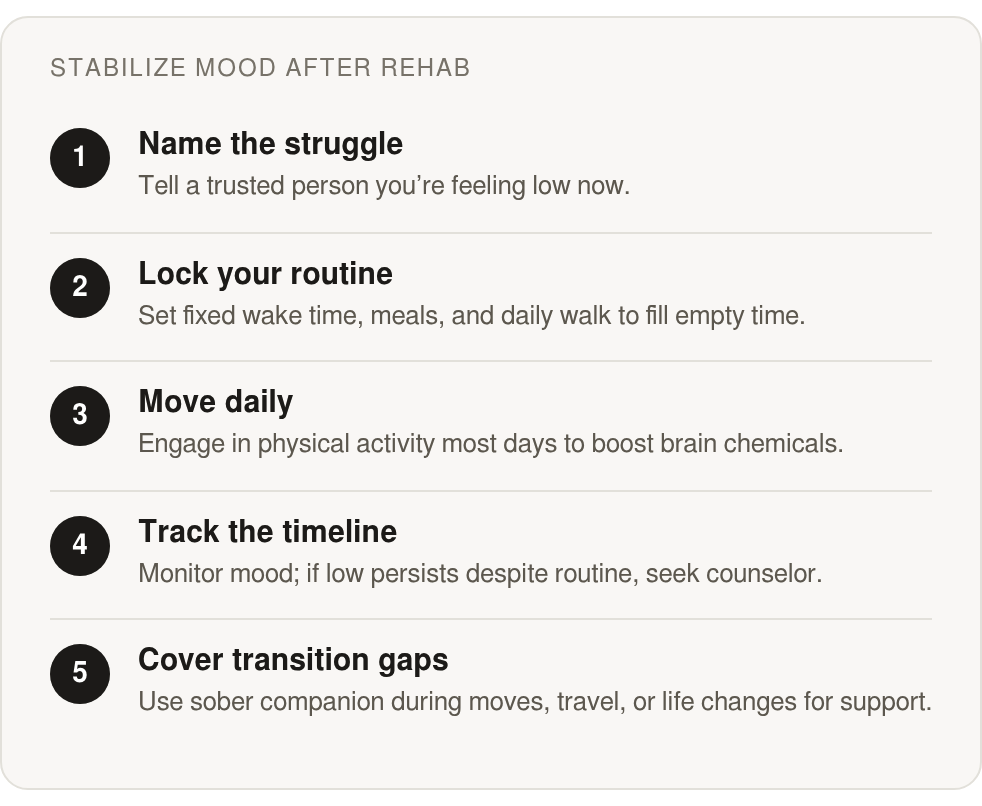
The first-things-to-do checklist
- Name it. Tell one trusted person you are struggling. Silence is where this gets dangerous.
- Lock your routine. Fixed wake time, three meals, one walk. Empty time feeds low mood.
- Move daily. Physical activity is one of the first-line tools for lifting low mood, so aim to work some in most days.
- Track the timeline. If low mood holds even after you have had some stable time, that is your signal to call a counselor or prescriber.
- Cover the transition. Life changes and travel are peak-risk stretches, and this is exactly the window a sober companion is built to hold.
Key Takeaways
- An estimated 40 to 60 percent of people experience clinically significant depressive symptoms in the weeks and months after leaving treatment.
- Post-acute withdrawal syndrome can keep low mood, emptiness, and anhedonia running for weeks to months as the brain chemically recalibrates.
- The day you leave the structured "rehab bubble" is the riskiest moment, because schedule, peers, and accountability disappear while the brain is still depleted.
- Anhedonia in early recovery ties directly to dopamine recalibration, showing up early alongside disrupted sleep and appetite.
- Unaddressed depression can raise relapse odds, because the feelings it produces create a direct pull toward using again.
- Any thoughts of self-harm warrant immediate professional help through the 988 crisis line or emergency care, bypassing coaching entirely.
Why the Flat Feeling After Rehab Is a Risk Factor, Not a Mood
Feeling flat after leaving treatment is not a mood swing you wait out. It is a risk factor, and it deserves that kind of attention. Low mood in early recovery is one of the clearest signals that relapse may be moving closer, not further away.
Depression is a common companion to early recovery, and many people keep carrying those symptoms after treatment ends. When that low mood goes unaddressed, the feelings it produces can create a direct temptation to use again, as one clinical overview of post-substance depression puts it plainly. So depression matters not because it feels bad, but because it can quietly raise the odds of everything you worked for coming undone.
Leaving Day Is the Danger Zone
The riskiest moment is the day you leave the structured setting. Shirley Hickman, a social worker at Mirmont Outpatient Center, calls it leaving the "rehab bubble," where a person no longer has the full-time job of keeping up their substance use as their daily agenda. Her point is blunt: the hard work begins when you leave, not while you are inside.
That timing is the whole problem. You lose the schedule, the peers, and the accountability at the exact moment your brain is still depleted and old stressors come flooding back. Premature loss of professional support is one of the strongest predictors of both worsening depression and relapse. This is the window we built sober companionship to cover, especially during moves, travel, and other life transitions, when someone is most alone and most exposed.
Chemistry Loads It, Behavior Decides It
Two views seem to clash here, and both are right. One source frames depression as a post-acute withdrawal symptom, a chemical brain-adjustment process that can leave life feeling flat for weeks or months after detox. Another argues getting sober does not inherently cause depression, and that your strategies for handling triggers shape the outcome.
Both fit together. The neurochemistry sets the vulnerability. Daily support and coping decide whether that vulnerability becomes clinical depression. Chemistry loads it. What you and your support system do next holds or pulls the trigger. That is why structure in this window is not optional comfort. It is prevention.
Who Gets Hit Hardest
Not everyone carries equal risk. People with co-occurring mental health conditions, those sober for the first time, and anyone returning to an unchanged home environment tend to feel the drop hardest. Men and women often show it differently, too. Women more often show persistent low mood and withdrawal, while men frequently mask it through anger, escapism, or physical complaints, which means it gets missed.
For families watching from the outside, that variation is the trap. The person rebuilding an identity beyond the label of "addict" (which we cover here) may look fine while sinking underneath. Catching it early, before it hardens into relapse, is the entire reason this matters.
Recognizing the Signs: Normal Adjustment vs. Clinical Depression
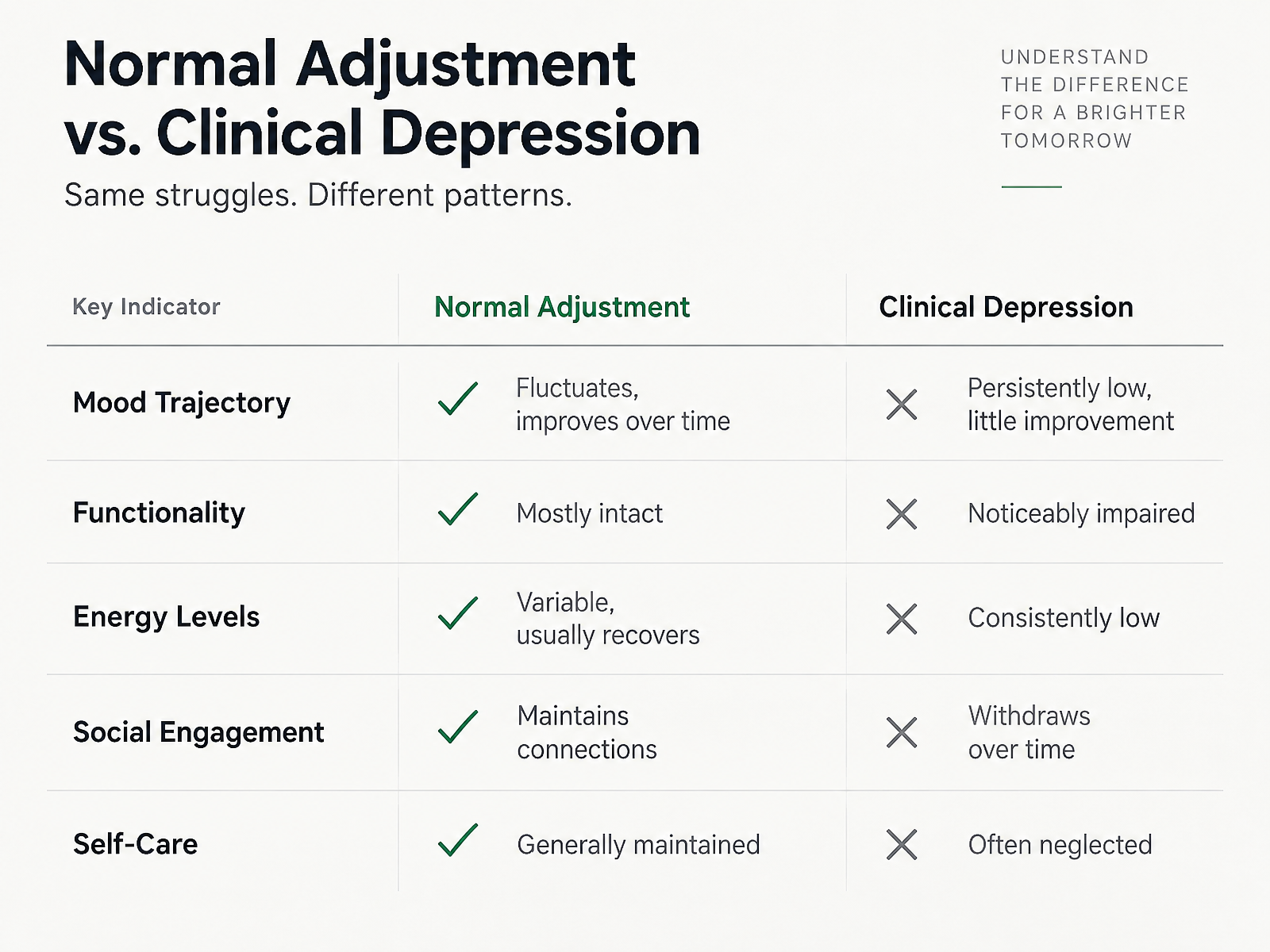
A rule of thumb we lean on with clients in the first weeks after rehab: feeling flat is expected, but feeling flat and shrinking your life is a warning. The difference between normal adjustment and clinical depression is not the presence of low mood. It is what the low mood is doing to your days.
Both can look identical on a bad Tuesday. The signal is in the trajectory. Adjustment blues drift upward as you rebuild routine and connection. A depressive episode digs in and pulls the rest of your functioning down with it. That distinction matters most during life transitions after treatment, which is exactly when we pair clients with a sober companion who can watch the trend, not just the moment.
Normal Adjustment Has a Timeline; Depression Loses One
The brain adjustment behind post-rehab low mood is real, and it is time-limited. Depression classified as a post-acute withdrawal symptom, feeling flat for weeks or months after detox, is your dopamine system relearning how to fire on its own. Those symptoms can linger for a year or longer, which surprises people who expected to feel steady by month two.

Here is the tell. Adjustment mood moves in waves and lifts when good things happen. Clinical depression flattens the response to everything, good and bad alike. If a genuinely nice day does not register at all, that is the line worth flagging.
Watch the specifics rather than the sadness itself:
- Sleep and appetite collapsing or spiking for two weeks straight, not just a rough night
- Total loss of pleasure in things you used to like, even now that you are sober
That last one is not a "monitor it" item. It needs a professional, same day.
The Signs Split by Gender, and People Miss Half of Them
One reason depression gets missed in recovery is that it does not always look sad. Signs differ by gender: women more often show persistent low mood and withdrawal, while men tend to route it through escapism, anger, and physical complaints. Families watching for tears can miss the irritable, restless version entirely.
This is also where a "dry drunk" pattern hides. Someone sober but still angry, resentful, and empty is often carrying untreated depression, not a bad attitude. The Discovery Institute puts it bluntly: it is "an addict or an alcoholic with no drugs or alcohol, and also no solution." Naming that gently, without judgment, is a skill we work on with the people around each client.
When to Bring in a Professional
Our judgment, drawn from where the evidence lands: structured support and daily routine handle a lot of PAWS-driven low mood on their own, which is why we start there. But two signals mean it is time to loop in outside clinical help without waiting.
First, duration. If clear depressive symptoms hold steady past two weeks with no upward drift, that is past the adjustment window. Second, pulling back from support is one of the strongest predictors of both worsening depression and relapse. When someone starts canceling, going quiet, and isolating, the risk is climbing even if they say they are fine.
A quick self-check helps clients name it out loud. Ask two things: over the past two weeks, how often have you felt down or hopeless, and how often have you lost interest in things you normally enjoy? Steady "most days" answers to both are your cue to move.
We are a nonmedical support team. We do not diagnose or treat depression. What we do is stay close during the transition out of the rehab bubble, catch the trend early, and help you get to the right professional before low mood becomes a relapse. That handoff, made in time, is often the whole ballgame.
Root Causes of Post‑Rehab Low Mood
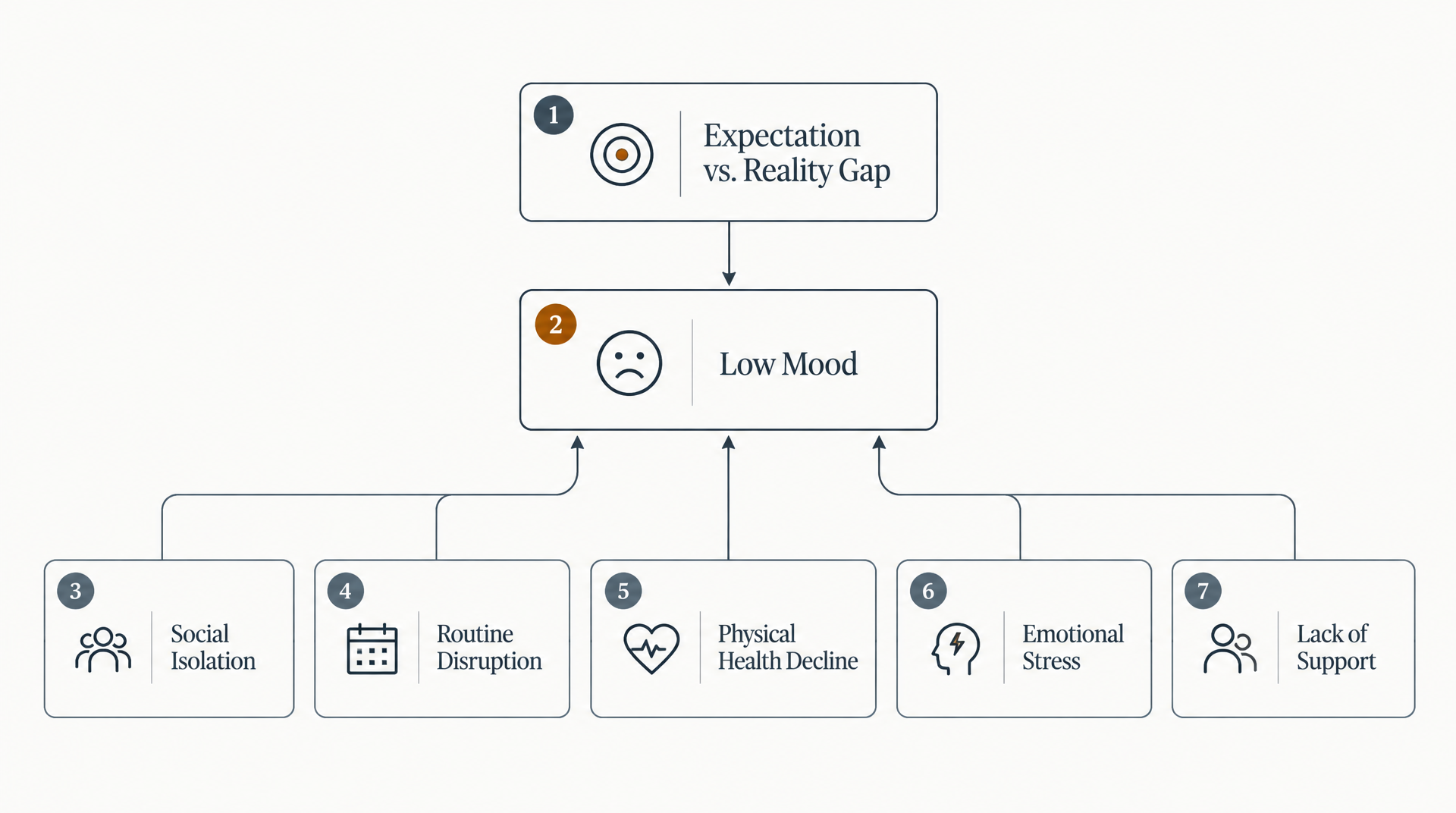
Most people leave treatment expecting relief. What they often get within days is a flat, joyless heaviness that feels like a betrayal. That gap between expectation and reality is the first thing we name with clients, because the low mood almost always has a cause you can point to. It is rarely random, and it is rarely a sign you did recovery wrong.
Low mood in this period usually comes from several mechanisms stacking at once: a depleted brain, a vanished routine, a shaken sense of who you are, and a support network that shrank the day you got home. Figuring out which ones are hitting you changes what actually helps.
Your Brain Is Running on Empty
During active use, substances hijacked the reward system. The drug flooded the brain with dopamine, so the brain stopped making its own. Pull the substance and you are left with a reward system that produces almost nothing, which is why life feels dull and pleasureless for a stretch. Brevard's overview of post-substance depression treats this flatness as a common part of the picture rather than a personal failing, and it can linger while the brain rebalances.
This is the same tension covered above, and both sides hold: neurochemistry sets your vulnerability, and what you do with your days decides whether that vulnerability hardens into a depressive episode or lifts as the brain recovers.
The Rehab Bubble Pops
Treatment hands you a full schedule. Meals, sessions, peers, accountability, all built in. Then you go home and it evaporates overnight. That vacuum is disorienting, and empty time is where low mood breeds.
There is an identity piece underneath it too. Rehab gave you a role. Now you are rebuilding who you are without the substance and without the structure, and that reconstruction carries real emotional weight. Redefining yourself beyond the label beats white-knuckling through it. Treat the substance alone and skip that work, though, and you risk the dry drunk pattern: sober, but stuck.
Isolation Fills the Gap Support Left
The cruel part is the timing. Your brain is at its emptiest exactly when your support drops off and old stressors come flooding back. Losing professional and peer contact too soon tracks with both worsening mood and relapse, per Trust SoCal's aftercare analysis.
No source names the fix for that specific gap, but it is clear once you see it. This transition, especially a move, a new job, or travel, is the exact stretch we cover by pairing clients with a sober companion. Someone present when the structure is gone and the isolation would otherwise win.
Immediate Self‑Help Strategies to Lift Mood
The sections above explain why low mood shows up after rehab. This part is about what you can do with it today, before a single appointment gets booked. None of these tactics require medication, and most cost nothing.
The frame is simple. Chemistry sets the vulnerability, but your daily behavior decides whether it hardens into something clinical. The routines below are how you tilt the odds back.
A Morning Anchor Beats an Empty Schedule
The single riskiest thing about leaving treatment is the vanished structure. In rehab, someone else built your day. At home, that scaffolding disappears overnight, and idle time is where low mood festers.
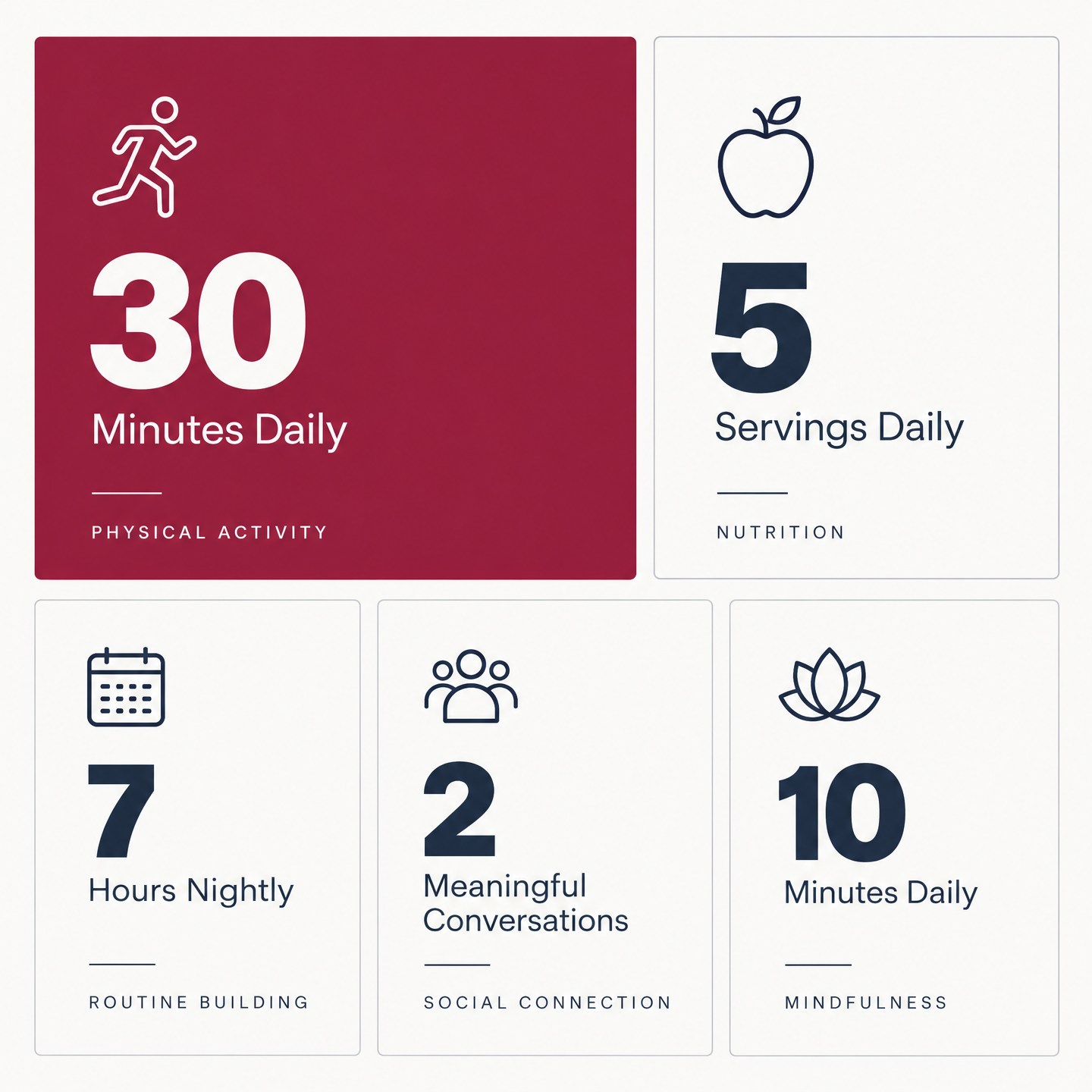
We start clients with a morning anchor: two or three fixed actions in the first hour awake, done at the same time daily. Bed made, feet outside for five minutes, one glass of water before coffee. Small, repeatable, non-negotiable. A consistent routine reduces anxiety and returns a sense of control when everything else feels unmoored.
This is also the piece a sober companion covers directly. During a move, a job change, or travel, we hold the anchor steady when the environment around you is anything but.
Movement Is the Fastest Lever You Have
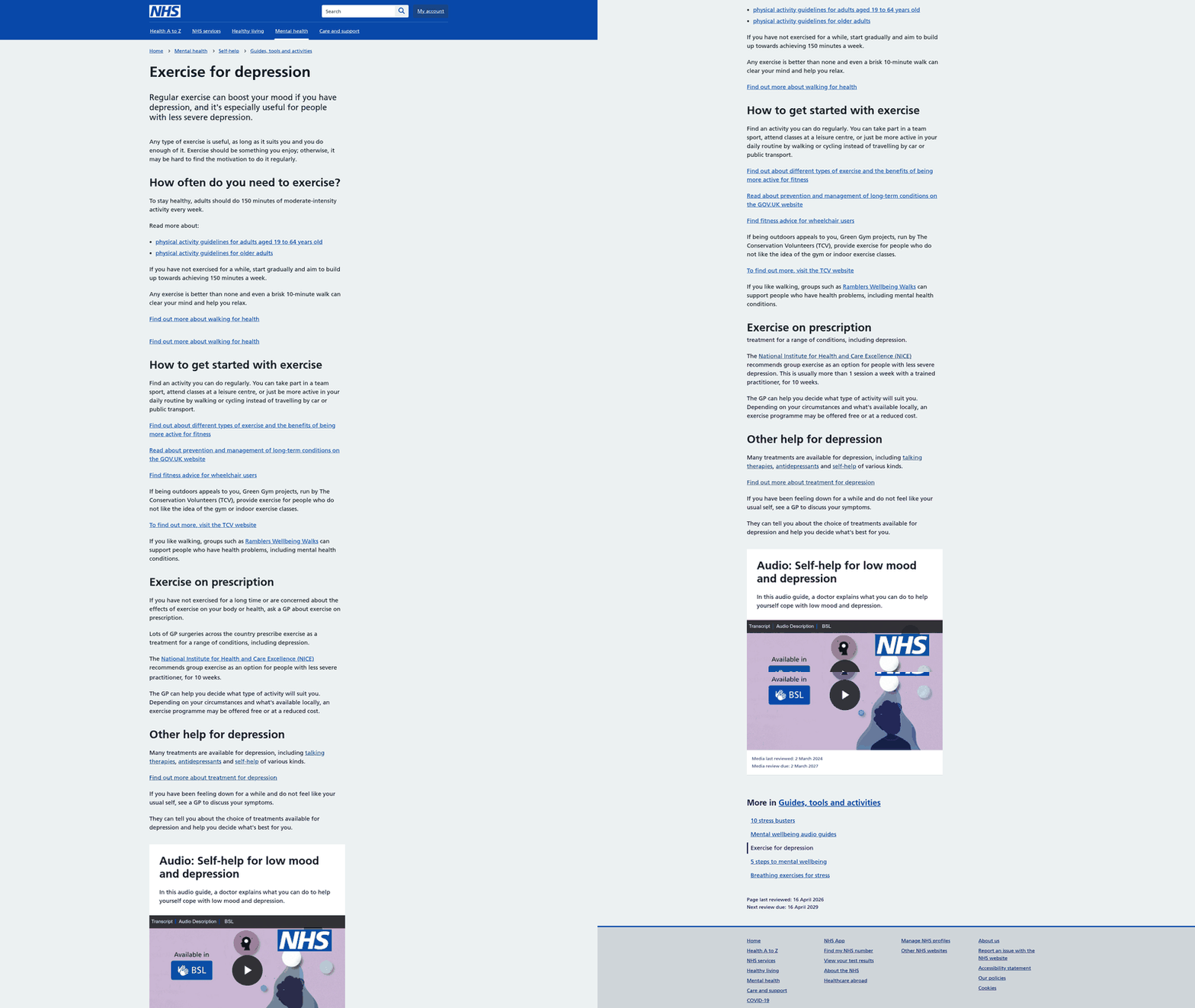
If you do one thing from this list, make it this. Thirty minutes of moderate exercise, three to five times a week, is one of the most accessible mood levers you have. That is not a wellness cliché. It is something you can self-administer.
You do not need a gym. A brisk walk counts. Physical activity drives up the feel-good chemicals your depleted brain is struggling to produce on its own.
Pair it with the basics that support the same system: whole grains, lean protein, fruit, and vegetables to steady your energy, plus protected sleep. Prioritizing your hunger, your rest, and your movement is what connecting with yourself actually looks like on a Tuesday.
Ground Yourself When the Spiral Starts
For the acute moments, when anxious thoughts start running, a simple grounding technique can help: the 5-4-3-2-1 method. Name five things you can see, four you can touch, three you can hear, two you can smell, one you can taste. It pulls you out of the spiral and back into the present. No equipment, works anywhere.
None of this replaces professional care, and it is not meant to. If your low mood keeps deepening despite doing these things, that is the signal to bring in a clinician. But for the first weeks home, a coaching-plus-structure approach is a defensible starting point, not a consolation prize.
When to Bring In a Therapist or Prescriber
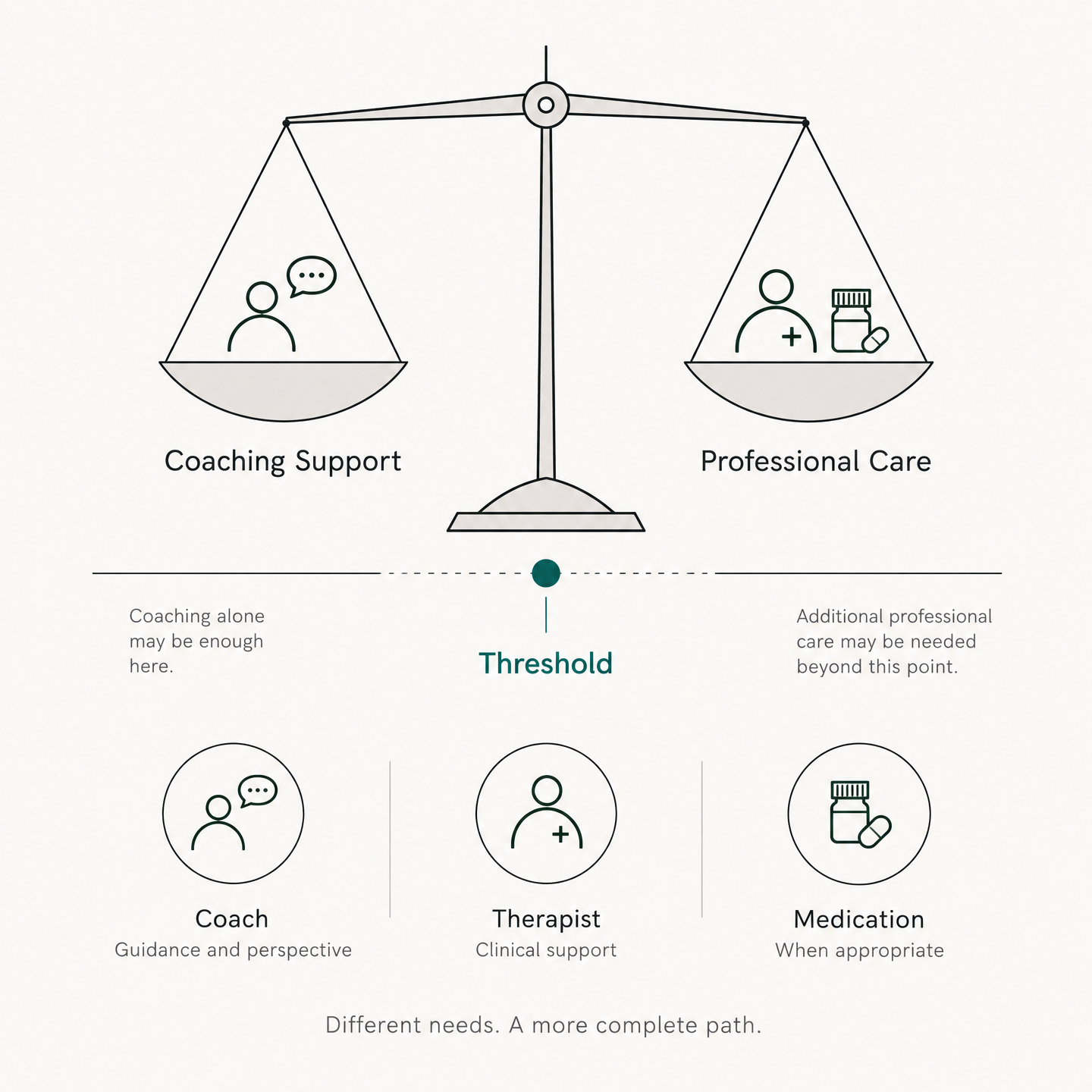
Coaching does a lot in the after-rehab window, but it has a ceiling. There is a point where low mood stops responding to routine, connection, and physical activity, and that is the moment to bring in a licensed therapist or a prescriber. We are clear about what our support is and isn't, and we encourage clients to connect with the right professional rather than white-knuckle a depression that needs clinical care.
We are a nonmedical recovery support team. We do not diagnose, prescribe, or provide therapy. What we do is provide steady accountability and human connection, and encourage clients to reach out to a qualified professional when mood isn't lifting.
When Does Low Mood Cross Into Clinical Territory?
Watch for three things. Symptoms that dig in for more than two weeks without lifting. Functioning that keeps collapsing rather than rebuilding. And any thought of self-harm, which is never something to sit on.
If that is where your head is, call 988 or go to an emergency room now. Coaching is not the right tool for an active crisis, and neither of us should pretend it is.
Sequential or Integrated Care: Which Path Fits You?
Here the evidence splits, and it is worth understanding why. The clinical meta-analysis by Nunes and Levin argues for a sequential approach: stabilize sobriety, watch mood for a week or two, and add an antidepressant only if depression persists. Structured psychosocial support often reduced the need for medication at all.
The dual-diagnosis view pushes back. One clinic frames co-occurring disorders as conditions that don't run side by side but combine into a single, stronger disorder, arguing they can't be untangled and treated one after the other.
Both are right, depending on you. If your low mood tracks with post-acute withdrawal and started after you left treatment, the sequential path fits. If depression predated your substance use and fused with it, you likely need integrated care from the start. Sorting out which path fits is a conversation for you and your clinician.
How Do Coaching and Clinical Care Work Together?
When medication enters the picture, adherence is where people fall down. As one aftercare team puts it, medication for depression in recovery "is not a crutch or a sign of failure." Our role is to hold the daily structure around you, providing companionship and consistent support through life transitions like a move, a new job, or travel that pulls you away from your support network.

Losing professional support too early tracks with both worsening depression and relapse, and a sober companion is built to cover that gap. We handle the daily structure and the isolation. The therapist and prescriber handle the clinical work. That division of labor is the whole point of collaborative recovery support.
References
[1] Dry Drunk Syndrome: Sober But Miserable - Discovery Institute - https://www.discoverynj.org/sober-miserable-dry-drunk-syndrome/
[2] 10 Tips for Managing Depression in Your Sobriety Journey | KY - https://www.sterlingcrossroads.org/recovery-blog/does-getting-sober-cause-depression/
[3] How Common is Feeling Depressed After Substance Abuse? - https://www.brevardhealth.org/blog/how-common-is-feeling-depressed-after-substance-abuse/
[4] Depression After Rehab: Post-Treatment Mental Health ... - https://www.trustsocal.com/blog/depression-after-rehab-post-treatment-mental-health
[5] Blog – Depression after rehab | Main Line Health - https://www.mainlinehealth.org/blog/depression-after-rehab
[6] Dealing with the Varying Emotions After Rehab - https://www.ukat.co.uk/help-guides/dealing-with-the-varying-emotions-after-rehab/
[7] Chapter 1 - Managing Depressive Symptoms in Substance Abuse ... - https://www.ncbi.nlm.nih.gov/books/NBK572969/
[8] Treatment of Co-occurring Depression and Substance Dependence - PMC - https://pmc.ncbi.nlm.nih.gov/articles/PMC2722074/
Frequently Asked Questions
Should I start antidepressants right away, or wait to see if my mood lifts on its own?
The evidence splits. The Nunes and Levin meta-analysis favors a sequential path: stabilize sobriety, watch mood for a week or two, and add an antidepressant only if depression persists. That call belongs with a qualified prescriber.
How long does post-rehab low mood usually last before I should worry?
Post-acute withdrawal can keep low mood, emptiness, and anhedonia running for weeks to months, and some symptoms linger a year or longer while the dopamine system relearns to fire. The worry line is trajectory: if it holds past two weeks with no upward drift, involve a professional.
What if my depression shows up as anger or restlessness instead of sadness?
Depression after rehab often does not look sad. Men frequently route it through escapism, anger, and physical complaints, while women more often show persistent low mood and withdrawal. Families watching for tears miss the irritable version, which can also signal a "dry drunk" pattern of untreated depression.
Can a sober companion diagnose or treat my depression?
A sober companion cannot. MADE Recovery is a nonmedical support team that does not diagnose, prescribe, or provide therapy. What we do is hold your routine steady during the transition out, catch the trend early, and help you reach the right clinician before low mood becomes relapse.
Is exercise really enough to handle depression in early recovery?
Movement is one of the fastest mood levers you have, roughly 30 minutes of moderate activity three to five times a week, and it drives up feel-good chemicals your depleted brain struggles to make. But if low mood keeps deepening despite it, that is your cue to bring in a clinician.