Six Sober Coaching Credentials and What Each Actually Prepares You For
August 10, 2026
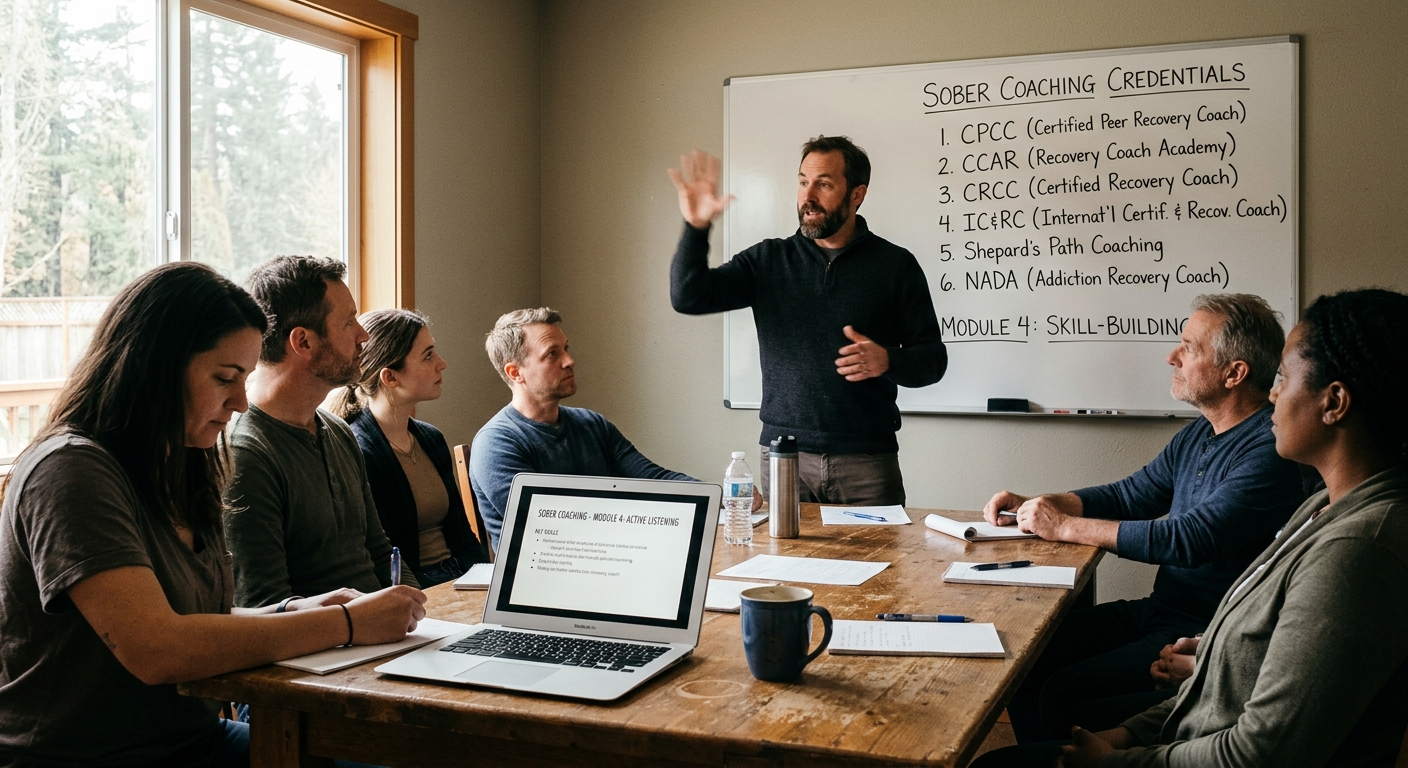
Key Takeaways
- A state-certified peer credential lets you bill Medicaid for sober coaching at code H0038, paid per 15-minute unit. An independent certification opens private practice, where coaches charge $50 to $150 an hour.
- Roughly 48.5 million Americans dealt with a substance use disorder in the past year. That's the demand behind every credential on this list.
- SAMHSA counts over 30,000 active peer support workers in the behavioral health workforce, so this isn't a fringe role anymore.
- State peer certs usually require one to two years of documented personal recovery. CCAR's RCP accepts family members and allies with no lived experience at all.
- Credentialed coaches fill the handoff after detox or residential care, the exact point where people slip through the cracks.
- The credential you pick decides your earning ceiling, your regulatory rulebook, and who you're allowed to serve.
- The lived-experience requirement splits the field into two career paths with different philosophies and different markets.
Two economies, one job title
The credential you choose decides which of two separate economies you can work in. A state-certified peer credential lets you bill Medicaid for sober coaching through code H0038, reimbursed per 15-minute unit. An independent credential like CCAR's RCP opens private practice, where coaches charge $50 to $150 an hour according to this certification guide. Same title. Two paychecks. Two rulebooks.
The demand under both is real. Rising substance use disorder rates have strained traditional treatment systems, which is why organizations keep pulling peer support workers into the behavioral health workforce. Credentialed coaches fill one specific gap: the handoff after detox or residential care, when people are trying to get back to daily life without much structure holding them up.
Do you actually need lived experience?
It depends on who's issuing the credential. State-issued peer certs usually want a documented stretch of personal recovery, on the theory that shared experience is the point. Independent credentials go the other way, training allies and family members and treating personal history as separate from professional qualification. Neither is wrong. They're built for different coaching philosophies and different markets.
Which credential fits which goal?
Match the credential to the setting. Want hospital or justice-system work and Medicaid billing? Start with a state peer cert, then stack CCAR's specialty modules. Want private-pay clients and room to move? An independent credential travels better across state lines.
| Credential | Training Hours | Cost | Best For | Difficulty | Lived Experience Required |
|---|---|---|---|---|---|
| CCAR RCP | 60 hrs | $149 or $1,200 package | National recognition, ER & justice settings | Moderate | No |
| ASU Professional Recovery Coach | 60 hrs (self-paced, ~6 mo) | Varies | Career changers, IAPRC certification | Moderate | No |
| SHE RECOVERS Coach | 12.5 hrs (self-paced) | Varies | Coaching women, trauma-informed work | Low | No |
| State Peer Cert | 40–100+ hrs | State-dependent | Medicaid-billable peer roles | Moderate–High | Usually yes |
The CCAR RCP designation has trained over 110,000 people worldwide and stacks a 30-hour academy, 16 hours of ethics, and 14 elective CE hours. The SHE RECOVERS program has graduated over 200 coaches since 2017 through a tighter, women-focused 12.5-hour curriculum.
Skip the pricey all-inclusive package if you already have recovery training and just need the credential. If you only want to support one family member, a full certification is overkill. A beginner's coaching webinar worth 1.5 CE hours gives you the conversation tools without the commitment.
Certified Recovery Coach (CRC) Credential
The CCAR Recovery Coach Professional (RCP) is a fixture in the peer recovery world. Employers know it. But know what it is: a training certificate, not a state-issued license. Finishing the program does not, on its own, let you bill public insurance. People miss that distinction and it costs them.
What the RCP training actually covers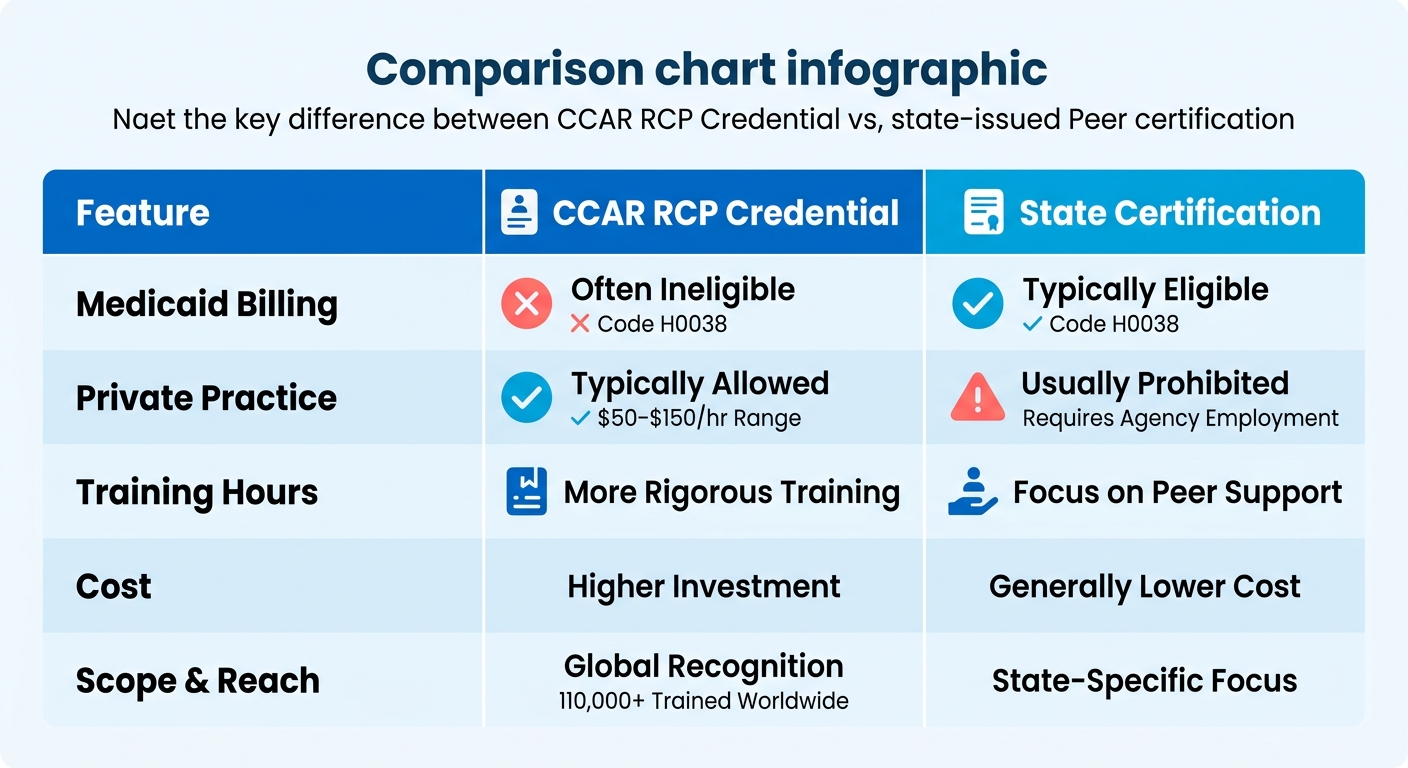
The curriculum builds core competencies in non-clinical support: foundational coaching principles, ethical boundaries, then specialized electives. The electives let you focus on specific environments, like emergency departments, where coaches meet people right after an overdose, or justice settings, where the challenge is helping someone transition out of incarceration.
The whole thing centers on non-clinical peer support, not assessment or treatment planning. You learn to help someone set recovery goals, manage resources, and stay accountable. You're not diagnosing. You're not writing treatment plans. That boundary is the spine of the training, and the ethics module comes back to it again and again.
The two economies this credential opens
For state-funded work, the RCP is a stepping stone, not a finish line. State boards that oversee reimbursement want more: documented personal recovery, state-specific legal training, sometimes both. In the private sector, the same credential does different work, signaling formal training to clients paying out of pocket. Plenty of coaches run both, mixing agency hours with private clients to keep income steady.
Who can get the RCP
It is open to allies, family members, and professionals with no personal history of addiction. The approach teaches support skills rather than validating a particular identity. Renewal runs every two years through continuing education, which keeps coaches current on harm reduction and medication-assisted recovery.
Where this credential falls short
It does not qualify you to perform clinical assessments, diagnose mental health conditions, or design treatment plans. Strictly peer support. Entry-level roles in that lane typically pay $25,000 to $45,000 a year. Local rules add wrinkles, too. The Maine Recovery Coach Certification Board, for instance, requires state-specific modules on top of the national curriculum.
How the RCP lines up with transitional coaching
The RCP's focus on non-clinical peer support mirrors how MADE Recovery structures sober coaching: clear boundaries, accountability, resource navigation, not clinical intervention. That matters in transitional work, where the goal is bridging treatment and independence with guidance and real human connection. The credential's specialty tracks, like the emergency department module, speak to the same crisis moments MADE handles through intervention and crisis management, helping families plan detox and treatment pathways without placement.
A credential like the RCP gives you a foundation. The real work takes more. MADE's programs can include coordination with nursing support, grocery shopping, meal prep, and day-to-day life management, and that support tapers on purpose as clients find their footing. The RCP covers the fundamentals. Applying them inside a customized, team-based program, and knowing when a client needs a higher level of care than coaching can give, takes practice well past the 60 hours.
National Sober Living Association Certified Coach (NSLAC) Credential
The National Sober Living Association's credentials come up less than CCAR or the state certs, and for a reason. NSLA works a narrower slice of the sober coaching market. It offers two: the Certified Coach (NSLAC) and the Sober Living Association Certified (SLAC). Both center on the operational and ethical frameworks for running sober living environments, not the broader coaching skill set. If you plan to work inside a sober living house or manage one, these teach the compliance side. If you plan to coach clients in private practice or clinical settings, they won't prepare you.
What the NSLAC credential actually covers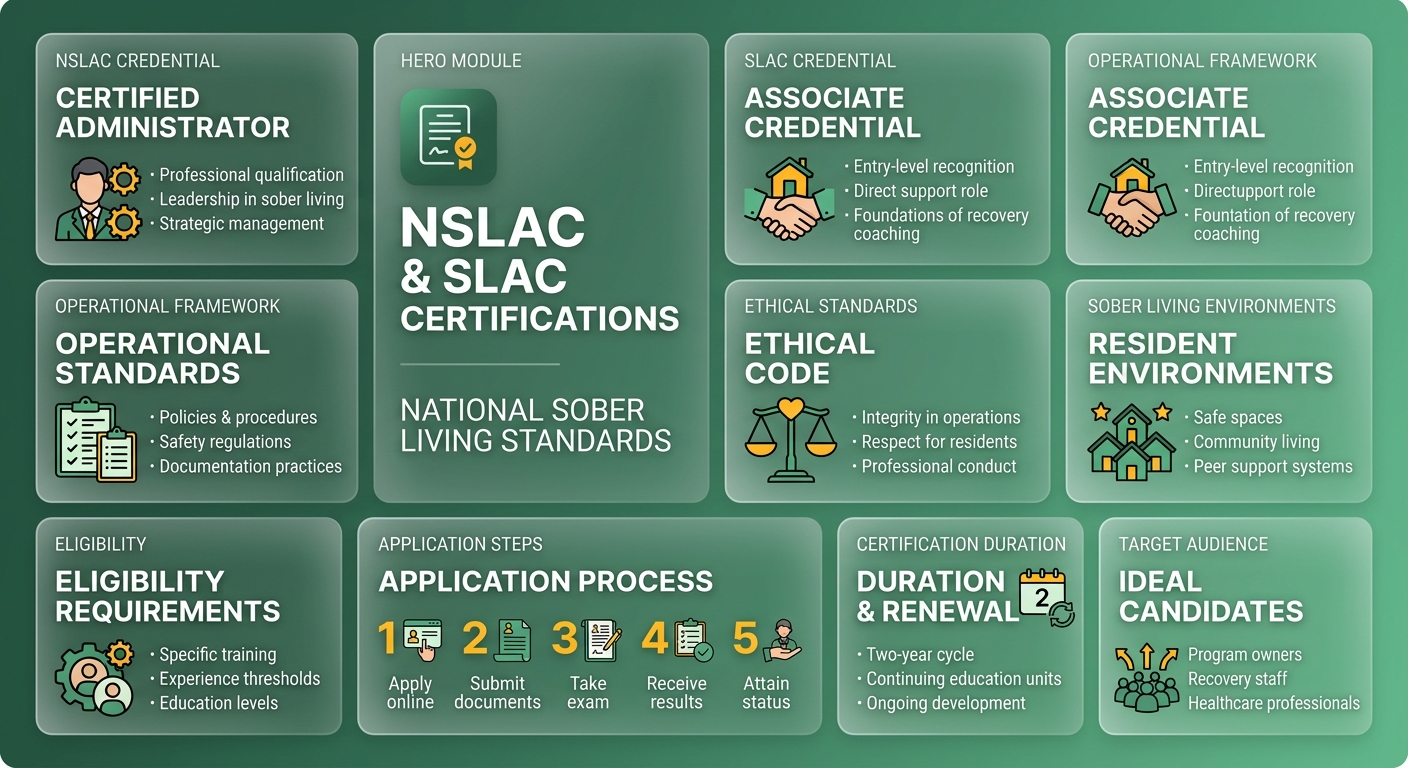
The NSLAC curriculum is about running a safe, compliant recovery residence. Fair housing laws, zoning regulations, emergency protocols, resident rights. Unlike peer-focused certs, it doesn't teach clinical communication or individual recovery planning. Because it's administrative, it doesn't line up with the billing rules for state-funded peer support, which require direct client-care hours and supervised practice.
It runs about 30 hours covering house operations, safety protocols, and the ethical boundaries that keep a sober living setting from sliding into exploitation or coercion. You take an exam on those operational standards. No supervised practice, no lived-experience requirement, which sets it apart from state peer credentials that gate on both. The point is compliance literacy, not peer support.
NSLAC holders usually work as house managers, intake coordinators, or compliance monitors. The credential doesn't open Medicaid billing because it doesn't meet the state-specific peer support definitions tied to H0038. Per Behave Health's certification guide, all 50 states now cover peer support through Medicaid, but those billable services need state-issued credentials with supervised practice and lived experience. The NSLAC has neither.
The SLAC credential and where it fits
SLAC is the entry-level version. It has fewer training hours and covers the basics of sober living operations without the deeper compliance frameworks. It is a foundational intro for staff who need to understand house rules, resident safety, and basic ethical boundaries but aren't running the facility. Shorter exam, lighter renewal.
SLAC holders work in support roles inside sober living houses: peer mentors, resident assistants, intake staff who help with the day-to-day. The credential won't prepare you to design recovery plans, facilitate groups, or move clients through external treatment systems. It teaches you how to keep a safe, structured living environment. Useful work. Just not the broader coaching role that CCAR's RCP or a state cert prepares you for.
Both NSLAC and SLAC renew annually through CE hours on updated regulations, safety protocols, and ethical standards. No recertification exam, just documentation that you finished the required training. That keeps holders current on fair housing updates and evolving compliance standards, which matters when state auditors or licensing boards walk through a facility.
When to skip these credentials
If your goal is individual coaching in private practice or clinical settings, these residential credentials won't get you there. They skip the motivational interviewing and goal-setting you'd find in broader peer programs. And because sober living homes run on a housing-rental model rather than a clinical service model, these certs don't qualify you for insurance reimbursement.
Skip them, too, if you need Medicaid billing. Sober living facilities generally operate as private-pay housing, not billable treatment. NSLAC and SLAC don't meet the state peer support requirements tied to H0038. If your income depends on insurance billing, get a state-issued credential instead. Private-pay sober living has its own financial logic, residents pay monthly rent rather than per-session fees, but it doesn't plug into the Medicaid-funded peer support economy now running in all 50 states.
Certified Addiction Recovery Coach (CARC) Credential
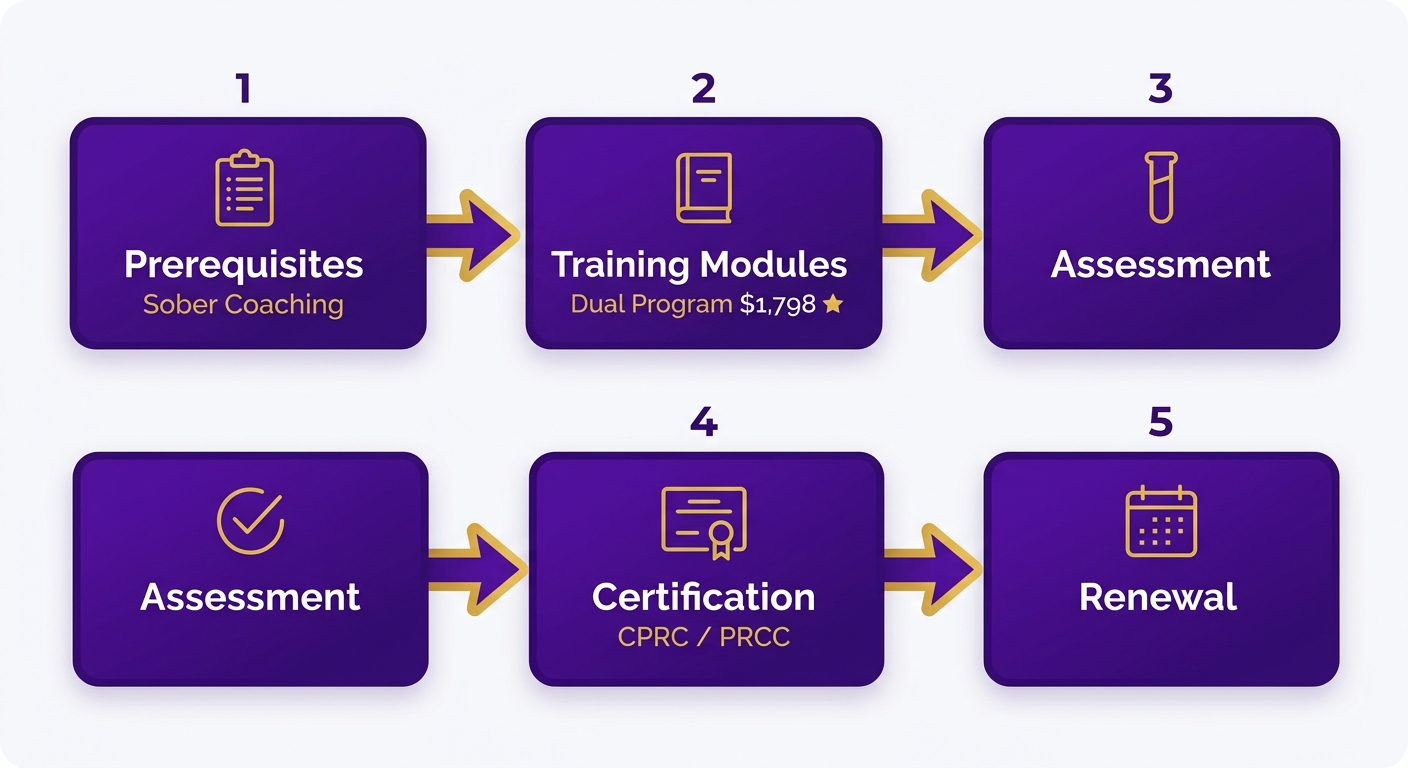
The International Association of Professional Recovery Coaches (IAPRC) offers the Certified Professional Recovery Coach (CPRC) and the Professional Recovery Coaching Certification (PRCC). The CPRC Dual Program runs $1,798 and combines recovery coaching with general life coaching methods. It's built for people who want a private practice without state-level peer requirements or lived-experience mandates hanging over them.
What the IAPRC training actually covers
The PRCC program is self-paced and runs roughly 80 hours across seven modules, per IAPRC's course description. The curriculum covers the neuroscience of addiction and recovery, motivational interviewing, and relapse prevention planning. The CPRC Dual Program adds 40 CE credits approved by the National Board for Health and Wellness Coaching, which matters if you're eyeing a broader wellness coaching credential later. The content leans coaching methodology over peer support, so you're learning goal-setting and accountability structures more than lived-experience storytelling.
IAPRC coaches usually land in private practice, corporate wellness, or treatment centers that don't require state certification. The training emphasizes one-on-one relationships over group facilitation, which fits how most private-practice coaches structure their services. Many package their work as monthly retainers or multi-session bundles instead of billing per session. That makes income more predictable but leans hard on your ability to bring clients in the door.
Where the IAPRC credential falls short
Because the curriculum is built around private business development and general coaching, state agencies, hospital systems, and community organizations rarely recognize it. Those settings favor curricula tied to national peer support standards, which makes this program a poor fit for traditional behavioral health roles.
The IAPRC credential fits coaches building a private practice who don't need Medicaid billing. It won't replace a state peer cert, and it won't open the institutional roles where most of the workforce demand sits. Choosing between IAPRC and CCAR comes down to one question: are you targeting the peer support economy or the independent coaching economy? That answer decides which credential actually prepares you for the work you want.
What MADE Recovery coaching looks like in practice
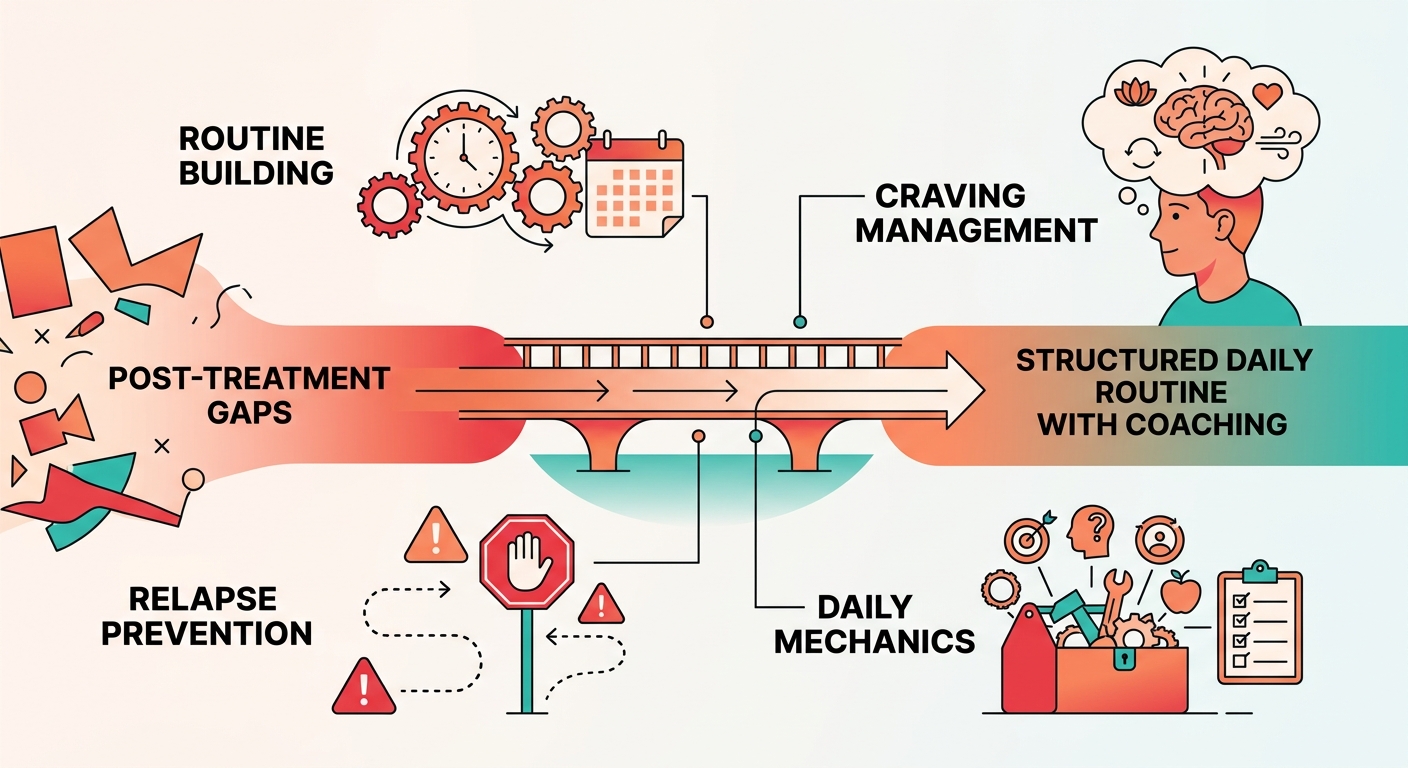
We built our sober coaching program around something we kept watching happen in aftercare: people left treatment knowing the theory but couldn't translate it into the daily mechanics of staying sober. Our coaches work one-on-one with clients coming out of detox or residential programs, focused on the operational gaps most treatment centers don't have time for. How to rebuild a routine. How to manage cravings in real environments. How to spot relapse patterns before they escalate.
The core is accountability paired with real-time support, not once-a-month contact. That frequency matters when you're three weeks out and your old social circle starts calling. We map specific scenarios with clients: what to do when you walk past your old bar, how to handle a family member who doesn't believe you're serious this time, how to fill the hours you used to spend using. Tactical, not theoretical.
What we actually do
Each client gets a dedicated coach, or a coordinated team when the level of care calls for it. These aren't therapists delivering clinical treatment. They're guides who help you execute the recovery plan your treatment team built. Sessions run in person or virtually, depending on your location and schedule. Every program is tailored to the individual, and as clients gain independence, the support tapers on purpose to build self-sufficiency. When it's part of the plan, we work with families too, helping relatives see the difference between supportive involvement and the kind that quietly sabotages.
The coaching covers practical skill-building: managing triggers, building a sober social network, handling the employment or housing problems that create relapse risk, and setting up daily structures that cut down on decision fatigue. Routine building is central, because the transition back to everyday life is exactly where structure tends to fall away. Clients tell us the ongoing check-ins create a rhythm that keeps them anchored when motivation dips.
How we're different from a credential
This isn't a certification path. It's a service. If you're comparing us to CCAR or a state peer credential, you're looking at two different categories. Those credentials prepare you to become a coach. We provide coaching to people in recovery. Clients sometimes ask what credentials our coaches hold, and fair question, but the credential alone doesn't decide whether the coaching works for you. What decides it is whether the coach understands your situation and shows up consistently.
Choosing the right credential for your career
Picking a credential means matching your training investment to your business model. The field splits between public-sector roles and independent practice, and that split shapes your daily work, your client mix, and the paperwork you'll be doing.
State-funded agency work offers stability, structured supervision, and a steady flow of referrals, along with consistent hours and benefits. An independent practice offers more autonomy and control over your schedule, but you own the marketing, the client acquisition, and the business operations yourself.
Does sober coaching require lived experience?
Your history is the biggest factor in which pathways are open. Without personal experience of addiction recovery, you'll focus on independent certifications that evaluate skills rather than background. With lived experience, state-approved pathways give you a direct route into the public health workforce.
Matching the credential to your client and goal
Start with who you want to serve, then work backward to the training. A coach aiming for hospital or justice-system placements needs different preparation than one building a private caseload. Here's how the main paths line up.
| Path | Best For | Training Load | Where It Leads |
|---|---|---|---|
| CCAR RCP | Emergency dept & justice settings | 60 hours | National recognition, peer or private work |
| State peer certification | Medicaid-billable roles | 40-100+ hours (varies) | Salaried behavioral-health jobs |
| IAPRC PRCC | Private-practice coaching | ~80 hours self-paced | Independent client work |
| MADE Recovery (aftercare) | Post-treatment 1:1 support | N/A (service, not credential) | Real-time relapse-prevention coaching |
Align the training with the population you want to serve. Supporting people right after residential treatment, for instance, demands a focus on real-time relapse prevention and daily structure. Read each program's curriculum closely and confirm it covers the scenarios you'll actually hit in your niche.
Write the plan down
Pick your economy, confirm your state's lived-experience rules, and match the training hours to a realistic budget. Want faster billable income? Skip the private-coaching bundles and go straight for state peer certification. Want autonomy and higher hourly rates? Invest in an independent credential and build a referral network. One clear path beats three half-finished ones.
Maintaining and renewing credentials
Credentials need upkeep to stay valid. Let one lapse and you can lose the ability to practice or even advertise your services. Every credentialing body runs its own schedule, so track your renewal dates and requirements from day one.
The process depends on what you hold. State boards enforce strict compliance tied to public funding. National organizations focus on continuing education inside the coaching scope. Knowing the difference keeps you from opening an administrative gap that hits your employment.
How do continuing education requirements work?
CE is the core of every renewal. You bank a set number of credit hours over your cycle, then submit proof before the expiration date. Many issuers let you split those hours across formats, mixing live workshops, ethics modules, and documented supervision, so build a mix that fits your calendar instead of cramming one course at the deadline.
State boards pile their own demands on top. The Behave Health guide notes that pathways like NAADAC's NCPRSS and various state certifications each carry their own training-hour and exam requirements. A CE course one board accepts may not count for another. Check acceptance before you pay, not after.
What happens if you don't renew?
Non-renewal hits your income first. A lapsed state peer certification can suspend your ability to bill H0038, the code tied to peer support services. No active credential, no billable units. For private-practice coaches, an expired national credential means you can no longer market yourself under that title honestly.
One useful detail: CCAR keeps certification records for six years, per its certification page. Lapse but reapply inside that window and your history is still on file, which can smooth reinstatement. Don't treat it as a safety net, though. Renewing on time beats rebuilding from scratch.
Renewal at a glance
| Credential type | Renewal cycle | CE source | Main risk if lapsed |
|---|---|---|---|
| CCAR RCP (national) | 2 years | CCAR courses, supplemental CE | Loss of RCP title, restart process |
| State peer certification | Board-defined | State-approved CE + audits | Suspended H0038 billing |
| Independent coaching (IAPRC-style) | Issuer-defined | Coaching-focused CE | Can't advertise credential |
An organized record of your training hours is your best defense against audit trouble. As state regulations shift and new licensing boards appear, detailed documentation lets you adapt fast to changing compliance standards in your region.
Set a calendar reminder ninety days before expiration. That buffer gives you time to finish missing hours without scrambling, and it keeps your sober coaching practice running without a gap in either economy you work in.
What I'd actually recommend
Which credential to pursue comes down to your long-term goals. Match the training to the work environment you want, and you skip wasted money while building the skills your clients will lean on.
Across the six credentials here, none wins for everyone. Each was built for a specific setting, and the wrong pick costs you time and money you won't get back. Here's how they stack up.
| Credential | Best for | Watch-out |
|---|---|---|
| State-certified peer | Medicaid-billable peer roles | Rules vary by state board |
| CCAR RCP | Nationally recognized entry, private practice | Not a state license on its own |
| IAPRC (CPRC/PRCC) | Blending life coaching with recovery support | Higher upfront cost, no Medicaid |
| NSLAC / SLAC | Working inside or running a sober living house | Narrow; won't prep you for clinical settings |
| SHE RECOVERS | Coaches focused on women's recovery communities | Community-specific scope |
How should you choose your sober coaching path?
Start by naming your target employer or client base. Planning to work inside established healthcare networks? Prioritize programs that meet state requirements. Want to operate independently? Pick a program with solid business and coaching tools. Finish one credential fully before you chase specializations.
If you're still deciding whether coaching is even the right support model before you commit to a credential, our take on why sober coaching beats going it alone after rehab lays out where this work earns its keep. Then pick the path that gets you into that room.
References
[1] CCAR Recovery Coach Professional (RCP) Designation - https://addictionrecoverytraining.org/rcp/
[2] Recovery Coach Certification Guide - Behave Health - https://behavehealth.com/blog/recovery-coach-certification-career-guide
[3] Professional Recovery Coach - Arizona State University - https://careertraining.careercatalyst.asu.edu/training-programs/professional-recovery-coach/
[4] Recovery Coach Certification Program - SHE RECOVERS® Foundation - https://sherecovers.org/recovery-coach-certification/
[5] International Association of Professional Recovery Coaches ... - https://iaprc.org/
[6] Peer Recovery Support Series, Part 1: A Beginner's Guide to Coaching ... - https://www.naadac.org/beginners-guide-to-coaching-recovery
[7] Certification - CCAR Training - https://addictionrecoverytraining.org/certification/
[8] Addiction Recovery Coaching: Training & Certification Guide - https://lifecoachingcertification.net/specializations/addiction-recovery-coaching/
Frequently Asked Questions
1. Can I bill Medicaid with just a CCAR RCP credential, or do I need state certification too?
No, the RCP designation is a training certificate rather than a state-issued license. To bill public insurance, you must apply to your state's credentialing board, which will require additional documentation, state-specific legal training, and proof of supervised practice hours.
2. What happens if I complete a credential but my state requires lived recovery experience I don't have?
You can focus your career on the private-pay sector or corporate wellness environments. Many organizations and private clients do not require state-issued peer credentials, allowing you to practice using independent certifications that validate your coaching skills rather than your personal history.
3. Which credential actually prepares me to work in emergency departments or justice settings?
The CCAR curriculum offers specialized elective modules specifically designed for these environments. These courses prepare coaches to navigate the unique protocols of hospital emergency rooms and correctional facilities, areas that general coaching programs typically do not cover.
4. If I already work as a therapist, does getting a recovery coach credential help or confuse my professional boundaries?
Recovery coaching credentials emphasize non-clinical peer support, which operates under different boundaries than therapy. The CCAR ethics module and state certification training explicitly address this boundary to prevent role confusion. IAPRC credentials skip peer-specific ethics, which creates risk if you're moving between clinical and coaching roles.
5. How do coaches actually make money if most entry-level roles only pay $25,000-$45,000 annually?
Many professionals combine salaried positions at treatment facilities with a private client base. This hybrid model provides a stable financial foundation while allowing coaches to build their independent brand and increase their overall earning potential over time.
6. Do credentials expire, and what does renewal actually require?
Yes, most professional designations require periodic renewal. This process typically involves submitting proof of continuing education hours completed during the credential cycle to ensure you remain current on industry standards and ethical guidelines.