Why Sober Coaching Beats Going It Alone After Rehab
July 28, 2026

Key Takeaways
- Roughly 65% to 70% of people relapse within the first 90 days after treatment. That window is the most dangerous stretch in recovery.
- Caron Treatment Centers report a 95% recovery rate at 30 days post-treatment among clients paired with a sober coach, compared with those handling the transition on their own.
- A meta-analysis of 28 studies covering 12,601 participants found peer recovery support reliably improves treatment engagement and retention. Its direct effect on substance use is less settled.
- Coaching's main value is indirect. It keeps people showing up for the outpatient therapy and meetings they'd otherwise skip. It's connective tissue, not a cure.
- Solo recovery usually fails on follow-through, not on knowledge. People know what to do. Doing it under pressure is the problem.
- Coaching fits best when someone already has the recovery tools but needs structure to use them outside a supervised setting.
- The gap between inpatient supervision and independent daily life is structural, not informational. That gap is exactly what coaching is built to close.
Quick Summary
Sober coaching beats going it alone because the weeks right after treatment are when most recoveries fall apart. Moving from supervised inpatient care to real life leaves a structural gap. A dedicated coach fills it.
For anyone searching for drug addiction help that outlasts a 28-day program, the evidence points one direction: people don't fail because they lack knowledge. They fail because follow-through collapses under pressure.
What actually helps people stay sober?
Early recovery numbers from individual providers look strong, but broader clinical data tells a more measured story. A review of peer recovery support found these services reliably improve treatment engagement and retention, even where long-term substance use outcomes still need more study.
That tracks with how coaching actually works. The mechanism is indirect. Coaches get clients to the outpatient appointment they'd otherwise blow off, or ride along to a support meeting. The coaching keeps proven clinical work in place. It isn't the clinical work itself.
Why solo recovery breaks down so fast
Futures Recovery Healthcare describes the fit well: coaching works best when someone already knows what to do but struggles to follow through. That's most people walking out of a residential program.
Treatment enforces the right behaviors from the outside. Back home, that structure vanishes. Decision fatigue sets in fast. The distance between knowing and doing turns into a relapse.
We see it constantly. People stepping down from residential care get overwhelmed once the scaffolding drops away. A coach rebuilds that external structure while the client's internal stability catches up.
When sober coaching is the wrong tool
Coaching is nonclinical. If someone has unmet psychiatric needs, needs medication management, or needs trauma processing, coaching alone won't cut it. Don't use it as a stand-in for those services.
Where it earns its keep is the ground therapy doesn't cover: building a daily routine, getting through a work event where the drinks are flowing, staying steady at 10pm on a Tuesday when no clinician is on call. A well-structured engagement can run from a few hours a week to something close to full-time, depending on where someone is.
Good programs taper on purpose. As clients build independence, support pulls back. That's not abandonment. That's the goal.
The reality of the post-rehab cliff
The transition out of treatment is the sharpest edge in recovery, and the numbers say so. Between 65% and 70% of people relapse in the first 90 days after they leave. Not because they forgot what they learned. Because the environment that held them accountable is gone.
The contrast is stark when support stays in place. Caron Treatment Centers report a 95% recovery rate at 30 days among clients paired with a sober coach, versus those who manage the step-down alone. One month isn't twelve, and provider data always runs optimistic. Still, the direction is hard to ignore.
This is a structural problem, not a willpower problem. Inpatient care is a controlled environment with wake times, meals, meetings, and no easy access to substances. Home has none of that by default. The coach's job is to put a version of that structure back in the client's actual life, where it has to hold up against a bad day.
The accountability you lose the day you leave treatment
Accountability is what turns a recovery plan into daily action. A coach gives you regular check-ins, concrete goals, and someone who notices when you drift. That external structure is exactly what most people lose the day they walk out of treatment, and it's the piece that separates lasting sobriety from a good intention.
For anyone after drug addiction help that survives past the first hard week, the mechanism matters more than the label. Coaching holds you to specifics: a wake time, a meeting schedule, a therapy appointment you said you'd keep. That daily friction against old patterns is where change sticks.
What kind of help do people actually follow through on?
The most reliable coaching isn't a lecture on relapse. It's a schedule you report against. Coaches build realistic routines, practice relapse-prevention skills in the moment, and set measurable goals so progress is visible instead of vague.
The structure flexes to the person. Coaches can physically accompany clients to outpatient therapy and 12-step meetings, cutting the friction of going alone. Hazelden Betty Ford puts it plainly in their connection coaching program: coaching helps establish new patterns and healthy routines, and goal-setting paired with consistent sessions supplies the momentum.
There's a real tension worth naming. Coaching serves two different people. For the returning professional who already knows the drill, it's an accountability layer. For someone still learning to read their triggers, recovery coaching is skill-transfer, teaching coping strategies in real time. It adapts to whichever you are.
Does sober coaching actually keep people sober?
The strongest evidence says coaching keeps you plugged into the clinical resources that carry long-term recovery. Research shows peer support during detox meaningfully raises treatment completion rates and later 12-step attendance.
Because the effect is indirect, judging coaching means looking at engagement, not isolated sobriety stats. Sustained participation in aftercare stays the most reliable predictor of long-term success.
When coaching beats groups and solo counseling
Support groups and solo therapy both matter. Neither one calls you at 7 a.m. to confirm you're up. Coaching adds the one-on-one accountability those methods miss. Recovery.com's Q&A with Cindy Feinberg argues that a coach who's in recovery themselves gives someone a genuine edge over going it alone.
One caveat we won't dodge: this is a paid service, running from roughly $800 a month up to $1,000 a day. Skip private coaching if free sponsorship and steady meeting attendance already keep you honest. Pay for it when follow-through is the exact place you keep breaking down.
Personalized coaching vs. self-directed recovery
Personalized coaching and self-directed recovery aim at the same finish line and get there very differently. Coaching gives you a matched professional who builds a plan around your triggers, your schedule, your specific risks. Self-directed recovery hands you the same goal with none of the scaffolding. For most people leaving treatment, real help isn't more information. It's someone making sure the plan actually happens.
That gap matters because the need is enormous. Over 19.3 million U.S. adults live with a substance use disorder, and public aftercare can't hand each of them individual attention. In our experience, the people who go it alone don't lack willpower. They lack a structure that catches them before a bad day becomes a relapse.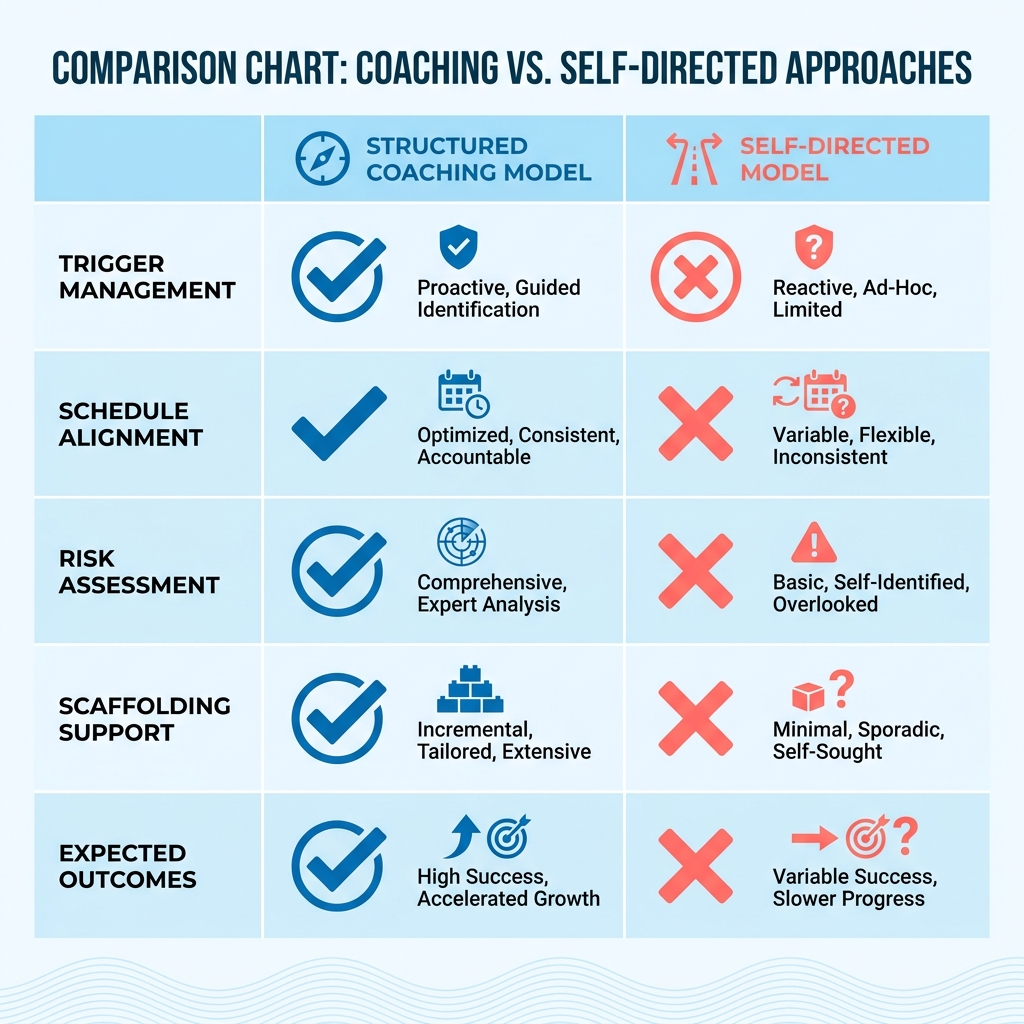
What does personalized coaching give you that going solo doesn't?
A tailored plan plus a person accountable for the follow-through. A coach matches strategies to where you actually are, then adjusts as your life shifts. Self-directed recovery leaves you to design, run, and audit that system yourself, usually during the most fragile weeks you'll ever face.
The support bends to the client's real environment. A coach working with someone re-entering a high-pressure corporate job is managing very different daily triggers than one supporting a parent juggling custody obligations and evening outpatient sessions. That situational fit is what separates active coaching from a generic action plan, and it's what lets a coach pivot between reinforcing what a client already knows and teaching something entirely new.
Where self-directed recovery falls short
Self-directed recovery fails at engagement, not intention. Without outside reinforcement, the daily practices that hold sobriety together get quietly deprioritized the moment life gets chaotic.
The first 60 to 90 days after discharge is when vulnerability peaks and when steady support most reliably changes the outcome. A coach keeps the daily momentum going through that window, the momentum that erodes on its own when someone tries to make the transition in isolation.
The honest limits
Be clear-eyed about two things. First, the research is more consistent on engagement than on direct substance use outcomes. Studies tracking treatment retention show strong, reliable results. Studies measuring sobriety at 12 months are more mixed. Coaching keeps you in care. It doesn't replace therapy. As Dr. Tammy Malloy puts it, it complements clinical treatment with real-world application.
Second, cost gates access. Private sober companions who provide daily support sit at the premium end. Community-based recovery coaches are more affordable but vary widely in training and certification. Few insurers reimburse either at any meaningful level, which means the most reliable accountability often stays a financial luxury. If money's tight, structured peer and group support delivers a lot of the same engagement benefit for a fraction of the cost.
Building daily routines with a coach
Most of coaching's value shows up in the unglamorous work of building a week that holds. A routine isn't a wellness aesthetic here. It's a defense. When there's a set wake time, a standing meeting, and a therapy appointment already on the calendar, there are fewer open moments for old patterns to fill.
A coach builds that routine with you, then keeps checking that it survives contact with real life. The point of the in-person check-in is that a routine looks fine on paper and falls apart on a Wednesday. Someone watching in real time catches the drift early, while it's still a skipped meeting and not a slip.
The routine is supposed to outlast the coach. As independence builds, sessions taper and the client carries more of the structure themselves. That handoff is the whole design. A coach who never steps back isn't succeeding, they're creating a dependency.
Steadying the emotional weight of early recovery
Emotional support does something logistics alone can't: it steadies your mental state during the weeks when stress, shame, and self-doubt run highest. The right help for someone leaving treatment isn't just scheduling. It's someone who listens without judgment and reflects your progress back when you can't see it yourself.
That layer matters because early recovery is emotionally loaded. Plenty of people feel anxiety and decision fatigue the second they leave a structured program. A coach absorbs some of that weight, acting as an advocate through the uncertainty of independent living.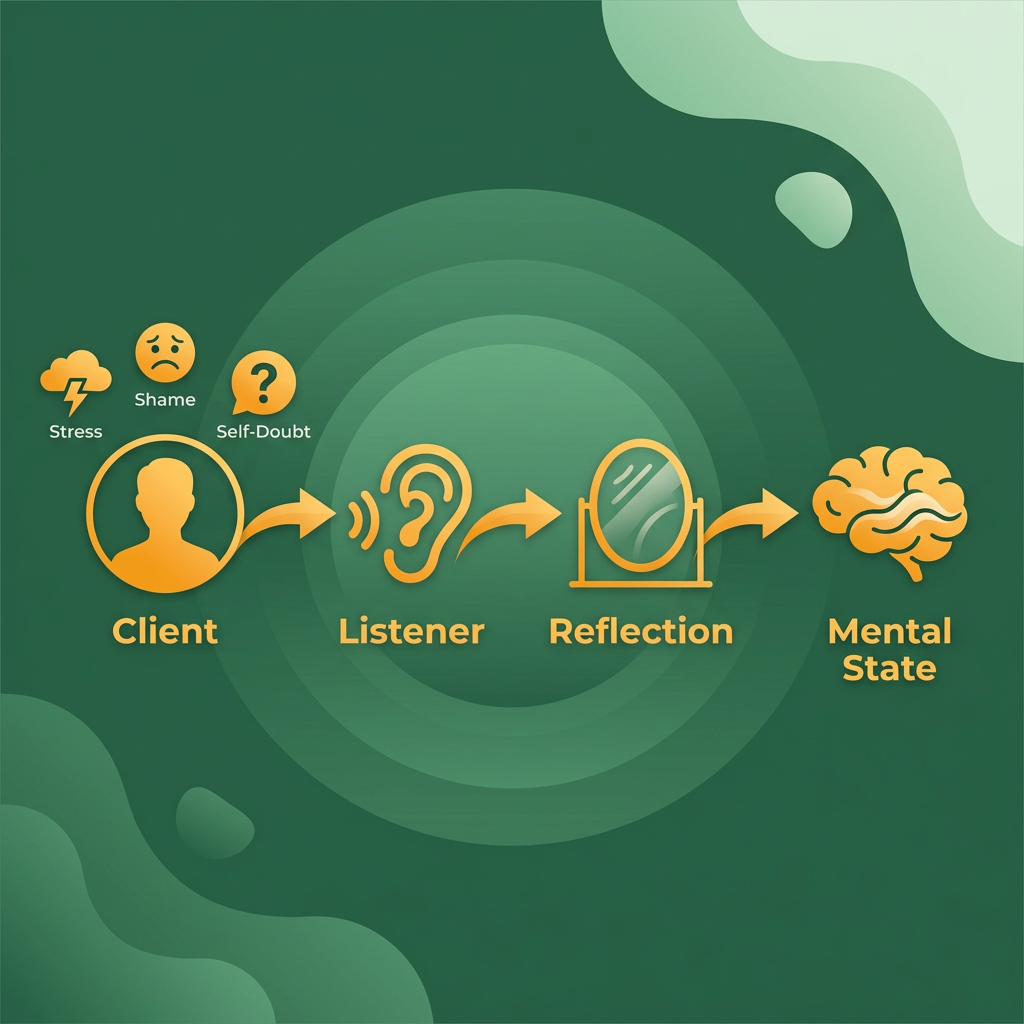
How does a coach support you emotionally?
Through active listening, empathy, and steady presence in high-stress moments. A coach holds space for hard conversations, gives honest feedback, and helps you build coping skills without leaning on substances. This is relational support, not clinical treatment.
Tim Stoddart lays out the mechanism plainly. Recovery coaches "teach important life skills without the use of substances and help hold space by listening and giving important feedback to help achieve goals," he told Sober Nation. That mix of listening and accountability is what lowers day-to-day stress.
We see it most in social re-entry. A young adult heading back to a college campus worked with a coach to set boundaries with old peer groups and finished a stable semester. Emotional stability rarely lives in a vacuum. When the immediate social environment steadies, recovery tends to steady with it.
Is coaching better than support groups or solo counseling?
Coaching works best alongside clinical therapy and peer groups, not against them. Therapists work the deep-seated psychological patterns. Coaches focus on executing those strategies in daily life.
Shame and self-doubt are documented drivers of people dropping out of treatment. They're the exact feelings behind a canceled appointment or a stopped-returning-calls stretch. A coach who already knows your history lowers the barrier to reaching back out when things go sideways.
A relationship built on consistent, non-judgmental contact lowers the cost of honesty. When you're struggling and have someone to call right now, you're less likely to spiral in private. That bond is what makes the clinical handoffs stick.
For women rebuilding their footing after drinking, recovery and sober coaching resources go deeper on this relational side.
Catching a relapse before it happens
Relapse prevention comes down to protecting the daily habits that keep sobriety intact. On the operational side of coaching, the clearest pattern is that it sustains the routines that stop a slip before it starts.
The National Institute on Drug Abuse estimates relapse rates for substance use disorders at 40 to 60%, comparable to chronic illnesses like hypertension or diabetes. That framing reframes relapse as a predictable risk to manage, not a personal failure. A coach manages it by keeping the client actively engaged with their recovery plan through high-stress transitions.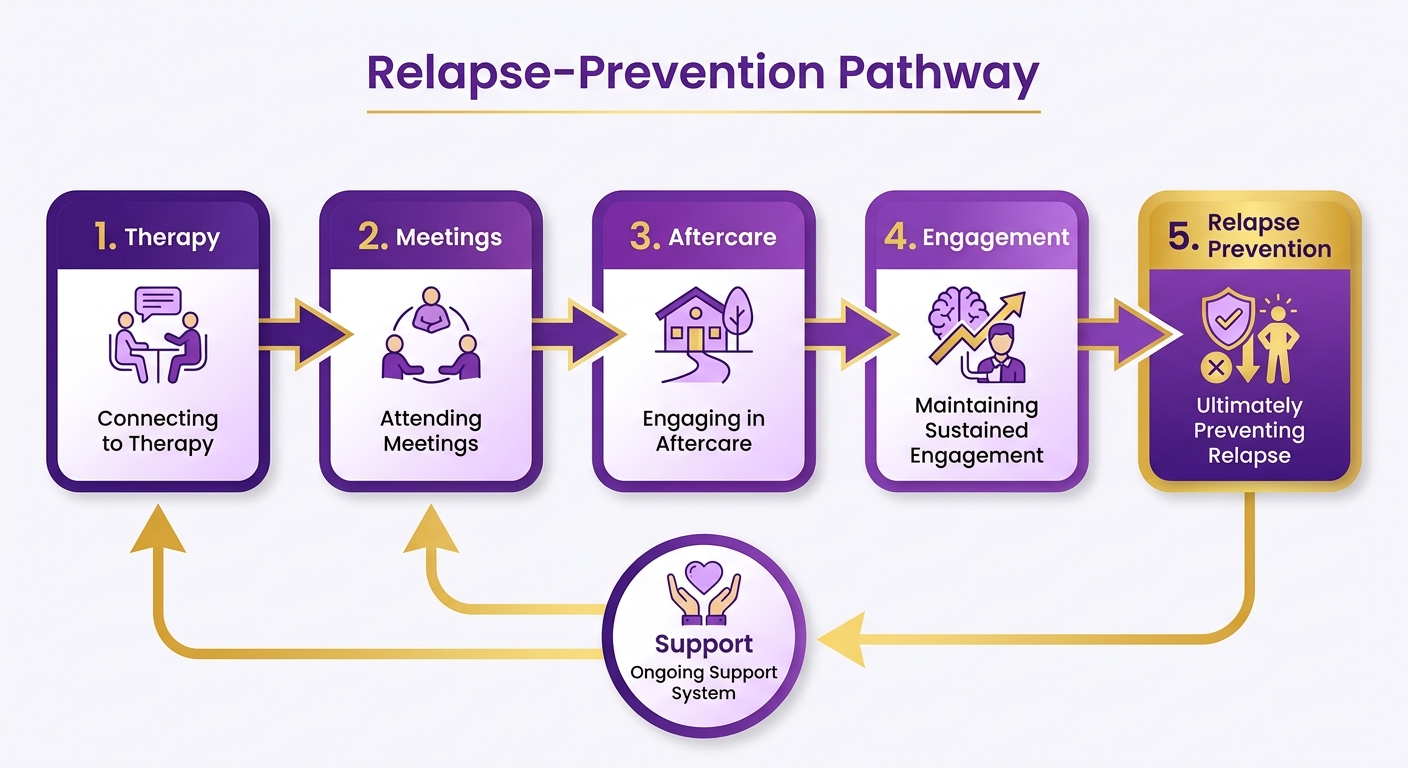
How does a coach spot a relapse before it happens?
The first prevention job is pattern recognition. A coach helps you name your specific triggers and build coping moves before the pressure hits, not after. Aftercare programs built around this, like one Florida-based program documented in the aftercare research, focus on teaching clients to catch warning signs and turn them into an individualized plan.
That same study flags something most vendors won't: client deception is a named, daily challenge for aftercare workers. Even motivated people hide slips. A coach who sees you in real life, not just on a scheduled call, is harder to hide from. That's the entire point of the check-in.
Coaching, support groups, or solo counseling?
The strongest answer is layering, not picking one. Traditional counseling often works backward through past issues. Recovery coaching handles the real-time challenges with practical skills. Support groups add community. They cover different gaps.
The right mix depends on your stage. A coach can shift emphasis, leaning hard on daily accountability when your routine is shaky, then moving toward skill-building when you hit new social or professional situations.
The structural catch worth knowing
One caveat we won't hide. The aftercare research names staffing shortages as a real barrier. Public programs are stretched too thin for individualized attention, which is a big reason post-rehab support fails. Paid coaching is effectively a private workaround for an understaffed system. That's honest, and it matters if cost is a concern for your family.
If you're weighing the decision, coaching earns its place by keeping you engaged with the interventions that carry the actual evidence. SAMHSA emphasizes that having supportive people involved is central to recovery. A coach makes that support consistent instead of accidental.
Measuring success: what actually counts as progress
Because coaching works indirectly, the honest measure of success isn't a single sobriety milestone. It's engagement. Are you still showing up for therapy, still hitting meetings, still reporting against the plan sixty days out? Sustained participation in aftercare remains the most reliable predictor of where someone lands long term, which is why it's the number worth watching.
That's also why coaches set measurable goals from the start. Vague goals can't be tracked, and untracked progress feels like no progress at all during the weeks when a client most needs to see it. A standing meeting count, a kept-appointment streak, a routine that held through a hard week, these are small, concrete markers you can actually point to.
Milestones matter, and 30 or 90 days sober is worth marking. But the day-to-day metric that predicts them is engagement. Keep the person in care and the milestones tend to follow. That's the quiet logic behind the whole approach.
References
[1] Sober Coaching: How It Works, Key Benefits, and What You Need to Know - https://www.caron.org/addiction-101/treatment-advice/sober-coaching
[2] What Is a Sober Coach? | Benefits, Costs, and How to Choose One - https://futuresrecoveryhealthcare.com/alcoholism/what-is-a-sober-coach/
[3] Sober and Recovery Coaching and Monitoring: Find a Coach - https://www.hazeldenbettyford.org/relapse-prevention/connection-recovery-coaching
[4] What Is Sober Coaching? - https://www.ashleytreatment.org/rehab-blog/what-is-sober-coaching/
[5] Sober Coaching Explained: Q&A with Cindy Feinberg - https://recovery.com/resources/put-me-in-sober-coach-qa-with-cindy-feinberg/
[6] What Is an Addiction Coach? (What They Do & Effectiveness) - https://alcoholrehabhelp.org/treatment/recovery-coach/
[7] 4 Reasons Why You Can Benefit From Recovery Coaching - https://sobernation.com/recovery-coaching/
[8] Building a Path to Sobriety: Challenges and Strategies ... - https://www.researchgate.net/publication/381197631_Building_a_Path_to_Sobriety_Challenges_and_Strategies_of_Rehabilitation_Workers_in_the_Aftercare_Process_of_Substance-Abuse_Individuals
[9] Peer Recovery Support Services and Recovery Coaching for ... - https://pmc.ncbi.nlm.nih.gov/articles/PMC12811009/
[10] Lived Experience in New Models of Care for Substance Use ... - https://pmc.ncbi.nlm.nih.gov/articles/PMC6585590/
Frequently Asked Questions
1. What certifications or credentials should I look for when hiring a sober coach?
No single national licensing standard exists for sober coaches, making credential quality variable. Look for certification through CCAR (Connecticut Community for Addiction Recovery), ICCRC, or NAADC. Lived recovery experience combined with formal peer support training is the strongest indicator of a coach who can provide both practical accountability and genuine credibility.
2. Does health insurance cover sober coaching?
Most health insurers do not cover sober coaching because it is classified as a non-clinical service. However, community-based organizations, state-funded programs, or local recovery community centers (RCCs) often provide peer recovery support services at little to no cost. Utilizing these community resources can help bridge the gap if private coaching is financially out of reach.
3. What is the difference between a sober coach and a sober companion?
A sober companion provides intensive, often around-the-clock in-person support—traveling with clients and accompanying them to high-risk events—while a sober coach typically meets several hours per week for check-ins and goal-setting. Companions are common immediately after discharge or during acute risk periods; coaches suit the extended accountability phase of ongoing recovery.
4. Can sober coaching be done virtually, or does it need to be in person?
Virtual coaching via phone or video is widely practiced and effective for accountability and emotional support. In-person coaching adds real-world presence—physically accompanying clients to therapy or meetings—that remote formats cannot replicate. The right format depends on how much live, situational intervention a person needs during their highest-risk windows.
5. How long does a typical sober coaching engagement last?
Engagement length varies based on individual stability and needs. Many programs begin with highly intensive daily contact during the initial transition home, gradually reducing the frequency of check-ins over several months as the client establishes a stable routine. The ultimate goal is a deliberate taper toward complete independence rather than an abrupt termination of support.
6. Can sober coaching help someone who also has a co-occurring mental health condition?
Yes, but only as a supportive layer alongside professional medical care. Because coaches do not provide clinical therapy or manage medications, their role with co-occurring disorders is strictly operational—helping you stay organized, attend psychiatric appointments, and follow through on treatment plans designed by your clinical team.
7. Is sober coaching worth it if I'm already attending AA or NA meetings consistently?
If you are already actively engaged in a 12-step program with a sponsor, you may already have a strong accountability framework in place. A professional coach becomes valuable if you find yourself struggling with specific real-world challenges that group meetings don't address, such as rebuilding a professional career, managing complex family dynamics, or navigating high-risk environments where immediate, personalized guidance is required.