Recovery Coaching vs Counseling: Which Answers Your 2am Cravings
September 25, 2026
TL;DR
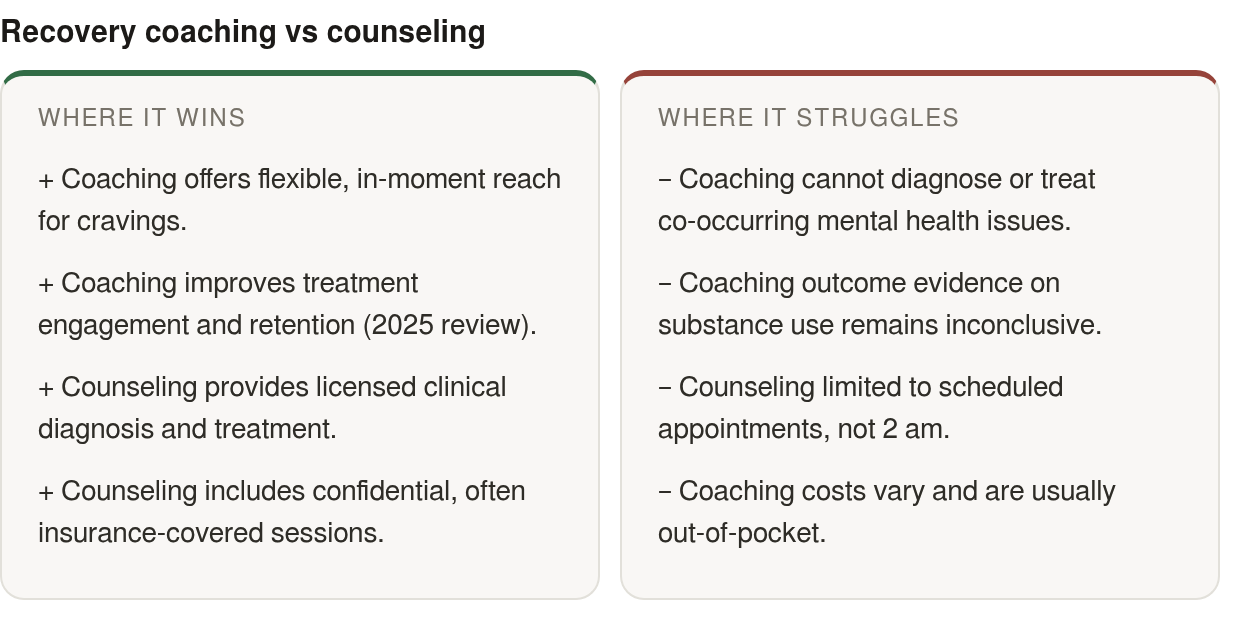
- Recovery coaching is non-clinical and reachable between sessions. Counseling is clinical, licensed, and confined to scheduled appointments.
- Coaching may improve treatment engagement and retention, but evidence on substance use outcomes remains preliminary and inconclusive.
- Coaches can't diagnose or treat co-occurring conditions like anxiety, trauma, or depression. Licensed counselors are built to address those clinical drivers.
- Counseling carries legally protected confidentiality and is often partly insurance-covered. Coaching is a paid service that varies by provider.
- Relapse risk climbs during travel, when standing therapists, home meetings, and routines all go dark at once. Most support models leave that window uncovered.
Quick Summary
Recovery coaching and counseling answer a 2am craving in opposite ways. Coaching is non-clinical and reachable in the moment. Counseling is clinical, licensed, and scheduled, built to treat what's driving the craving underneath.
So the practical call comes down to where your worst hour comes from. If the 2am spiral is situational, sober coaching after rehab tends to be the faster catch. If it's rooted in untreated anxiety, trauma, or depression, counseling is the layer you can't skip. Most people leaving residential treatment do best with both.
The comparison matrix at a glance
| Dimension | Recovery Coaching | Counseling | MADE Recovery |
|---|---|---|---|
| Core focus | Present and future action, daily routines | Past trauma, mental health diagnosis | Transitional aftercare, companionship, routine building |
| Availability | Scheduled sessions plus flexible support | Scheduled appointments | Virtual, in-person, and sober travel companions for high-risk windows |
| Credentials | Trained professional, often peer with lived experience | Licensed mental health professional | Non-medical sober coaches, team-based |
| Cost range | Paid service, varies by provider | Paid, may be covered by insurance | Custom packages, à la carte or team-based |
| 2am craving strategy | Reachable outreach between sessions | Addressed at next appointment | A companion who's physically present when the craving hits |
Where each one wins, and where it doesn't
Coaching's strength is availability and momentum. As All The Way Well frames it, therapy heals your wounds and coaching builds your new life. The trade-off is depth. A coach won't diagnose or treat a co-occurring condition, and the outcome evidence is still inconclusive.
Counseling's strength is clinical depth and legally protected confidentiality, often with insurance covering part of the cost. The trade-off is the calendar. Cravings don't wait for your Tuesday appointment.
The window most models leave open is travel. Away from your standing therapist, home meeting, and routine is exactly when relapse risk climbs and your usual supports go quiet. A sober travel companion closes that window by putting coaching's engagement benefit right where it's needed most.
The best-for takeaways
- Choose coaching, or a coaching-first model like ours, when your risk peaks in unstructured hours, on the road, or in the first weeks home, and you need someone reachable rather than a diagnosis.
- Choose counseling when cravings trace back to a clinical condition. Or pair both: therapy for the root cause, coaching for the 2am follow-through.
Why the coaching vs counseling choice actually matters
Coaching and counseling matter as separate choices because they fail you at different hours. A counselor treats what drives the craving. A coach answers the phone when the craving hits. For anyone weighing sober coaching after rehab, that timing gap is the whole decision, and it gets sharpest after midnight when your Tuesday session is four days away.
We watch this play out the same way over and over. Someone leaves treatment, picks one form of support, and assumes it covers everything. Then a 2am urge lands and the mismatch shows. If the craving is situational, boredom, a hotel minibar, a hard phone call, and all they have is a weekly clinical appointment, they wait it out alone. If the craving is rooted in untreated anxiety or trauma and all they have is a coach cheering them on, the root keeps firing. Picking wrong doesn't just frustrate people. It's how momentum breaks.
The mismatch that sends people back out
Support-need mismatch: choosing a support type that can't reach the actual driver of your craving at the moment it peaks.
The research is useful because it separates what coaching does well from what it hasn't proven yet. It backs coaching as a way to keep people connected to care, while stopping short of calling it a full clinical solution. That's why we treat coaching as one layer of a plan, not a stand-alone fix.
Read that next to the consumer framing from All The Way Well, which leans toward therapy when substance use has been tied to mental health pain. Both are right at different levels. Coaching keeps recovery active in daily life. Counseling works on the clinical reasons recovery keeps getting interrupted.
Night is when the two split apart
Cravings don't respect office hours, and that's exactly where the two approaches diverge. Counseling is scheduled, licensed, and built for depth. Coaching is non-clinical, reachable, and built for the moment. At 2am, reach beats depth. You need presence first, insight later.
| Factor | Recovery coaching | Counseling |
|---|---|---|
| Clinical? | Non-clinical support | Licensed clinical treatment |
| 2am reach | Flexible, between-session contact | Scheduled appointments only |
| Best for | Situational cravings, structure, accountability | Anxiety, trauma, co-occurring conditions |
| Diagnoses? | No | Yes |
| Our fit | Coaching, companionship, sober living | Referred to outside licensed providers |
We run the coaching column and refer the clinical column out. We're a nonmedical support service, not a treatment facility, and we're clear about that line.
Travel is where coaching's reach wins
Travel is one of the high-risk moments where coaching's reach can matter most. A sober travel companion turns coaching from a scheduled support into a real-world buffer when risk is no longer theoretical. You're away from your standing therapist, your home meeting, your routine. The 2am craving in an unfamiliar city has no local backup.
A companion fills that space. Not a cure, a presence. It's one of the ways our day-to-day companionship extends beyond home. For cravings driven by a clinical condition, pair that reach with counseling. You don't pick one. You match each layer to what's actually firing.
What a recovery coach does
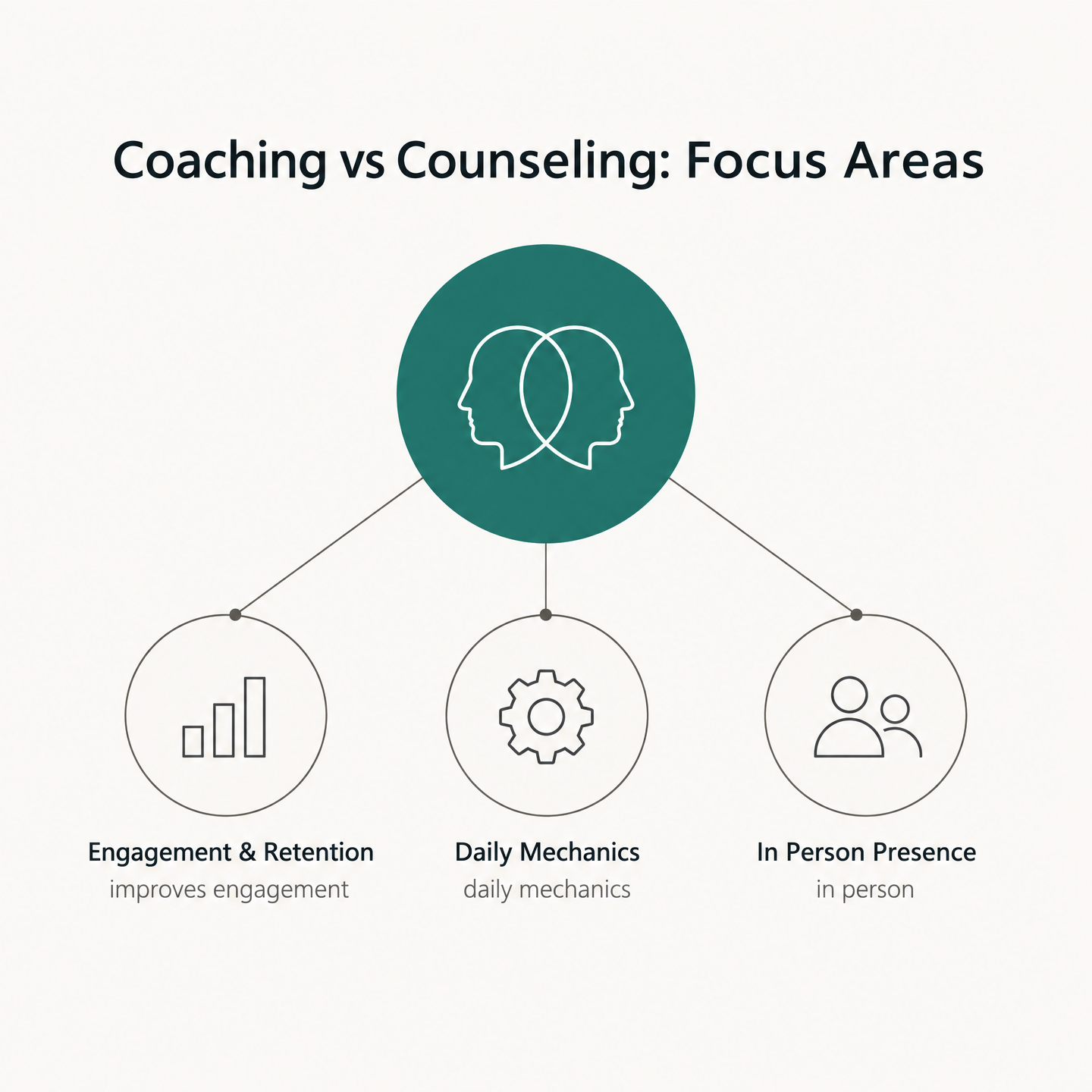
A recovery coach is a non-clinical guide who works on where you are now and where you want to go, not the wounds underneath. That distinction matters for anyone weighing sober coaching after rehab, because the coach's whole job is the day-to-day mechanics of staying sober: building routine, holding you accountable, and being reachable when the plan wobbles.
Coaches don't diagnose or treat mental health conditions, as All The Way Well lays out. They set goals with you, build daily structure, help with housing, work, and relationships, and keep you accountable between clinical appointments. We watch that last piece carry most of the weight, because the risky hours rarely line up with a scheduled session.
What does a recovery coach actually do day to day?
The work is practical and repetitive by design. A coach helps you map the day so there are fewer empty, high-risk gaps, then checks in against that plan. Routine planning. Stacking a new sober habit onto an existing one. Short real-time check-ins when a craving spikes.
Our approach leans on availability over analysis. A client hits a hard phone call or a boring hotel night, they text or call, and we work the moment: name the trigger, run the plan, ride it out. That's coaching's real strength, and we position it as an access and engagement tool, not a cure. If your urge is rooted in untreated trauma, a coach can help you stay steady tonight, but the underlying wound still belongs in counseling.
What training and credentials should you expect?
Coaching is a paid, professional service, often delivered by people with lived recovery experience. That lived experience is the credential clients feel first, but reputable coaches also work under supervision and coordinate with your treatment team, family, and sober living home rather than operating alone.
Be clear on the line we hold. We provide nonmedical support. We don't detox, manage medications, or deliver clinical therapy. When a situation needs a licensed clinician, our job is to connect you, not replace them.
Why does a sober travel companion change the math?
One unresolved question in the peer-support field is fit: which setting, timing, and client profile benefit most from this kind of support. Travel is an obvious stress test. It removes your usual meeting, clinical schedule, and familiar routine all at once, then asks you to improvise under pressure.
A sober travel companion puts support inside that disrupted environment. Instead of checking in after the hardest part has passed, the companion is present during the trip, in person, while decisions are being made. We wrote more on why that beats going it alone.
| Support type | Reachable at 2am on the road? | Best for |
|---|---|---|
| Sober travel companion (MADE Recovery) | In person during the trip | High-risk trips, first sober travel |
| Recovery coach (phone/text) | Often, if arranged | Situational cravings, daily accountability |
| Counselor | No, scheduled only | Trauma, anxiety, root causes |
| 12-Step meeting | Only if one's nearby | Community, ongoing fellowship |
Coaching wins on presence. Away from home, that presence is the whole point.
Decision framework: matching need to support
Picking between coaching and counseling gets easier when you stop asking "which is better" and start asking "what does my hardest hour actually need." That reframe does most of the work. The right call for sober coaching after rehab depends on where your cravings come from and where you physically are when they hit.
Run your situation through four questions before you decide. Each one points toward coaching, counseling, or both.
Four criteria that decide coaching, counseling, or both
| Criterion | Points to coaching | Points to counseling |
|---|---|---|
| Craving trigger | Situational: boredom, travel, a hard call | Rooted in anxiety, trauma, or depression |
| Need for diagnosis | None; you want structure and accountability | You suspect an untreated condition |
| Timing of risk | Off-hours, weekends, on the road | Manageable until your next appointment |
| Communication style | Reachable, in-the-moment contact | Scheduled, confidential clinical sessions |
If your cravings are situational and land at odd hours, coaching lines up best when the immediate need is connection, structure, and accountability. It can help you stay attached to your recovery plan when the plan is easiest to abandon.
But be honest about the ceiling. Coaching can keep you in the game. It doesn't treat every reason the urge shows up.
When cravings are clinical, counseling isn't optional
If you've been self-medicating anxiety, trauma, or depression, a coach cheering you on won't reach the root. Counselors use evidence-based modalities like CBT, DBT, and EMDR to diagnose and treat what a coach isn't licensed to touch.
Our role sits alongside that clinical work, not on top of it. We help families plan detox and treatment pathways, then support clients as they reintegrate into daily life, coordinating with outside professionals rather than replacing them. Knowing where coaching ends and clinical care begins is part of building a plan that actually holds.
A 2am spiral fueled by untreated PTSD needs the clinical layer, full stop. A 2am spiral fueled by a hotel minibar and jet lag needs someone reachable right then. Most people leaving treatment need both, at different hours.
Where a sober travel companion fits the framework
Travel gives the framework a practical place to land. If the riskiest stretch is the airport bar, the business dinner, the empty hotel room, or the first trip after treatment, remote advice may not be enough. The support has to match the setting, not just the diagnosis.
That's the gap we built around. Our sober travel companions go with you on the trip, providing consistent, in-person support during the moments that matter most, so being away from home doesn't mean being on your own. Pair that with counseling back home and you cover both fronts.
Use the framework this way: if your cravings are clinical, book the counselor first. If they spike when you're on the road or off-schedule, a companion closes the window relapse loves. For most people fresh out of treatment, the answer is a blend, weighted toward wherever your hardest hour actually lands.
How MADE Recovery answers the 2am craving
Here's where we fit in the coaching-versus-counseling split. We're a nonmedical recovery support team, not a clinic. We don't diagnose, detox, or manage medications. What we do is the part that goes quiet after the residential doors close: sober coaching after rehab that helps you keep the plan alive when structure fades and real life returns.
Our model is built around the hours that trip people up. A counselor treats the root. We keep the plan alive between those sessions, through personalized coaching, routine-building, nutrition guidance, crisis planning, and sober companionship you can do virtually or in person. That last piece is where we differ most from a solo coach.
What does sober companionship on the road actually look like?
A hotel room at 2am is one of the loneliest places in early recovery. The minibar is stocked, the front desk sells beer, and your Tuesday counseling slot is days away. A travel-ready companion fills exactly that gap. Our sober travel companions provide consistent, real-world support during the moments that matter most, so you're not managing those stretches alone.
That's the honest edge. Weekly clinical care can't board a plane with you. A companion can.
| What you need | Our team | Standalone coach | Counselor |
|---|---|---|---|
| Between-session contact | Yes | Sometimes | Rare |
| Travels with you | Yes | Depends | No |
| Nutrition and routine support | Yes | Varies | No |
| Diagnoses or treats conditions | No | No | Yes |
Where we're the wrong fit: if your 2am spiral traces back to untreated trauma, anxiety, or depression, coaching alone won't reach it. You need licensed counseling for that layer, and we'll say so plainly rather than pretend our support replaces medical care. Many clients pair both, and that combination tends to hold.
We can't promise sobriety. Nobody honest can. What we can do is help you build a plan that has an answer for the hardest hour. If you want to see what that looks like for your situation, schedule an initial consultation and we'll map the first steps with you.
References
[1] Recovery Coaching vs. Therapy vs. 12-Step | All The Way Well - https://allthewaywell.org/recovery-coaching-vs-therapy-vs-12-step/
[2] (PDF) Peer Recovery Support Services and ... - https://www.researchgate.net/publication/390092484_Peer_Recovery_Support_Services_and_Recovery_Coaching_for_Substance_Use_Disorder_A_Systematic_Review
Still Wondering?
1. Can I use recovery coaching and counseling at the same time?
Yes. The cleanest version is a divided role: the counselor handles clinical treatment, and the coach helps carry your recovery plan into daily life. That can be especially useful after residential care, when the schedule suddenly gets looser and small decisions start mattering again.
2. Will insurance cover recovery coaching the way it covers counseling?
Usually no. Recovery coaching is typically an out-of-pocket service, while counseling may qualify for partial insurance coverage because it is licensed clinical care. Ask each provider how they price sessions, packages, travel support, and any à la carte options before you commit.
3. Is what I tell a recovery coach as confidential as what I tell a therapist?
Not in the same legal sense. Therapist confidentiality is tied to licensed clinical treatment. Coaching services should still be professional and clear about privacy, coordination, and communication boundaries, but you should ask directly what is shared with family, sober living staff, or your treatment team.
4. Can a recovery coach help me detox or manage my medications?
No. Detox and medication management belong with licensed medical professionals. A coach can help you follow a plan, get to appointments, communicate with appropriate providers, and stay supported while care is being arranged.
5. How is a sober travel companion different from a coach who checks in by phone?
Phone support is remote. A sober travel companion is there with you during the trip, which changes the timing and texture of the support. Instead of talking after a risky dinner or late-night urge, the companion can help you plan, leave, redirect, or reset in the moment.
6. What credentials should I look for when choosing a recovery coach?
Look for lived recovery experience paired with professional structure. A strong coach should be transparent about training, supervision, boundaries, crisis planning, and how they coordinate with clinicians, family, or sober living when appropriate.
7. Does recovery coaching actually keep people sober?
Coaching is best understood as support that helps people stay connected, accountable, and engaged. It is not a guarantee of sobriety and should not be sold that way. If the craving is tied to a deeper clinical condition, coaching works best beside licensed counseling rather than instead of it.