Rebuild Purpose After Addiction by Rebuilding One Daily Routine
August 30, 2026

Key Takeaways
- The hardest part of early sobriety is not stress or triggers. It is empty time. Adults in recovery named it directly.
- Relapse in the first year is common: roughly 85% of people with substance use disorder relapse within twelve months, and 40% to 60% relapse overall.
- One well-placed habit does more than a packed calendar. It fills the emptiest, riskiest hours instead of impressing anyone.
- Cravings work in the blank stretches between obligations. That is where relapse concentrates.
- Anchor one habit in your worst time slot first. Grow outward from there. Do not try to rebuild the whole day overnight.
- A morning ritual can shut down the exact craving window. One routine beats scheduling every hour at once.
- The routine has to match your actual empty hours, not a generic recovery checklist.
Why one daily habit rebuilds more than a full schedule does
Life after rehab has one specific enemy, and it is not stress. It is empty time. A mixed-methodology study of adults in early recovery found that unoccupied time was the condition participants named as making recovery hardest. Not triggers alone. Not willpower. The blank hours between obligations.
That matters because relapse in the first year is not rare. The same research reports 85% of people with substance use disorder relapse within the first year, and roughly 40% to 60% relapse overall. Those blank hours are where the danger lives.
Why one routine beats a full day of them
One keystone habit works because it fills your highest-risk empty hours. It does not work because it looks impressive. A single well-placed morning ritual can neutralize the exact window where cravings do their work.
Here is the tension we sit with. One school of thought says a purpose-driven routine should fill all 24 hours with exercise, journaling, and volunteering. Another warns that rebuilding a life should be gradual, not a total overhaul installed overnight.
A sequenced approach settles the argument. Instead of a complete lifestyle redesign on day one, anchor a single habit into the most vulnerable slot. The routine expands from there. Our coaching centers on finding your individual risk windows, not stamping the same template on everyone.
Why purpose has to come first
A routine tied to purpose gets followed. A routine framed as chore avoidance gets dropped. That is the difference between preventing what you do not want and protecting what you do.
The recovery protection framework makes this concrete. As researcher Lisa Ogilvie puts it:
"Recovery protection advocates that instead of working to prevent what they do not want, individuals should focus on protecting what they do."
So we clarify purpose first. When a morning walk becomes "protecting the clear head I need to be present for my kids," adherence changes. The habit stops being maintenance and turns into something you refuse to lose. That reframe is why purpose strengthens resilience and gives you a reason to stay on track.
Who this is actually for
This works best for recent detox graduates, people returning to work or school, and families trying to stabilize a home. If your week is suddenly full of unstructured hours, you are the target reader. Our habit-first model is built for exactly that gap. Passion discovery, mentorship, and community connection are woven into every program so a routine has purpose to stand on.
Skip the full-schedule overhaul if you're one week out of residential. Loading a 24-hour plan onto someone still adjusting sets them up to fail. Start with one habit. Prove it holds. Then expand.
| Phase | Typical Time Needed | Difficulty (1-5) | Primary Benefit | MADE Coaching Support |
|---|---|---|---|---|
| Anchor one keystone habit | 30 min morning mindfulness | 2 | Uses the highest-risk empty hour | Virtual or in-person coaching sessions |
| Add a purpose link | 15 min journaling | 2 | Reframes chore as protection | Passion discovery and mentorship |
| Layer a physical habit | 45 min meal prep or movement | 3 | Builds mood and structure | Nutrition and routine-building guidance |
| Add service or connection | 60 min volunteering | 4 | Rebuilds identity and belonging | Companionship and community connection |
Start low on the difficulty column. Pick the 2s first. Those are your easy wins, and early wins on cravings, mood, and purpose alignment keep the whole structure standing.
Get your purpose clear before you design anything
Design your routine backward from your purpose, not forward from a task list. Coaching people through life after rehab, we see it play out the same way: clients who anchor a single habit to a clearly stated "why" stick with it. The ones who install a routine because a worksheet told them to abandon it within weeks.
This flips the psychological focus from avoidance to promotion. When you define what you're building toward, daily actions feel like choices, not restrictions. It lines up with the positive recovery-protection view, which is about growing positive assets instead of just managing symptoms.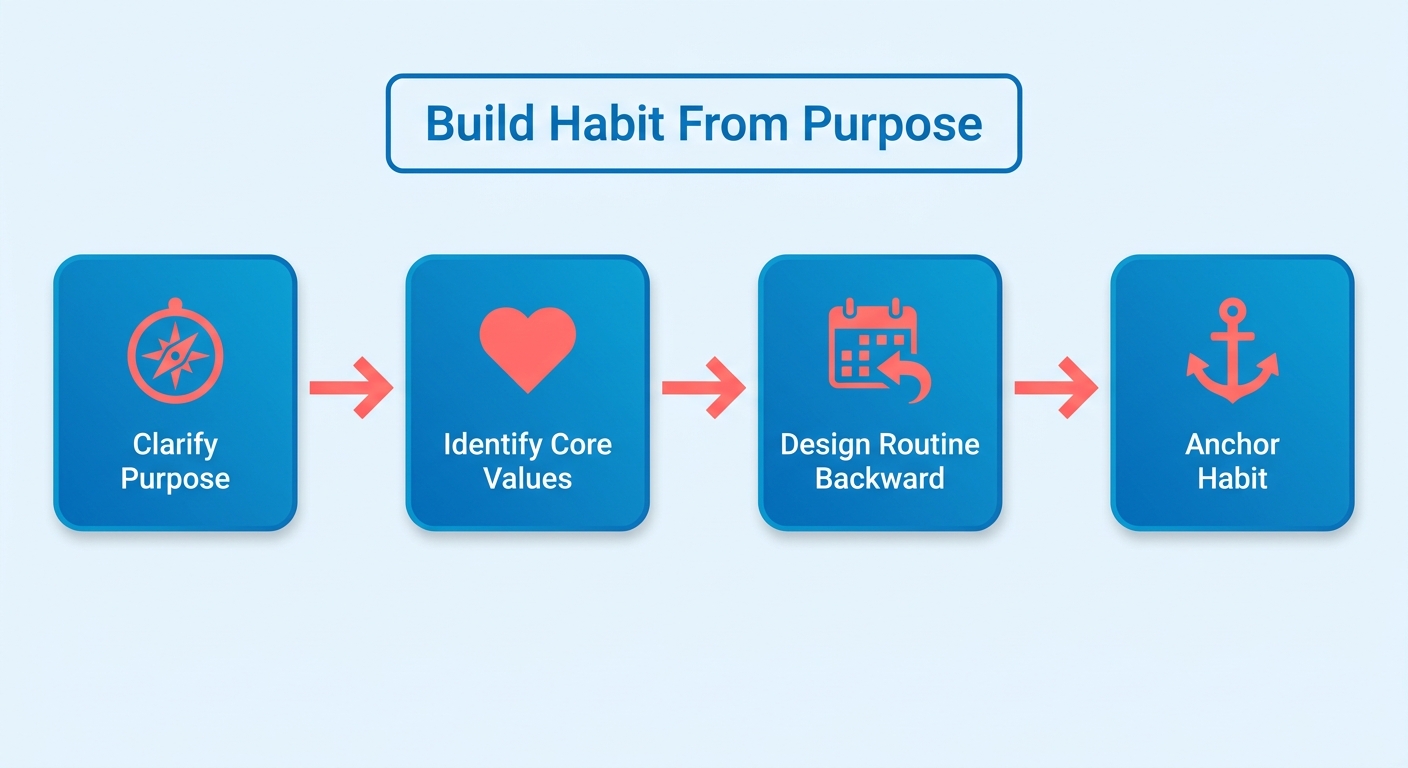
What purpose discovery actually is
Purpose discovery is a short written process that surfaces the deeper reason behind your sobriety before you build any habit around it. It is one of the fundamentals our coaching rests on, alongside nutrition, routine building, mentorship, and community connection.
Start by listing your top five values. Health, honesty, being present for your kids, financial stability. Then write a short legacy vision. Who do you want to be in two years, and what would that person's ordinary Tuesday look like?
Finally, compress it into one sentence: "I stay sober so I can ___." That sentence becomes the filter for every habit you consider. Finding purpose, as one recovery guide puts it, "is a journey, not a single moment of discovery," so treat this as a draft you revisit.
Turning purpose into something you can measure
Match each core value to one small, observable habit. If your purpose is health, the habit might be a balanced breakfast every morning. If it is connection, a five-minute call to someone in your support network.
Take being a present parent. A legacy vision built around that might be staying calm and available at school pickup. The measurable action could be a two-minute morning gratitude note about the kids, done before you check your phone.
This targets behavior and mindset at once. A meaningful task displaces risk while it reinforces your self-image as a supportive parent. Research on purpose-driven routines finds that linking daily actions to personal significance improves long-term adherence, because the routine feeds your sense of self-worth.
Why not build the whole 24-hour routine at once
Because ambition backfires. Some guides push a full-day schedule of exercise, journaling, volunteering, and personal development. Other coaches argue that rebuilding works through steady, gradual changes, not a perfect life installed overnight.
Both are right, and this is how we settle it. Build the full routine incrementally around one keystone habit tied to your purpose statement. Add the rest only after the first sticks.
The most common thing we have to correct is an overambitious purpose statement that reads like a mission for a saint. "Heal my family, transform my career, run a marathon." That produces overwhelm, then avoidance. Keep the statement specific and human. An experienced guide helps keep these goals realistic, so your daily schedule matches the capacity you actually have right now.
Build the foundational 24-hour routine
A foundational routine should cover roughly 7 core hours across three anchor blocks, with flexible buffer time in between. The blocks are simple: Morning (mindfulness, movement, fuel), Midday (connection, a purpose-linked task), and Evening (reflection, wind-down). Everything else flexes around those fixed points.
Trying to overhaul every hour at once usually leads to burnout. The same guide to rebuilding after treatment stresses that sustainable progress starts with basic stability first. Focus on one block at a time, and let each new habit go automatic before you add the next layer.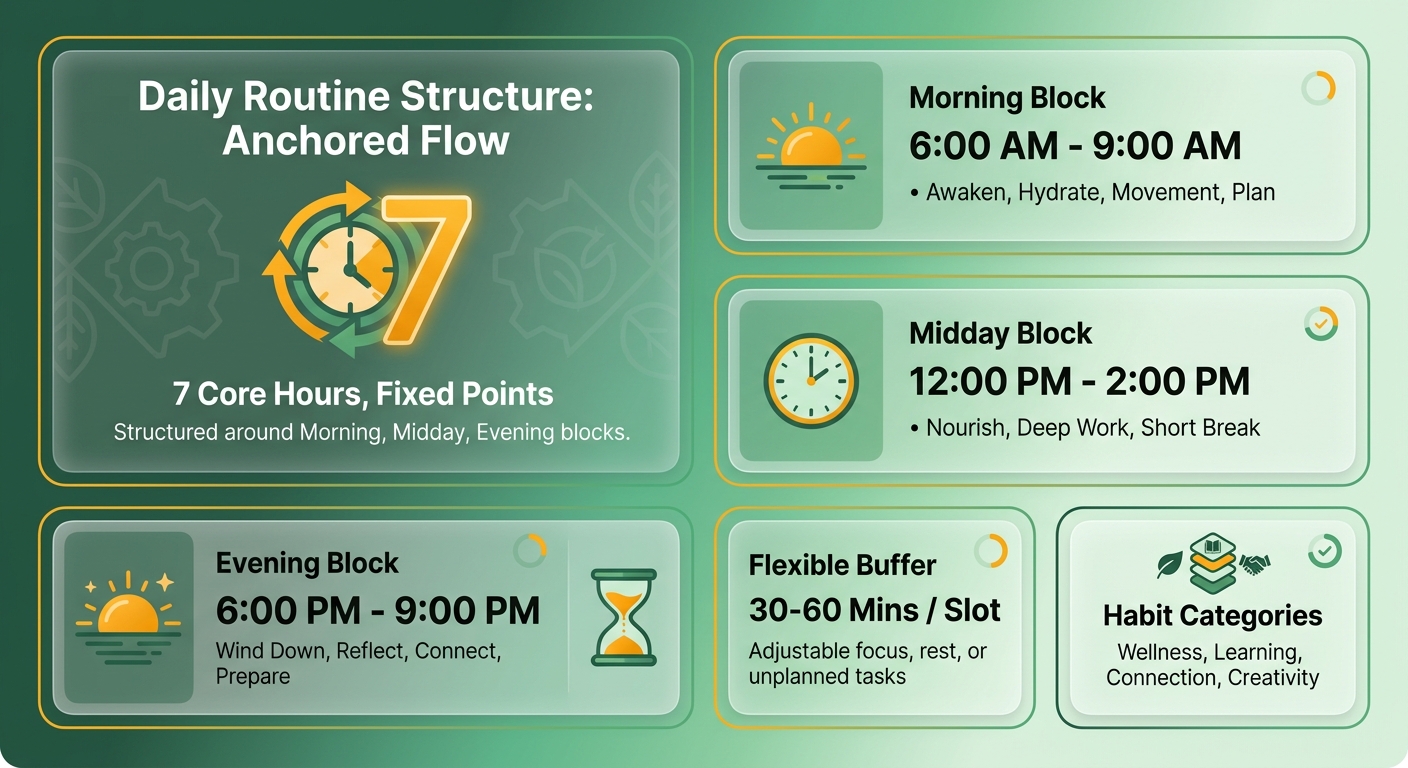
What goes in each anchor block
Morning: 30 minutes of mindfulness, then 20 minutes of moderate movement, then a protein-fat-carb breakfast. Mindfulness first is deliberate. It steadies you before the day's cues arrive, and a balanced meal keeps blood sugar and mood level so cravings do not ride a mid-morning crash.
Midday: your connection slot. Schedule a check-in with a coach or a peer group, then attach one small purpose-linked task. Recovery is not meant to be done alone, and real-world support during the moments that matter is exactly what this block is for.
Evening: close the day with reflection. A short journaling prompt tied to your purpose ("what did I protect today?") turns the day into evidence that the routine is working. Then use a wind-down ritual for sleep.
Where the routine should actually go
Placement matters because risk profiles vary. The early-recovery habits study found that successful recovery involves actively replacing old, unstructured patterns with constructive social and physical activities. Put your anchor blocks directly over your historically vulnerable hours, so good habits fill those spaces before cravings can.
Some frameworks focus on managing external stressors, others on value alignment. They are connected. Unstructured time often becomes the trigger for stress. A firm routine protects your mental space and keeps your values in front of you all day.
Prepping so the routine survives a bad day
Batch-cook in 3-day blocks and name each batch for its purpose ("fuel for creativity"). Naming the food after the "why" is a small thing, but it keeps the nutrition habit tied to meaning instead of chores. Decision fatigue is what breaks routines on hard days, and a full fridge removes three decisions.
Sleep is the anchor most people underrate. Aim for 7 to 8 hours, cut blue light an hour before bed, and keep a fixed wind-down. Physical foundations and emotional support have to run together, not one instead of the other.
Master one small window of the day and you build a sense of self-efficacy that makes the next schedule addition much easier to hold.
Fit recovery supports onto habits you already have
Recovery-specific supports work best when they ride on top of a habit you already keep, not when they fight for a fresh slot in your day. The goal is to attach one small sobriety action to something you already do reliably. Coaching people through life after rehab, we find that attachment is what keeps the support from feeling like homework.
Building accountability into your existing schedule prevents decision fatigue. When a check-in is linked to an established habit, it goes automatic. That structure acts as a buffer, so when cravings or stress show up, the safety net is already active.
What a recovery window is, and where it goes
A recovery window is a short, fixed slot for one sobriety action, dropped into the highest-risk empty hour of your day. A 15-minute check-in right after lunch. A 5-minute log after work. It is not about doing more. It is about placing one thing exactly where the void falls.
Good planning maps rather than prescribes. Find the exact hour where your structure tends to collapse, then target that window with a single, deliberate action. That precision beats generic advice that ignores your daily rhythm. Positioning this block on your personal fault line gives you a reliable anchor through the transition.
Adding supports without burning out
External cues cut the mental load of a new routine. Digital reminders or a physical planner keep your recovery windows visible without leaning on constant willpower. This gradual integration lines up with Tim Stoddart's guide to rebuilding, which favors sustainable, practical adjustments that reinforce your long-term goals over time.
Small and consistent is how we coach. One reliable daily action, anchored where the risk is highest, does more than a crowded plan you cannot sustain. One activity. Not five.
Build your crisis plan into the evening routine so it is never something you scramble for. Our services include planning for detox and treatment pathways and companionship during the moments that matter, so you are not managing a hard night alone. When the day ends and defenses drop, that support is already in place. For a fuller build-out, our post-rehab routine guide covers how sleep and support systems fit together.
When to taper coach-led check-ins
Taper once the habit runs without your reminder, not on a fixed calendar. As clients find their rhythm, our support steps back on purpose to encourage independence. The habit stays daily; the coaching frequency drops as you gain your footing.
Skip the taper if the log is still spotty or a major life change just landed. Protecting the habit matters more than hitting an independence milestone. Pull back too fast and you reopen the empty hour you spent months closing.
Use the routine to handle cravings, stress, and triggers
A routine only earns its place when it holds up during a craving. The blank hours you scheduled around still fill with stress and triggers, and that is where most people rebuilding after rehab lose ground. So the routine you build with your coach needs simple, portable tools to lean on. Controlled breathing, sensory grounding, and timed micro-breaks are common approaches worth folding in.
These are immediate interventions that protect your progress under stress. A craving is a temporary neurological spike; a preplanned response lets you ride out the urge without leaning on raw willpower. That proactive stance sits at the center of a recovery-protection mindset, turning abstract values into concrete actions.
Defusing a craving in the first 60 seconds
Start with the breath, because it works faster than reasoning does. Use 4-4-4 breathing: inhale for four seconds, hold for four, exhale for four. Run three or four cycles. The slow, exhale-focused pace is what pulls your nervous system out of the alarm state a trigger sets off.
If your mind is still racing, add the five-senses grounding check. Name five things you see, four you hear, three you can touch, two you smell, one you taste. That drags attention out of the craving loop and back into the room. Grounding tends to work best during the highest-risk windows, usually late afternoon and the first hour home.
Why the 90-minute micro-break matters
A 3-minute reset after every 90-minute block keeps unoccupied time from stacking into a craving. Work or focus for 90 minutes, then step away on purpose: stand, breathe, walk to the window. The reset is short by design, so it survives a busy day instead of getting skipped.
We see this one often. Someone keeps an afternoon trigger log and adds a five-minute walk to their post-lunch reset. Within a couple of weeks, the walk becomes the moment cravings drop instead of climb. A stable routine like this leaves people feeling more in control and less anxious, which is what defuses an urge before it escalates.
How you actually remember to do this
Cue every tactic to something already in your environment. A note on the coffee maker triggers morning breathing. A phone alarm marks each 90-minute reset. Let the physical prompt do the remembering so your willpower does not have to.
This is where a coach earns their keep. The accountability of a sober-coach team offers real human connection that fills the void before your own supports rebuild. During the high-risk windows you and your coach map together, that support shows up in the moments that matter: breathe now, ground now, walk now.
External support matters most in the first weeks, when a supportive environment raises your odds but you have not rebuilt one yet. For the full picture on stacking these tactics onto sleep and nutrition anchors, see our guide on rebuilding your post-rehab routine.
One carve-out: skip the formal five-senses drill if a simple breath already settles you. Layering tools you do not need turns a 60-second reset into a chore, and chores get dropped.
Refine the routine and move toward independent living
A routine is never finished. The version that fits your first month out of treatment will feel wrong by month three, and that is the point. What keeps a daily habit working through life after rehab is a feedback loop: a short, honest weekly review that catches drift before it becomes relapse.
That ongoing adjustment matters because recovery needs change. A long-term recovery guide points out that staying sober takes active, self-directed management of your environment and habits. Updating your schedule keeps it a supportive tool instead of a rigid constraint.
What goes in a weekly routine review
Routine review: a 15-minute weekly check-in with three columns. Success metrics, obstacles, one adjustment for next week. That is the whole template. Keep it short enough that you actually do it.
Success metrics are the honest data: did the keystone habit hold on the days that mattered? Obstacles name what got in the way, usually a specific empty stretch you did not plan for. The adjustment is one change, not five. The weekly rhythm lets you adapt to real-world snags, catching small disruptions before they threaten your stability.
Track it however you will actually keep up. A habit-tracking app works. So does a printable dashboard on the fridge. The tool matters less than the weekly rhythm.
Scaling down coaching without losing ground
Moving to self-reliance is a deliberate handoff. Rather than cutting support abruptly, check-in frequency drops as your own tracking shows the habit holding steady. That phased approach keeps your structure solid while you take full ownership of your schedule.
The taper is deliberate, not a cost decision. People living with structure and support hold sobriety better, as the same recovery guide notes. Pull support too fast and you strip that structure before the internal version is ready. Pull it too slow and you stay dependent on someone else's accountability. The review data tells you which is happening.
A transition plan respects your pace. Some people need extended check-ins through major life changes; others adapt to independent tracking quickly. The goal is a self-sustaining system where you run your own feedback loops.
Are you ready for independent living?
Independence is not the absence of support. It is the point where you self-direct the feedback loop and reach for help on purpose instead of by schedule. Recovery, as SAMHSA frames it, is self-direction across health, home, purpose, and community.
Before the last check-in, run a short transition checklist:
- Time budget: are the highest-risk empty hours filled with something purpose-linked, including self-directed learning?
- Self-run review: have you completed four weekly reviews without a coach prompting you?
- Community: do you have real people to call, not just a coach?
- Adjustment reflex: when a week goes sideways, do you change one thing instead of quitting?
Check all four and you are running the loop yourself. That is the goal. Not a routine we maintain for you, but one you keep building as your purpose keeps changing. And if you want to talk through where you are in that transition, help starts with a conversation.
References
[1] Rebuilding Your Life and Finding Purpose After Addiction - https://recoverycentersofamerica.com/blogs/rebuilding-your-life-and-finding-purpose-after-addiction/
[2] How to Rebuild Your Life After Addiction: A Guide to Long ... - https://sobernation.com/how-to-rebuild-your-life-after-addiction-a-guide-to-long-term-recovery/
[3] Finding Purpose and Meaning: Building a Fulfilling Life ... - https://www.addicted.org/after-treatment/discovering-purpose-and-meaning/
[4] (PDF) Habits and Routines of Adults in Early Recovery ... - https://www.researchgate.net/publication/368599802_Habits_and_Routines_of_Adults_in_Early_Recovery_From_Substance_Use_Disorder_Clinical_and_Research_Implications_From_a_Mixed_Methodology_Exploratory_Study
[5] From relapse prevention to recovery protection: a positive ... - https://www.researchgate.net/publication/383768299_From_relapse_prevention_to_recovery_protection_a_positive_perspective_on_recovery_from_substance_use_disorder
Frequently Asked Questions
1. What if I have no morning free time and my empty hours are late at night?
Focus your efforts on your actual high-risk periods rather than forcing a morning routine. If your unstructured time is late at night, establish an evening anchor, such as a reading habit, a reflection journal, or a structured wind-down sequence. The goal is to secure the specific hours when you are most vulnerable, regardless of the clock.
2. How is a "recovery window" different from just journaling every day?
A recovery window is a tactical intervention designed to preempt vulnerability. While general journaling can be done anytime, a recovery window is intentionally scheduled during a transition point, like the immediate hour after work, to disrupt old patterns. It serves as a scheduled speed bump when your defenses are typically lowest.
3. Is 4-4-4 breathing better than the five-senses grounding check for cravings?
Both serve different neurological purposes. Deep, rhythmic breathing directly targets the autonomic nervous system to lower physical arousal quickly. Sensory grounding, on the other hand, is a cognitive tool designed to interrupt obsessive thought loops. Use breathing as your immediate physical reset, and layer sensory grounding if you need to redirect intense mental focus.
4. What happens if I taper coaching support too quickly?
Removing accountability too soon can cause a silent regression where old habits creep back into unstructured gaps. To prevent this, ensure your core routine has been completely self-sustaining for several consecutive weeks before reducing check-ins. If you experience a sudden increase in cravings or life stress, maintain your current level of support until stability returns.
5. I'm one week out of residential treatment—should I build the full routine now?
No, attempting a complete lifestyle overhaul immediately after residential treatment often leads to cognitive fatigue. Your primary focus in the first week should be physical stabilization and emotional grounding. Start by establishing just one consistent daily anchor, such as a regular wake-up time or a single balanced meal, before attempting to structure your entire day.
6. What's a common mistake people make when writing their purpose statement?
Many people draft statements that are too broad or idealistic, which can feel intimidating on difficult days. A highly effective purpose statement focuses on immediate, tangible motivations rather than long-term monumental achievements. Frame your 'why' around concrete daily interactions that you can directly influence today.
7. How do I keep the routine going on a bad day when motivation collapses?
Reduce the friction of execution by automating your environment ahead of time. When energy is low, rely on pre-established environmental cues, like laid-out clothes or pre-prepared meals, to guide your actions. On exceptionally tough days, give yourself permission to perform a simplified version of your routine rather than abandoning it entirely.