Rebuild Family Trust After Rehab Without Rushing the Hard Conversations
August 28, 2026

Key Takeaways
- Roughly 40 to 60% of people relapse within a year of discharge.
- The first 30 days home carry extra weight for rebuilding trust.
- About 68% of family members felt shut out of treatment planning.
- Family involvement measurably improves recovery outcomes.
- Trust returns through consistent daily behavior, not one apology.
- Families left out of treatment often misread ordinary moments.
- A quiet evening or canceled plan can look like relapse.
- Family systems research found these misreadings raised household stress.
- That stress can slow the recovering person's progress.
- Early structured conversation is part of recovery work.
- It is not a courtesy added later.
- Left alone, the early exclusion gap can harden into distance.
Why the First Month Home Decides So Much
Trust doesn't return with a speech. It returns when you stay reliable in small moments, day after day. Early recovery depends on predictable routines everyone can count on. The first stretch home matters because recovery is fragile, and a steady home supports sobriety.
Standard treatment programs often overlook the family's side. Research in Family Systems documents how family members frequently feel left out of discharge and the move home, even though family involvement improves clinical outcomes. Close that communication gap early, and you can prevent emotional withdrawal.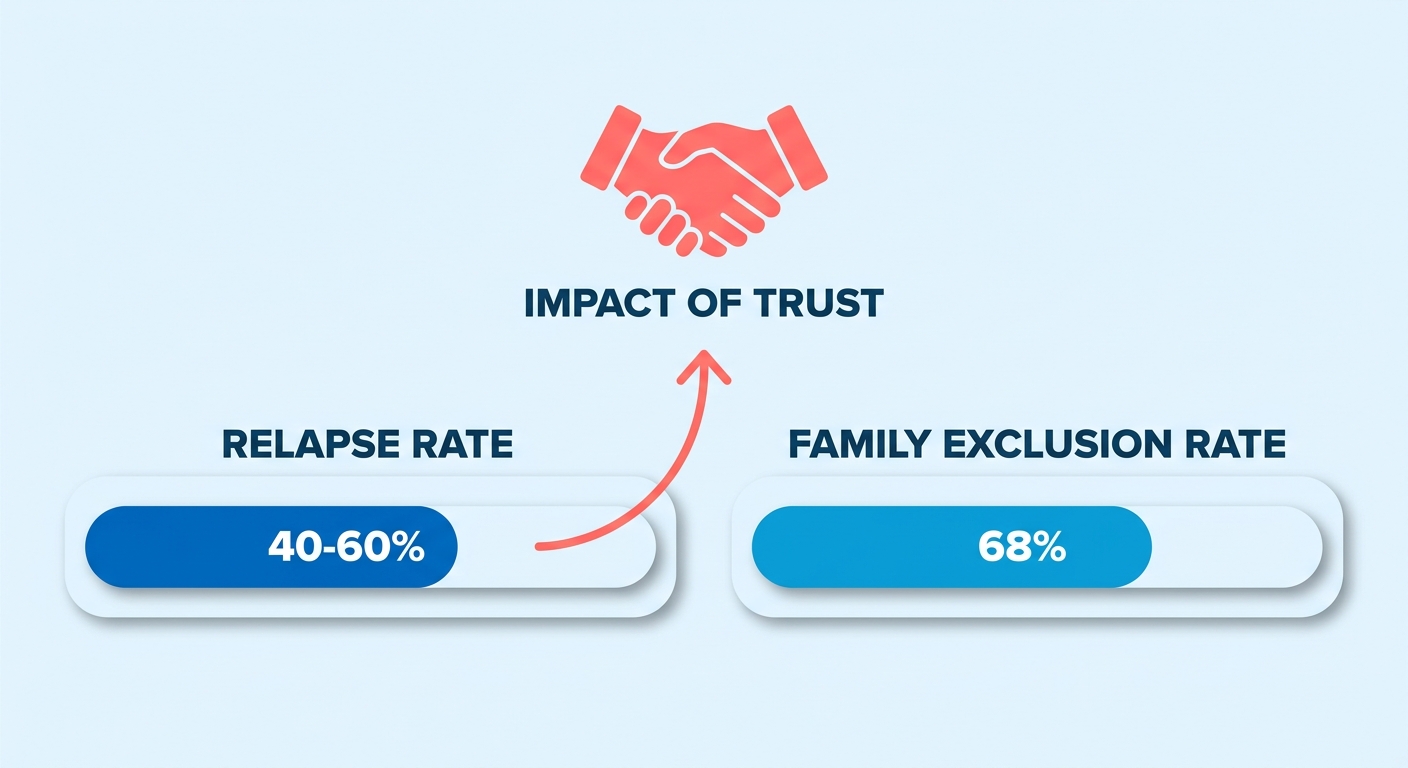
Why the First 30 Days Carry So Much Weight
Families often come home without a roadmap. Nobody tells them what early sobriety looks like. So an ordinary mood shift or schedule change can trigger anxiety. That uncertainty quietly builds tension in the house.
The family-dynamics literature is clear. Unaddressed household tension can disrupt a person's clinical progress. So structured conversation early is not a nice gesture. It addresses a common weak point after discharge.
Does Trust Come Back on a Schedule?
Partly. One useful framing breaks it into stages: early recovery from 0 to 3 months, mid-recovery, then sustained recovery past a year. Consistent action moves you through them. That roadmap is real and worth following.
But sobriety alone doesn't restore closeness. A study of adult children after a parent's rehab found real improvement in family cohesion alongside stubborn emotional distance. One participant said it plainly: trust has to be rebuilt over time, shaped by the old instability "and the hope for more than just sobriety."
So separate two things. Transactional trust rebuilds on a timeline. Emotional intimacy lags behind it. Families get discouraged when they expect both at once.
Who This Helps, and Where a Coach Fits In
This helps newly discharged people, their spouses or partners, adult children, and extended family. One counselor's advice is that you earn your own trust first before your family's. Personal accountability matters. But on its own, that view can repeat the family exclusion research warns about.
We work on both at once. The person leads on accountability while the family stays engaged. A team-based coach acts as a neutral translator, turning behavior into shared meaning. Accountability becomes a two-way conversation, not a solo performance.
That is where routine building and crisis planning matter. When everyone shares the same plan for a hard night, a canceled evening stops looking like a red flag. It starts looking like recovery in motion. We walk families through one honest conversation at a time, because paced dialogue holds better than a rushed hard talk.
Before the Hard Talk: Timing, Readiness, and Safety Nets
The best time for hard conversations is not week one. Wait two to four weeks after discharge before raising the deepest issues — money, broken promises, old betrayals. Those first days are for building a foundation through small, repeated actions.
Push heavy topics too soon, and everyone gets overwhelmed. A household already managing a major transition has little slack. A charged subject dropped early often brings defensiveness and rising anxiety. Give the home a few weeks to settle into new routines before touching the complicated history.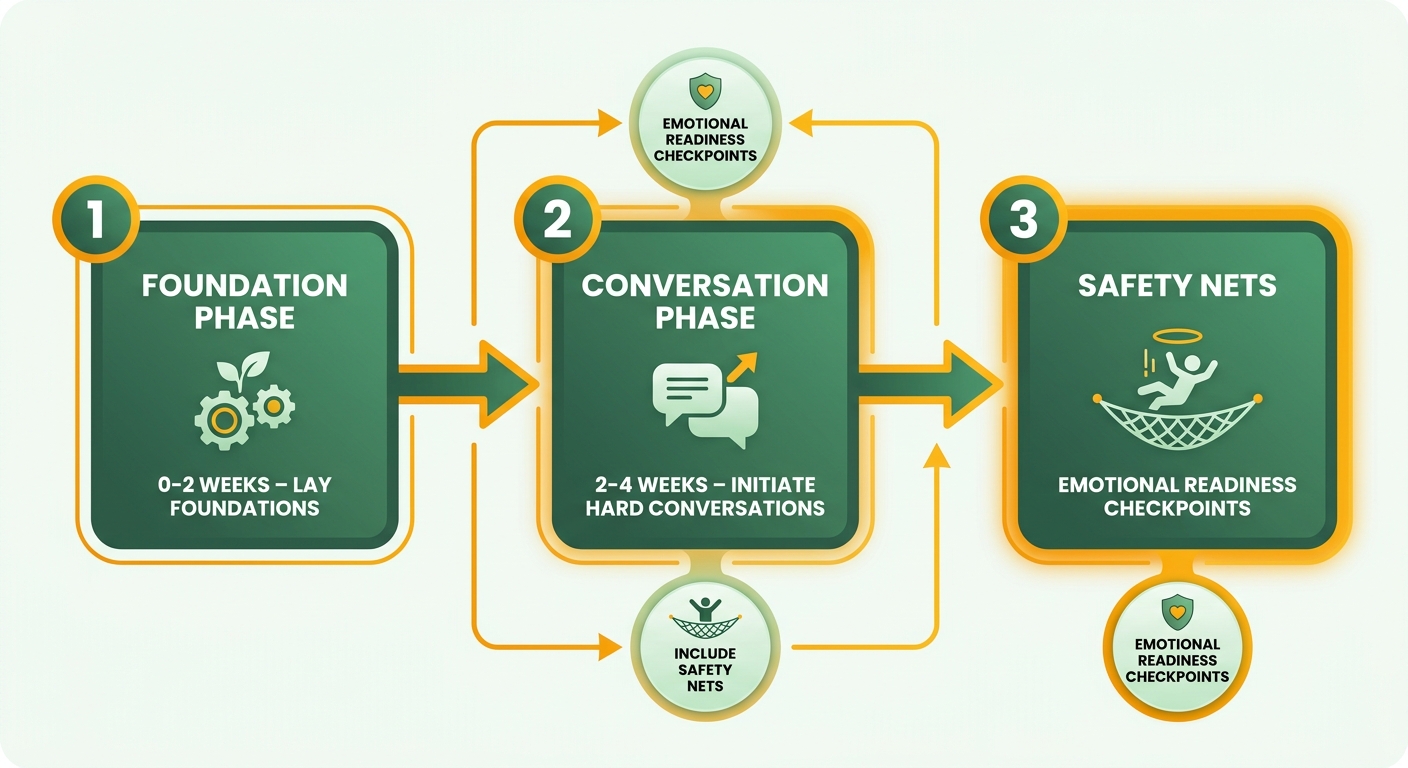
When Is Someone Actually Ready to Talk?
Ready means being able to rate three things honestly and high: calm — can I stay regulated if this gets hard? openness — can I hear hard truth without defending? support — is a coach or ally reachable during and after? If any one is low, the conversation waits.
Readiness is mutual, not one-sided. Loved ones often miss how much their own state shapes the talk. If either person is stressed, exhausted, or already braced for a fight, the conversation won't help.
Patience matters because none of this is linear. Even when daily commitments hold, real safety and comfort take time to return. Saying that emotional comfort often lags practical cooperation keeps people from expecting closeness too soon.
Why Bring in a Neutral Facilitator?
A good facilitator keeps the conversation constructive. Families tackling the deep issues alone often slip into old arguments and defensive patterns. A professional keeps the focus on solutions and makes sure both sides are heard.
This is a core part of team-based coaching. With a coach or coordinated team, families can prepare in advance: sequence the topics, name likely triggers, and set clear boundaries. When the hard subject comes up, the framework helps hold the conversation together.
What Safety Nets Go In First?
Set three things before anyone speaks: a pause word either side can say to stop things instantly, a crisis-call contact reachable in the moment, and an after-call debrief with your coach to process what came up. If a family wants to talk finances, a common flashpoint, use a short cool-down. Agree on a three-day pause before the money talk, so nobody negotiates from a spike of emotion. When the conversation happens, the pause word and debrief keep it from becoming a rupture.
If your family is still finding its footing, the honest-conversation-over-time approach pairs well with this preparation.
In the Conversation: Language, Listening, and Boundaries
The words you use in the first month decide whether a hard talk builds trust or breaks it. Structured language helps. 2022 family-therapy research found 71% of families using it reported lower tension afterward. That is why planned sentences matter before anyone sits down. Foundations are poured in preparation, not in mid-argument improvisation.
The size of the problem is worth seeing. The New Mexico family-systems study, which analyzed interviews with 122 clients and 54 family members, showed how quickly communication breaks down without a framework. Specific, pre-planned tools keep the conversation on collaboration instead of accusation.
How to Use the "I-Message" Formula
I-Message: a sentence built as I feel ___ when ___ because ___, which names your emotion without blame. It keeps the focus on your experience instead of the other person's failure.
Compare two openers. "You always disappear and lie" triggers defense. "I feel scared when you come home late without a text because it reminds me of the using days" opens a door. The second gives the recovering person something to answer, not something to fight.
A parent who says, "I feel anxious when plans change last minute because I'm still learning to trust the new routine," gives their child something to work with. It is not an accusation. That kind of opener can become a joint check-in plan instead of a shutdown. That is the difference structured language makes.
What Active Listening Actually Looks Like
Active listening means proving you heard the other person before replying. Three moves do most of the work: paraphrasing ("So you're saying the daily texts feel like surveillance"), reflecting ("It sounds like you feel watched"), and validating ("That makes sense, given how things were").
These moves lower the heat in hard moments. Show your family member you understood their side, and you open space for real connection. This matters most for the emotional distance that can linger after routines settle.
Setting Boundaries Without Sounding Like an Accusation
State boundaries as your needs, not their crimes. The format is simple: I need ___. "I need a text if you'll be past nine" lands cleaner than "You never let me know where you are."
Pair the boundary with a micro-pause. Take a three-second breath before you respond to anything that stings. That pause lowers reactivity and keeps the conversation from sliding into an old fight.
This differs from more traditional, individual-only recovery advice. Some views hold that the person must focus entirely on self-reliance before engaging the family. We think family support from the start builds a sturdier recovery.
A professional can help boundaries sound clear and respectful. Families who want structure can lean on support for pacing difficult dialogue. And if safety is ever at stake, boundaries come before any conversation.
Small, Consistent Actions That Rebuild Trust Day-to-Day
Rebuilding a relationship depends on daily, visible actions, not grand promises. Brief, structured habits give family members something they can see. That moves accountability from an abstract idea to a shared effort.
Early recovery is a balancing act between individual responsibility and family connection. The person keeps personal commitments while the family supports the home. The daily practices below bridge those two goals.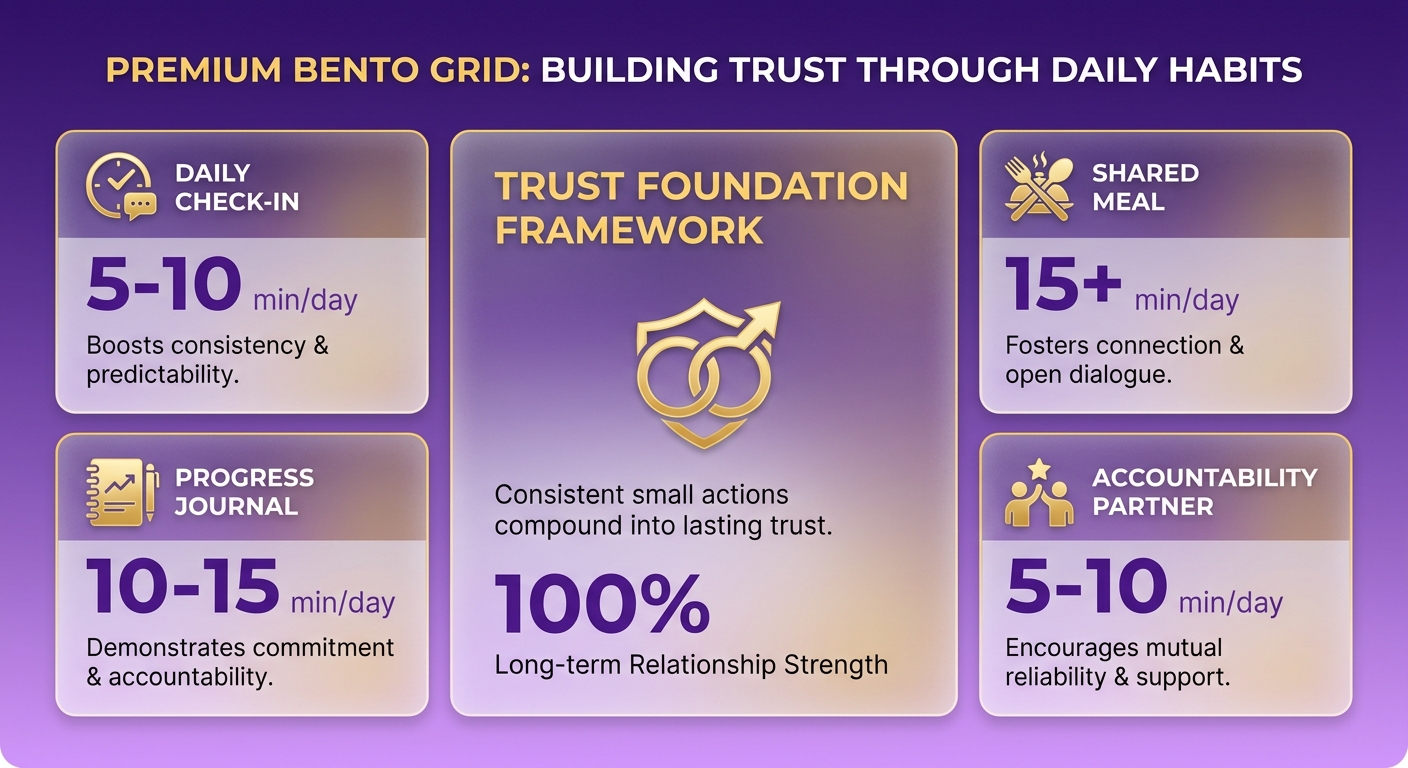
What a Daily Check-In Ritual Looks Like
Daily check-in: a five-minute morning or evening status update where you name how you're doing and what you've got planned for the day. Keep it short and predictable. Depth isn't the point. The point is that it happens every day, so your family stops guessing and starts seeing.
Having a professional facilitate the early ones keeps them brief and focused. A coach can keep the updates objective so they don't drift into therapy sessions or interrogations. That helps the check-in become a reliable, low-stress routine.
The daily check-in is the first routine we point families to, because predictability rebuilds trust. It is small, repeatable, and easy to protect. Start there before anything else.
Sharing Responsibility Without Micromanaging
Split ordinary tasks with clear ownership, then let the results speak. A simple chart does the job: who does the grocery run, who handles a bill, who cooks. Written ownership turns "you never help" into "you own Tuesday's dinner," which is easier to check.
Two low-effort routines carry real weight:
- Nutrition partnership: cook a sober-friendly meal together twice a week. Shared work in a shared kitchen rebuilds the everyday support that aids recovery.
- Transparent financial tracking: log spending in a shared spreadsheet or app. Clear visibility into household spending addresses money anxiety before it festers.
Why Keep a Trust "Win" Journal?
Each family member writes down one trustworthy action they saw that day. It creates a record of progress and keeps the family focused on improvement instead of mistakes. A family might pair it with a weekly shared meal, giving them a set time to talk through those observations.
Rebuilding a relationship is long-term work, and consistency matters most. Stop the win journal once it starts feeling like a performance metric. Otherwise, the small daily efforts reinforce the progress from your structured family talks.
Keeping Trust Long-Term: Routines, Review, and Renewal
The first 30 days build the foundation. The next year decides whether it holds. Trust rebuilds in stages, and what works at month one is not what works at month six — Ashley Treatment maps it as early recovery (0–3 months), mid-recovery (3–12 months), and sustained recovery. Strong foundations stay strong only if you keep checking them.
As recovery continues, remember that different parts of a relationship heal at different speeds. Practical cooperation and daily routines usually stabilize faster. Deep emotional intimacy takes longer. Naming that difference helps families keep working on the emotional side even after daily life looks normal again.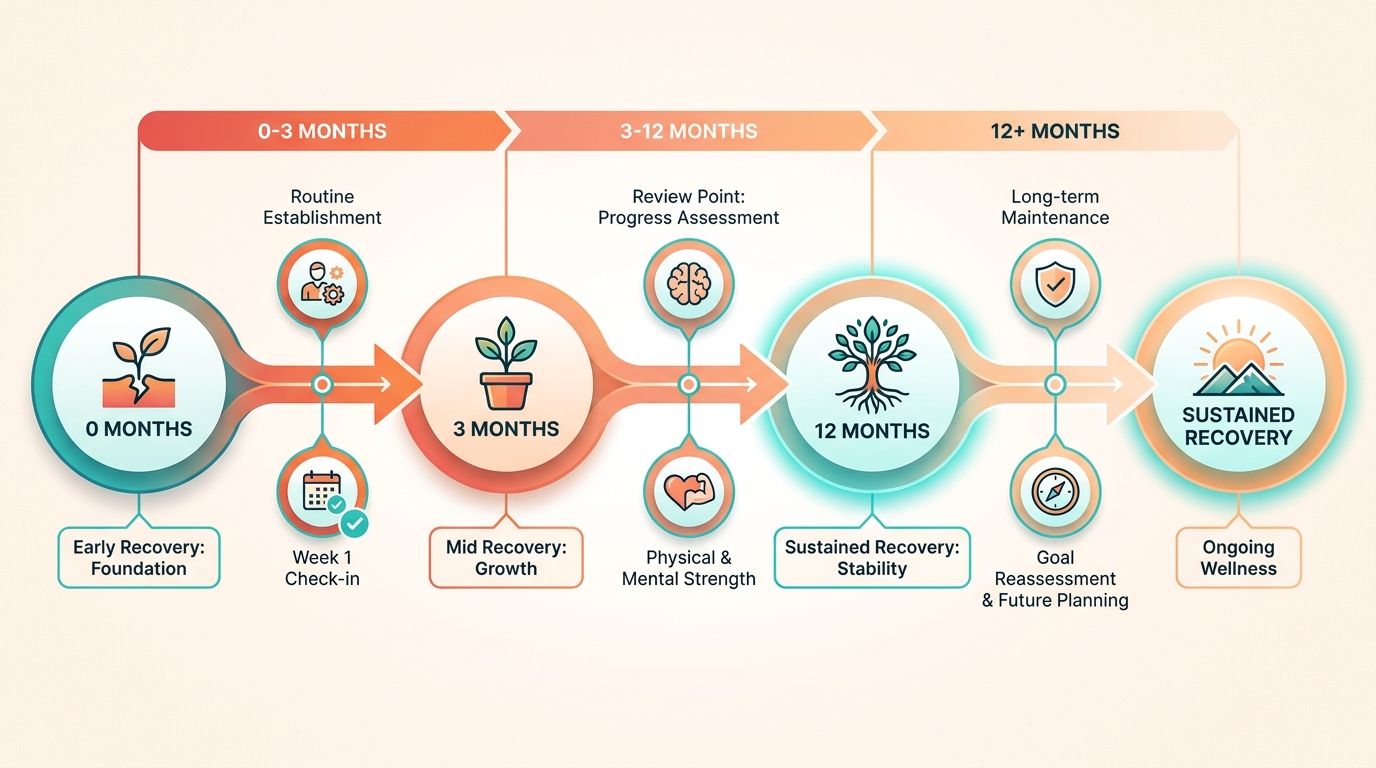
How to Run a Quarterly Trust Review
Quarterly trust review: a scheduled sit-down every three months where the family re-scores where trust stands and adjusts the plan. Put the current picture next to your starting baseline, then name what improved and what stalled.
These reviews work best when both sides speak. The person in recovery and the family should both weigh in on the transition. Keeping it mutual makes communication a shared effort, with everyone able to voice needs and adjustments.
Score behavioral trust and emotional trust on separate lines. You might rate "keeps commitments" strong and "we talk about hard feelings" weak. That split shows exactly where to focus next quarter.
Renegotiating Boundaries When Life Changes
Big life events reset the ground. A new job, a move, a new baby — each one changes stress levels and daily routines. So the boundaries set at month one may not fit month eight. Renegotiate them before the change, not after a crisis. If a family faces a stressful cross-country move, they can call a short "trust-reset" meeting to re-agree on check-in times and high-risk plans. That kind of deliberate reset protects sobriety through the disruption instead of gambling on it.
Our take: because our programs are fully customized and shift as needs change, big transitions are exactly when coaching matters. Life-event planning is where accountability and consistent care do their work.
When Should Coaching Taper Off?
Coaching hours should drop as family self-reliance rises, not on a fixed calendar. The two move together. As a family gets better at running its own honest conversations, our support intentionally tapers to build independence and long-term stability.
A gradual step-down helps make sure the family has built the skills to keep these routines on its own. Individual accountability stays the foundation, but open communication keeps the family from feeling cut off. Taper too fast, and you can undo progress. Let the family's comfort level set the pace.
Mark the milestones. Three months, six months, one year — real anchors. Celebrating them together reinforces that this was shared work, not a sentence served alone.
References
[1] How Do I Regain My Loved Ones' Trust After Rehab? - https://www.addictioncenter.com/rehab-questions/regaining-loved-ones-trust/
[2] 6 Ways to Restore Trust While in Recovery - https://www.ashleytreatment.org/rehab-blog/6-ways-to-restore-trust-while-in-recovery/
[3] (PDF) Adult Children's Lived Experiences of Family ... - https://www.researchgate.net/publication/399033312_Adult_Children's_Lived_Experiences_of_Family_Change_Following_Parental_Drug_Rehabilitation
[4] Family systems as support and impediment to recovery - https://www.researchgate.net/publication/51608111_Everything_that_I_thought_that_they_would_be_they_weren't_Family_systems_as_support_and_impediment_to_recovery
Frequently Asked Questions
1. Can I rebuild trust after rehab without involving a coach or facilitator?
Yes, but it takes strong discipline and clear communication. A professional facilitator helps set objective guidelines and prevents talks from sliding back into old arguments. They act as an objective guide, helping both sides express concerns without triggering defensiveness.
2. What if my family member relapses during the first 30 days?
If a relapse happens, address it using the pre-established safety plan. Do not treat it as a total failure. A clear, agreed-upon protocol for professional help or support networks helps keep the situation calm and safe, while reducing panic and emotional escalation.
3. How long until my family feels emotionally close to me again, not just trusting?
Emotional intimacy usually takes much longer than daily cooperation. Reliable behavior can show up fairly quickly through consistent actions. Rebuilding deep emotional comfort and vulnerability takes patience and open communication over many months.
4. Should I apologize for everything right away when I get home?
It is usually better to focus on daily reliability first. Rushing into major past conflicts right away can overwhelm everyone. A stable, predictable routine in the first few weeks gives those difficult conversations a safer foundation later.
5. What if only I want to do this work and my family stays disengaged?
If family members are hesitant, keep showing consistent, positive behavior without demanding immediate participation. Reliability over time can gradually encourage them to engage. You can also offer low-pressure opportunities for structured discussions when they feel ready.
6. How do I bring up money without starting a fight?
Bring up finances by focusing on objective, forward-looking solutions instead of past mistakes. Set clear, agreed-upon boundaries for the discussion, such as focusing on budgeting and tracking rather than blame. If the talk gets heated, agree to take a break and return when everyone is calm.
7. Does trust rebuilding stop after the first year?
Maintaining trust is an ongoing process. As relationships stabilize, the focus shifts from basic reliability to long-term growth and life transitions. Reviewing communication agreements from time to time helps them keep meeting the family's needs as circumstances change.