Need a Sober Coach After Rehab? 3 Gaps to Check Before Day 90
October 26, 2026

Key Takeaways
- The transition after residential treatment deserves a concrete support plan, not a vague promise to "stay on track."
- Three gaps commonly emerge after rehab: structure, accountability, and readiness for high-risk situations.
- Relapse risk often shows up behaviorally before it shows up as a clear craving.
- A sober coach helps turn a discharge plan into daily action through practical support, pattern recognition, and availability during vulnerable moments.
- Emotional relapse is often visible in self-care long before someone consciously decides to use.
- Less frequent clinical contact after discharge can leave long stretches where small problems go unnoticed.
- In-person support during difficult transitions can be more useful than relying on scheduled calls alone.
Why the first 90 days look different than rehab
The discharge paperwork lists relapse-prevention strategies, outpatient appointments, and mutual-support meetings. None of it explains what Tuesday at 2 p.m. feels like when the day has no built-in structure and no one is checking whether you ate lunch or went to bed at a reasonable hour.
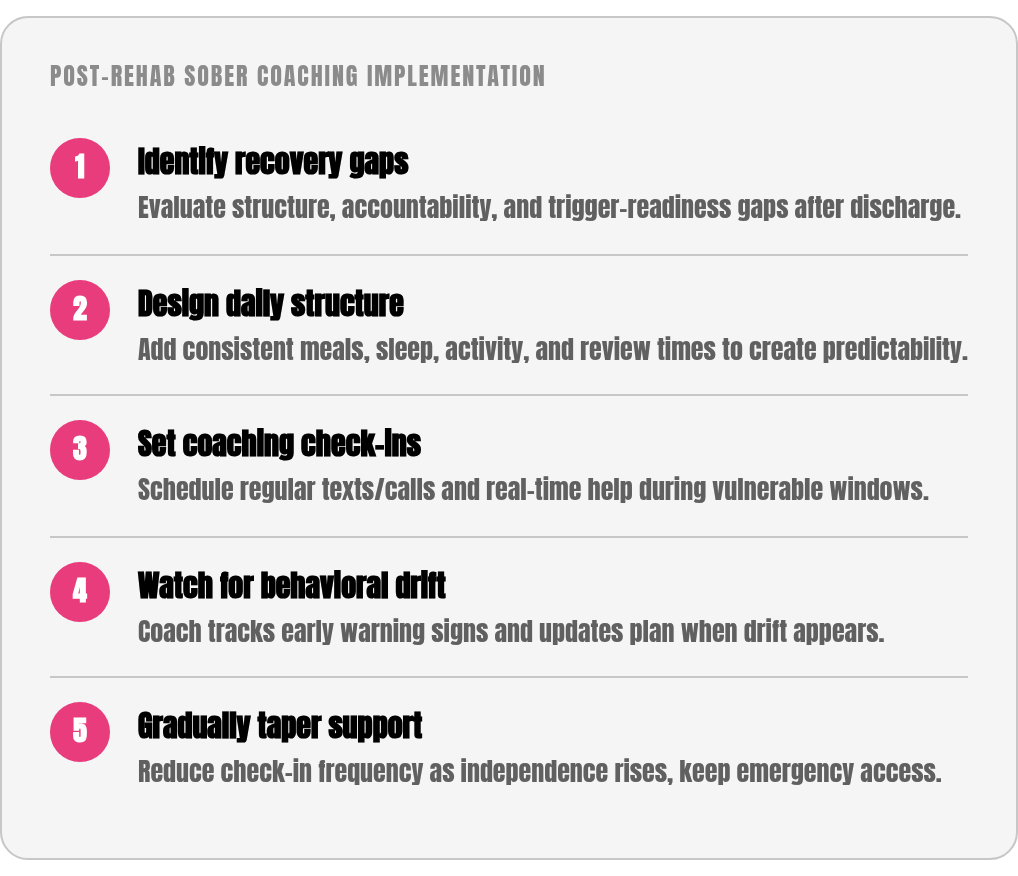
The first 90 days carry elevated relapse risk, and relapse remains a common concern during this window. That statistic reflects a mismatch between what residential treatment provides and what happens when you walk out the door. Treatment builds a scaffold: group sessions anchor the morning, meals mark transitions, therapy appointments give the afternoon direction. At home, that scaffold disappears overnight. You are expected to recreate stabilizing routines in the same environment where old patterns already felt familiar.
The breakdowns fall into three categories. The structure gap appears when open-ended days replace programmed schedules. The relapse-risk review cited in the references links depression to higher relapse risk, and that depression often shows up as skipped meals, irregular sleep, and social isolation before cravings become obvious. The accountability gap emerges when clinical contact drops from daily sessions to weekly or biweekly check-ins, leaving long stretches where no one notices if recovery tasks slide. The trigger-readiness gap hits during high-risk transitions—airports, family gatherings, work stress—when isolation and trigger-rich environments converge without a concrete plan.
A sober coach addresses these gaps through practical guidance, scheduled check-ins, real-time accountability during vulnerable moments, and emergency support when routines break down—not through therapy or medical intervention.
The evidence also has limits. The research cited above confirms elevated relapse concern during the early post-discharge period. It does not establish an average timeline at which most people feel stable. Treat 30-, 60-, and 90-day marks as planning checkpoints rather than milestones where coaching should taper. There is no evidence-based estimate for how quickly coaching impact appears, and the available research doesn't establish which MADE Recovery offerings map to specific gap-closure strategies.
Formal continuing care—outpatient treatment, mutual-support groups, therapy—often works alongside coaching. A systematic review of peer recovery support services indicates that recovery-informed peer support from individuals with lived experience can produce meaningful outcomes in maintaining sobriety. The outcome research also suggests that individuals who maintain sobriety tend to show stronger self-efficacy than those who relapse. General social support—family encouragement, friends checking in—is not the same: it can be emotionally valuable but lacks recovery-specific pattern recognition. Coaching sits between those categories: more structured than informal encouragement, less clinical than therapy.
Two points matter most when deciding whether to add this layer of support. First, coaches monitor daily routines as an early-warning system rather than waiting for a crisis. Poor self-care defines emotional relapse, the stage where individuals are not yet thinking about using but their behaviors are creating risk. Second, presence matters. The value is not just another weekly accountability call. It is having support close enough to intervene when routines, stress, and isolation start combining.
Why coaching fills a gap formal treatment was never meant to cover
When someone leaves residential care, they are returning to the environments, routines, and relationships that shaped daily life before treatment. A sober coach acts as a bridge between the protected clinical setting and ordinary life, helping the person follow through on the plan they created before discharge.
That bridge matters because early recovery is not only about motivation. It is about logistics. Someone may understand their relapse-prevention plan perfectly and still struggle when the day has no built-in structure, no group schedule, and no immediate feedback when they start withdrawing. Coaching makes the plan visible in real time: appointments are tracked, routines are reviewed, and warning signs are addressed while they are still small.
Our approach recognizes what coaching can and cannot do. A coach will not prevent relapse through willpower alone, and coaching is not a substitute for medical care or therapy. What it can do is help establish the daily conditions that support stability: consistent routines, honest check-ins, and connection during the parts of the week when someone is most likely to drift.
When behavioral drift shows up before cravings do
When someone returns home from residential treatment, depression symptoms often increase among those who eventually relapse. That depression does not always announce itself as sadness. It can look like a slow loss of rhythm: fewer commitments kept, less movement through the day, and more time spent alone without a plan. A sober coach watches for those changes because behavioral drift often appears before someone can clearly name what is happening.
What it looks like when days blur together
Sleep becomes inconsistent—midnight to noon one day, 3 a.m. to 11 a.m. the next—because no one is enforcing wake-up times anymore. Meals happen whenever, if at all, because meal times no longer mark the day. Activity drops off because the built-in gym time and group walks are gone. Work boundaries blur because there is no programmed separation between tasks and rest.
The absence of a framework that tells you what comes next creates vulnerability. Without daily anchors, it is harder to notice when things start drifting. A person may not feel in trouble yet. They may simply feel bored, restless, or disconnected. That is exactly why structure needs to be installed before motivation drops, not after.
A starting framework
A daily structure can include several core elements. Morning check-in at the same time each day, even weekends. This could be a text to your coach, a log entry, or a brief call. Planned meals at consistent times, even if you are eating alone. One scheduled activity—a meeting, a walk, grocery shopping—that gets you out of the house. Clear work hours with a defined stopping point. Evening review to note what worked and what did not.
The goal is not rigidity. It is creating enough predictability that you can spot when things drift. The relapse-factor literature cited above links self-care routines to protection against behavioral drift before relapse. When days blur together, the schedule is not just a productivity tool. It is an early-warning system.
How to decide whether coaching addresses your specific gaps
Start with a simple self-assessment: Are you returning to an unstructured home environment? Do you have someone who will notice when your routine starts slipping? Can you identify the moments when you are most likely to disconnect—unplanned evenings, social events, return-to-work pressure—and do you have support during those windows?
These are not clinical diagnostic questions. They are practical ones. Sober coaches help people show up, stay connected to care, and translate intentions into behavior when formal treatment structure is no longer organizing the day.
Why lived experience changes what gets noticed
Not all accountability is equal. When a coach has lived experience, that background can help them notice warning signs before you have fully articulated them: the skipped gym session, the declining phone calls, the "I'm fine" that sounds different this week. The value is recovery-specific pattern recognition, not family history or emotional pressure.
When choosing a coach, match intensity to the risk markers. If depression is high, self-care is already drifting, or self-efficacy is low, prioritize more present support—physical companionship during travel, social events, or unstructured time. If routines are fairly stable, lighter check-ins may be enough. Our team provides physical companionship during these moments, not just scheduled check-ins afterward.
Building a plan that evolves with your needs
We build fully customized coaching programs that evolve as your needs change, with support intentionally tapering as you gain independence. Your plan should include daily structure anchors, trigger logs, appointment tracking, and emergency contact protocols. Families can participate by agreeing on communication expectations and supporting appointments without surveillance or coercion.
Use the gaps as a planning map:
- Structure gap → Routine design, meal planning, sleep consistency, and scheduled activity
- Accountability gap → Check-ins, progress review, and direct feedback when follow-through drops
- Trigger-readiness gap → Support plans for vulnerable windows, including companionship when being alone would raise risk
Our coaching coordinates around medical care, therapy, and medication management rather than replacing them. If you want to discuss how our team approaches post-rehab support, contact us to ask about coaching options or consultation.
References
[1] Sober Coaching: How It Works, Key Benefits,… - Caron Treatment Centers - https://www.caron.org/addiction-101/treatment-advice/sober-coaching
[2] Relapse Prevention and the Five Rules of Recovery - PMC - NIH - https://pmc.ncbi.nlm.nih.gov/articles/PMC4553654/
[3] (PDF) Peer Recovery Support Services and Recovery Coaching ... - https://www.researchgate.net/publication/390092484_Peer_Recovery_Support_Services_and_Recovery_Coaching_for_Substance_Use_Disorder_A_Systematic_Review
[4] Risk and protective factors for relapse after residential substance use ... - https://www.researchgate.net/publication/410738679_Risk_and_protective_factors_for_relapse_after_residential_substance_use_treatment_a_systematic_review_and_meta-analysis
FAQ
1. How does sober coaching differ from outpatient therapy after rehab?
Outpatient therapy is a clinical service delivered through scheduled sessions. Sober coaching works in the day-to-day layer of recovery: helping someone follow through on routines, attend commitments, stay connected, and respond quickly when warning signs appear between appointments.
2. Can my family provide the same accountability as a sober coach?
Family support can be valuable, but it is not the same as peer coaching. A coach brings recovery-specific pattern recognition and a role that is separate from family history, conflict, or emotional pressure. Families can still help by supporting structure, respecting communication agreements, and encouraging care without turning the home into surveillance.
3. If I'm already in outpatient treatment, do I still need a coach?
You may not need one if your daily structure is solid and you have reliable support during vulnerable periods. A coach becomes more useful when the main problem is follow-through outside the therapy room: getting to appointments, maintaining routines, handling unstructured time, or reaching out before a difficult moment turns into a crisis.