How to Support a Loved One in Early Recovery
August 17, 2026

Key Takeaways
- Only 19% of the 23.1 million people who needed substance use treatment in 2012 actually received it, leaving families without support.
- The brain's frontal cortex begins healing around 90 days after detox, but full neuroplasticity requires 9 to 18 months of recovery time.
- Post-Acute Withdrawal Syndrome can persist for up to two years, creating a biological timeline that rarely matches family expectations.
- Family and friend support is the critical system patients depend on during early recovery, but only when it matches actual needs.
- Addiction damages the family bond first, making coordinated support nearly impossible without a neutral third party.
Why Supporting a Loved One in Early Recovery Matters
Families wrestle with a painful question in the days after detox: is my being here helping, or am I making this harder? Clinical insights from Riverside Health suggest close relationships are vital, but their effectiveness depends entirely on alignment. Caregiver involvement only moves the needle when it's structured around the individual's specific stage of change rather than the family's anxiety.
This misalignment points to a broader problem. Most people facing substance use challenges do not access formal care, leaving countless families to navigate the crisis alone. When a household tries to manage these dynamics internally, emotional history often distorts communication. Structured recovery pathways become difficult to sustain without professional mediation.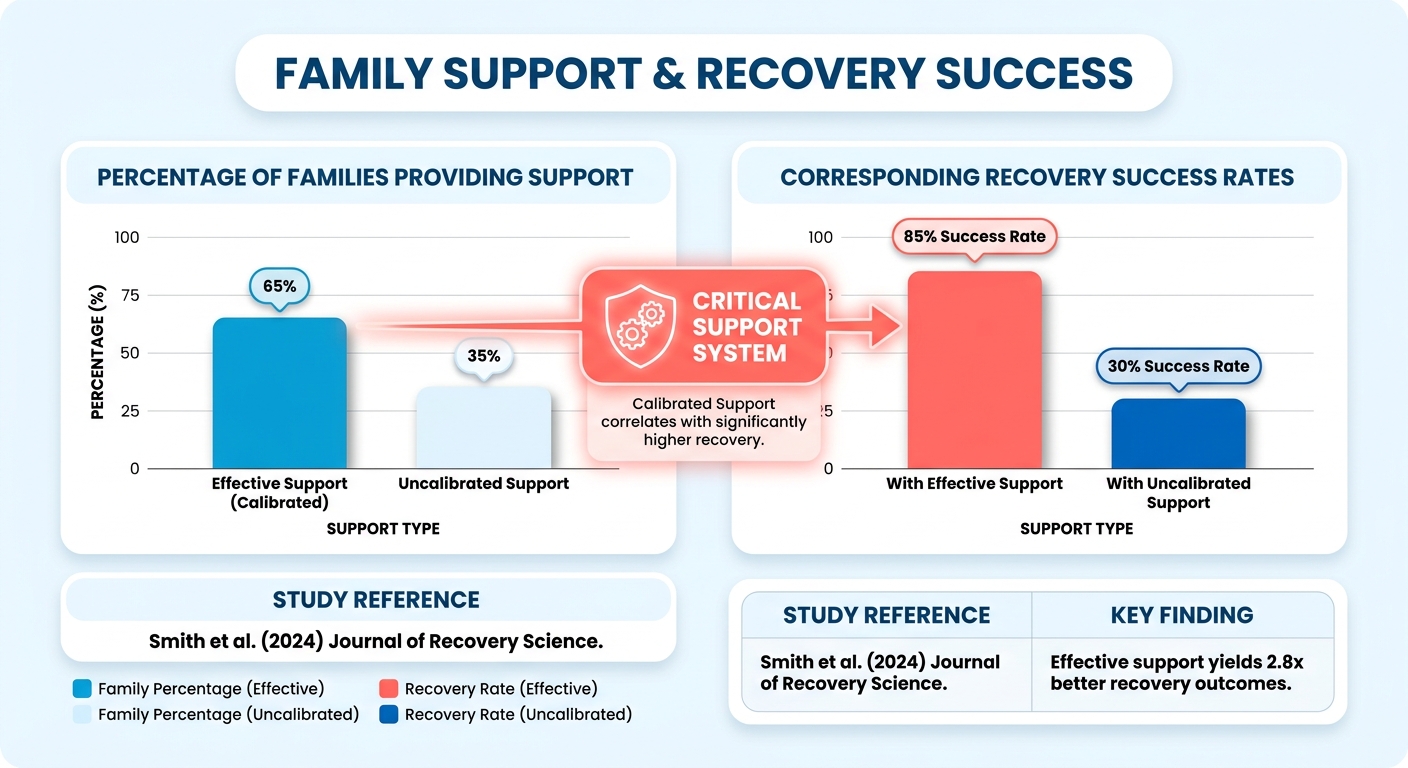
The Biology Sets the Timeline, Not Your Expectations
During the first phases of sobriety, cognitive deficits and emotional instability are common as the brain undergoes structural repair. According to the Penn Foundation, expecting rapid behavioral stability ignores the reality of neurological healing. When families operate on an accelerated emotional clock, they often misread normal cognitive lag as a lack of motivation.
This mismatch creates a destructive cycle. A parent expects visible progress within the first quarter, but the individual is still navigating mood swings and executive dysfunction. The family reads this sluggish progress as a lack of effort, while the individual interprets the family's frustration as rejection. Both sides spiral.
A recovery coach who understands that timeline absorbs the mismatch. We specialize in transitional coaching, bridging the gap between treatment and independence with accountability, guidance, and real human connection. We assist families as they manage the recovery process. That protective layer keeps the relationship from fracturing under expectation-driven conflict that pure family support structurally can't avoid.
When Support Flips Into Harm
Eighteen individuals in recovery were interviewed about what family involvement actually felt like. They named 18 categories of relational factors, half helpful, half harmful. The takeaway: family support can hinder recovery just as easily as it can help. The same behavior, checking in daily, setting boundaries, or offering advice, lands differently depending on the individual's readiness and the family's communication style.
This duality requires family involvement to be negotiated rather than assumed. Because families are emotionally invested, they struggle to judge whether their actions foster independence or enable dependence.
Our role is to hold that mirror. We provide the guidance and accountability families are too close to offer, supporting them as they manage recovery pathways. Natural consequences outperform punishment in motivating change, but emotionally involved families struggle to let consequences happen without intervening. A coach provides the distance families can't manufacture on their own.
The Communication-Pattern Trap
Support-group participation and coping outcomes track with a family's conversation orientation, how openly they communicate, rather than addiction severity. Families with closed communication patterns are least likely to seek help when they need it most. If your household defaults to conflict avoidance or surface-level check-ins, group-based family resources won't reach you.
A recovery coach delivers consistent accountability that doesn't depend on the family already having healthy communication patterns. We show up regardless of whether the household talks openly or keeps everything under the surface. That structural independence is what family-only resources can't replicate; they require the family to already function well enough to ask for help.
We also address the paradox no one wants to name: confrontation adversely affects motivation, yet families instinctively escalate when they feel powerless. The urge to do something, anything, often becomes pressure, ultimatums, or unsolicited advice, all of which backfire. Our coaches offer steady guidance and real human connection, giving families a neutral partner as they manage recovery. For more on structuring family roles so no one burns out, this breakdown of recovery workload walks through what we see work in practice.
Assessing and Rebuilding Healthy Relationships
Rebuilding a relationship requires moving past the crisis-response mode that defines active addiction. Families often struggle to determine whether their actions are helpful or intrusive. Using resources like Riverside's family guidance can help clarify these boundaries, ensuring that support is offered collaboratively rather than imposed unilaterally.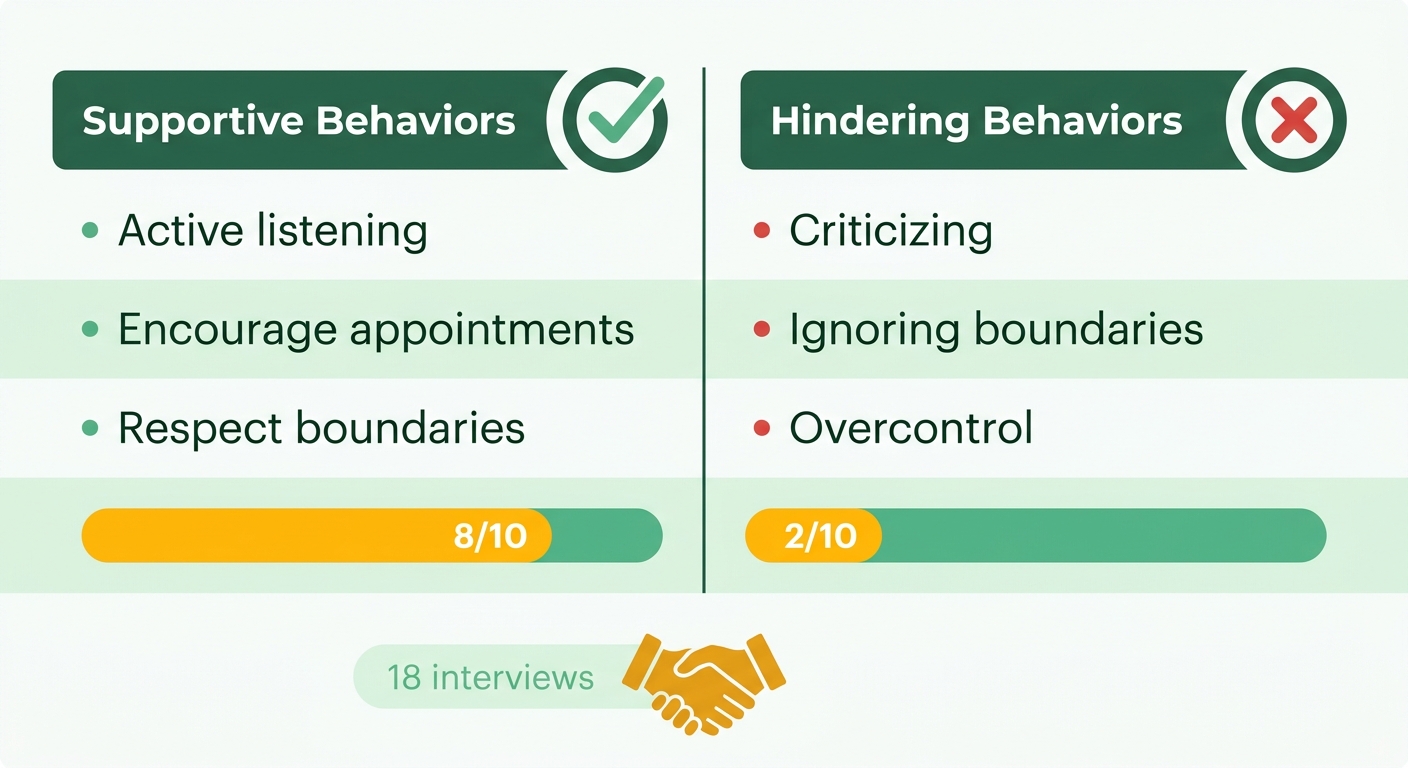
How Do You Assess a Relationship Before Rebuilding It?
Start by naming what the relationship does, not how it feels. Ask a plain question: does this connection support sobriety, or does it quietly protect old patterns? Research on family communication patterns and coping surfaced three honest coping themes: building protective boundaries, creating new ways to love, and collaborating with informed support.
Using these coping themes takes active effort. Establishing protective boundaries often feels counterintuitive to a worried parent, while finding new ways to love requires separating the individual from the disease. A coach helps families put these concepts into practice with a structured framework.
What Does Loving Detachment Actually Require?
Loving detachment means treating a setback with compassion while refusing to shield the individual from the outcomes of their choices. Boundaries are a form of love, not a withdrawal of it, as one person in long-term recovery put it after crediting family support for his success. The hard part is holding both at once.
This is where emotionally invested families falter. Compassion for a relapse and firm consequences feel contradictory when you love the person. Objective distance makes it possible. Splitting the roles so no one carries all of it helps too.
Where Does a Coach Bridge the Gap?
Because neurological recovery is slow, families often feel frustrated when progress seems to stall. A coach helps manage these expectations by educating the family on the physiological stages of healing, ensuring that milestones are measured realistically rather than emotionally. Penn Foundation's insights emphasize that understanding this timeline prevents premature burnout.
A coach anchored to that biological clock absorbs the mismatch. They translate slow progress into something the family can hold onto, protecting the relationship from expectation-driven friction that family-only support tends to generate.
Encouraging Participation in Support Groups
Support groups do two things family alone can't: they surround your loved one with people who've walked the same road, and they add accountability that doesn't come loaded with family history. That combination matters. Research on family recovery support groups found that families engaged in these networks scored higher on coping and resilience than those who weren't, and the same benefit extends to the person in recovery.
A recovery coach helps bridge the gap between recognizing the need for a support group and actually attending one. By acting as an objective facilitator, a coach can help lower the emotional barriers that prevent families from seeking external help, ensuring that the process of finding a group is collaborative rather than conflict-ridden.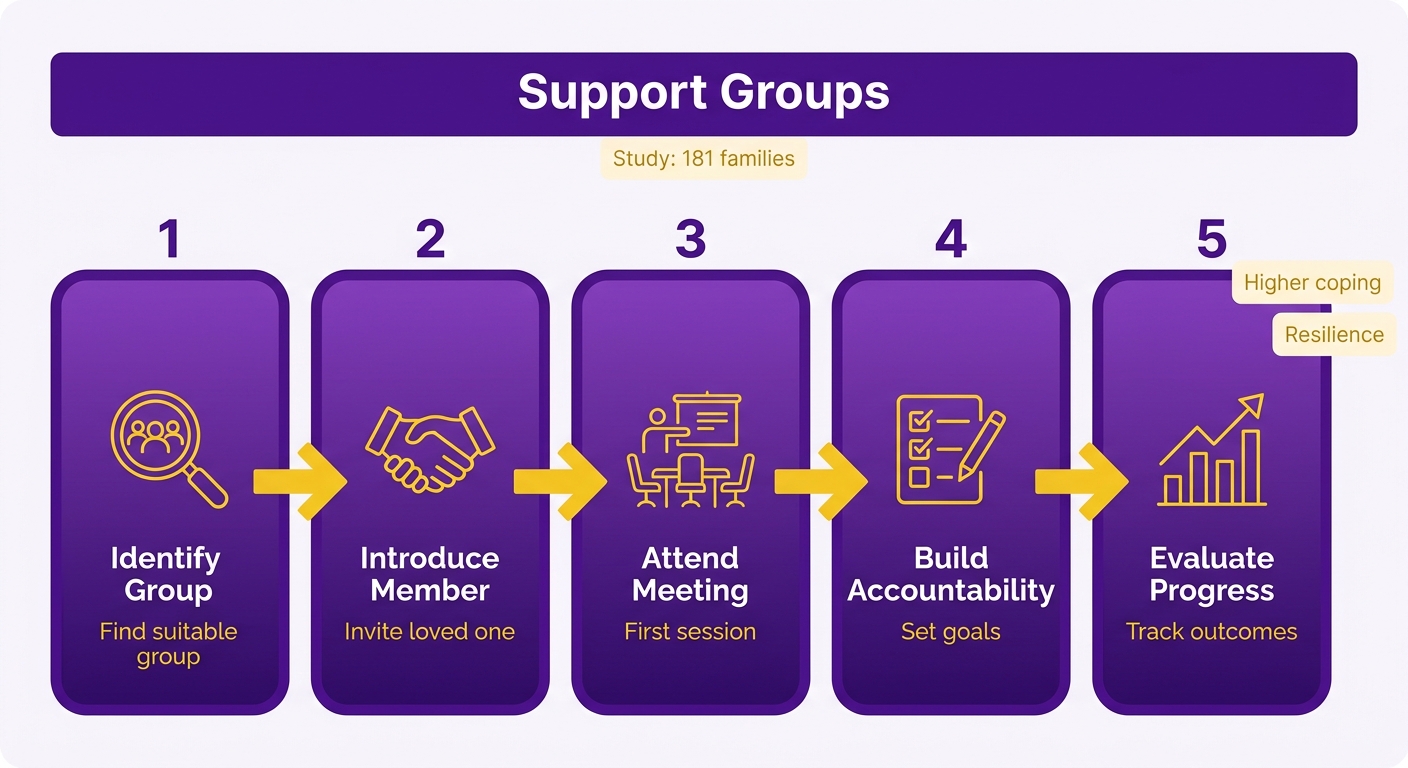
What types of support groups should you be aware of?
Support groups fall into two broad families: 12-step programs and non-12-step alternatives. The right fit depends on your loved one's beliefs, personality, and what didn't work before.
Twelve-step groups follow a structured, peer-led framework and have the widest availability, in-person and online. Non-12-step groups lean on cognitive and behavioral tools instead of a spiritual framework, which suits people who bounce off the traditional model. There are also groups built specifically for you, the family member. Al-Anon Family Groups and facilitated family recovery groups give caregivers their own space to process the toll, because family members have a recovery process too, not just the person leaving detox.
Why does group timing cause family friction?
Early recovery is often marked by cognitive fatigue, mood swings, and difficulty concentrating. According to Sanford Behavioral Health, these symptoms can make the structured environment of a support group feel overwhelming. When families expect immediate, active participation, they may overlook the mental exhaustion their loved one is experiencing.
Nine focus groups with people in recovery and their families surfaced real tension when expectations diverged from physiological capacity. A coach can help mediate this tension, identifying when encouragement is helpful and when it risks causing burnout.
How do you actually encourage participation?
Lead with education, not ultimatums. Understanding addiction as a chronic disease, as Pine Rest emphasizes, reframes a missed meeting as a symptom to work through, not a personal failure.
Then give space for choice. Clinical insights from Riverside Health suggest that autonomy drives long-term engagement. Offering practical assistance, like researching local meetings or providing transportation, allows the individual to take ownership of their recovery path.
Skip the hard push if your loved one is actively resistant and you're the only one asking. That's when family-only pressure calcifies into conflict, and when an outside coach carries the accountability you can't. If you're worried about who owns what, our guide on splitting family recovery roles helps keep any one person from becoming the sole enforcer.
Offering Practical Help and Support
Caregiver support matters most when it shows up in the routines someone actually lives: meal prep, rides to meetings, and daily check-ins. In our experience, families often want to help but struggle to translate goodwill into the specific, daily actions early recovery demands. A recovery coach steps in to help establish these daily structures, ensuring they are realistic and sustainable for both the individual and the family.
What Does Practical Help Actually Look Like?
Practical help isn't grand gestures. It's driving your loved one to their outpatient appointment on a Tuesday morning when they're too exhausted to trust themselves behind the wheel, or stocking the fridge with simple meals. Recognizing the cognitive fatigue described by Sanford Behavioral Health helps families understand that missed texts or forgotten plans are often symptoms of mental exhaustion rather than a lack of commitment.
We see families burn out because they try to do everything at once. You don't need to. Start with transportation. Getting to support groups and therapy sessions is non-negotiable, and early recovery often means a suspended license or simply not trusting yourself to make the drive. Meal planning comes next. The brain is relearning how to regulate appetite and routine; having consistent, easy access to food removes one decision from a day already full of them.
A coach adds value family alone can't: we help define the boundary between supportive assistance and enabling. By referencing resources like Families for Addiction Recovery, we help families identify when to step back and allow the individual to navigate their own challenges. We track progress week to week, ensuring that support evolves as the individual's capacity increases.
Crisis Planning: Preparing for the Hard Days
A crisis in early recovery isn't always dramatic. It's your loved one calling at 10 p.m. because they're sitting in a parking lot outside a bar, not yet inside but not driving away either. It's waking up to a text that says "I don't think I can do this anymore" with no context for what "this" means. Families need a plan before the crisis hits, not because your loved one will definitely relapse but because uncertainty magnifies panic, and panic drives bad decisions on both sides.
We help families script their responses ahead of time. Knowing who to contact, whether a sponsor, therapist, or coach, reduces panic. When communicating during a high-stress moment, avoiding accusatory language matters. As noted by Families for Addiction Recovery, high-pressure interactions can decrease an individual's drive to stay on track, making a calm, structured response necessary.
A coach can take the call. We're not panicking because we're not grieving the version of your loved one you wish they still were. We can ask the direct questions, are you safe right now, do you need to go to the hospital, what triggered this, without the conversation collapsing into blame or despair. That's the piece caregiver support alone struggles to provide: the ability to stay calm and directive when the stakes are highest.
Addressing Isolation Without Smothering
Early recovery is isolating. Old friendships often revolved around using, so cutting ties with that circle can leave your loved one with a nearly empty contact list overnight. The people who remain may not understand why they can't "just have one," or may have written them off entirely after years of broken promises. You want to fill that gap with companionship, and you should, but not every hour of every day.
We watch families overcorrect. Filling a loved one's calendar with social obligations can be overwhelming. Guidance from Riverside Health suggests that allowing space for quiet reflection is just as important as offering connection. The goal is to provide a supportive presence without making the individual feel monitored.
A coach offers companionship that doesn't come loaded with family history. We can sit with your loved one through a hard afternoon without either of you wondering if this moment will define your relationship going forward. We also connect them to peer support that isn't you: people who've been where they are and came out the other side. Listening without judgment is one of the most powerful tools in early recovery, and sometimes that listening needs to come from someone who isn't waiting for them to turn back into the person they were before the addiction started.
Our role isn't to replace family support. It's to absorb the parts of early recovery that family struggles to manage alone: the daily check-ins that feel intrusive coming from you, the crisis calls that land better when they're fielded by someone who isn't also terrified, the evolving boundaries that shift as the brain heals. You stay close. We stay calibrated.
Transitioning to Ongoing Support and Tapering
Tapering support isn't the same as withdrawing it. The goal is to shift caregiver support from daily scaffolding to a lighter, steadier presence as your loved one rebuilds the capacity to run their own day. Done well, that handoff protects sobriety. Done abruptly, it can leave a gap that stress rushes in to fill.
Reducing support works only when it is paced to the individual's actual progress. In our experience, this is where external guidance is invaluable. A coach can manage the accountability structure, allowing family members to focus on rebuilding trust and repairing the relational damage that often occurs during active addiction, as noted by Families for Addiction Recovery.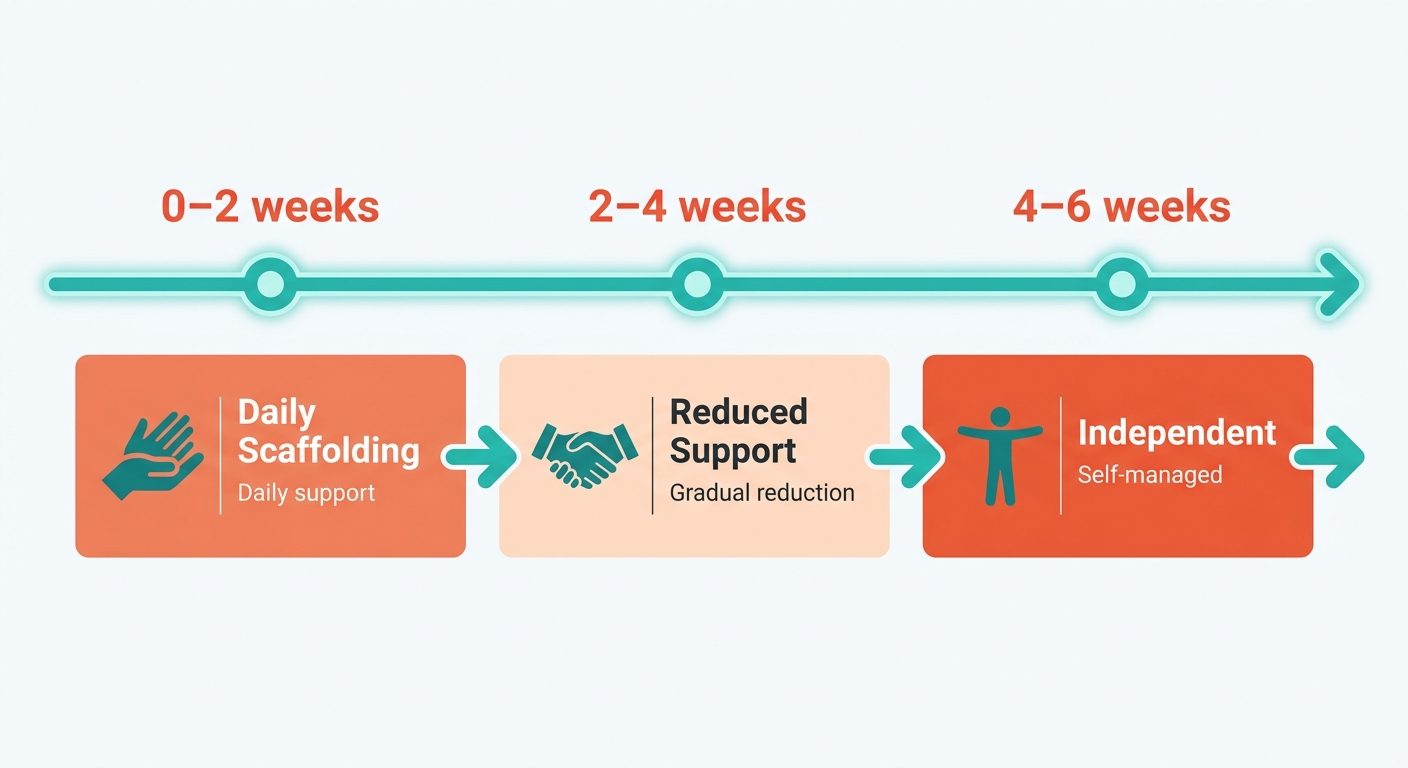
When Should You Start Reducing Support?
Start tapering when your loved one shows they can hold routines without prompting. Look for self-initiated meeting attendance, steady sleep and meals, and problem-solving that doesn't route through you first. Those are readiness markers, not the passage of a set number of weeks.
Hope is the quieter signal. Researchers using structural equation modeling on family recovery found that family support builds hope indirectly, through resilience. As Spencer Bradshaw notes, "without hope, the motivation necessary to activate change will be lacking." When generating their own motivation, they can absorb more responsibility. Structured support tapering is built exactly for this shift, handing back control in stages rather than all at once.
How Do You Handle Setbacks Without Enabling?
Responding to a setback requires balancing empathy with accountability. This balance is often the most difficult boundary for families to maintain.
Clinical perspectives offer different emphases. While some frameworks view setbacks as expected parts of a nonlinear recovery requiring patience, others, such as Families for Addiction Recovery, emphasize that shielding an individual from the outcomes of their choices can hinder long-term progress.
Why Your Own Recovery Matters
Supporting someone else requires maintaining your own well-being. The team at Valley Health emphasizes that caregiver self-care is a prerequisite for effective support. Our coaching provides families with the resources and guidance needed to maintain these boundaries without feeling isolated.
FAQ
How long does early recovery typically last?
Early recovery generally spans the first 90 days to one year after detox. The brain's frontal cortex begins healing around 90 days, but full neuroplasticity requires 9 to 18 months. Post-Acute Withdrawal Syndrome can persist for up to two years. The timeline varies by individual, substance, and length of use.
What are the signs my loved one is ready for less support?
Watch for self-initiated meeting attendance, consistent sleep and meal patterns, and problem-solving that doesn't route through you first. When they're generating their own motivation and holding routines without prompting, they can absorb more responsibility. Tapering support is about matching their capacity, not a set calendar date.
Should I confront my loved one if I suspect they're using again?
Confrontation adversely affects motivation. If you suspect a relapse, approach the conversation calmly and without accusation. Ask direct questions, are you safe, do you need help, what happened, rather than making assumptions. If you're too emotionally invested to stay calm, let a coach or therapist facilitate the conversation.
What if my loved one refuses to attend support groups?
Don't force it. Autonomy drives long-term engagement more than pressure. You can offer practical assistance like researching local meetings or providing transportation, but if they're actively resistant and you're the only one asking, family-only pressure will calcify into conflict. A coach can carry that accountability without the relational friction.
How do I set boundaries without feeling like I'm abandoning them?
Boundaries are a form of love, not a withdrawal of it. Loving detachment means treating a setback with compassion while refusing to shield the individual from the outcomes of their choices. If that balance feels impossible to hold alone, split the roles so no one carries all of it. A coach provides the distance families can't manufacture on their own.
References
[1] Supporting a Loved One in Recovery: 5 Dos and Don'ts - Riverside Health - https://www.riversideonline.com/en/patients-and-visitors/healthy-you-blog/blog/h/how-to-support-a-loved-one-in-recovery
[2] How to Support Someone in Recovery | Family Resources - https://recoverycentersofamerica.com/blogs/a-guide-on-how-to-support-someone-in-recovery/
[3] Walking Through Early Recovery with Our Loved Ones - https://www.pennfoundation.org/resources/blog/walking-through-early-recovery-with-our-loved-ones/
[4] Supporting Loved Ones in Early Recovery: Resources for Family ... - https://www.pinerest.org/newsroom/articles/supporting-loved-ones-in-early-recovery-resources-for-family-members/
[5] What to Expect From a Loved One in Early Recovery - https://sanfordbehavioralhealth.com/2024/02/09/what-to-expect-from-loved-one-in-early-recovery/
[6] Why is Family Support Important in Addiction Recovery? - https://www.valleyhealth.com/services/recovery-and-wellness-unit/why-family-support-important-addiction-recovery
[7] Ten Ways to Support a Loved One in Addiction Recovery - https://www.narconon.org/blog/ten-ways-to-support-a-loved-one-in-addiction-recovery.html
[8] Support Your Loved One - Families for Addiction Recovery - https://www.farcanada.org/support-your-loved-one/
[9] The Need for Family Supports During Individual Recovery - https://www.researchgate.net/publication/334317095_The_Need_for_Family_Supports_During_Individual_Recovery
[10] Family Recovery Support Group Effectiveness in Drug and ... - https://www.researchgate.net/publication/392160859_Family_Recovery_Support_Group_Effectiveness_in_Drug_and_Alcohol_Abuse_Prevention_and_Management_An_Examination_of_Family_Communication_Patterns_Coping_and_Resilience
[11] "I didn't do it alone": Family involvement in recovery from ... - https://pubmed.ncbi.nlm.nih.gov/42055163/
[12] focus groups with individuals in recovery and family members - https://www.researchgate.net/publication/338635280_Perspectives_on_addiction_recovery_focus_groups_with_individuals_in_recovery_and_family_members
[13] Hope, Readiness, and Coping in Family Recovery From ... - https://www.researchgate.net/publication/286523831_Hope_Readiness_and_Coping_in_Family_Recovery_From_Addiction