How to Split Family Recovery Roles So No One Burns Out
August 8, 2026

Key Takeaways
- A 2024 study in China found that structured family interventions cut relapse rates to 39.7%. Planning who does what protects recovery better than improvising.
- Over 60% of caregivers report burnout symptoms. Role confusion drives much of that exhaustion.
- Recovery roles rarely get discussed. They often fall to whoever said yes first.
- Without a plan, crisis contact, logistics, and emotional labor land on individual family members instead of being shared deliberately.
- Families show up for therapy sessions, then go home and operate with no structure.
- The feeling that you're responsible for everything comes from no one else clearly claiming specific tasks.
- Uneven distribution leaves one family member exhausted while others feel underused and shut out.
Why Splitting Family Recovery Roles Matters
When families support someone leaving detox or residential care, the instinct is to divide tasks—one person drives to therapy, another manages medications, a third tracks insurance. But families rarely plan these divisions. Roles settle on whoever grabbed them first, and burnout starts there. Research from FHE Health shows that structured family interventions improve long-term outcomes. But that same involvement can quietly break the family if nobody rotates the load.
The Hidden Cost of Unplanned Role Assignment
There's a paradox worth naming: family groups that show up for structured therapy often have no structure at home. One parent becomes the crisis contact. A sibling absorbs logistics—appointment reminders, prescription refills, transportation. Another family member takes emotional labor, fielding late-night calls and managing relapses. These roles aren't negotiated. They happen because someone said yes once.
According to the Cleveland Clinic, role confusion drives caregiver exhaustion—the vague sense that you're responsible for everything because nobody else claimed anything specific. Families assume that if a role isn't explicitly yours, it defaults to whoever's already doing the most. The result: one exhausted person and several others who feel underused and guilty.
The financial dimension compounds this. Qualitative studies from Pakistan, Botswana, and South Africa show caregivers juggling work, caregiving, and bills while stigma blocks them from seeking help. When one family member shoulders treatment costs, legal fees, and lost income while managing daily care, they're running a second unpaid job with no off-hours. MADE helps families plan detox and treatment pathways before a single person's limits stall needed care.
Why Static Roles Break Down During Early Recovery
The first three months after residential treatment carry the highest relapse risk. Between 65–70% return to their primary substance in that window. Support demand spikes early, then tapers as someone builds stability. But families assign roles as if intensity stays constant—so whoever takes the lead during that critical window absorbs peak stress with no relief plan.
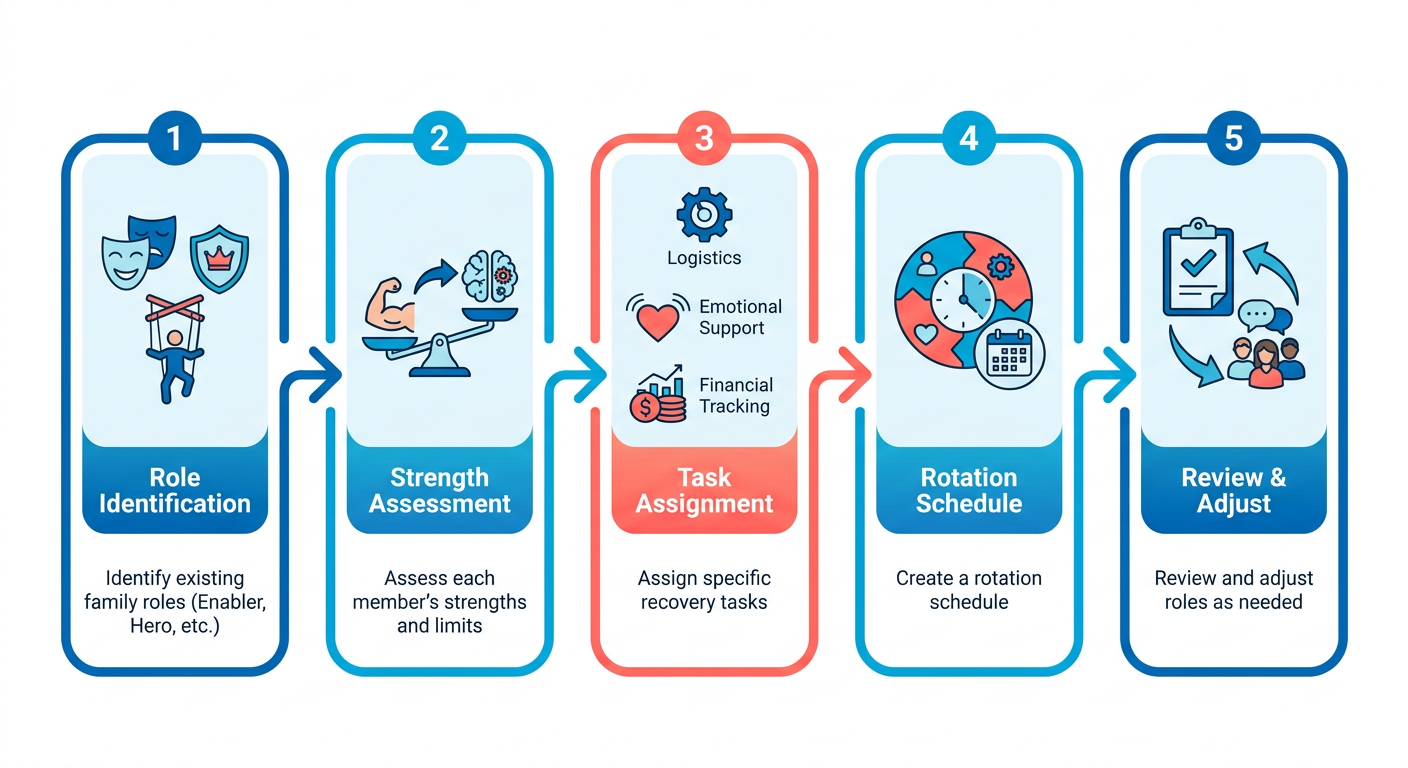
Another structural problem: addiction assigns its own roles long before families consciously distribute them. The Enabler, Hero, Scapegoat, Lost Child, and Mascot are patterns that emerge from years of accommodating use. These roles actively hinder recovery when they persist unchanged. The Enabler shields from consequences. The Hero overcompensates. The Scapegoat absorbs blame. The Lost Child withdraws. The Mascot deflects through humor.
Families enter recovery carrying these unconscious scripts, then layer new caregiving tasks on top without dismantling the old dynamics. The Hero takes on logistics and keeps managing everyone's anxiety. The Enabler handles finances and continues covering mistakes. Deliberately assigned roles run parallel to unexamined ones, and whoever carries both burns out fast.
Splitting Roles as a Burnout-Prevention Strategy
Start by naming what's already happening. Map current responsibilities—not what they should be doing, but who actually handles medication reminders, crisis calls, appointments, money. Then look for gaps and overlaps. Often one person is doing three roles while another capable family member is doing none, simply because nobody asked.
The fix isn't symmetry. One analysis notes that time is fixed but energy is renewable, so you schedule by energy capacity rather than equal hours. During the high-risk first quarter, MADE provides intensive coordinated support—from a single coach or a full team—then tapers as stability builds. Families can apply the same principle: one member handles daily check-ins for weeks one through four, then hands off to someone else for weeks five through eight while they recover capacity.
A structured role matrix assigns tasks to milestones instead of permanent owners. When someone hits 30 days sober, logistics shift from daily oversight to weekly planning. At 90 days, the crisis-contact role might rotate or dissolve entirely. This prevents the maintain-everything-as-before expectation that research identifies as a key strain.
Families need built-in permission to step back. Respite care programs provide temporary relief, and families need similar permission structures at home. If the financial manager hits their limit, another family member picks up insurance calls for two weeks. If the emotional-support lead is drained, someone else takes late-night check-ins. The role doesn't vanish; it rotates to someone with current capacity.
Who Benefits Most From This Approach
This framework works best when multiple members are available and willing. If you're a single parent or the only involved relative, role rotation isn't an option—you'll need external respite care and community support. But when you have two or more family members who can commit, splitting roles prevents one person doing 80% of the work while everyone else hovers, unsure how to help.
It's particularly effective for families exiting residential treatment, where the person in recovery has new structure but the family doesn't. The transition from 24/7 professional oversight to home-based support is where roles either get deliberately planned or chaotically improvised. Families that build a role matrix before discharge avoid the scramble.
Skip this if your loved one is still in active crisis or early detox. Role planning assumes everyone has enough stability to negotiate and follow through. If you're managing daily overdose risk or involuntary commitment proceedings, your priority is immediate safety.
Identifying and Assigning Family Roles
Transitioning from default habits to structure requires a clear look at how tasks are currently distributed. Instead of letting responsibilities fall to whoever is closest to the crisis, families must catalog what needs to be done. This prevents the silent accumulation of duties that leads to sudden exhaustion.
Addiction already established behavioral patterns before you started planning. These unconscious patterns hinder recovery by locking family members into reactive behaviors. You're not starting from a blank slate; you're dismantling a system built to survive active substance use.
Map the Hidden Roles First
Before assigning new responsibilities, name the old ones. Sit down and ask who historically handled crises, who avoided conflict, who took blame. Write it down. Often several people are shielding the individual in different ways—covering rent, making excuses to employers, preventing natural consequences. Nobody agreed to these patterns, and resentment builds quietly.
The goal isn't shame. It's to surface the unconscious coordination that kept active addiction stable. Once you see the pattern, you can deliberately break it. Assign the person who previously managed crises to financial logistics—insurance claims, payment schedules, budgeting for co-pays. Give the family member who overcompensated the task of milestone tracking instead of crisis rescue. Put quieter members in charge of appointment reminders, a bounded task that keeps them connected without overwhelming them.
Assign by Current Capacity, Not Historic Duty
Caregivers are often expected to maintain previous household and professional roles on top of recovery support. One family member is still working full-time. Another is managing aging parents. A third just had a health scare. If you assign roles based on who "should" do it or who did it last time, you're scheduling burnout.
Assign by present energy, not fixed-time blocks. Ask each person: what's your capacity this month? Those with more bandwidth can handle therapy session attendance and daily medication monitoring. Lower-capacity members handle documentation. Scanning receipts, logging medication, updating shared calendars. These tasks matter, but they don't drain you the way live emotional support does.
Rotate tasks regularly. The person who handled morning calls in January might be underwater at work in March. Swap them to a lighter role before resentment builds. Clear role expectations prevent burnout, but only if they flex with real life.
Sync Roles to Recovery Milestones
Support demand isn't evenly distributed. It spikes early. The opening phase requires someone to attend therapy, monitor withdrawal symptoms, and intervene when cravings surface. After six months, the person in recovery may need less hands-on support and more accountability check-ins. Your role assignments should mirror that arc.
A milestone-based map: weeks 1–12 need a primary emotional supporter and a logistics coordinator. Months 4–6 shift to a single accountability partner and a financial tracker. Month 7+ might only need quarterly family check-ins and someone managing recurring prescriptions. The mistake is locking someone into "primary supporter" for the entire year when intensity drops after the high-risk window closes.
Front-load your strongest caregiver for the critical opening quarter, then rotate them out to focus on their own health while someone else takes monthly goal reviews. This keeps both people engaged without either collapsing.
Build in Respite Without Guilt
Caregivers believe asking for relief means they're failing. That belief breaks people. Research on caregiving burdens highlights how societal expectations and stigma prevent families from seeking external help. The fix: schedule respite as a structural requirement, not a personal favor.
Give every family member one "off week" per quarter where someone else covers their role. Write it into the plan from day one. The person in recovery knows who to call that week. The substitute knows they're on deck. Nobody has to ask permission or justify exhaustion. When respite is optional, only the least burned-out people take it. When it's mandatory, everyone recharges before they hit empty.
Don't rotate roles so fast that the person in recovery never knows who to reach. We recommend multi-week blocks for primary roles and quarterly swaps for lighter tasks. Faster than that, you lose continuity. Slower, and burnout sneaks in.
Setting Boundaries to Protect Family Well-Being
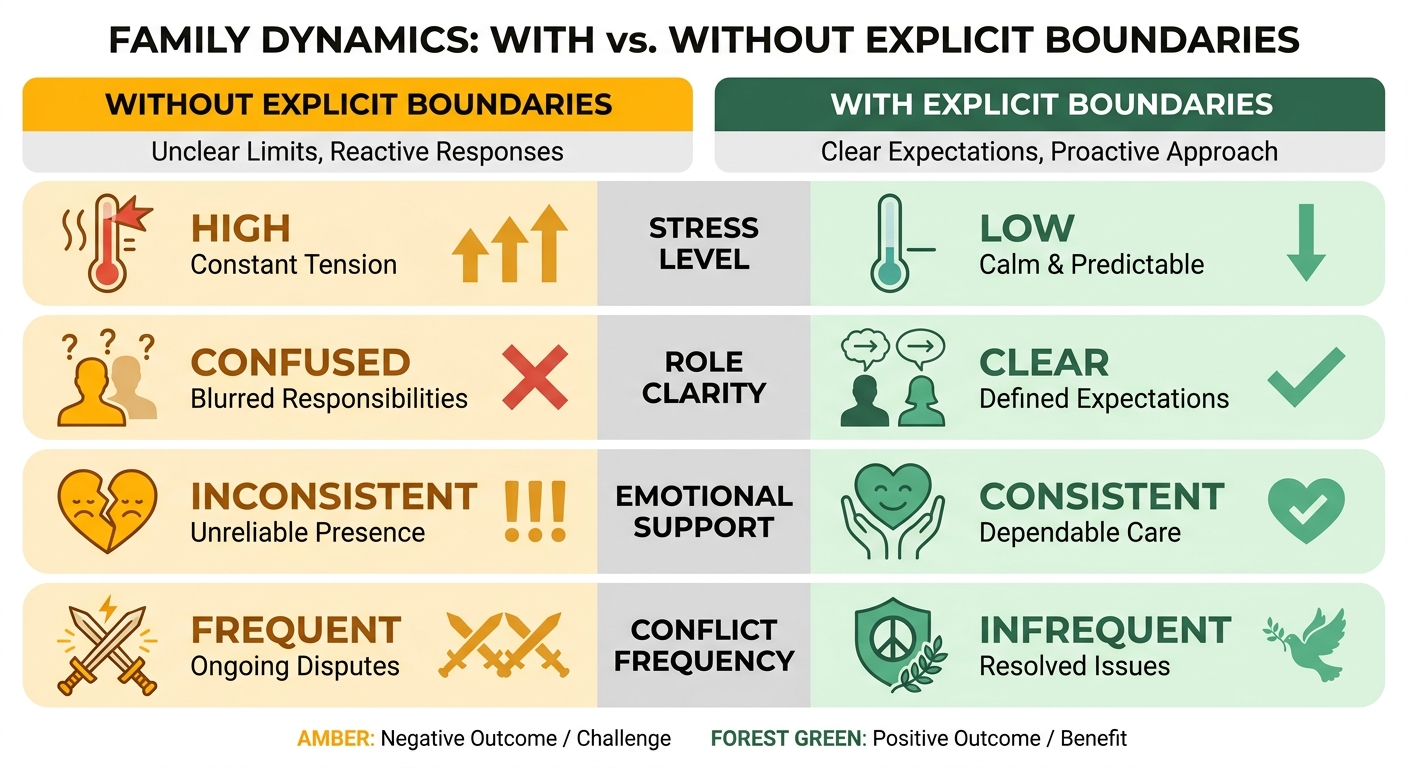
Without clear boundaries, even well-intentioned role division collapses. When family members fail to define their limits, the system defaults to over-reliance on a single person.
The structural problem: caregivers are expected to maintain their pre-recovery routines on top of new support tasks. One person keeps their full-time job, drives to appointments, monitors medications, and fields late-night panic calls—all while others assume everything is under control. Role assignment by default is a countdown to collapse.
Boundaries That Protect Energy, Not Just Time
Boundaries in recovery aren't about limiting involvement. They're about defining what each person can sustain without sacrificing their health. Families schedule by fixed time slots—"I'll handle Tuesday and Thursday"—but that ignores emotional and physical capacity. Distribute the heaviest responsibilities based on current bandwidth rather than rigid calendar slots.
Different recovery phases demand different intensity. Instead of maintaining constant involvement, adjust support based on observable markers: therapy frequency, medication stability, housing security. One family member might handle intensive daily contact during the first treatment discharge, then hand off to weekly check-ins once routines stabilize.
Setting Limits Without Guilt
The most damaging boundary myth: taking care of yourself while caring for someone else is selfish. It's not—it's necessary. Name your non-negotiables: the hours you need for sleep, the weekly activity you won't cancel, the evening you reserve for your own family. Then build the rotation around those anchors instead of asking people to bend until they break.
Local organizations host support groups where family members share strategies and realize they're not alone. But these resources only work if families give themselves permission to use them. Set realistic standards instead of trying to be the all-day crisis line.
What "No" Looks Like in Practice
A boundary isn't a wall—it's a defined edge. One parent might say, "I'll handle financial coordination and insurance calls, but I can't manage daily medication reminders." Another might commit to weekend check-ins but clarify they won't answer late-night calls on workdays. Engaging family members in specific, named tasks prevents one person from defaulting into the catch-all role.
Write down each boundary and share it with everyone involved, including the individual in recovery. Clarity prevents passive resentment that builds when expectations stay unspoken. If a family member violates your boundary repeatedly, that's data—the role needs to shift or the expectation needs renegotiating.
A structured schedule that tracks boundaries alongside recovery milestones helps families maintain clarity about who does what, for how long, and under what conditions someone rotates out. That structure separates intentional, protective roles from the unconscious ones addiction imposes. You're not abandoning your loved one by protecting your capacity. You're ensuring you're still functional when they need you most.
Engaging in Structured Family Programming and Therapy

Structured family therapy solves both halves of a problem most programs only treat one side of: it helps shed old behavioral patterns and gives the family a facilitated space to negotiate who does what. When family groups show up to therapy together, they're not just learning communication skills—they're dismantling the reactive habits that build up around untreated addiction.
Why Family Therapy Beats Ad-Hoc Role Division
Without a therapist in the room, families divide tasks around the dining table. Someone volunteers to handle med schedules and therapy rides, and weeks later that person is doing all of it because nobody planned a handoff. Structured family programming names those roles explicitly—who tracks appointments, who manages insurance, who holds the emotional support line—and builds rotation into the plan from day one. A licensed therapist guides the negotiation so that over-functioning members don't quietly take over, quieter members don't vanish, and protective members learn to stop smoothing every crisis. The therapist also documents the agreement, so when a role feels unfair, the family has a written baseline to renegotiate from.
The programming also teaches families how to spot when old habits are creeping back. One common trap: the family member who historically played peacemaker starts absorbing conflict again, which lets unhealthy dynamics return under the cover of "keeping things calm." A clinical setting provides tools to rebuild trust and communication by addressing unhealed resentment directly. That honesty is what makes new role assignments stick.
Finding and Engaging in the Right Program
Look for programs that integrate both individual therapy for the client and joint family sessions. Individual sessions give your family member space to work through their own recovery; joint sessions let the family address system-level dysfunction that individual therapy can't touch. Some providers offer family intensives—multi-day workshops combining education on addiction neuroscience with live role-mapping exercises. Others run weekly sessions over several months.
When evaluating a program, ask whether they use a structured framework for assigning and rotating tasks. Generic "family support groups" can be helpful for emotional processing, but they often skip the practical question of who does what and when roles shift. The programs that reduce relapse and prevent burnout schedule role reassignments in sync with recovery milestones—so the person managing daily check-ins during early sobriety isn't still doing it six months later when that intensity is no longer needed.
Common Obstacles and How to Work Through Them
The biggest resistance: "Our family doesn't need therapy; we just need to know what to do." That mindset treats recovery planning like a checklist when it's actually a negotiation that surfaces old wounds. One family member may resent being assigned logistics because they already handle everything at home. Another may refuse the emotional support role because they burned that bridge years ago. A therapist creates the container for those objections to come out without derailing the whole plan.
Another common block: families start strong, attend the first few sessions, then drop off when the initial crisis stabilizes. The program works when you stay through the phase where roles actually rotate and the family practices new communication patterns under supervision. Dropping out early leaves you with role awareness but not role change, which means the same person still ends up carrying the load. Commit to the full program length, and if cost is the barrier, ask about sliding-scale options or whether insurance covers family therapy as part of the treatment plan. Many policies do, especially when tied to a documented substance use disorder.
Monitoring Burnout Indicators and Adjusting Roles
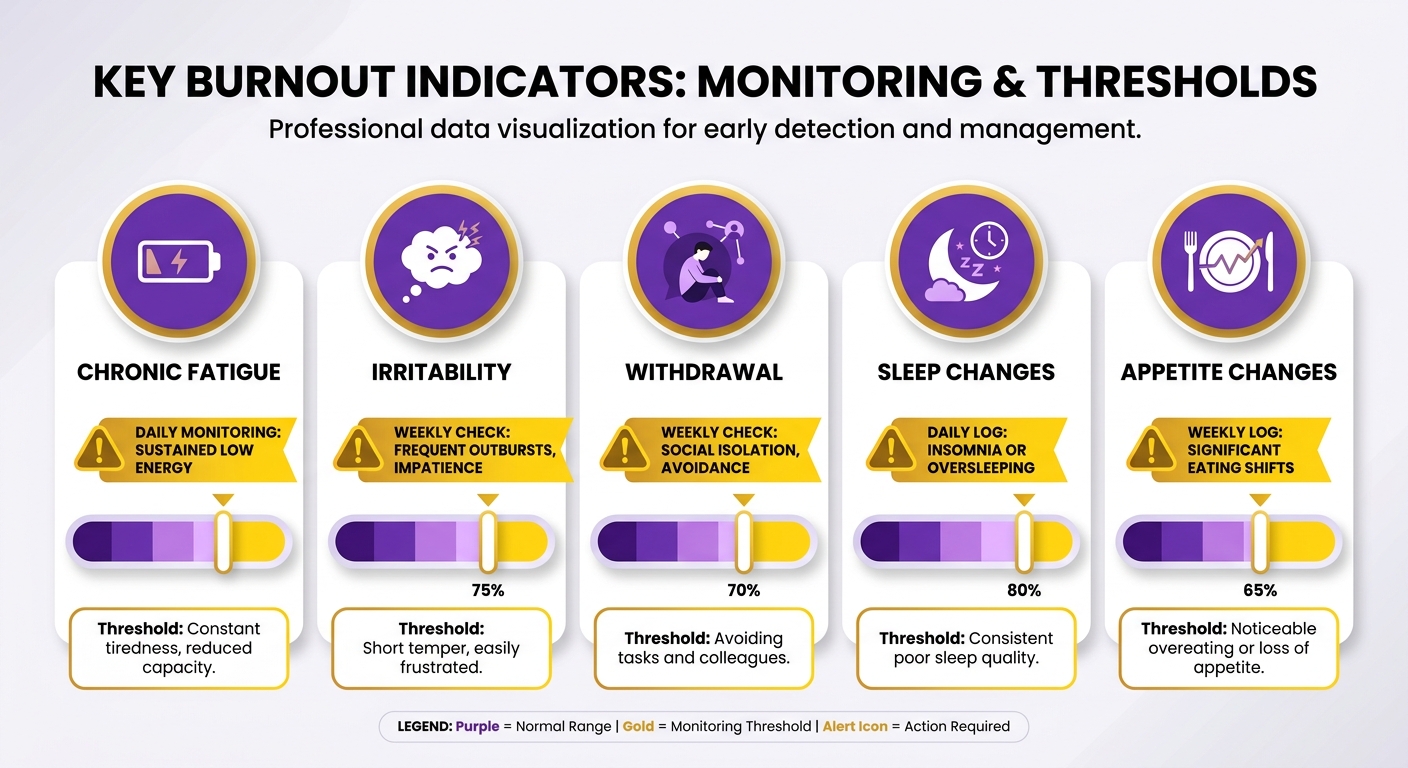
Watching for burnout means tracking specific signals, not waiting for someone to collapse. In family groups supporting recovery, the early markers are consistent: chronic fatigue, irritability, withdrawal from people they normally lean on, changes in sleep or appetite. Clinical resources on caregiver health name these plainly, and they show up in whoever carries the heaviest role first.
Recovery demand isn't flat over time. Studies tracking long-term impact on families document how families absorb rising emotional, financial, and time costs as they carry someone through early recovery, and that weight concentrates in the first stretch rather than spreading evenly. Support demand spikes early, then eases. So a schedule that assigns fixed roles for the whole year loads one person right when pressure peaks. Rotate the heaviest role through the high-risk window so no single member absorbs the spike alone.
What Burnout Indicators Should You Actually Monitor?
Watch for four things: physical exhaustion, emotional flatness, social withdrawal, and creeping resentment or guilt. Coping guides for families tie burnout to role confusion, unrealistic expectations, and unreasonable demands. Those three are schedulable problems. When someone starts saying "I've got it" while looking wrecked, that's your signal to swap.
A simple weekly check-in helps. Each person rates their current energy, not their hours logged. That distinction matters. Assign the emotional-support role to whoever has capacity this week, not whoever held it last month.
How Do You Adjust Roles Before Someone Breaks?
Reassign by capacity at each recovery milestone, and pull in outside relief when everyone's tank is low. Our coaching is tailored to each individual, with support that tapers as the client finds their rhythm, so the load matches where the client actually is.
Practical moves:
- Front-load then taper. Concentrate support in the first three months, then step it down as the high-risk window closes.
- Rotate the crisis line. The person answering late-night calls this milestone should not be the same one next milestone.
- Book respite deliberately. Using temporary relief services and support groups gives caregivers a place to compare notes and recharge.
Don't over-monitor. If a family member is genuinely steady and enjoying their role, forcing a swap on schedule creates friction. Adjust when the indicators show up, not because the calendar says so.
Clinical experts emphasize that self-care is a prerequisite for effective caregiving. Naming that out loud, at the check-in, is often what gives someone permission to hand off before they hit the wall.
Using Professional Resources and Support Networks

When family groups carry the full weight of recovery support alone, the effort to protect sobriety can quietly push caregivers past their limits. Families stretch to handle therapy logistics, medication tracking, crisis calls, and emotional check-ins—often without realizing they're running a support operation that professional care teams usually staff in shifts. What starts as devotion turns into a second full-time job nobody scheduled.
Professional resources close that gap. Aftercare coaches, family therapists, and structured support groups aren't replacements for family involvement—they're the infrastructure that keeps family involvement sustainable. Engaging in clinical family programs creates a facilitated space to address unhealed resentment, negotiate who handles what, and interrupt the reactive roles that addiction assigned before anyone planned a rotation.
How to Find Resources That Match Your Recovery Timeline
Start with the treatment program's discharge plan. Most residential programs hand families a list of referrals at checkout, but the list often sits in a folder while the family scrambles. Pull it out within the first week. Call the aftercare coordinators, family therapists, and sober coaches on that list and ask one specific question: what does your support look like during the first 90 days? That window is when relapse risk peaks and families burn out fastest.
If the discharge referrals don't fit, look for providers who specialize in transitional coaching—the phase between residential care and full independence. These programs coordinate with nursing support, handle logistics like meal prep and grocery runs, and taper off intentionally as the person gains stability. Local support networks also offer respite care options, giving the primary caregiver a planned break rather than waiting for collapse.
Support groups like Al-Anon and Nar-Anon operate on a different model: they give family members a space to connect with peers facing similar challenges. These groups don't solve logistics, but they solve isolation—the feeling that you're the only family struggling with this exact pattern. The groups run on a drop-in basis. You show up when the load feels heaviest.
Making Professional Support Work Alongside Family Roles
The mistake families make is treating professional resources as backup—something to call when the system breaks. That approach waits too long. Integrate outside support into the role matrix from the start. If your family assigns one person to handle therapy rides, pair them with a sober coach who covers companionship during sessions. If another family member tracks medications, bring in a nurse for the first month to verify the system works before handing it off fully.
Structured community programs provide another integration point: they give activity and supervision while the primary caregiver works or handles their own health appointments. This isn't abandonment; it's rotation. The same principle applies to engaging other family members in specific tasks—one person manages insurance paperwork, another coordinates meal prep, a third shows up for family therapy. Breaking the load into named, bounded roles prevents the drift where one person quietly absorbs everything.
Common Obstacles and How to Clear Them
Cost is the first barrier families name. Professional coaching and therapy aren't covered by every insurance plan, and respite care often requires out-of-pocket payment. Before ruling it out, ask providers about sliding-scale fees and check whether your insurance covers family therapy as part of the treatment continuum rather than standalone counseling. Some aftercare programs bundle coaching into post-discharge packages, which spreads the cost and ties it directly to recovery milestones.
The second obstacle is guilt. Family members feel they should handle support alone, and asking for outside help reads as failure. That belief makes burnout inevitable. Clinical guidelines emphasize that sharing the caregiving load is necessary. Professional resources don't replace family—they prevent the family from breaking under a load that was never meant to be carried by one or two people indefinitely.
References
[1] How to Balance Multiple Roles Without Burnout - LinkedIn - https://www.linkedin.com/top-content/soft-skills-emotional-intelligence/burnout-prevention-tips/how-to-balance-multiple-roles-without-burnout/
[2] Family Roles and Dysfunction: The Impact on Recovery - FHE Health - https://fherehab.com/learning/family-roles-dysfunction-impact-recovery/
[3] The Power of Recovering as a Family - 10 Acre Ranch - https://10acreranch.org/the-power-of-recovering-as-a-family/
[4] Caregiver Burnout: What It Is, Symptoms & Prevention - https://my.clevelandclinic.org/health/diseases/9225-caregiver-burnout
[5] Strategies for Caregiver Stress Management and Self-Care - https://www.caregiveraction.org/taking-time-out/
[6] How Family Caregivers Can Find Balance & Prevent Burnout - https://www.brentwoodhcc.com/how-family-caregivers-can-find-balance-prevent-burnout/
[7] Coping Strategies for the Family Caregiver - My Doctor Online - https://mydoctor.kaiserpermanente.org/mas/structured-content/Health_Topic_Caregiver_-_Coping_Strategies_-_Staying_Healthy.xml
[8] Caregiver burnout and strategies for coping - https://www.uhc.com/health-and-wellness/caregiver-resources/caregiver-burnout-and-strategies-for-coping
[9] The Growing Burden on Families of Individuals with Substance Use ... - https://www.researchgate.net/publication/399774289_Crushed_by_Caregiving_The_Growing_Burden_on_Families_of_Individuals_with_Substance_Use_Addiction
[10] The Role of the Caregiver in the Addiction Treatment Process - https://www.researchgate.net/publication/394168659_The_Role_of_the_Caregiver_in_the_Addiction_Treatment_Process
Frequently Asked Questions
1. What should I do if the person who volunteered for a recovery role is now clearly overwhelmed but won't admit it?
Document observable signs—missed check-ins, delayed responses, or irritability—and bring them to a family meeting with specific examples. Frame the conversation around role rotation as a planned system feature, not a personal failure, so stepping back feels like following the structure rather than admitting defeat.
2. How do I convince family members who think structured role planning is unnecessary bureaucracy?
Point to clinical research showing that structured family interventions significantly reduce relapse rates compared to unplanned support. Ask them to map current responsibilities honestly—who actually handles what right now—and the uneven distribution usually makes the case for deliberate planning better than any argument about "bureaucracy" ever could.
3. Can role rotation work when only two family members are available instead of a larger group?
Two people can rotate by splitting tasks into high-intensity and low-intensity blocks rather than dividing by type. One handles daily medication monitoring and therapy attendance for a set block of time while the other manages documentation and insurance calls, then they swap the intensive role so neither burns out during the critical early months of recovery.
4. What happens when the person in recovery resists having multiple family members involved in their care?
Start with one primary contact they trust, then introduce other family members through single bounded tasks—one person handles appointment reminders, another manages prescription refills—so involvement builds gradually. Explain that distributing tasks protects the primary supporter from burnout, which protects their continuous availability when crises actually happen.
5. How do I know when to reduce family involvement versus when to maintain intensive support?
Track concrete milestones—consecutive therapy attendance, medication compliance streaks, stable housing—rather than calendar time. Support demand typically peaks during the initial transition home when relapse risk is highest, then tapers as routines solidify. Reduce intensity when observable stability builds, not when a predetermined timeline expires.
6. Should family therapy happen before or after we assign specific recovery roles at home?
Start therapy first because it surfaces the unconscious behavioral patterns addiction already assigned that will sabotage any new task distribution you plan. The therapist helps dismantle those dynamics while facilitating the negotiation of who handles logistics, emotional support, and financial coordination going forward.
7. What if one family member refuses to participate in any recovery support role at all?
Don't force participation—resentful involvement harms recovery more than absence does. Assign that person to low-contact tasks like documentation or quarterly check-ins if they'll accept it, then redistribute active roles among willing members. Revisit their capacity in three months when they see the system working without requiring their constant presence.