How to Structure Your First Week After Rehab, Hour by Hour
September 22, 2026
Why the First Week Home Is the One to Get Right
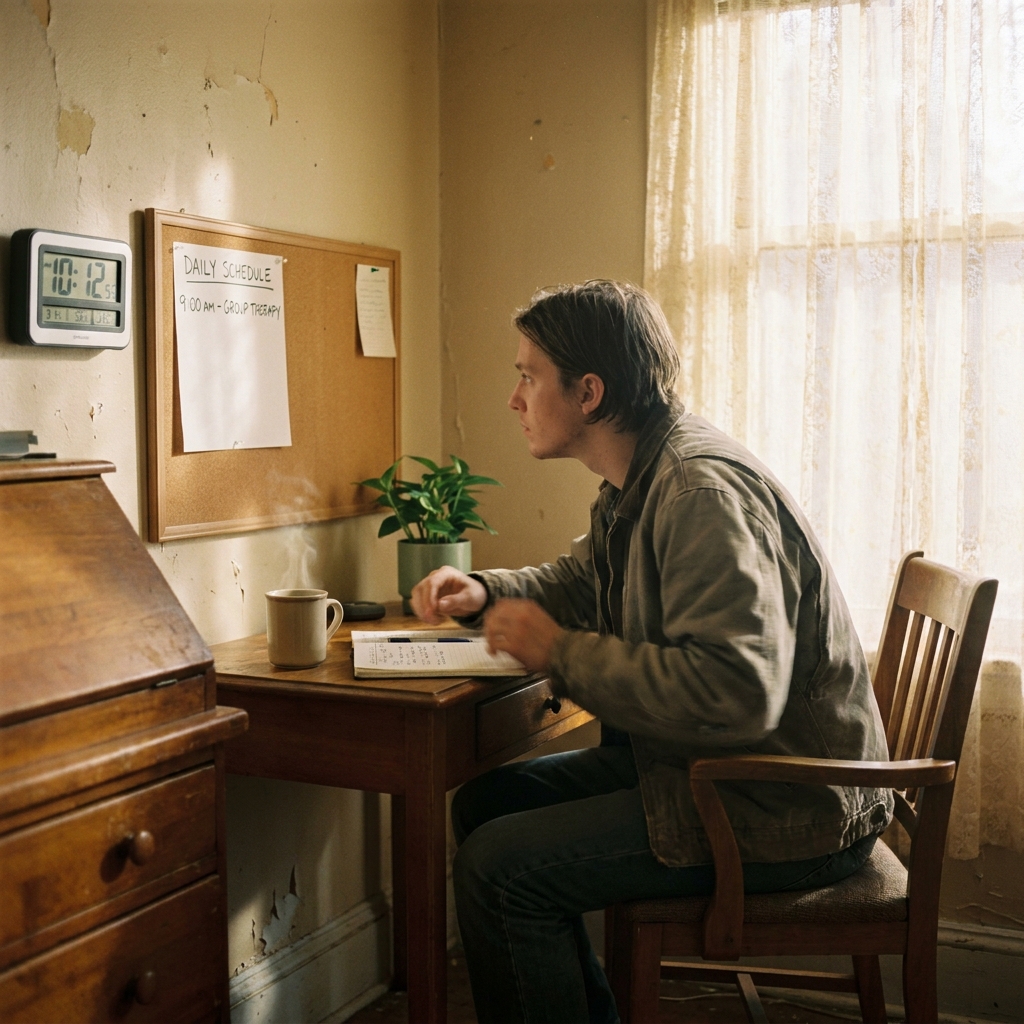
The first week after rehab is the most fragile stretch of recovery. It's also the most protectable. Everything that held you steady in treatment disappears the moment you walk out the door. Caron's clinical team points out that what you do in the first 72 hours shapes your long-term outcome. So we build those seven days as a real schedule, not a vague plan to "take it easy."
Think about what actually changes. In treatment, almost every hour was decided for you. At home, all of that lands back on your shoulders, and Addiction Help notes the brain in early recovery isn't rested yet. Sleep is off. Moods swing. The old neural shortcuts to using are still well-worn. Put your original triggers back in the mix, and the risk is real. A schedule gives your nervous system something predictable to lean on while it recalibrates.
Structure Beats Willpower in the First 72 Hours
A dense, hour-by-hour plan works because it removes decisions when you have the least capacity to make them. Decision fatigue and loneliness are two of the most reliable setups for a slip, so we fill the early days with fixed blocks: sleep and meals at set times, a recovery meeting, a coach check-in, movement, and ordinary sober activity.
We front-load the uncomfortable actions on purpose. Caron's team frames comfort itself as a warning sign this early. Staying home instead of going to a meeting feels easier, but it reinforces the exact patterns you just worked to break. When those actions sit in fixed hours on your calendar, avoidance gets caught within hours instead of drifting into days.
The Schedule Should Taper, Not Stay Rigid
This is where two credible views seem to clash. Caron's practitioners build an hour-by-hour schedule for the first days. Addiction Help argues you don't need a rigid plan, just anchors like consistent sleep, meals, and a few non-negotiables.
Both hold up at different moments. As clients find their rhythm, our support tapers on purpose, encouraging independence and long-term stability. The hour-by-hour plan is training wheels, not a permanent cage. You keep it tight while your footing is worst, then let it breathe as your own rhythm returns.
Why This Window Rewards Booking Support Early
Recovery runs on a plan, not willpower alone, and people who stay connected to care tend to do better than those who try to coast. That's the case for lining up support before the hard day arrives, not after.
We pair the schedule with concrete touchpoints: a sober coach in your first week home, our sober living home, and a sober travel companion for any trip you can't avoid. If a slip happens, the plan already has the phone numbers in it. As Addiction Help puts it, shame and silence are what turn a slip into a relapse. A structured week keeps you reaching out fast.
The Short Version
- The first 72 hours after leaving rehab directly shape long-term recovery outcomes, according to Caron's clinical team.
- In treatment, nearly every hour is decided for a patient. At home, all those decisions shift onto a brain that isn't rested yet.
- Decision fatigue and loneliness rank among the most reliable triggers for a slip during the earliest days home.
- Caron builds an hour-by-hour schedule; Addiction Help favors flexible anchors like consistent sleep, meals, and a few non-negotiables.
- Caron frames comfort as a warning sign in early recovery, since staying home instead of attending meetings reinforces old patterns.
- Caron describes addiction as "a disease of isolation," and Addiction Help's core rule is reaching out before using rather than after.
- A bedside recovery kit usually holds a water bottle, phone charger, and written contact list, with the contact list mattering most.
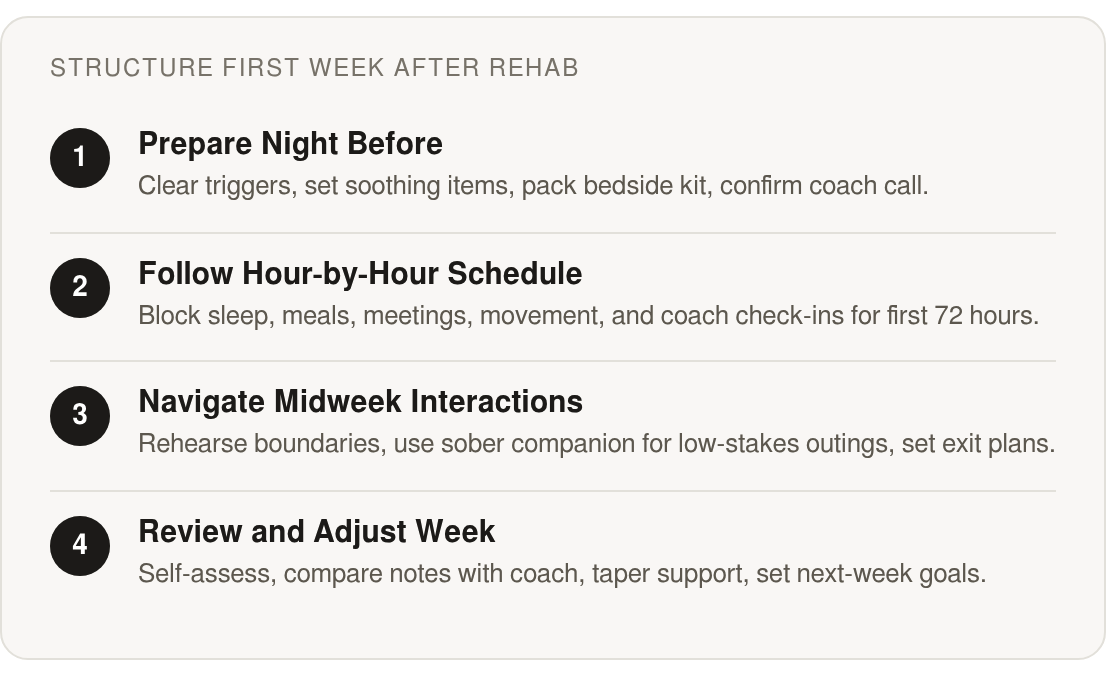
The Night Before: Stacking the Deck
The night before your first day home sets the tone for everything that follows. Most people treat it as downtime to collapse into. We treat it as setup work, the quiet hour where you get ahead of the week before it starts.
The Caron team frames unpacking and organizing your belongings as one of the first real recovery actions, not a chore to put off. Getting your space right the evening before means you wake into a room that supports you, instead of one you have to fix while your defenses are low.
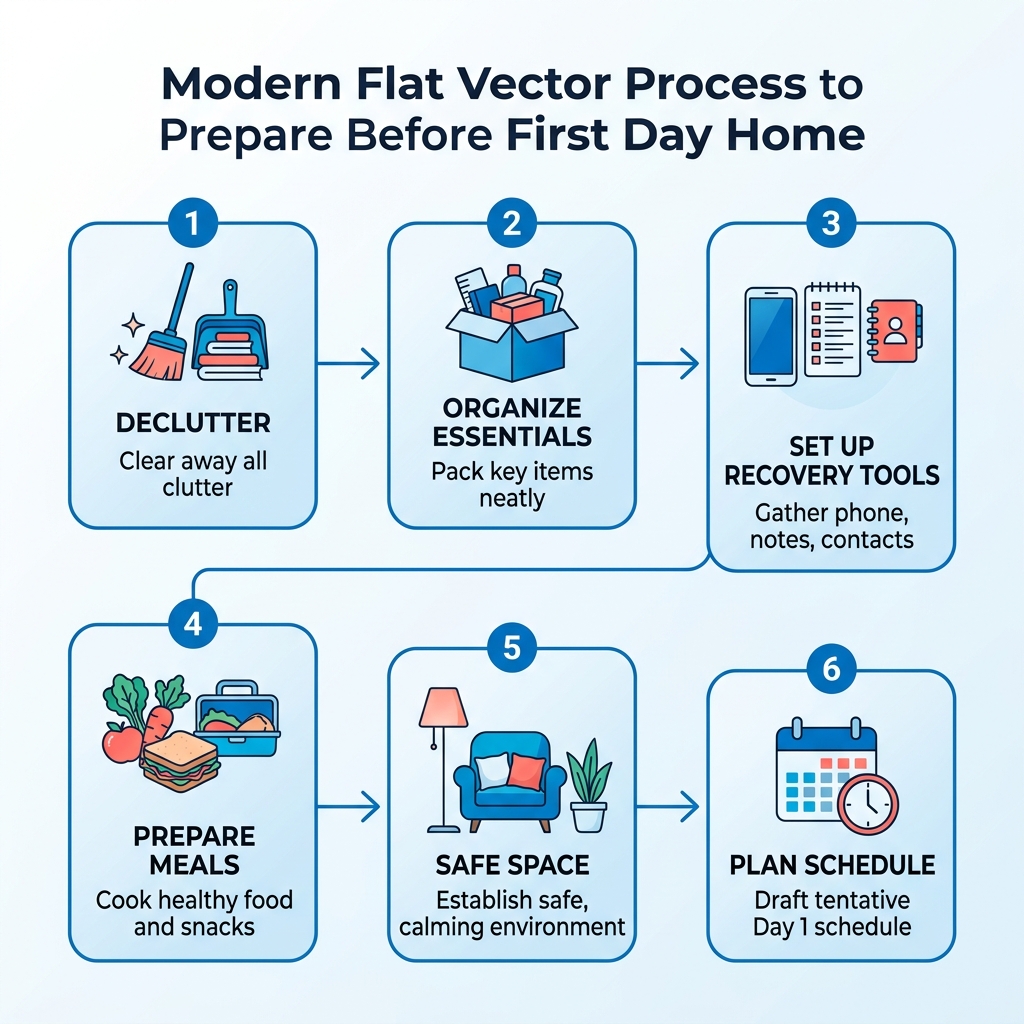
How Do You Set Up the Room the Night Before?
Start with what has to leave. Addiction Help is blunt about clearing the house of any substances and paraphernalia before cravings test you. Do that walkthrough tonight, while you have energy and a clear head, not tomorrow when the day is already moving.
Then add what steadies you. Caron's guidance is to replace triggering items with soothing ones: recovery literature, positive photos, letters from people in your corner. Put one of those letters somewhere you'll see it first thing. A calm, uncluttered bedroom lowers the friction of every decision you make in the morning.
Keep the surfaces clear. A messy room is one more thing your tired brain has to manage, and early recovery has enough of that already.
What Belongs in a Bedside Recovery Kit?
Build a small kit within arm's reach of where you sleep. When you wake up shaky or restless, the tools are already there and you don't have to hunt for them.
A practical version includes a water bottle, your phone charger, and a written contact list. The list is the piece that matters most. Caron calls addiction "a disease of isolation," and Addiction Help's core rule is to reach out before you use, not after. A visible list of names and numbers turns that advice into a two-second action instead of a decision you have to talk yourself into.
Add a short note to yourself, or one of those supportive letters. Reading a reminder of why you're doing this, in your own words or a loved one's, is a better first input than your phone's notifications.
Why Run a Pre-Flight Call With Your Coach?
Before you sleep, do a brief check-in with your sober coach or companion. Ten minutes is enough: confirm your wake time, your first meeting or appointment, and one action you're nervous about.
That last question does real work. Staying home instead of going to a meeting, or putting off a new therapist appointment, both feel easier and quietly pull you back toward old patterns. Naming the uncomfortable action out loud tonight makes it much harder to skip tomorrow. We walk through exactly this in your first week home with a coach.

One note on medications: if a doctor or treatment program set up a schedule, lay everything out tonight so you're not improvising in the morning. All medical decisions stay with your prescriber. Where we can help is the daily routine around it, the structure and accountability that keep your mornings steady.
Close the night by writing down one intention for the week. Not a resolution, just a single sentence about how you want to show up. It gives tomorrow a direction before your feet hit the floor.
Days 2–3 – Nutrition, Movement, and Sleep
By the second day home, the adrenaline of arrival has worn off. This is where the week either builds momentum or drifts. Days 2 and 3 are when we push clients to lock in three physical habits that hold up the rest of recovery: eating on a schedule, moving your body, and protecting your sleep.
We treat these as scheduled blocks, not good intentions. Early sobriety leaves the body run-down, and a shaky physical foundation makes cravings and mood swings hit harder. So we map the hours out with the client and their sober coach, the same way we mapped the night before.
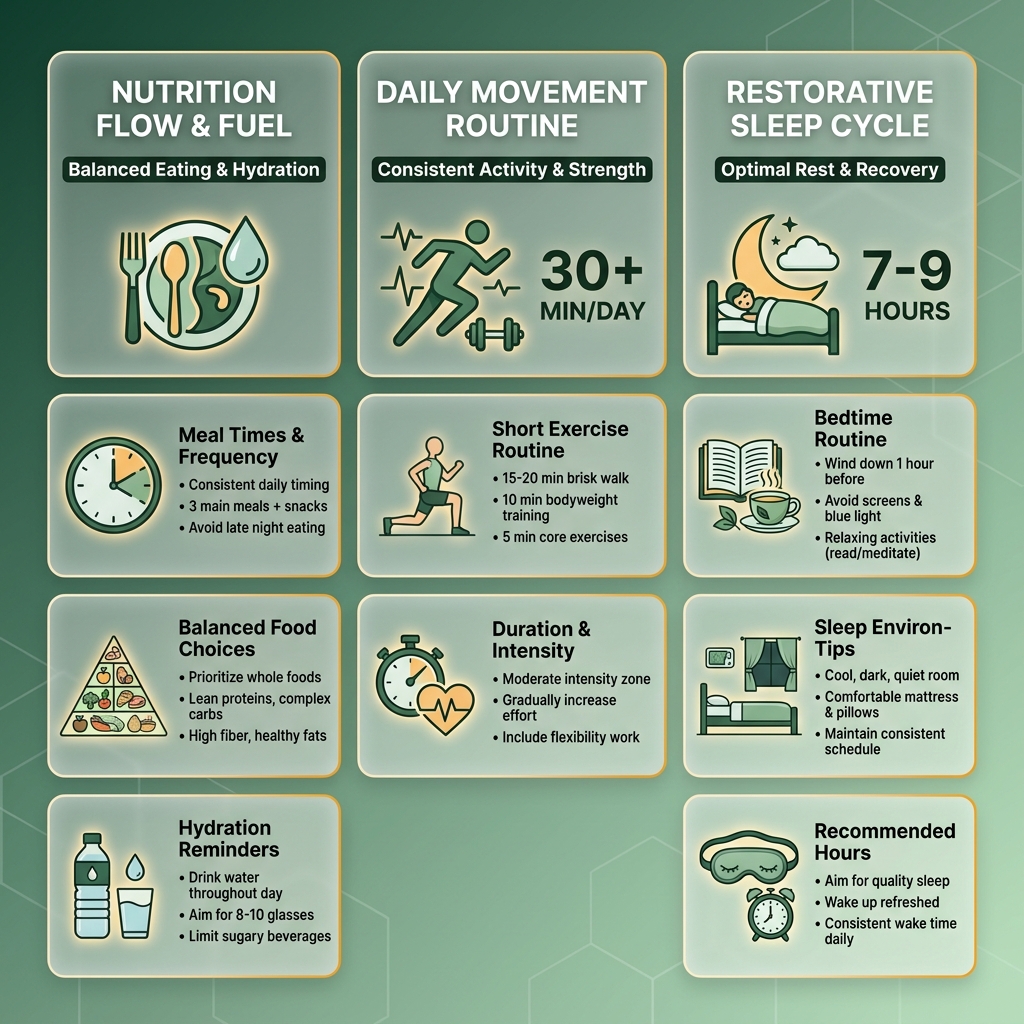
An Hour-by-Hour Rhythm for Days 2 and 3
Start the morning with food, not caffeine on an empty stomach. A simple breakfast by 8 a.m., something with protein you don't have to cook, like yogurt, eggs, or peanut butter toast. No knife skills required. Keeping meals brainless removes one more decision from a day already full of them.
Mid-morning is a coaching touchpoint. A quick check-in around 10 a.m., in person or by phone, keeps you accountable to the plan instead of white-knuckling it alone. Our sober coaches use this window to walk through the day's meals and confirm the movement block is on the calendar.
Keep exercise short and gentle. A 20-minute walk in the early afternoon does more for anxiety and restlessness than an ambitious gym session you'll dread. Movement steadies the nervous system when it's most jangly.
Eat lunch and dinner at consistent times, roughly noon and 6 p.m. Predictable fuel means predictable energy, and that stability shows up in your mood.
Sleep Is the Habit That Rebuilds Everything
Insomnia is one of the most common struggles in the first days home. We protect sleep hard. Screens off an hour before bed, a fixed lights-out time, no caffeine after early afternoon.
If sleep won't come, don't lie there fighting it. Get up, do something quiet and boring, and return when you're tired. For clients in a sober-living setting, the house routine reinforces these bedtimes automatically.
Days 4–5 – People, Boundaries, and a Sober Companion
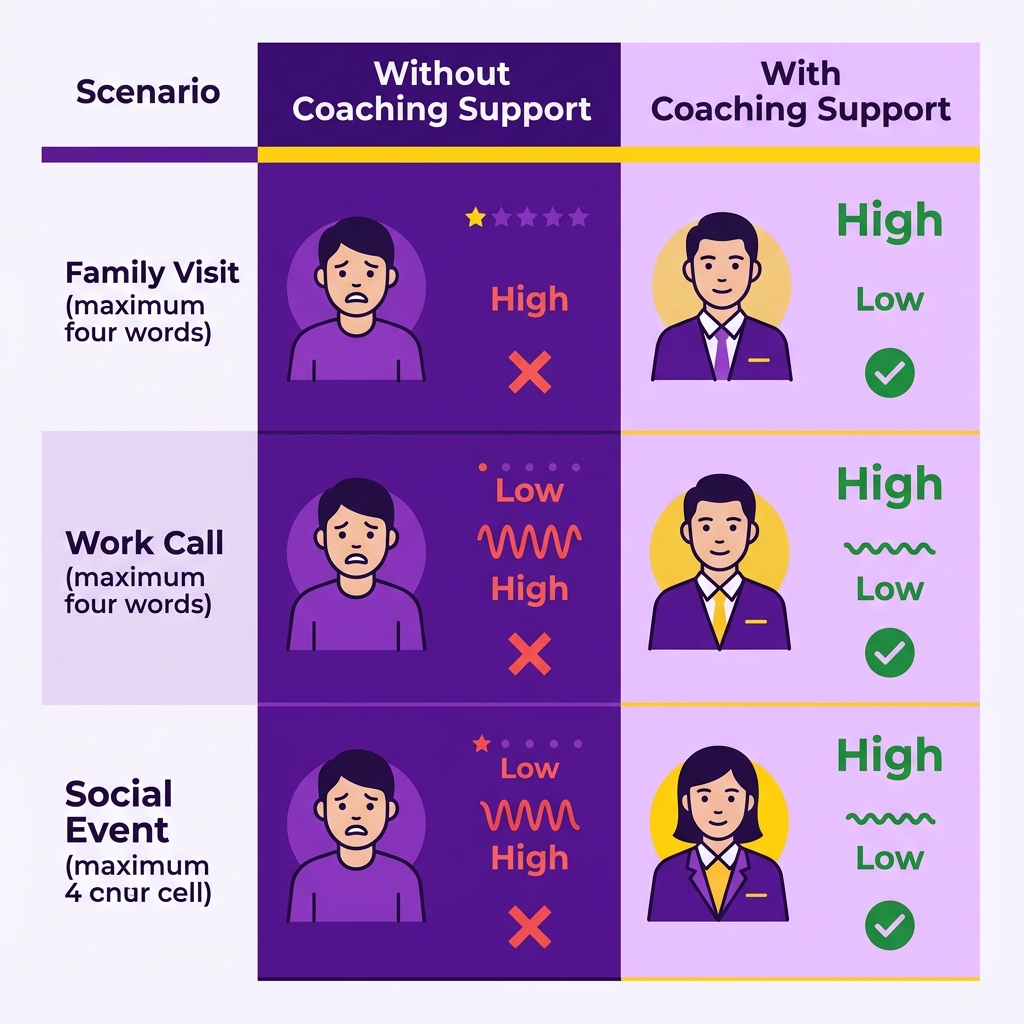
By midweek, the world starts pushing back in. Family wants to visit. Work or school expects an answer. Someone invites you to a birthday dinner. Days 4 and 5 are when the outside moves faster than you do, and our coaching is built to support you through exactly these interactions.
The approach is simple. We map these two days around the interactions you can't avoid, then decide together which ones you actually take on. A returning-to-work-after-rehab plan gets built the same way we built your meals and sleep: hour by hour, with a sober coach who knows the plan before you walk into the room.
Set Boundaries Before the Visit, Not During It
Family love doesn't always show up as helpful. We rehearse the boundary lines with clients ahead of time so they aren't improvising under pressure. A short script works best. "I'm home, I'm glad to see you, and I need us to keep alcohol out of the house for now."
Say it once, calmly, before anyone arrives. If a relative pushes, repeat the line rather than defend it. Because we plan these moments together beforehand, you walk in already knowing your lines instead of second-guessing yourself alone.
The First Outing Should Be Boring on Purpose
The first trip out isn't a social event. It's a rep. We send a sober companion with clients on low-stakes errands, a grocery run or a short coffee stop, and the goal is for nothing dramatic to happen.
That's the point. You practice ordering, paying, and leaving while someone steady is beside you. If a craving spikes in the checkout line, your companion is right there to name it and move you along.
For a birthday or a work lunch, plan the exit before you go in. Set a leave-time and know your out ahead of time, so the decision is already made. If the room turns risky, you leave. No apology owed.
Days 6–7 – Review, Adjust, and Ease Off
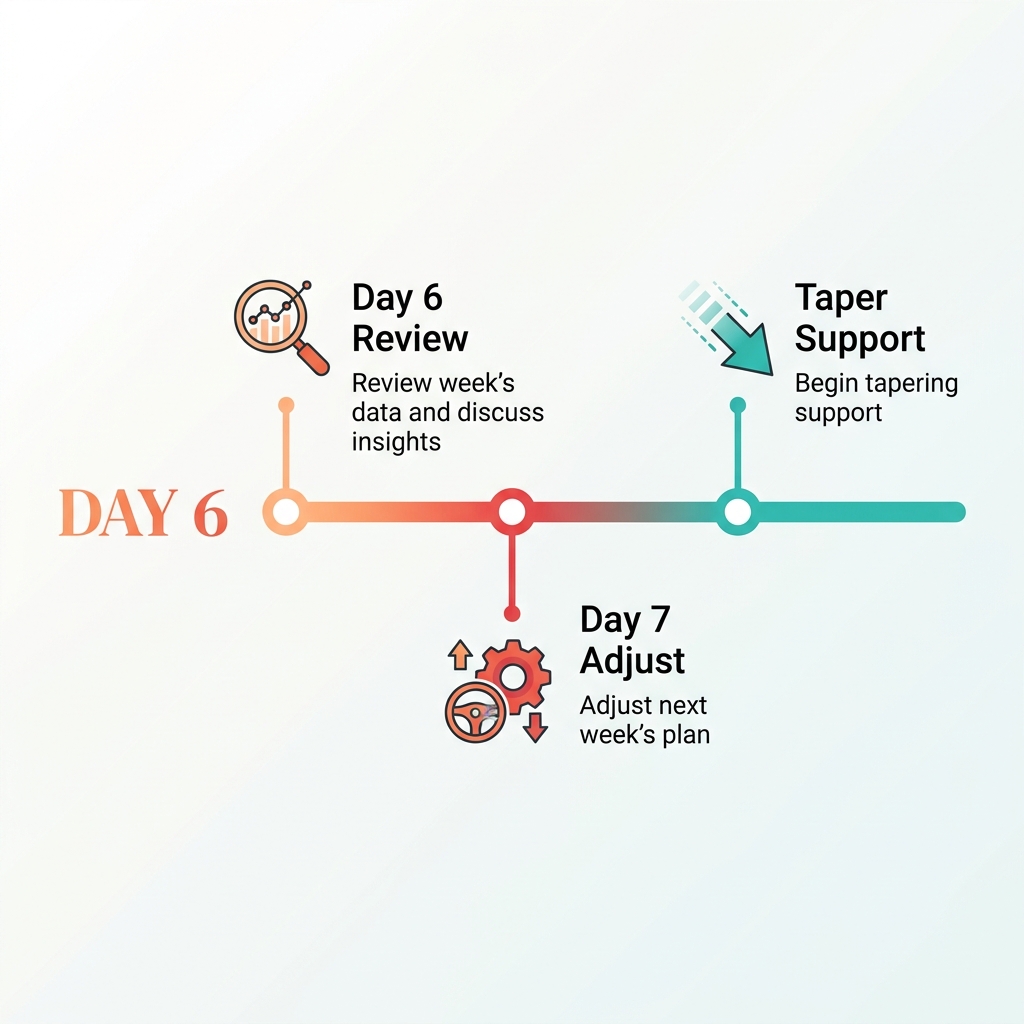
By the end of the week, you have real data on yourself. Days 6 and 7 are when we stop guessing and start reviewing. You and your coach look back at what the week actually showed, then use it to shape what comes next.
This is also when the support starts to shift. The goal was never to keep you on an hour-by-hour leash forever. It's to hand the schedule back to you, one piece at a time, without losing the accountability that held the week together.
A Morning Self-Assessment Sets the Agenda
Start Day 6 by rating the week honestly before anyone else weighs in. Keep it simple: how did you sleep, how did you eat, where did cravings spike, which boundary held or broke. Five minutes of honest reflection, not a therapy session.
The point is to walk into your coaching session already knowing your own answers. Tracking yourself this way builds the self-awareness that makes the shift toward independence possible, which is exactly what our coaching is designed to support.
Easing Off Without Dropping Accountability
The midday check-in is where you and your coach compare notes. You bring your self-assessment. They bring what they observed. Together you decide what stays and what changes for week two.
Here's the honest part: as clients find their rhythm, our support tapers to encourage independence. That can mean adjusting the format or frequency of coaching, virtual or in-person, based on where you actually are. If the week didn't go as planned, we hold the intensity or add to it. The taper is earned by evidence, not by the calendar. Depending on your level of care, that support can come from a single dedicated coach or a coordinated team.
End Day 7 with a next-week preview. Pick one or two new goals, name the support you'll need, and put them on the calendar the same way you did the night before day one. Independence feels good precisely because you built it on a week of proof, not wishful thinking.
How MADE Recovery Fits Into the Week
Everything we've mapped only works if someone is actually there to run it with you. That's the piece we fill. Our after-rehab coaching slots directly into the hour-by-hour week, rather than sitting off to the side as a weekly phone call.
Match the Support Tier to the Hour That Needs It
Our programs run from a single dedicated coach to a coordinated team, and the right fit depends on how much of your week feels shaky. Someone steady enough to handle mornings alone but rattled by evening cravings needs different coverage than someone who wants a person in the room from wake-up to lights-out.
For the highest-risk blocks, sober companionship at home means a coach is physically present during the hours you flagged as hardest. The empty stretch after dinner, say, or the first solo trip to the grocery store. For the rest of the day, virtual check-ins hold the line. A quick video call before a family visit keeps accountability alive without someone shadowing every hour.
If travel lands in your first week, we send sober travel companions so a work trip or family obligation doesn't blow up the structure you just built. And when home itself is the trigger, our sober living home gives you a stable base with a built-in daily rhythm and people who understand the work.
Where a Coach Runs the Blueprint With You
The night-before setup, the nutrition and sleep blocks, the boundary rehearsals, the end-of-week review. A coach can run all of it with you. We help build the routine, coordinate with the nursing support or outpatient care your outside providers handle, and ease off our presence as your footing improves. We're nonmedical support, so we work alongside your treatment team, not in place of them.
If you want to see what the first week looks like with a coach in it, our breakdown of what a sober coach actually does in your first week home walks through it.
Ready to map your own week? Call us at 661-369-6255 to schedule an initial consultation, and we'll help you build the plan.
References
[1] The First 72 Hours Home - Caron Treatment Centers - https://www.caron.org/blog/the-first-72-hours-home
[2] Life After Rehab - Protecting Your First Weeks Home - Addiction Help - https://www.addictionhelp.com/recovery/life-after-rehab/
Frequently Asked Questions
What should I do if I slip during the first week home?
Reach out immediately, before the slip turns into a full relapse. Addiction Help's core rule is contacting someone before or right after using, not staying silent, because shame and silence are what escalate a slip into a relapse. That's why a written contact list sits in your bedside kit, turning outreach into a two-second action.
How is a sober coach different from a therapist or medical provider?
A sober coach provides nonmedical support: building your daily structure, running boundary rehearsals, and holding accountability through check-ins. MADE Recovery works alongside your treatment team, not in place of them. All medical decisions, medications, and clinical treatment stay with your prescriber or outside providers. Coaching handles the day-to-day routine around that care.
What if I live alone with no family support during my first week?
Structure and connection matter even more when you're on your own. A sober companion can be physically present during your hardest hours, like the empty stretch after dinner, while virtual check-ins hold accountability the rest of the day. If home itself feels unstable, a sober living home offers a base with built-in daily rhythm and people who understand the work.
Should I return to work right away during the first week?
Only take on the interactions you can genuinely handle, and plan them the same way you mapped meals and sleep. A returning-to-work plan gets built hour by hour with a coach who knows the plan before you walk in. For any event, set a leave-time and know your exit ahead so the decision is already made.