How to Build a Relapse Prevention Plan That Works
August 14, 2026

Key Takeaways
- Relapse moves through three stages: emotional, mental, and physical. The emotional stage gives you the widest window to change course.
- Relapse follows recognizable emotional patterns instead of striking out of nowhere. Pattern recognition beats willpower.
- A full plan covers six core pieces, from a trigger inventory to a standing review schedule.
- A first draft usually takes most people two to three hours.
- Coping strategies and if-then scripts take the most time, roughly 30 to 60 minutes each.
- A single slip is not the same as relapse. A lapse hasn't yet hardened into a repeated pattern.
- Support contacts take 15 to 20 minutes to list. Rank them by role so you're not guessing who to call in a crisis.
Quick Summary
A relapse prevention plan is a written document that maps your triggers, early warning signs, and coping responses before you need them. The distinction that matters most: a lapse is an isolated event, a relapse is a return to a sustained pattern of use. The Priory Group's framework splits that slide into three phases: emotional, mental, and physical. Catch it in the emotional phase, and you have the most room to turn things around.
What a plan actually buys you
A structured plan turns anxiety into steps you can take. Hazelden Betty Ford's research points to the same thing we see. Recovery holds when people learn to spot early behavioral shifts, not when they white-knuckle through a crisis on willpower.
Here's the breakdown:
| Element | What It Covers | Time to Build | Difficulty |
|---|---|---|---|
| Trigger inventory | People, places, emotions that raise risk | 30-45 min | Easy |
| Warning-sign list | Behaviors signaling emotional relapse | 20-30 min | Easy |
| Coping strategies | Mindfulness, calls, movement, distraction | 45-60 min | Moderate |
| If-Then scripts | Specific response for each trigger | 30-45 min | Moderate |
| Support contacts | Names and numbers, ranked by role | 15-20 min | Easy |
| Review schedule | Weekly or biweekly plan check-ins | 10 min setup | Easy |
The draft goes fast. Keeping it relevant is the part that never ends.
Why a written plan dies without a name on each part
Guides on writing a plan and guides on staged relapse theory both stop at the same point. They tell you what to write. They don't tell you who checks that you're doing it. That's the real gap.
A plan with nobody assigned to notice your early warning signs is a document in a drawer. That's the piece we focus on with clients leaving detox or residential care. A plan built during treatment and a plan actually followed at home are two different things. The difference usually comes down to whether someone else is tracking it with you. For families providing caregiver support, that means every warning sign gets a name attached, not just a description.
When to skip the long version
Still in early detox and not physically stable yet? Skip the full seven-step plan for now. The Recovery Village's guide is built for people who've finished initial treatment and are hitting daily-life triggers, not acute withdrawal. Start with a short trigger list. Expand it once you're through stabilization.
Why Relapse Prevention Matters
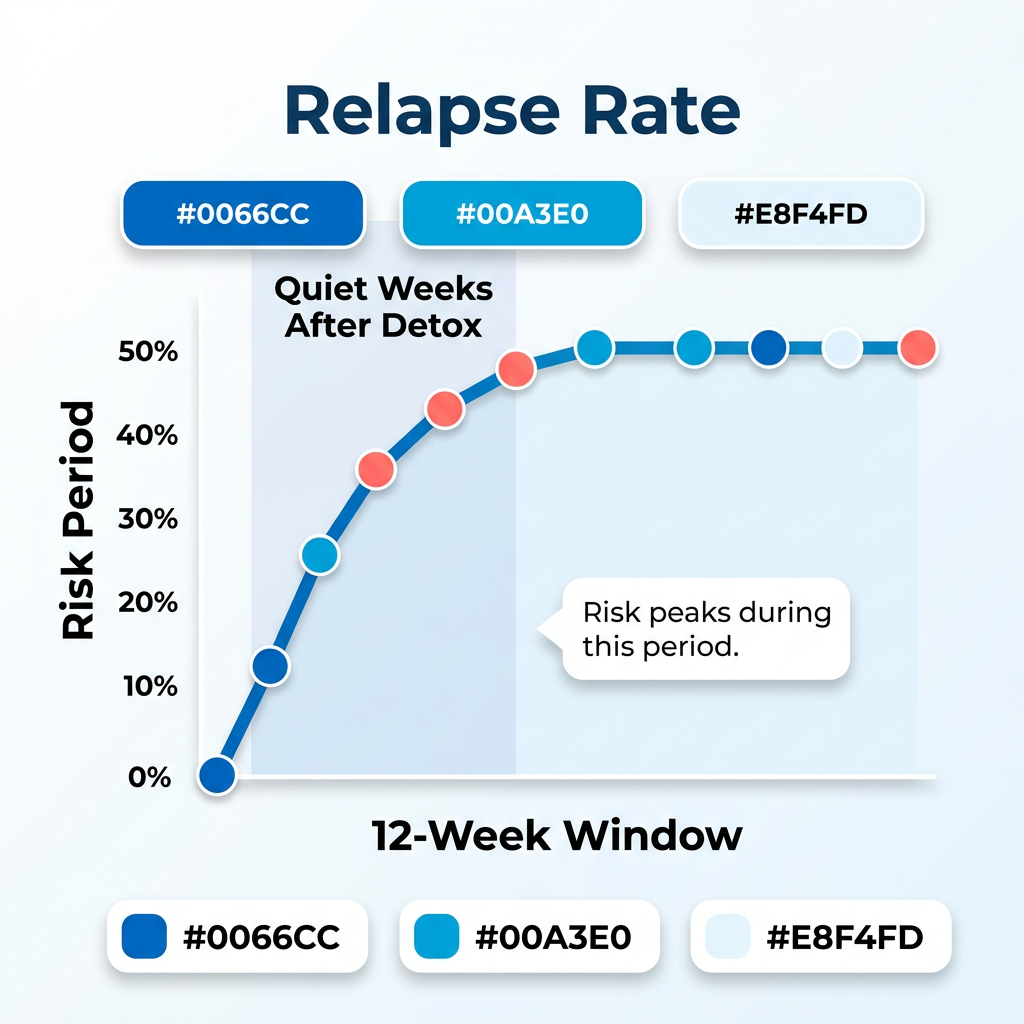
Half of people leaving intensive treatment relapse within the first 12 weeks, according to the StatPearls addiction review. That single number is why we build plans before anyone walks out the door. The riskiest stretch of recovery isn't detox. It's the quiet weeks after, when the structure disappears and ordinary life floods back in.
This is also where caregiver support gets tested hardest. Families want to help, but they're often watching for the wrong signal. They wait for a drink or a missed pill, when the slide actually started weeks earlier in someone's mood and habits. A written plan gives everyone on the team, including the people who love you, something concrete to watch for.
Why the post-treatment window keeps getting missed
The highest-risk period lands right when formal therapy is thinnest. One review found that relapse prevention works best in the maintenance stage of recovery, while a step-by-step recovery guide argues structured planning matters most the moment treatment ends.
Both are right. Our read: maintenance starts on discharge day, not months later. Treat those as separate stages, and you open a coverage gap in the exact window where half of relapses happen. Closing that gap is the whole point of a coaching plan. We keep accountability continuous instead of letting it fall off a cliff after residential care.
Who catches the signs you can't see
Someone else does. That's the honest answer, and it's why we build plans around a team instead of a solo checklist. As addiction specialist Dr. Steven Melemis notes, the first slide often starts with internal changes that are hard to self-diagnose. They're subtle, and the person living them is usually the last to see them.
The clinical staging model describes an internal process. The reentry and case-management research shows that catching it takes collaboration across a support network. Put them together and the conclusion is clear: early warning signs need outside eyes. A coach, a peer, a family member, all positioned to notice what you can't.
Does one standard plan work for everyone?
No, and this is where generic templates fall short. Relapse prevention is a well-established cognitive-behavioral approach, but preliminary evidence from the Recovery Research Institute suggests Black and Latino individuals may benefit less than White individuals from the standard model. The mechanism is sound. The delivery has to fit the person.
That fit is what we build for. Our programs are tailored to each individual, so the plan is a personalized document, not a worksheet you fill in once and file away. If your family wants a starting point, our guide on building post-rehab routines walks through the daily scaffolding that keeps a plan alive after discharge.
Identifying Personal Triggers
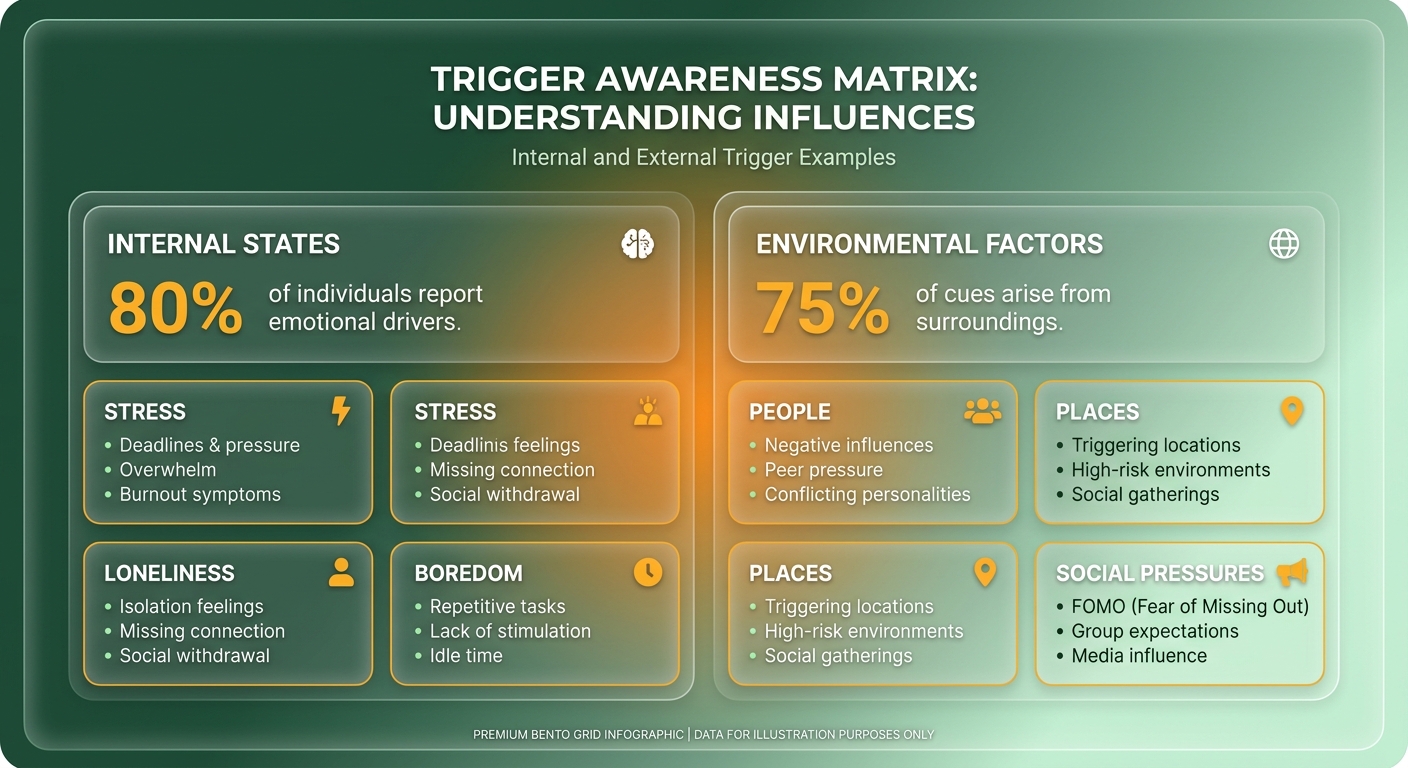
A trigger is any cue that pushes you toward using: a feeling, a thought, a person, a place, a situation. They split into two kinds. Internal triggers are emotions like stress, loneliness, and boredom. External triggers are the people, places, and social pressures that used to surround your use, per Gateway Rehab's trigger guide. Naming yours is the first real work of a plan.
This is where caregiver support gets practical instead of vague. Families want to protect the person they love, but they can't watch for triggers nobody has written down. In our experience, the move home from detox or residential care is exactly when unnamed triggers do the most damage, because the clinical structure is gone and everyday life comes rushing back. A shared list turns that worry into something the whole team can act on.
The most common triggers
Physical discomfort, neglected self-care, and returning to old social circles show up again and again, as Dr. Melemis's research details. Marlatt's cognitive-behavioral model puts high-risk situations at the center of the whole relapse process, according to a PubMed overview of his work. The point isn't the situation itself. It's whether you have a response ready when it shows up. A drive past an old bar only matters if you have no plan for the next ten minutes.
How to recognize your own triggers
Track them in real time instead of trusting your memory. A trigger diary lets you log each brush with a craving and watch the pattern form, a method Gateway Rehab recommends for building coping tactics that fit your actual life.
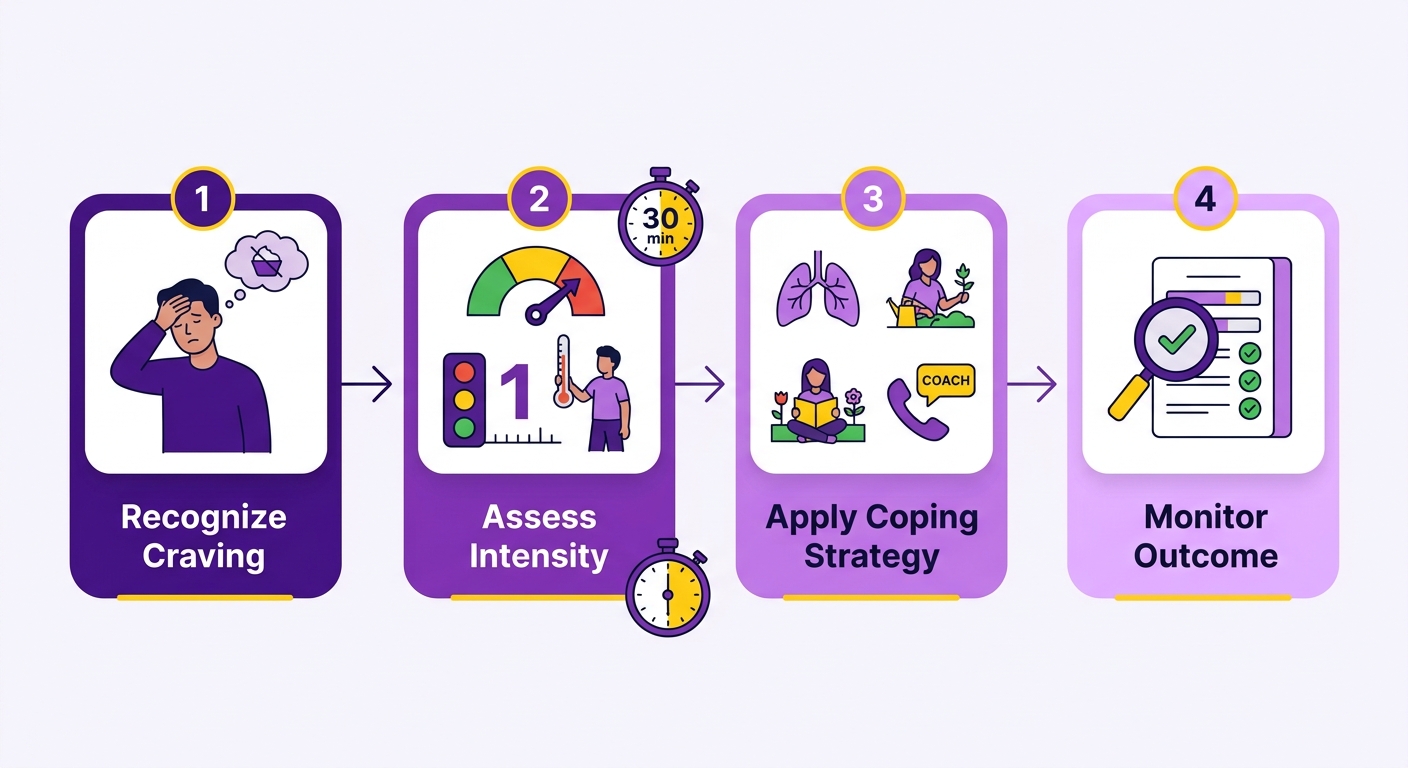
Self-awareness has a shelf life here. Most urges to use last under 30 minutes, per Melemis's early-warning research. That short window is good news. Name the trigger, ride out half an hour with distraction or a phone call, and the craving usually passes on its own. That's exactly the kind of moment our coaches are built for: consistent, real-world support when it counts.
Why you can't spot your own triggers alone
Because the moment you most need to notice a trigger is the moment you're least equipped to. Someone sliding into emotional turmoil is, by definition, the person least likely to see it in themselves. A solo plan can't close that gap.
Reentry programs solved a version of this by refusing to leave detection to one person. Data from the CSG Justice Center shows that folding these strategies into a shared care plan improves outcomes. A dedicated coach makes sure the insights get used, not forgotten. If you're mapping these factors out before discharge, do it with your support people in the room so expectations line up early.
Developing Coping Strategies for Cravings
Cravings are temporary physiological events, not permanent states of mind. Per Dr. Melemis's early-warning guide, these urges peak and fade relatively fast. A coping strategy is just a way to bridge that window.
This is also where caregiver support earns its place. In the weeks after treatment, the people around you are watching, but they often don't know what to do with a craving in the room. A written coping plan hands your family and coaching team a shared script, so nobody freezes when the wave hits.
Coping mechanisms that actually work
The strongest responses shift attention, put the urge into words, and relax the body. The addictionsandrecovery guide stresses that breaking the isolation of a craving is often the fastest way to defuse it. We lean hard on the "tell someone" piece. Distraction works, but it's private, and privacy is where mental relapse hides. Naming a craving out loud to a coach or family member breaks its grip faster than gutting it out alone.
Mindfulness is the other tool worth building in. Mindfulness-Based Relapse Prevention teaches people to sit with a craving without judgment instead of fighting it, and the Hazelden Betty Ford team points to mindfulness techniques that measurably reduce cravings. The skill is simple to name and hard to do: notice the urge, label it, let it pass.
Building a coping plan for high-risk situations
Start with an "If-Then" list. The If-Then strategy pairs each trigger with a pre-decided response, so you're not improvising under pressure. If a party has alcohol, then you drive separately and leave at nine. It maps directly onto the cognitive-behavioral frameworks that stress preparing for high-risk situations before they arrive.
Rehearsing these scenarios ahead of time builds resilience. The Recovery Research Institute's overview notes that a diverse set of coping skills helps with the environmental stressors you can't predict. Self-care sits underneath all of it. Poor sleep, skipped meals, and isolation lower your defenses before any external trigger even shows up. Our take: a coping plan without a self-care floor is a plan that only works on good days.
Why the network does the catching
A person deep in a craving is the least able to think clearly in that moment, so the plan can't live only in their head. It has to live in a team.
That's the core of our coaching model, and it's why we build the plan with families before discharge, not after. For families setting these boundaries, a structured post-rehab routine guide helps clarify who does what during the transition home. The waves get easier. The team makes sure you're not riding them alone.
Creating a Structured Support Network
A support network fails when it exists only on paper. A structured support network names specific people, specific meeting times, and specific backup plans, so nobody has to think during a crisis. This is where caregiver support stops being a feeling and becomes a schedule.
We build these networks around one hard truth: a person in emotional relapse is the worst-positioned person to catch it. Early warning signs tend to show up as behavior, shifts in eating, withdrawal, mood changes, which the Priory Group's staging model flags as precursors to physical relapse. Nobody in that state reliably clocks their own mood shift. That's a job for the people around them, and it only works if those people know what their job is.
What a support network actually includes
A support network is the specific list of people, meetings, and check-ins you can lean on, mapped out before you need it. It usually includes a sponsor, a peer group, family members acting as caregivers, and a coach who checks in on a set schedule instead of waiting for the crisis call.
We put this in writing with our clients, not just talk about it. Each name gets a role: who to call for a bad night, who to call for a bad week, who handles logistics like rides to meetings. "Call someone" collapses under pressure. Named plans hold.
Building a meeting attendance schedule
A meeting schedule works when it's fixed on the calendar before motivation dips, not decided day of. Set specific days, times, and locations, and treat them like a medical appointment: non-negotiable unless something serious comes up.
The StatPearls review backs this up, noting that active engagement in mutual-help groups tracks with sustained recovery. Our take: pick a cadence you can actually hold. Three fixed sessions a week beats seven you'll abandon by month two. Anchor each one to a routine you already have, a commute or a standing meal, so the meeting rides on an existing habit instead of fresh willpower every time.
How to structure sponsor check-ins
Sponsor contact works best as a routine, not an emergency line. Set a standing call time each week, plus a clear rule for what counts as urgent enough to call outside that window.
Regular check-ins build accountability. Behavioral studies in that same StatPearls review show structured reinforcement schedules help lock in positive habits during early recovery. Same logic for a sponsor: consistency makes the relationship functional, not the depth of any single conversation.
Where technology fits in
Virtual coaching fills the hours between meetings, when isolation and unnamed stress do the most damage. We treat video check-ins the same way we treat in-person ones: scheduled, expected, and tied to the same team that knows your specific triggers. It's a bridge between face-to-face meetings, not a replacement for a real attendance routine. Think of it as an extra layer of safety, not the whole floor.
Setting Goals and Tracking Progress
Goals turn a prevention plan from something you read into something you run. In recovery, a goal is a concrete, dated commitment: attend three meetings this week, call your coach every morning, walk 20 minutes when a craving hits. The Florida Courts relapse plan frames prevention as a structured plan of action, not a feeling. Goals are that action written down.
Caregiver support shifts from watching to participating. In the weeks after treatment, families often ask us what they're supposed to actually do. Goals answer that. When a goal is written, dated, and assigned, the people who love you have a job that isn't guesswork. That's the line between a plan on paper and an accountability structure that holds in daily life.
What short-term and long-term goals look like
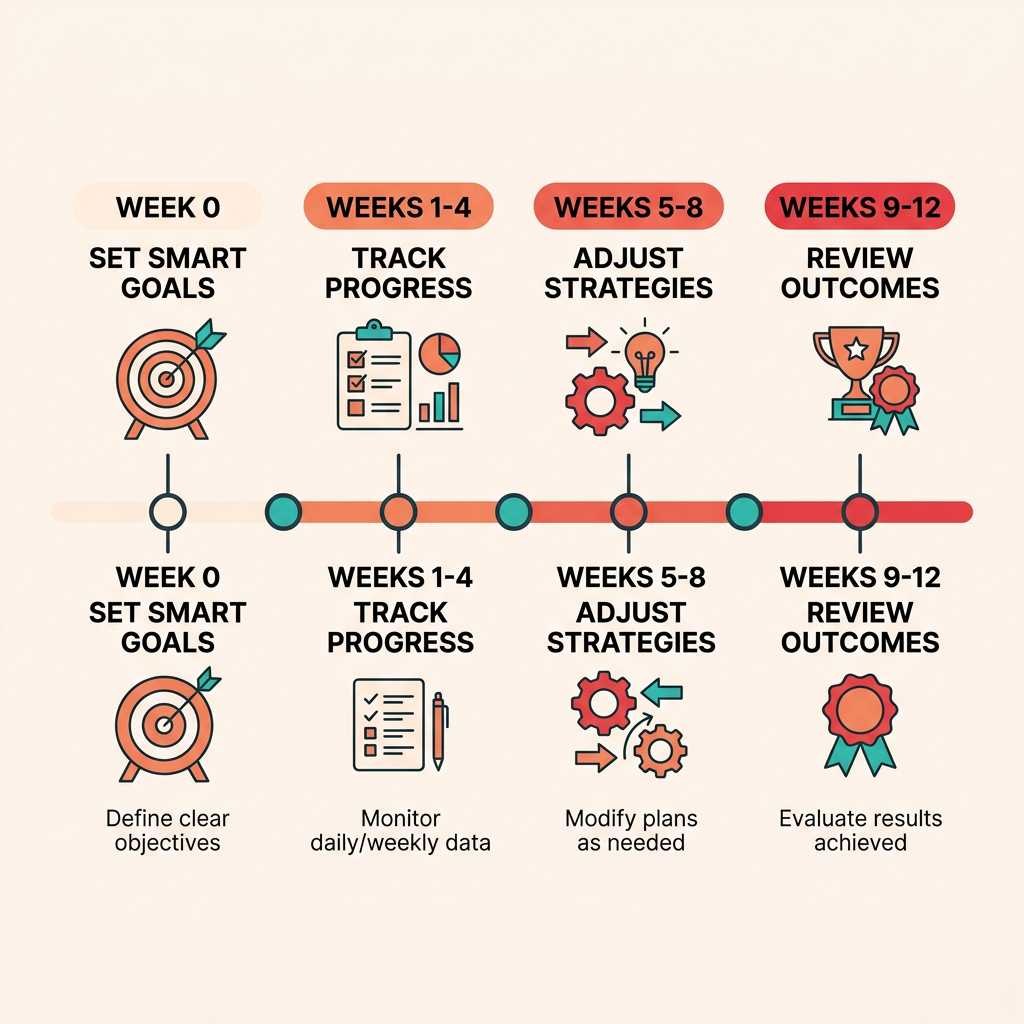
Short-term goals are the daily and weekly commitments that rebuild structure. Long-term goals are the milestones that give the daily work a direction.
Short-term goals are small on purpose. Attend a set number of meetings. Log your mood each night. Text your coach before, not after, a high-risk situation. A documented schedule, as the Florida Courts plan recommends, anchors daily activity and prevents the drift that sets in when structure is missing.
Long-term goals stretch further: 90 days sober, repairing a relationship, holding a job for six months. In our experience, the mistake is starting there. Chase the six-month milestone without the daily reps, and the gap swallows people during the exact post-treatment window where relapse risk peaks.
Tracking progress and handling setbacks
Track behavioral indicators, not just sobriety dates. The Hazelden Betty Ford approach watches for changes in attitude and daily routines to catch early warning signs. A day counter tells you where you've been. A mood log tells you where you're heading.
Pairing behavioral planning with clear accountability is what makes it stick. The If-Then strategy works best when specific support members are assigned to help execute each response. Roles turn a static template into something that actually runs.
Setbacks aren't the end of the plan. Treat relapse as a process with identifiable stages rather than a single event, and the right structure and accountability can interrupt it before it takes hold. A missed goal is data. It tells your team where the plan needs tightening.
Where a sober coach fits
A coach keeps the tracking objective and adjusts goals as recovery progresses. To build these habits early, our guide on post-rehab routines that last is a good place to start. Naming a 30-day milestone matters as much as naming a trigger.
Writing a Relapse Prevention Plan
A relapse prevention plan works best on paper, not in your head. A written plan turns scattered intentions into a document your whole team can run: your triggers, your early warning signs, your coping moves, and the exact people to call. Caregiver support gets a job description instead of a vague hope, because you can finally see what to watch for and when to step in.

Writing it down matters most when residential care ends. That transition is where a plan either becomes a working tool or gathers dust. Coordinating with nursing support, family, and other caregivers is part of how a sober coach helps clients reenter daily life, so caregiver involvement starts early instead of after the first scare.
What goes into a written plan
A relapse prevention plan lists your triggers, cravings, coping tools, and support contacts. It spells out the behaviors that precede a slip, the people you'll call, and a dated meeting schedule. The Priory Group's framework offers structured layouts to help organize those pieces clearly.
Keep it concrete. List the feelings and behaviors that come before a slip, the people you'll call, and a schedule with real dates on it. The Recovery Village's guide points out that different models suit different needs, so don't treat any single template as gospel. Pick the one you'll actually open.
Folding treatment and aftercare into one plan
Getting clinical strategies into daily life is what keeps care continuous. Applying cognitive-behavioral techniques, spotting high-risk scenarios, and practicing your responses protects the progress you made in formal treatment. Skills training, relapse rehearsal, and cognitive restructuring belong in the plan, not just in the therapy room you left behind.
One caveat: standard relapse prevention programs often run as 12 weekly sessions that ramp up in the maintenance stage. But the highest-risk stretch is the first weeks home, before that programming fully kicks in. A written plan, paired with routine building and daily check-ins, is what covers that gap until structured aftercare catches up.
Where a sober coach fits in
A coach is an active partner in running the plan, not a spectator. For families working through this transition, our resources on post-rehab routines lay out how to coordinate support without stepping on each other.
References
[1] [PDF] Relapse Prevention Plan - https://www.flcourts.gov/content/download/732700/file/RELAPSE
[2] Addiction Relapse Prevention - StatPearls - NCBI Bookshelf - NIH - https://www.ncbi.nlm.nih.gov/books/NBK551500/
[3] How to Create a Successful Relapse Prevention Plan - https://www.therecoveryvillage.com/treatment-program/aftercare/relapse-prevention-plan/
[4] Relapse Prevention: Make a Plan to Stay Sober - https://www.hazeldenbettyford.org/relapse-prevention
[5] Relapse Prevention Plans – Collaborative Comprehensive Case ... - https://projects.csgjusticecenter.org/collaborative-comprehensive-case-plans/relapse-prevention-plans/
[6] Relapse Prevention (RP) (MBRP) - Recovery Research Institute - https://www.recoveryanswers.org/resource/relapse-prevention-rp/
[7] Relapse Prevention Plan and Early Warning Signs - https://www.addictionsandrecovery.org/relapse-prevention.htm
[8] Relapse Prevention Plans: Writing, Using, and Free PDF Template - https://www.priorygroup.com/rehab-aftercare/relapse-prevention-plan
[9] Relapse Prevention Plan: A Step-by-Step Guide for Recovery - https://www.youtube.com/watch?v=gIAO-Jw03po
[10] A Guide for Navigating Triggers and Temptations - https://www.gatewayrehab.org/blog/a-guide-for-managing-triggers-and-temptations
[11] Relapse Prevention and Prediction Strategies in ... - https://pubmed.ncbi.nlm.nih.gov/37276204/
[12] Relapse prevention. An overview of Marlatt's cognitive ... - https://pubmed.ncbi.nlm.nih.gov/10890810/
[13] Addiction Relapse Prevention - https://pubmed.ncbi.nlm.nih.gov/31855344/
[14] Relapse of substance use disorder and its prevention ... - https://pubmed.ncbi.nlm.nih.gov/16215194/
[15] Digital relapse prevention plan for substance use disorders - https://pubmed.ncbi.nlm.nih.gov/41290251/
Frequently Asked Questions
1. What's the actual difference between a lapse and a relapse?
A lapse is an isolated instance of substance use, whereas a relapse is a return to a sustained pattern of behavior. Clinically, separating these terms helps prevent the "abstinence violation effect," where an individual views a single mistake as a total failure and abandons recovery efforts entirely.
2. Should I build the full plan while still in detox?
During acute withdrawal, cognitive resources should stay focused on physical stabilization. A detailed, multi-step strategy is more effective once you have transitioned out of initial detox and are preparing to face everyday environmental stressors. Start with a basic safety checklist and expand it later.
3. Can I build and run a relapse prevention plan entirely on my own?
Self-monitoring has inherent limitations, particularly when stress or fatigue impairs judgment. Having a trusted peer, family member, or professional review your plan ensures that subtle behavioral shifts are noticed before they escalate. Accountability relies on external perspective.
4. How often should I revisit the plan after writing it?
Regular reviews keep the document relevant as your routine changes. Updating your strategies allows you to adjust for new environments, changing social circles, and personal growth, ensuring the plan evolves alongside your recovery.
5. Why doesn't a standard template work equally well for everyone?
Standardized templates often fail to account for unique cultural, environmental, and socioeconomic factors. To be effective, cognitive-behavioral tools must be adapted to align with an individual's specific community context, support systems, and daily realities.
6. How should I organize my support contacts so they're useful in a crisis?
Categorize your contacts based on the specific type of assistance they can provide, such as emotional support, crisis intervention, or practical logistics. This structure removes decision-making fatigue during high-stress moments, allowing you to reach the right person immediately.