How Sober Coaching After Rehab Tapers Support to Engineer Your Independence
September 26, 2026

TL;DR
- Continuing care research suggests longer support may better support recovery.
- Continuing care studies show benefits, though duration remains unclear.
- Effective tapering pegs the reduction rate to a person's actual stability, not to a fixed weekly cut in contact.
- Early coaching maps three things: a client's daily rhythm, their stressors, and the resources they can reach across a normal week.
- Most insurance plans don't cover after-rehab sober coaching, so the work is largely an out-of-pocket expense.
How Long Should Support Actually Last?
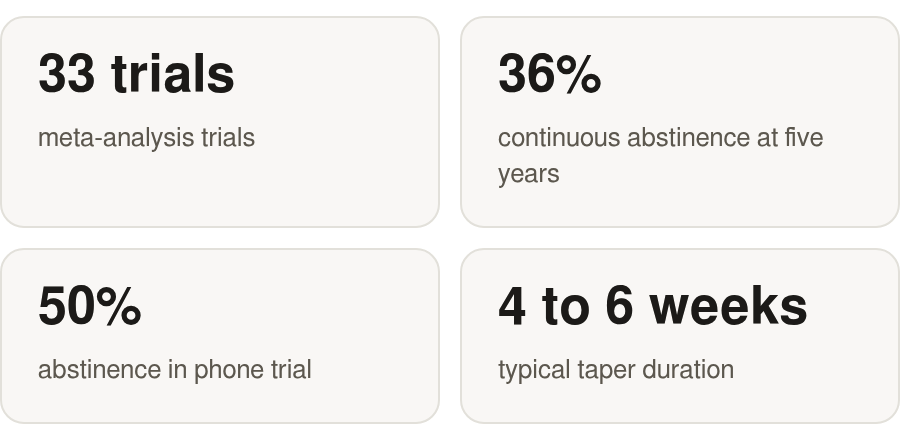
The evidence leans toward longer support, but nobody has pinned down the exact number. One continuing care review argues that longer support may be needed for durable recovery. A meta-analysis of 33 trials couldn't statistically isolate duration as the deciding factor, though it did confirm that continuing care helps.
We read that gap plainly. No statistical proof isn't proof that duration doesn't matter, and the strongest individual trials tend to run long. So we design each program around the person in front of us and taper support as their own stability grows, not against a date set on day one. For a closer look at what those check-ins actually cover, our team walks through it in this 90-day relapse guide.
Start by Mapping Your Life, Not Your Schedule
Every plan we build starts with a map. Before we talk about reducing anything, we run an initial consultation to understand the terrain of your actual life. That's the foundation of sober coaching after rehab: you can't taper something you haven't sized correctly first.
The move back to daily life is fragile, and plenty of people struggle to hold their footing without structured support underneath them. So early coaching leans toward consistent, real-world presence in the moments that matter most. Everything we assess up front is aimed at getting you through that stretch with your independence intact.
What the Initial Assessment Maps
We start with three things: your daily rhythm, your stressors, and your resources. Where do the hard hours fall? Which relationships help, and which ones pull? What does a normal week look like once the airport pickup is over and you're back in your own kitchen?
Travel gets special attention. If you fly for work or have a wedding across the country in month two, we flag it now. A trip during an early, higher-risk stretch isn't a footnote. It's a planning priority, and it shapes how much presence we build in versus how much we can hand back to you.
We name the early challenges honestly, too. The transition out of rehab is where people report the biggest gaps: high-stress social events, unstructured time, and the sudden absence of the walls that used to hold the schedule together. Those are the situations we design around first.
Setting Goals That Aren't Just Wishful
We keep early goals small, specific, and countable. Attend three sober social events in your first two weeks. Lock a consistent sleep and wake time for seven days straight. Short goals build evidence that you can trust yourself again.
Daily structure carries a lot of this weight. We help you build a routine around nutrition, sleep, and movement, because rebuilding those habits is what makes the harder emotional work possible. A body that's fed and rested argues with cravings better than one running on fumes.
Dedicated Coach or Coordinated Team?
Not everyone needs the same intensity, so we match the model to the moment. A dedicated coach fits when you need one consistent relationship, scheduled check-ins, and steady accountability. A coordinated team fits when early risk is higher or travel is heavier, because it lets us cover hands-on, in-person presence during vulnerable stretches while still holding the long-term goal work.
The research supports the split. Active outreach that brings support to you sustains engagement over the long haul, while high-touch in-person presence protects you during acute moments like travel and events. The taper is the migration between those two modes. We front-load presence while risk is high, then shift toward scheduled contact as the case for reducing it grows.
We also talk through payment before a plan starts, so the care model and the budget match the level of support on the table.
Designing the Taper: How the Reduction Actually Works
A good taper starts with the number most plans get wrong: the rate of reduction. Cutting contact by a fixed amount every week feels tidy, but recovery risk doesn't decline on a tidy schedule. Effective sober coaching after rehab pegs the reduction to how the person is actually doing, not to a calendar.
We build the taper as a migration, not a shutdown. Early on, support looks like companion-level presence: real-world, high-touch, available in the vulnerable moments. As stability holds, that shifts toward scheduled coach-level check-ins. The point is moving a client along that path without letting the floor drop out from under them.
The Reduction Should Track Risk, Not the Calendar
People treated for alcohol and drug use can relapse within the first year. That risk isn't spread evenly. It concentrates hard in the early stretch, which is why we front-load intensity and hold it there before easing off.
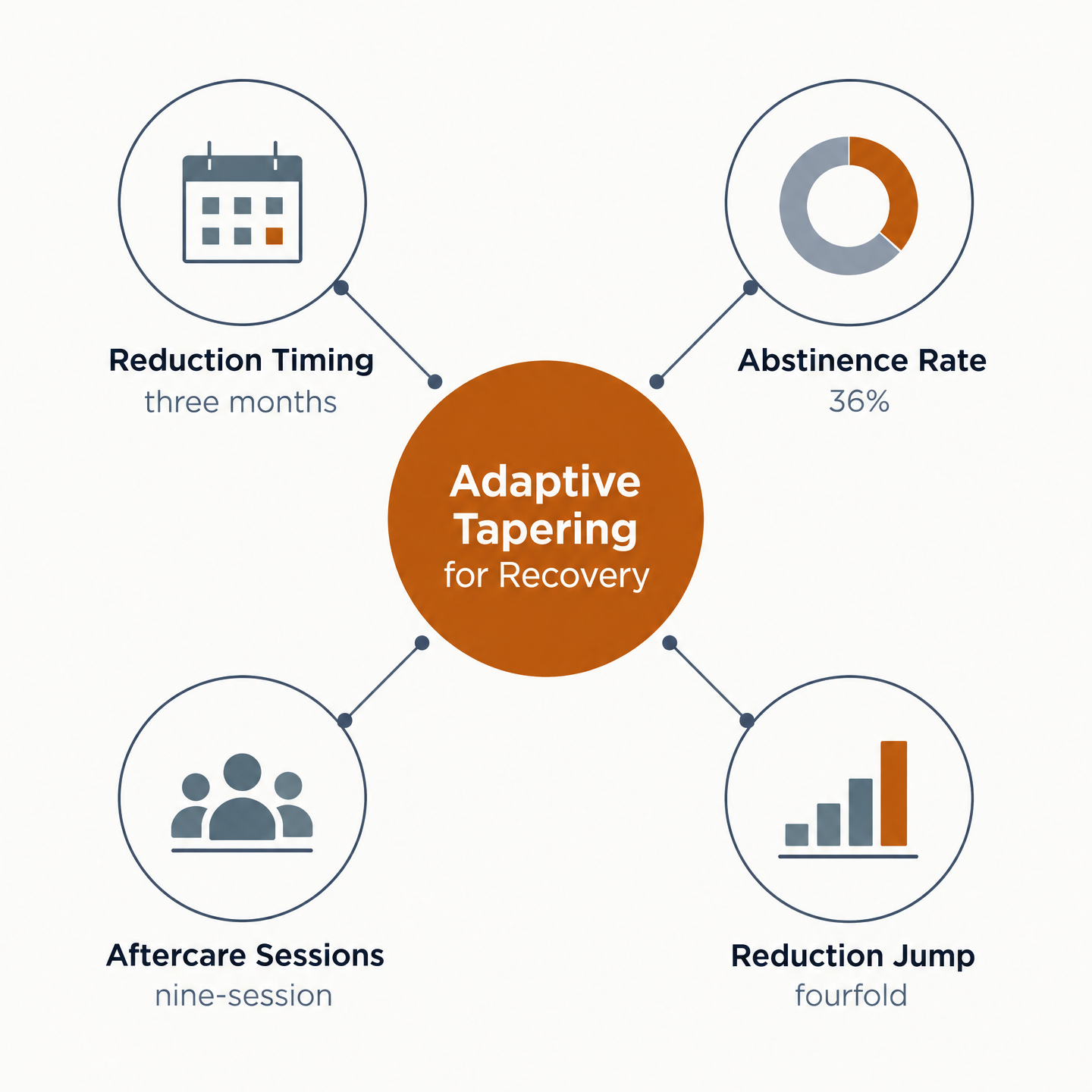
The research on adaptive care backs this up. McKay's continuing care review describes step-down and step-up algorithms that adjust support based on progress, not a preset timeline. We use the same logic. If someone hits a rough patch three months in, we step contact back up rather than push through a reduction they aren't ready for.
A workable frame: hold high-frequency contact through the highest-risk window, then reduce contact modestly each phase, gated on the client clearing specific competencies before the next cut. No competency met, no reduction.
From Daily Presence to Weekly Check-Ins
The modality shift is where the taper does its real work. Daily video calls or in-person presence give way to weekly calls, then to scheduled goal-focused sessions. This isn't guesswork. Structured, active outreach outperforms passive clinic-based contact across the continuing care literature.
The numbers are striking. Patterson's home-visit study found 36% continuous abstinence at five-year follow-up, versus 6% for lighter review visits. A structured nine-session aftercare program drove more attendance and reduced uncontrolled use compared with unstructured care. Structure and reach matter more than raw hours.
For clients traveling after rehab, this is where the approach earns its keep. A sober travel companion combines direct observation, immediate redirection, and practical help with the logistics that can quietly raise stress. Instead of asking the client to translate a risky moment into a later appointment, support is right there while the choice is still unfolding.
Self-Management Fills the Space Contact Leaves
As contact drops, something has to take its place. We lean on the daily routines built earlier, so the structure a client depends on increasingly comes from their own practice rather than constant coach contact. Routine building is a core part of how we help clients steady themselves between sessions.
Telephone check-ins make a good bridge. Brief phone-based aftercare has produced meaningfully higher abstinence and far lower readmission than no continuing care, at a fraction of the cost of live presence. We treat "graduation" as something the client demonstrates, not a date. When someone handles a high-risk stretch on their own and reports back, that's the signal the taper is working.
One caveat worth stating plainly: not everyone tapers on the same curve. Response varies widely, and we adjust support to match rather than force a fixed schedule.
Coordinating With Family, Sober Living, and Travel
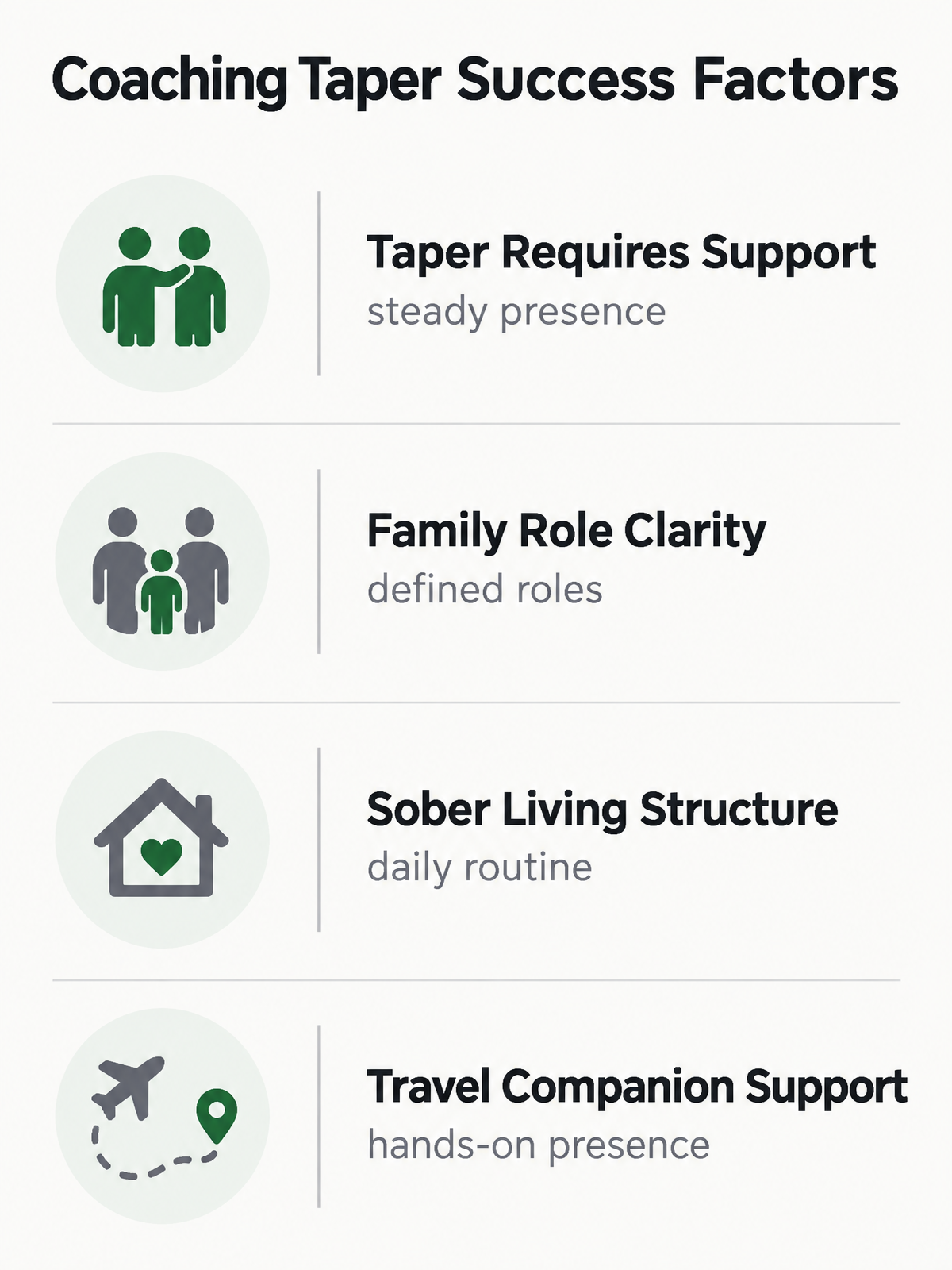
A taper only works if something catches the weight as coaching intensity drops. That's why we coordinate sober coaching after rehab with the supports already in your life: family, a sober living house, and the trips that used to blow plans apart. Synced up, a reduction in coach contact doesn't leave a hole.
Think of it as a relay, not a solo effort. Continuing care works best when it lowers the burden on the person in recovery and keeps support connected to ordinary life. That principle shapes how we make handoffs. The coach stays accountable for the plan, but other stable supports begin carrying more of the daily load as the taper moves along.
How Families Fit Into the Plan
Families do best with defined roles, not vague availability. We set clear boundaries early so a parent or partner isn't improvising crisis response at midnight. Their job is steady presence and honest observation, not policing.
Part of our work is helping families understand the recovery process, and that guidance carries through as coaching tapers. As formal check-ins stretch out, a family member who knows the warning signs becomes a real part of the accountability structure. That handoff is deliberate. The person in recovery gets more room, while the family gets clearer instructions about when to speak up and when to step back.
Where Sober Living Reinforces the Taper
A sober living environment provides the daily structure that a reduced coaching schedule can't. Meals, curfews, house expectations, and peer accountability make the day less improvisational, which matters when coach contact is no longer constant.
As that structure takes hold, coach contact can safely step down toward scheduled sessions. This is gradual tapering in practice: the home environment reinforces ordinary habits while coaching focuses on decision-making, stress response, and the next stretch of independence. The floor stays solid because the client isn't losing all their structure at once.
What Sober Travel Support Actually Looks Like
Travel is where recovery plans break, so it gets companion-level support, not a phone call. A sober travel companion helps with the parts of a trip that look harmless on paper but feel loaded in real time: airport delays, hotel isolation, work dinners, family receptions, and the long unstructured gaps between obligations. Sober companions are often present during critical moments like social events and travel, exactly when focus on sobriety is hardest to hold.
The cost tradeoff is straightforward. Live travel support takes more time and more hands-on attention than a planned call, so it sits at a different intensity level. As stability holds, that travel support can narrow: first less continuous presence, then planned remote check-ins, then a pre-trip and post-trip review.
Our sober travel companions provide hands-on presence during the trip itself, the kind of support that matters most when routines are disrupted. We build the taper as a migration from that in-person presence toward lighter remote support, so travel becomes proof of independence rather than a gap in it.

Reading the Signal: Feedback Loops That Adjust the Taper
A taper plan is only as good as the signal you're reading it against. Effective sober coaching after rehab runs on a working feedback loop: watch how the person is actually doing, then move support up or down based on what you see. Read it wrong and you either pull back too fast or hold on too long.
We watch for concrete behavioral markers, not a subjective sense of readiness. Routine adherence tells us whether the daily structure is holding. How a client handles real-world triggers, whether social, emotional, or physical, shows whether internal coping is taking hold. No single marker decides the taper. Together they show whether stability is building, and that's what we adjust against.
Variability Is the Rule, So the Plan Has to Adapt
The research keeps confirming an uncomfortable pattern. In one continuing care research review, people fall into mixed outcome patterns, while others show sustained abstinence or little benefit. As the author puts it, "the variability in patient response is still the rule, not the exception."
That variability is exactly why a fixed schedule fails. A client may be strong with home routines and still vulnerable around conflict, travel, boredom, or one specific social circle. We build that uncertainty straight into the taper. Your reduction schedule is a hypothesis, and what we see week to week either confirms it or tells us to slow down.
What Adjusting the Taper Actually Looks Like
As clients hit behavioral markers, we adjust how often we check in. It's a structured conversation about progress, not a status update. We look at whether the daily routines are holding and how the client is handling triggers, then weigh that against where the taper says they should be.
The questions are direct. Are the reduced check-ins still catching what matters? Is a particular trigger, a certain person or a type of trip, still tripping things up? Does the client's own read on their stability match ours? We use what we learn to shape the next step, so each reduction is informed by how the last one went.
If what we see says hold or reverse, we re-intensify. That's not a failure in the plan; it's the plan working. Low-burden phone check-ins keep people engaged over the long haul, and the numbers back it. In one telephone-based aftercare trial, five calls over three months produced 50% abstinence versus 24% and cut readmissions sharply. But when a trip or a crisis raises the risk, we step back up to real-world presence fast.
Travel Is Where the Feedback Loop Gets Tested
Trips are the stress test for any taper. A client who's steady at home can hit a wall at an airport bar or a hotel minibar. That's why a travel window is often when we pause a reduction, send a sober travel companion along, then check in afterward to feed what happened back into the plan.
The post-trip review matters as much as the trip itself. We look at what the client anticipated correctly, what surprised them, and which decisions they handled without prompting. That record becomes the next taper signal, so independence grows from observed behavior rather than optimism.
A Sample 12‑Week Taper You Can Actually Run
Here's how the pieces fit into a single arc. This template pulls together everything above: the assessment map, the skill-building work, the family and travel integration, and the feedback loop. Treat it as a template for sober coaching after rehab, not a fixed prescription. Adjust the pacing to what your read on stability tells you.
One thing we hold onto throughout: independence includes the freedom to travel. A plan that only works when you're home isn't a real plan. So the trips get built in, not bolted on.
Early On: High-Touch Presence
The opening block is about safety and sizing your actual life. Support looks like companion-level, real-world presence during the vulnerable hours. Homework is simple and daily: log your triggers, hold one routine anchor such as a morning ritual or set mealtime, and name the situations you're avoiding. We're mapping terrain here, not testing you yet.
As Stability Grows: Solidifying the Routine
Now the daily structure has to hold with less oversight. Coach contact starts shifting toward scheduled check-ins. Your practice work moves to running your own coping play on a low-stakes trigger and reporting back. If a short local trip fits your life, this is where we plan it together as a controlled rehearsal.
Later Stages: Peer Integration and Sober Travel Support
As you find your rhythm, other supports carry more weight and coach contact thins out. Family, a sober living community, and peer connections take the front line. When a real trip lands in this window, our sober travel companion service can step in so you keep moving without the plan collapsing at the airport.
Attach a short weekly review to every stage. Three questions do the job:
- What routine held, and what slipped?
- Which trigger did you handle solo, and how?
- Where did you need a support-network touch-point?
That feedback is what moves you up or down the taper. The endpoint isn't a graduation date. It's the moment you're running your own recovery and calling us when you choose to, not because you have to.
References
[1] Sober Companion and Recovery Coach: Professional Support for ... - https://www.addicted.org/after-treatment/support-programs/sober-companion-and-recovery-coach/
[2] Sober Coaching: How It Works, Key Benefits,… - Caron Treatment Centers - https://www.caron.org/addiction-101/treatment-advice/sober-coaching
[3] The Continuing Care Model of Substance Use Treatment - PMC - https://pmc.ncbi.nlm.nih.gov/articles/PMC4007701/
[4] Continuing Care Research: What We've Learned and Where We're ... - https://pmc.ncbi.nlm.nih.gov/articles/PMC2670779/
[5] (PDF) The Continuing Care Model of Substance Use Treatment - https://www.researchgate.net/publication/262422106_The_Continuing_Care_Model_of_Substance_Use_Treatment_What_Works_and_When_Is_Enough_Enough
[6] How effective is continuing care for substance use disorders? A meta ... - https://www.researchgate.net/publication/257204132_How_effective_is_continuing_care_for_substance_use_disorders_A_meta-analytic_review
FAQ
1. Does insurance cover sober coaching after rehab, or is it entirely out of pocket?
Plan for a private-pay conversation before services begin. The practical question is usually intensity: scheduled remote coaching is a different commitment than live companion coverage during travel, events, or other high-risk windows.
2. What happens if I relapse or hit a rough patch while my support is being reduced?
We treat a setback as new information. The taper pauses, the risk is reassessed, and the next level of support is matched to what is actually happening rather than to the original plan.
3. How do I know whether I need a dedicated coach or a coordinated team?
Look at complexity. If your main need is accountability and continuity, one coach may be enough. If your first months include higher-risk settings, frequent movement, or situations that require in-person coverage, a team gives the plan more reach.
4. Is sober coaching the same as clinical treatment or therapy?
No. Sober coaching is nonmedical recovery support. It helps translate recovery goals into daily structure, accountability, and real-world decision-making, while licensed clinicians remain responsible for diagnosis, medication, detox, and therapy.