Home After Rehab vs Sober Living: Which Fits Your Household?
September 21, 2026
Quick Summary
Going home or moving into sober living usually comes down to two questions: how much structure your household can realistically provide, and how safe home feels in early recovery. That is the real decision families face after rehab, and it looks different for a single adult than it does for a couple with kids or a house with three generations under one roof.
The table below compares the three paths we see most often. The research points in a consistent direction: the social environment drives results more than the address does. A study on sober living houses found that recovery-oriented social networks and 12-step involvement predicted success. So a home that supplies a pro-recovery network can stand in for sober living. A home that cannot is exactly where sober living earns its keep.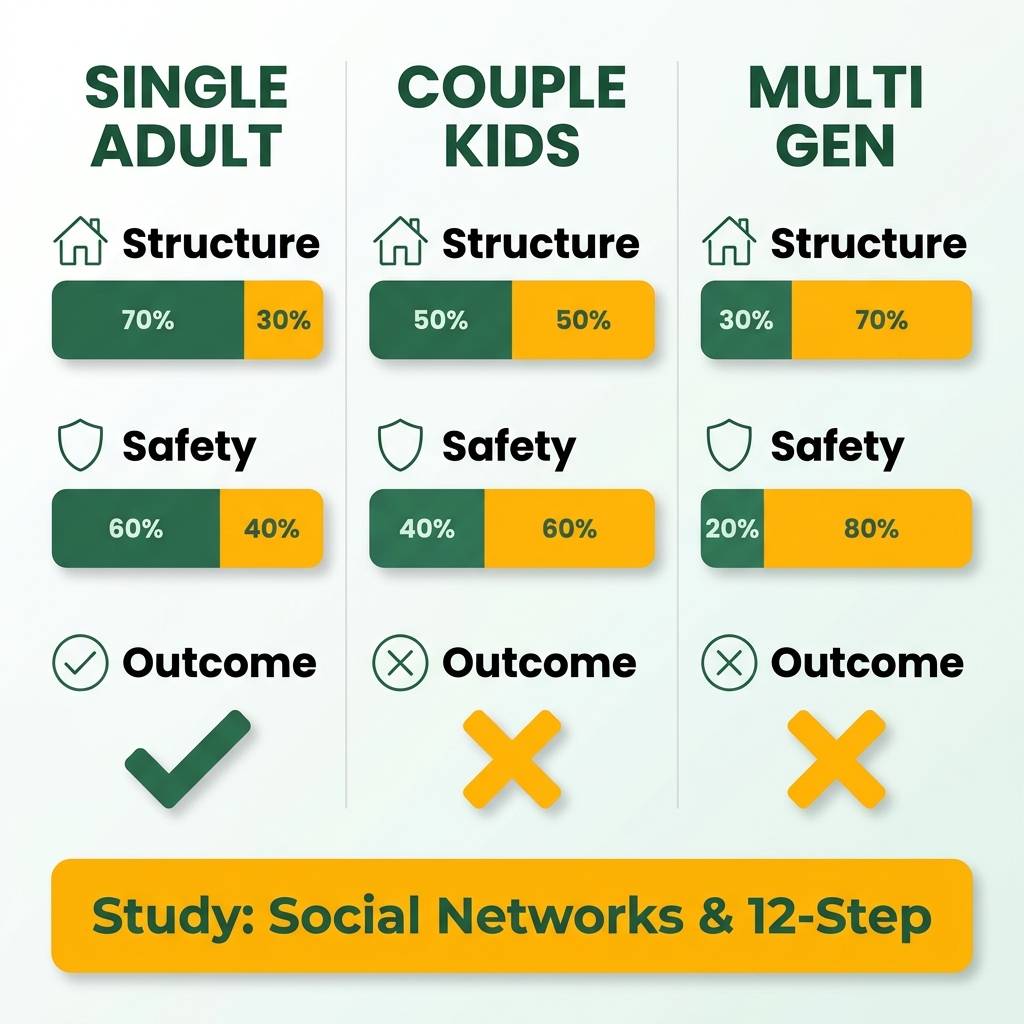
How do the three options compare?
| Dimension | Home After Rehab | Traditional Sober Living | MADE Recovery (Hybrid) |
|---|---|---|---|
| Setting type | Existing household | Shared recovery residence | Coaching at home, with optional sober living residence |
| Typical length of stay | Open-ended | 90-day minimum recommended | Tapered to need; support shrinks as independence grows |
| Level of structure | Depends on family | Curfews, chores, screenings | Built around the client; adjustable |
| Type of support | Family and outside care | Peer community | Dedicated coach or team, plus optional peer residence |
| Cost | Lowest direct cost | Varies by home and region | Depends on the à la carte or custom package chosen |
| Family involvement | High, sometimes too high | Limited by visitor policies | Coordinated with the family directly |
| Ideal profile | Stable, sober-supportive home | High-trigger or unstable home | Households wanting structure without leaving home |
Which setting fits which household?
Home works best when the household is stable and genuinely sober-supportive. Sober living tends to win for the single adult heading back into a high-trigger environment, or for anyone whose home lacks a recovery-minded network.
One thing worth naming: "sober living" is not one thing. The NARR framework spans four levels, from peer-run homes to clinically integrated ones. Vet the specific home, and check its relapse policy. Some homes reconnect a resident to care after a slip. Oxford Houses require completing a 28-day program before return. Neither is wrong. They protect different priorities.
Two takeaways before you decide
-
No single stay covers the full stabilization window. Homes recommend roughly 90 days, but recurrence risk stays elevated for years. Whichever setting you pick, pair it with a multi-year support plan instead of treating the housing choice as the finish line. We walk families through this tradeoff in our guide on sober living versus moving home.
-
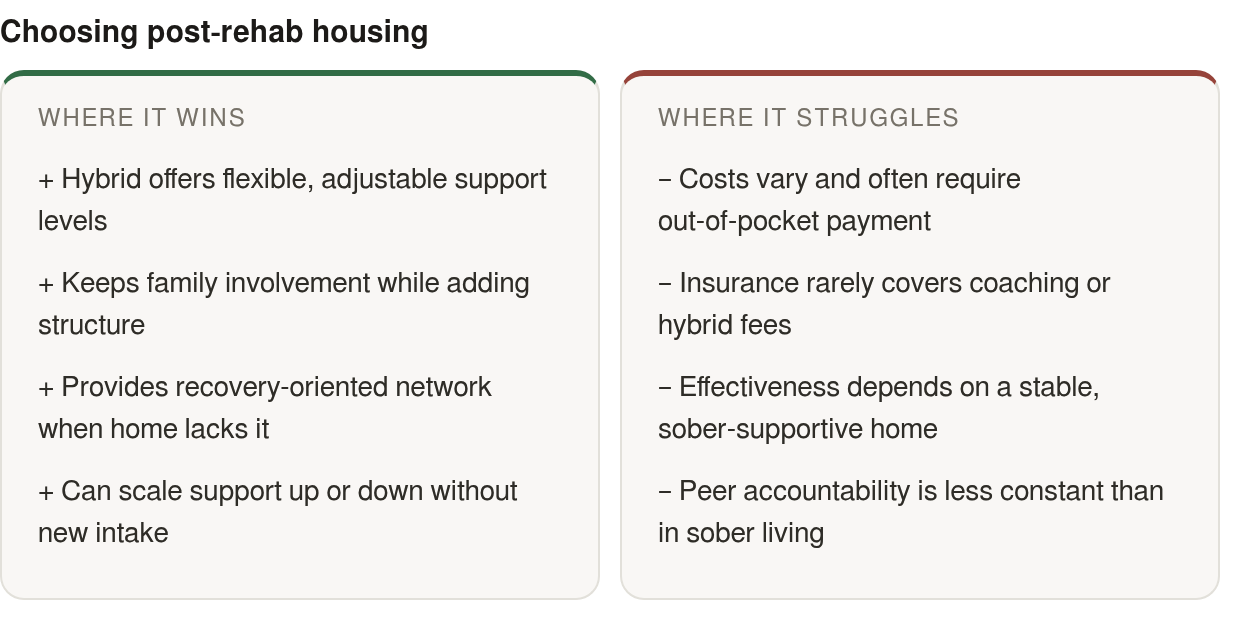
The hybrid path exists because this is rarely all-or-nothing. Our approach pairs a dedicated coach with an optional premium sober living residence, so a household can add structure without uprooting the person. That flexibility matters most when home is loving but not yet equipped to hold recovery on its own.
Key Takeaways
- Peer engagement and active fellowship participation predict lasting sobriety better than location alone.
- Long-term data on residential recovery shows broad gains across personal stability, employment, legal standing, and emotional health.
- Initial residential stays are short, but full stabilization takes an extended continuum of care.
- Housing standards range from self-governed cooperatives to fully staffed therapeutic settings.
- Re-admission rules after a setback range from immediate clinical re-engagement to completing an outside treatment program first.
- Old household dynamics, leftover substances, and familiar stress points create friction when someone steps straight back into family life.
- Out-of-pocket fees for transitional housing swing widely by region and amenities, while returning home carries no direct room fees.
Why the Setting You Pick Is a Safety Decision
"Destructive living environments can derail recovery for even highly motivated individuals." That line from a study on sober living houses is the clearest reason this decision deserves real thought. The willpower your loved one brings home after rehab matters far less than the room they walk into every night.
Families underestimate this constantly. The stakes are not abstract. Substance use disorder carries a real cost in lives and stability, and the environment someone returns to can either protect recovery or quietly work against it. The setting you pick in those first weeks is a safety decision, not just a logistics one.
How much does environment actually drive relapse?
More than most people expect. A study that followed 300 residents entering sober living houses documented improvement in alcohol and drug use, employment, arrests, and psychiatric symptoms. That is a meaningful result, and it is why structured settings exist.
The same data shows why. Gains showed up when residents were surrounded by other people working toward the same behavioral goals. The building does not generate recovery on its own. Shared expectations, common routines, and mutual reinforcement are the active ingredients that keep people on track.
What stressors show up when someone comes straight home?
Homes carry emotional memory. Lingering tension, old social circles a few blocks away, and unstructured free time all create openings in the early weeks. For households already juggling work schedules, childcare, or their own coping habits, running daily oversight on top of that becomes exhausting and can strain the relationships you are trying to protect.
The table below shows what actually moves relapse risk in each setting, so you can weigh your own home against it honestly.
| Risk driver | Going home | Sober living |
|---|---|---|
| Recovery-minded people nearby | Depends entirely on the household | Built in by design |
| Exposure to old triggers | Often high | Low, especially early |
| Daily accountability | Family must provide it | House rules and peers provide it |
| Length of support | Flexible, family-controlled | Residents stay as long as they follow rules |
Unlike halfway houses that run on rigid court- or agency-mandated discharge dates, recovery houses typically let people stay until they establish self-sufficiency, according to the sober living research.
Why no single housing choice is the whole plan
Recovery unfolds in stages. It does not end at residential discharge. The behavioral rewiring happens over many months of facing real-world stress, which means the first housing decision is only the first phase.
A real safety net connects housing to ongoing mentorship, mutual-aid meetings, and family boundary work. Those durable layers are what carry someone past any short-term stay.
What a Traditional Sober Living Home Actually Includes
Most traditional sober living homes run on a handful of shared elements: a substance-free house, drug and alcohol screenings, curfews, visitor policies, and required participation in meetings or outside support. That basic model is the first thing many families look at when weighing where a loved one lands after rehab.
Also called recovery residences or transitional housing, these properties give people finishing a clinical program a structured landing pad to reinforce daily habits before living fully independently.
The range is wider than families expect
"Sober living" is not one product. Homes run from peer-run houses with no clinical staff up to settings with professional support built in. The oversight, cost, and structure you get depend entirely on which kind of home you are looking at.
Here is how the core elements typically break down across that spectrum:
| Element | Peer-run home (e.g. Oxford House) | Higher-support home |
|---|---|---|
| Oversight | Residents self-govern | Trained staff, sometimes on-site counselors |
| Entry | Approval by current residents | Application and clinical screening |
| Cost | Rent-based | Higher |
| Recommended stay | Open-ended | Longer, more structured |
Insurance rarely touches any of it. Homes are usually priced so a person can afford them out of pocket, which is a real budgeting factor to map before choosing this path over home.
How these homes are staffed and governed
Governance varies a lot from house to house. One common model leans on senior peers with long-term sobriety to run daily operations, which builds an organic culture of mutual responsibility. Higher-tier residences instead employ dedicated support staff, life-skills facilitators, and case coordinators.
Knowing the difference prevents mismatched expectations. Resident-led houses foster autonomy. Someone who needs intensive routine management or clinical coordination usually does better in a professionally staffed program.
What happens when someone relapses
How a house handles a setback is a policy families should evaluate early. Reconnection-oriented homes treat a slip as a reason to reassess the plan, helping the person access medical stabilization or higher care without a permanent discharge.
Other homes enforce immediate exit rules to protect the sobriety of the wider household, asking the person to re-establish stability elsewhere before they can return.
Neither approach is careless. They just weigh the individual and the group differently, and matching that to your comfort level matters.
Cost, Duration, and Flexibility
The cost spread in sober living is wider than most families expect. Rooms start as low as $450 a month. On the other end, a home in West Los Angeles was listed at $10,000 a month with pools, personal chefs, and massage therapists. A four-bedroom house in Laguna Hills averages closer to $900 per room, or $450 dorm-style with two people sharing. So the first thing to sort out after rehab is not which option is "cheapest," but what a given price actually buys.
Plan for self-pay. Third-party insurance reimbursement is rare for non-clinical residential fees.
What each path costs and commits you to
| Factor | Home + coaching | Traditional sober living | MADE residence |
|---|---|---|---|
| Typical cost basis | Coaching fees on top of existing housing | ~$450–$900/room; up to $10,000 in luxury markets | Premium tier; contact us for current ranges |
| Insurance | Rarely covered | Rarely covered | Contact us for details |
| Length of stay | Flexible, scales with need | 90-day minimum common; stay as long as house rules are followed | Structured, with step-down to home coaching |
| Oversight | Non-clinical coaching | Peer-run to clinically integrated (NARR levels) | Non-clinical, staffed recovery support |
| Family involvement | High, built into home routine | Varies by house | High, coordinated with coaching |
Our supportive housing and companion services provide non-clinical lifestyle guidance. They are not medical detox, psychiatric treatment, or licensed psychotherapy.
The duration mismatch no single stay fixes
Most facilities suggest an initial three months and let residents extend as long as they meet community expectations. Practical stabilization runs well past that first quarter.
Real independence comes from phasing supervision out slowly, moving from frequent touchpoints to routines someone can hold on their own without falling into old patterns.
Where flexibility earns its keep
Home-based mentorship scales with the person. Support can start with daily in-person structure, shift to weekly check-ins as confidence grows, and ramp back up temporarily if a life stressor hits.
A fixed facility can't do that. Fees there cover amenities, not adjustable tiers of guidance. A hybrid model lets someone move between a dedicated residence and their own home as stability develops. When a home already has strong sober social ties, personalized mentorship usually makes more sense than high-rent luxury amenities.
Relapse Prevention and Ongoing Support Across Every Path
This is where the home-versus-sober-living choice stops being abstract. Every path needs the same three things in the first months after rehab: a way to catch triggers early, someone who checks in when something feels off, and a plan for what happens if use resumes. What changes between settings is who supplies each piece.
Clinicians at Hazelden Betty Ford stress that lapses should be met with structured clinical escalation, not punitive isolation. Setting up a clear action plan before trouble hits means a recurrence gets swift support instead of getting hidden.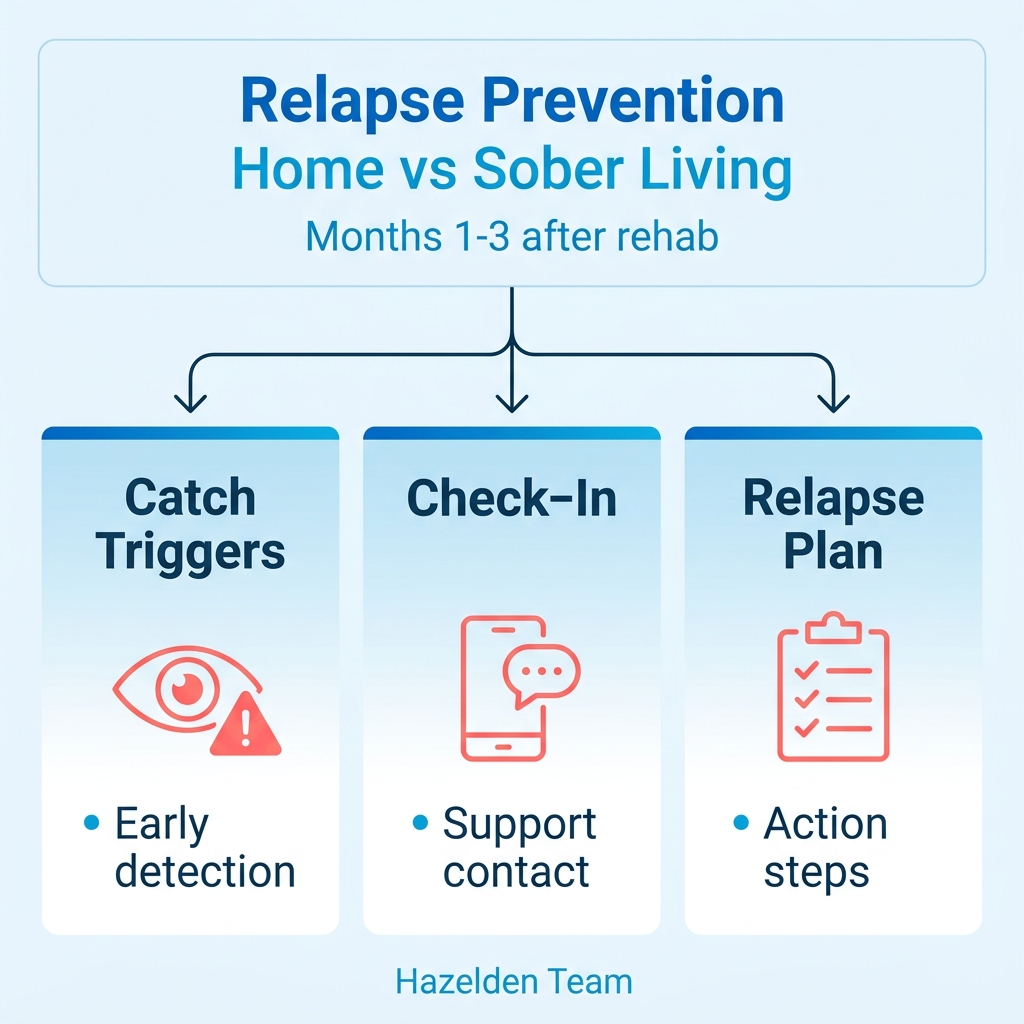
How each setting responds to a slip
| Element | Home after rehab | Traditional sober living | Our coaching model |
|---|---|---|---|
| Trigger monitoring | Family-run, informal | Screenings, curfews, house rules | Structured check-ins, plan-building |
| Response to a slip | Whatever the family decides | Varies by house philosophy | Crisis support, reconnect to care |
| Support duration | Open-ended if you build it | Set by each house's rules | High early, tapers as routines hold |
Some homes prioritize rapid reconnection to care. Independent directories like drugrehab.com note that others require formal off-site clinical completion before considering re-admission. Reading these policies up front helps families pick one that matches how they want a crisis handled.
What home needs to match a sober living house
Rebuilding that structure at home takes deliberate boundaries: scheduled breathalyzer or toxicology checks, a strict calendar, no substances anywhere in shared living areas, and daily contact with recovery sponsors.
As the systematic review on recovery housing points out, long-term outcomes lean heavily on ongoing social immersion. If a household can't hold those structures on its own, a communal sober residence bridges the gap.
Where our coaching fits
Our mentorship focuses on building daily routines, setting up home accountability systems, and giving on-demand guidance when cravings spike.
Support runs heaviest in the first weeks of transition, then tapers toward self-management as healthy habits hold.
Working Through the Decision for Your Household
What happens after rehab comes down to a handful of honest questions about your household. Not "which option is best in general," but which one fits your budget, your family's bandwidth, and how much structure your loved one actually needs right now. Run through the checklist below before you commit to anything.
Work through these five criteria in order. Each one narrows the field:
- Budget. Can your household cover out-of-pocket housing for several months, or does staying home make more financial sense? Be realistic, not optimistic.
- Family involvement. Is someone home enough to notice a rough day and check in? A present, sober household can supply real accountability. An empty or chaotic one cannot.
- Need for structure. Curfews, screenings, and shared routines help some people and feel suffocating to others. Match the structure to the person, not the other way around.
- Length of stay. A few weeks of transition support is a different plan than six months of gradual rebuilding. Decide the horizon up front.
- Desire for professional coaching. Some families want a trained set of hands guiding the plan. Others prefer to lead it themselves with occasional support.
Where each path actually wins
| Strength | Home + Coaching | Traditional Sober Living | MADE Recovery |
|---|---|---|---|
| Flexibility | High | Low | High |
| Family integration | High | Low | High |
| Built-in structure | Low | High | Moderate to high |
| Professional guidance | Varies | Peer or staff-based | Coaching-led |
| Option to escalate support | Limited | Limited | Home coaching or structured residence |
Our model provides non-clinical lifestyle coaching, dedicated companion mentorship, and access to premium residential living when independent housing is premature. That hybrid structure lets families dial support up or down without disrupting progress or starting a new intake process.
If you are weighing these paths and want guidance tailored to your family's dynamics, reach out to our team to set up an initial strategy session.
References
[1] What is Sober Living - Things to Know | Hazelden Betty Ford - https://www.hazeldenbettyford.org/articles/what-is-sober-living
[2] What Did We Learn from Our Study on Sober Living Houses and Where ... - https://pmc.ncbi.nlm.nih.gov/articles/PMC3057870/
[3] Sober Living Homes & Oxford Houses - Cost & Length of Stay - https://www.drugrehab.com/recovery/sober-living-homes/
[4] Cost of Sober Living Homes | Recovery First Treatment Center - https://recoveryfirst.org/sober-living/how-much-does-it-cost/
[5] Recovery housing for substance use disorder: a systematic review - PMC - https://pmc.ncbi.nlm.nih.gov/articles/PMC11922849/
Questions People Ask
What's the difference between a sober living home and a halfway house?
Halfway houses are frequently state-funded or tied to correctional programs, often imposing strict maximum lengths of stay. Sober living homes operate primarily as private-pay communities that allow individuals to remain as long as they adhere to house standards and financial agreements.
How do I vet a specific sober living home before committing?
Inspect the property's physical safety standards, staff credentials, manager-to-resident ratios, and daily schedule requirements. Ask whether the facility holds regional quality certifications and verify how they handle roommate conflicts and routine drug screenings.
Can we start with coaching at home and move into a residence later if things get harder?
Yes. An adaptable hybrid model allows individuals to begin with personalized home-based accountability and step up into a residential living environment if domestic triggers or emotional instability demand more intensive daily containment.
Is a peer-run home like an Oxford House enough if my loved one needs professional support?
Self-governed cooperative houses function without clinical staff or administrative directors, relying entirely on resident voting and peer accountability. If an individual struggles with severe co-occurring mental health conditions or requires medication monitoring, professionally staffed environments provide essential oversight.
What does a home actually need to stand in for sober living?
A domestic environment must implement objective accountability measures, including routine toxicology checks, structured schedules, clear house rules, zero household access to substances, and mandatory participation in external mutual-aid or therapy groups.
Why isn't a 90-day stay enough on its own?
Neurological healing, habit restructuring, and stress tolerance develop over months of real-world exposure. Treating initial 90-day benchmarks as complete recovery leaves individuals vulnerable to delayed triggers once immediate oversight is removed.