5 Things to Have Ready Before Joining a Family Support Group
August 25, 2026

Key Takeaways
- Families who define support needs beforehand avoid wasted first meetings.
- A 30-minute needs-mapping session helps each member set goals.
- Separating short-term from long-term goals clarifies the group’s response.
- The Eisenhower matrix keeps early sessions focused on urgent issues.
- Defined goals turn passive attendance into active aftercare support.
- Good needs-mapping needs one facilitator, everyone’s input, and no small goals.
- Different family members often hold different goals. Write each one separately.
1️⃣ Figure Out What Your Family Actually Needs
Before joining any group, get clear on your family’s needs. Support groups for families of drug addicts work best when everyone arrives with defined goals, not vague hopes. Families who skip this step often spend their first meetings figuring out why they came.
Do the work at home first. Sit down together, grab a simple worksheet, and write down what each person wants from the group. This is where a family support group stops being passive attendance and starts reinforcing the aftercare coaching roadmap.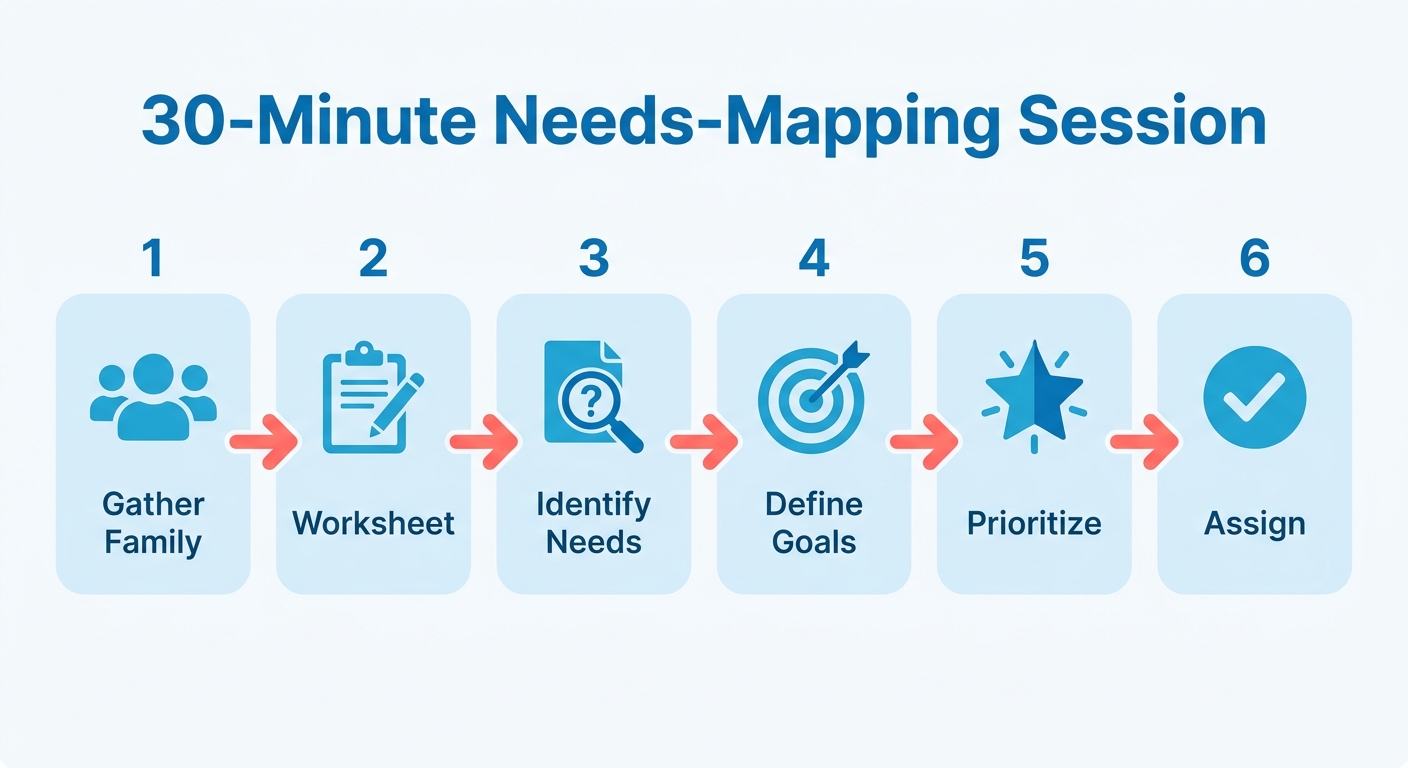
How to map your family's support needs
Needs-mapping is a structured exercise where each family member writes down personal objectives. Block off an uninterrupted stretch of time. Pick one person to guide the discussion. Make sure every voice gets heard, and validate every contribution.
Start by splitting goals into two buckets.
- Separate short-term from long-term goals. Immediate safety concerns are one thing. Lasting lifestyle changes are another. Short-term goals focus on getting through active challenges safely. Long-term goals focus on building healthy daily routines over time. Both matter, but they need different responses.
- Prioritize with the Eisenhower matrix. Sort each goal by urgent versus important. A relapse warning sign is urgent and important. Rebuilding weekend routines is important but not urgent. This keeps your first sessions on what cannot wait.
- Write down each member's own goal. A mother might want to understand her son's triggers. A teen sibling might want to rebuild trust. Those are not the same goal, and pretending they are helps no one.
Tie each goal back to the coaching roadmap
Every goal your family writes down should map to a coaching module, so group sessions and aftercare work pull in the same direction. That turns a support group into part of the recovery plan instead of a separate calendar item.
- Connect each goal to a coaching module. Trigger awareness ties to goal-setting. A shaky daily schedule ties to routine building. Low energy and poor sleep tie to nutrition.
- Store goals in a shared, editable file. Keep it open during meetings so you can update progress on the spot. A living document beats notes nobody reopens.
- Track two simple numbers. Count how many goals you defined, and what percent align with professional recommendations. If most of your goals match the coaching plan, you are set up well.
If your family is mid-crisis, skip the formal matrix. Handle the emergency first, then map goals once things steady.
2️⃣ Research the Group's Focus, Membership Rules, and Facilitation Style
Once you know what your family needs, the next job is matching that need to the right group. Not every support group for families of drug addicts runs the same way. The wrong fit makes milestones feel imposed instead of reinforced, and your aftercare roadmap stalls.
Two variables matter most: the group's underlying model and its facilitation style. Get these right and every session pushes your goals forward. Get them wrong and you spend weeks translating your family’s language into a framework that does not fit.
What model does the group follow?
Groups split along a spiritual-versus-secular line, and this is the first thing to check. Al-Anon describes itself as a spiritually based program that still welcomes all beliefs, including atheism and agnosticism. A science-based program like SMART Recovery skips the higher-power concept entirely and uses a structured 4-Point approach.
Pick the model that matches how your family already thinks about recovery. The same goal, such as coping with a loved one's urges, maps to a defined SMART step in one room and gets framed through shared experience in a fellowship group. Neither is better. But knowing the difference lets you translate your milestones into the group's language before you walk in.
- Identify the primary focus (relapse prevention, trauma-informed, or dual-diagnosis) so it lines up with your coaching roadmap's current phase.
- Confirm the model is spiritual-but-inclusive or explicitly secular, matching your family's own beliefs.
- Check membership criteria: required sobriety length, which family roles are eligible, and any geographic limits.
How facilitation style changes your prep
Facilitation style decides how much your family has to self-advocate. A participant-driven format is not facilitator-led, so you arrive with your own goals and coping tools ready. A more structured meeting carries more of that load for you.
That changes what you prepare. In a self-directed room, your current treatment summary and coach notes become your script. In a structured fellowship group, you can share or pass, and every opinion holds equal weight.
- Assess facilitator credentials: licensed therapist, peer-led, or a hybrid.
- Ask about the confidentiality policy and how first-timers are greeted before you commit.
- Review format and frequency: in-person, virtual, or hybrid, and how often the group meets.
Don't judge fit after one meeting
Al-Anon recommends attending at least six meetings before you decide a group is right, plus at least one meeting a week for real progress. One awkward visit tells you almost nothing.
Build a multi-week trial into your roadmap as a scheduled milestone, not a one-time try. Experienced members put it simply: "Keep Coming Back." Our team-based coaching walks families through this transition with accountability, guidance, and real human connection, adapting as your needs shift. For tracking what those early weeks should reinforce, what caregivers should track during the first 90 days home pairs well with this step.
3️⃣ Pack Your Coping Tools, Emergency Plan, and Support Resources
Support groups for families of drug addicts ask a lot of you emotionally, and you will do better in the room if you walk in with your own tools ready. Families who prep a small personal kit tend to stay steadier through hard shares, tense moments, and the occasional meeting that stirs up a craving or an old memory. This is not optional gear. It is what keeps your milestones from unraveling between sessions.
These tools bridge the group and your coaching roadmap. When your coping kit maps to the same goals your coach and family already agreed on, every meeting reinforces the plan instead of competing with it. Al-Anon's own guidance tells newcomers it takes several meetings to feel settled, so give yourself what you need to keep showing up.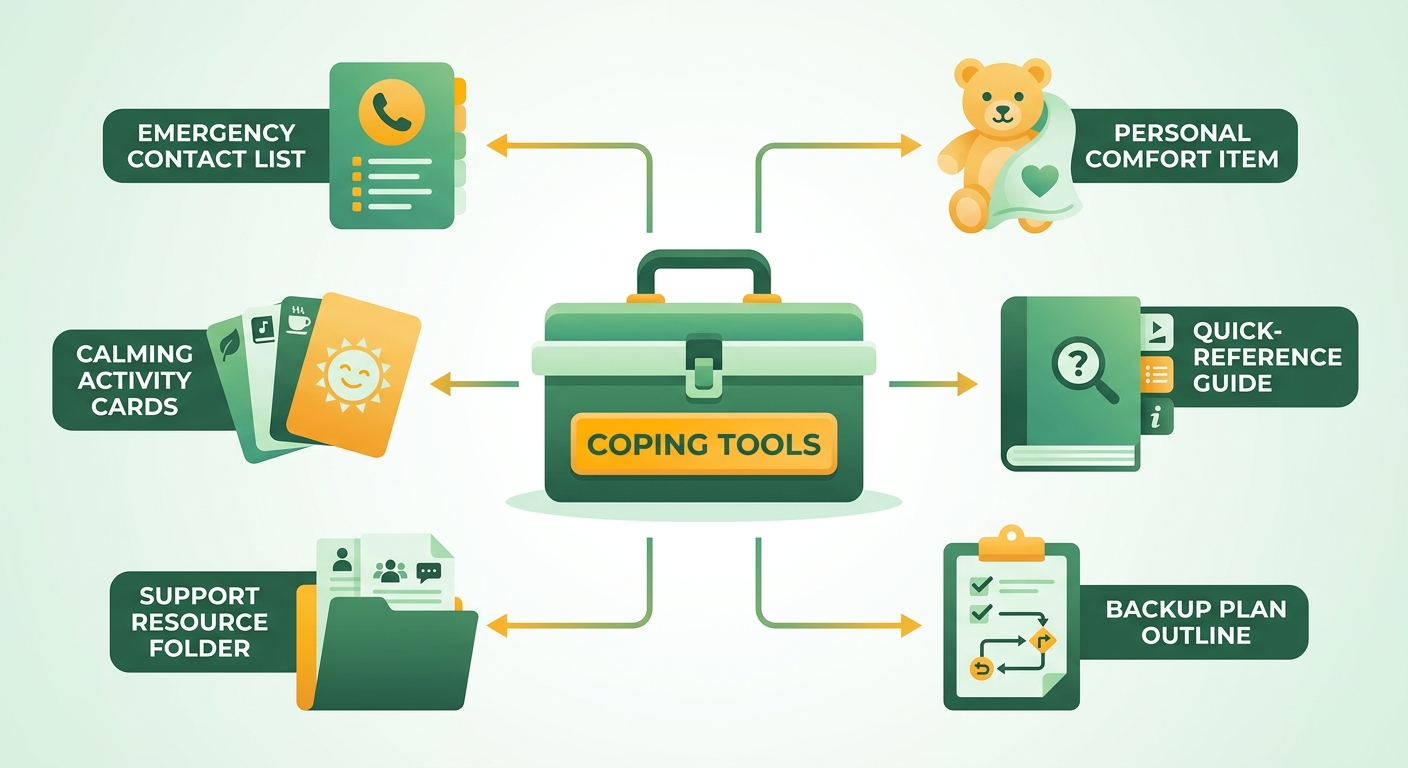
What belongs in your coping toolbox
Your coping toolbox is a small, portable set of tools you can reach for when stress spikes. Build it before your first meeting, not during your third.
- Breathing and grounding cards. Two or three index cards with a box-breathing pattern or a 5-4-3-2-1 grounding script, so you're not improvising under pressure.
- Short-term distractions. A puzzle app, a walking playlist, or a quick text thread with a sober friend to reset when a share hits too close to home.
- A pocket trigger log. Jot down what set you off and when. Bring that log to coaching sessions. It sharpens both your self-awareness and what you bring to group.
Who you call when a craving spikes mid-meeting
Your emergency plan names the exact person you'll reach and the exact steps you'll take before a craving turns into a crisis. Decide this in advance. Panic is a terrible time to build a phone list.
- A crisis contact list. Your coach, one sober peer, and a 24/7 line, ranked in order.
- A step-by-step exit plan. Step out, breathe, text your contact, rejoin or go home. Simple beats clever here.
- A local resource sheet. Nearby AA/NA meetings and tele-therapy options for the hours the group isn't running.
- Your shared calendar and daily routine plan. Sync appointments and fold the routine you built with your coach into the kit, so care stays continuous.
Track two numbers your first month: how many tools you prepared, and how often you actually used them. Low usage is not failure. It tells you and your coach where the plan needs adjusting, and that is clear data for your regular check-ins.
4️⃣ Sort the Logistics, Commitments, and Boundaries First
The practical side of joining these groups is where good intentions die. You pick the right group, prep your coping kit, then miss two sessions because childcare fell through or the Zoom link would not load. Sort the logistics first, and attendance stops being a weekly gamble.
Here is the mindset shift: logistics are milestone infrastructure, not busywork. Al-Anon recommends at least one meeting per week to build momentum. So your setup has to survive weeks of repetition, not just one visit. Build the trial commitment into your aftercare roadmap as a scheduled milestone.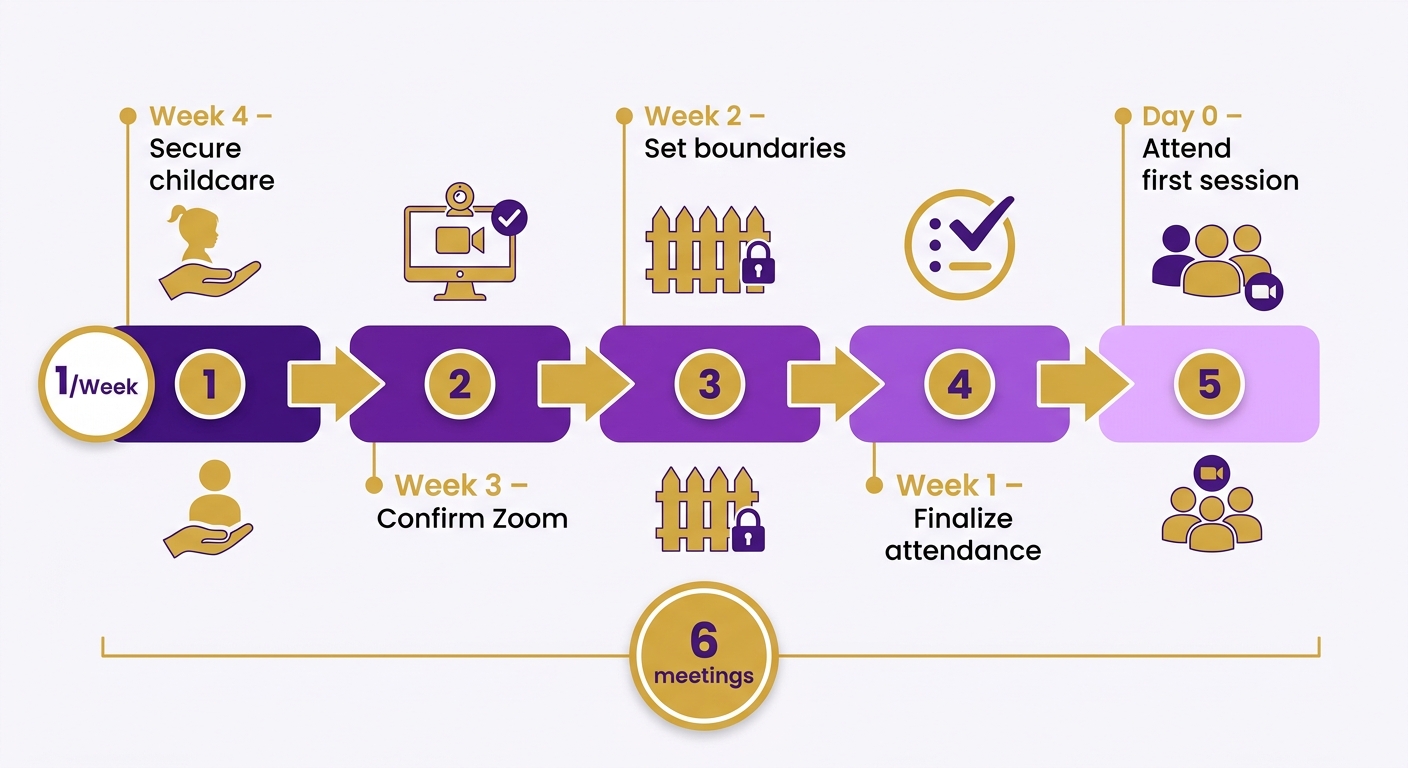
Picking a format and schedule that actually sticks
Format choice: match the meeting to your household's real constraints, then lock a recurring time. A virtual room with screen-share works when travel or caregiving pins you at home. A community center room works when you need to leave the house to focus.
- Choose your format deliberately: virtual with screen-share for housebound schedules, in-person when home is too distracting
- Set a recurring weekly slot that respects work, school, and caregiving duties, since regular weekly attendance is what drives progress
- Commit to a multi-week trial before deciding the group fits, so you don't quit on a rocky first night
A weekly "quiet hour" at home, phones off and door shut, purely to protect focus during virtual meetings, is exactly the kind of routine our coaches help clients build. That small boundary turns a distracted half-listen into a real seat at the table.
What tech and care coverage to lock down
For virtual groups, reliable tech is the difference between showing up and dropping out. For everyone, care coverage removes the excuse that ends attendance streaks. Sort both before session one.
- Secure a headset, stable internet, and a backup phone line so a dropped connection doesn't cost you the meeting
- Arrange childcare or elder-care for the exact meeting window, recurring, not ad hoc
- Do a test call to the platform beforehand. SMART Recovery notes newcomers often arrive already carrying fear and anxiety; tech failures pile on more
Treat care coverage as a family goal, not a solo chore. When the family troubleshoots logistics together, no single person carries the burden of coordination, and you don't miss milestones over technical issues. Tracking these small wins matters as much as the big ones, which is why we build them into the healthy routines our coaches help clients establish. It is part of how a household settles into its new normal.
Why draft a boundary statement before you walk in
A written boundary statement tells the facilitator what's off-limits for you before pressure hits in the room. It protects your milestones from getting derailed by topics that trigger conflict or shame.
- Draft a one-line boundary, for example "I will not discuss legal matters during group," and share it with the facilitator ahead of time
- Decide in advance that you can pass on any share. Al-Anon members tell newcomers all opinions are valid and passing is always allowed
State the boundary, then stay with the process. That's how logistics turn into progress.
References
[1] Are You Ready Newcomer Preparedness Checklist - https://al-anon.org/blog/are-you-ready-newcomer-preparedness-checklist-2/
[2] How to Prepare for Your First SMART Recovery Meeting - https://smartrecovery.org/blog/preparing-to-attend-your-first-smart-recovery-meeting
[3] Tips to pass on to clients attending Al-Anon as newcomers - https://al-anon.org/blog/tips-to-pass-on-to-clients-attending-al-anon-as-newcomers/
Frequently Asked Questions
1. Can I join a family support group if my loved one isn't in recovery yet or refuses treatment?
Support groups for families of drug addicts help you regardless of your loved one's status. Programs like Al-Anon focus on your own coping and goals, such as establishing healthy boundaries or learning how to handle financial strain, not on whether the person using substances has agreed to treatment.
2. What's the difference between Al-Anon and SMART Recovery for families?
Al-Anon is a spiritually based, fellowship-driven program that welcomes all beliefs, including atheism, framing recovery through shared experience. SMART Recovery focuses on self-empowerment and cognitive-behavioral tools, offering a secular alternative that emphasizes practical skills for managing behaviors. Neither is better; choose the model matching how your family already thinks about recovery.
3. What if my family is in the middle of a crisis right now?
Prioritize immediate safety and stabilization during an active crisis. Skip complex prioritization frameworks during an active crisis. Use your emergency plan instead: contact your ranked crisis list (coach, sober peer, 24/7 line), follow your exit steps, then return to structured planning when the situation calms.
4. Why shouldn't I quit a support group after one bad meeting?
One awkward visit tells you almost nothing about fit. Give the group several weeks to become familiar, allowing time to build real progress. Early sessions often stir fear and anxiety, so build a multi-week trial into your roadmap as a scheduled milestone rather than a single try.
5. How do I know if my coping tools are actually working?
Evaluate your coping tools by noting which ones brought your stress levels down during moments of high anxiety, and discuss these patterns with your coach. Low usage is not failure. It signals to you and your coach where the plan needs adjusting, giving a clear direction for what to change next.
6. Should the whole family share one goal or write separate ones?
Write down each member's distinct goal rather than merging them. For example, a spouse might need help managing daily household stress, while a grandparent wants to learn how to talk to the children about addiction. These are not the same objective, and pretending they are helps no one. Each person contributes their own goal during needs-mapping.
7. How do I set boundaries so group topics don't trigger conflict?
Draft a clear, concise boundary statement beforehand, such as specifying that you will not share details about your loved one's employment status, and communicate this to the facilitator. Also decide in advance you can pass on any share. In many groups, passing is always allowed and all opinions hold equal weight.