5 Post-Rehab Coaching Tiers That Prevent Overspending and Coverage Gaps
October 2, 2026

Why Post-Rehab Coaching Tiers Matter
Picking the right sober coach after rehab isn't about finding the "best" coach. It's about matching support intensity to what your insurance will actually pay for. That mismatch is where families get burned. Early recovery needs frequent contact, but insurance rarely funds it for long.
Non-medical recovery coaching often gets squeezed by the same session-cap logic that limits physical therapy. If someone needs frequent contact right after treatment, a rigid package can drain available benefits before the person has stabilized. That's why flexible, customized support matters more than a one-size-fits-all program.
The Coverage Gap Hits When Vulnerability Peaks
The cruelest part of session caps is the timing. Insurance may cover rehab but set a hard ceiling on follow-up sessions. The benefit can run dry at the exact moment relapse risk is highest: right after discharge.
When covered sessions end, you either pay out of pocket or drop support entirely. A plan that adjusts as your needs change lets you step down on purpose, not get dropped by surprise.
A Provider's Coverage Gap Becomes Your Bill
Here's a connection most families never see coming. Many sober living homes carry only general liability coverage even when staff deliver structured coaching or case management, an insurance broker reports. That broker puts it plainly: "Insurance policies do not automatically adjust when operations evolve."
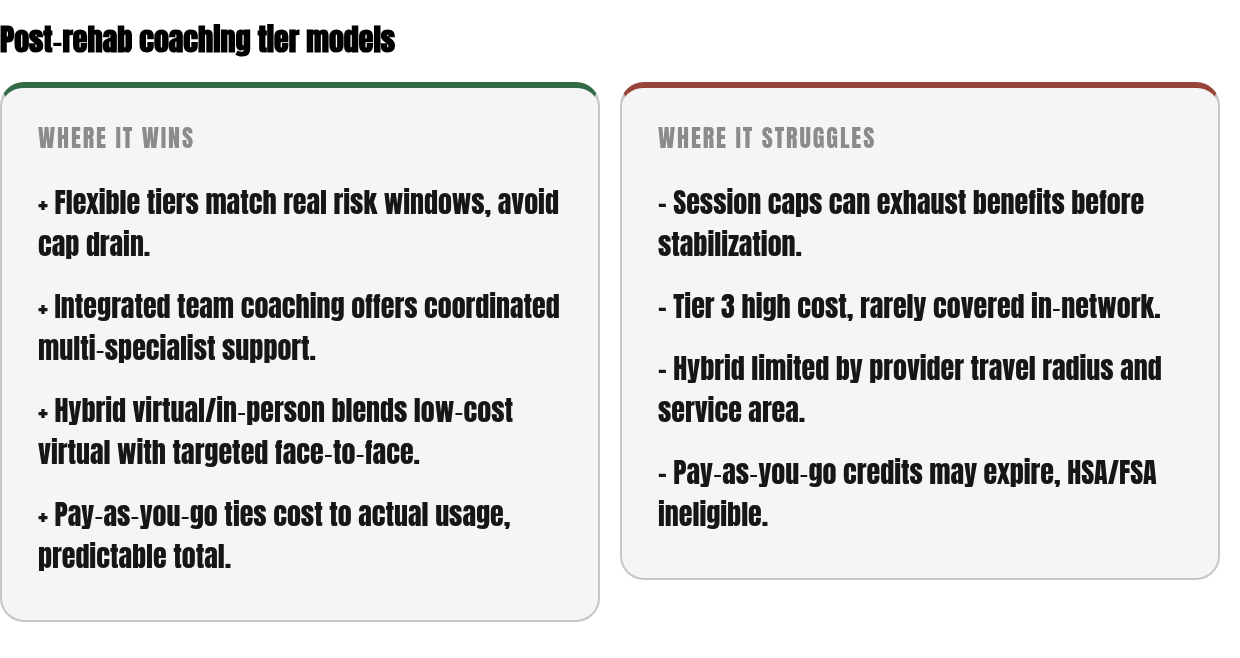
When a provider's coverage doesn't match the services it actually delivers, claims get denied and that cost can land on you. Combine that with session caps and you get a predictable squeeze: the provider is underinsured, the plan is capped, and the client pays the difference. Knowing what you're paying for matters. For a plain breakdown, see our guide on what a sober coach costs.
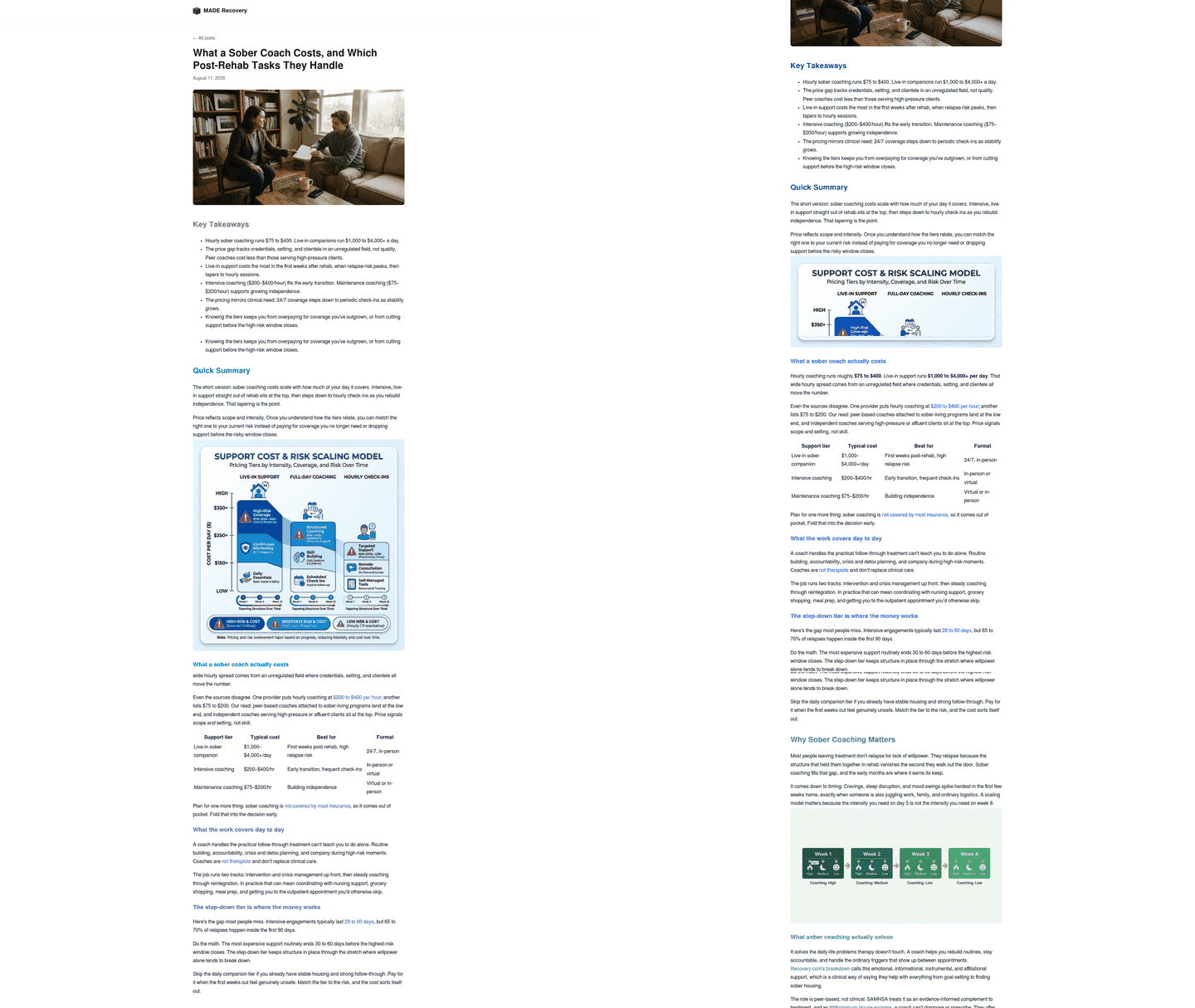
How Support Options Map to Coverage Reality
| Support Type | Core Service | Typical Frequency | Coverage Reality |
|---|---|---|---|
| Home-based coaching | In-home check-ins, trigger planning | Daily to several times weekly | Burns caps fastest; plan for out-of-pocket early |
| Travel companion | Support during high-risk travel | As-needed, short bursts | Rarely covered; budget directly |
| Sober-living support | Coaching inside structured housing | Weekly | Watch for provider liability gaps |
Match the support level to your real risk window, then stretch covered sessions across the weeks that matter most. That sequencing is the point: keep accountability high without draining your benefit before you're steady.
Key Takeaways
- The right tier fits the current risk window, not the menu's most intensive option.
- Provider paperwork matters. Make sure promised services match insured, contracted services.
- Team-based support fits complex situations where one coach cannot cover everything.
- Hybrid support helps when risk is situational, mobile, or event-based.
- Flexible models help families avoid paying for unused intensity, but fine print matters.
Tier 3: Integrated Team Coaching (Provider C)
Most tiers put one person next to you. This one puts a small group. Tier 3 typically wraps a client in a coordinated team working from a shared recovery plan, with various specialists supporting different aspects of reintegration.
This level of support can make sense for people leaving residential care with medical complexity or a history of fast relapse cycles. When one coach can't reasonably cover the full scope of support needed, a coordinated team spreads the responsibility across multiple touchpoints.
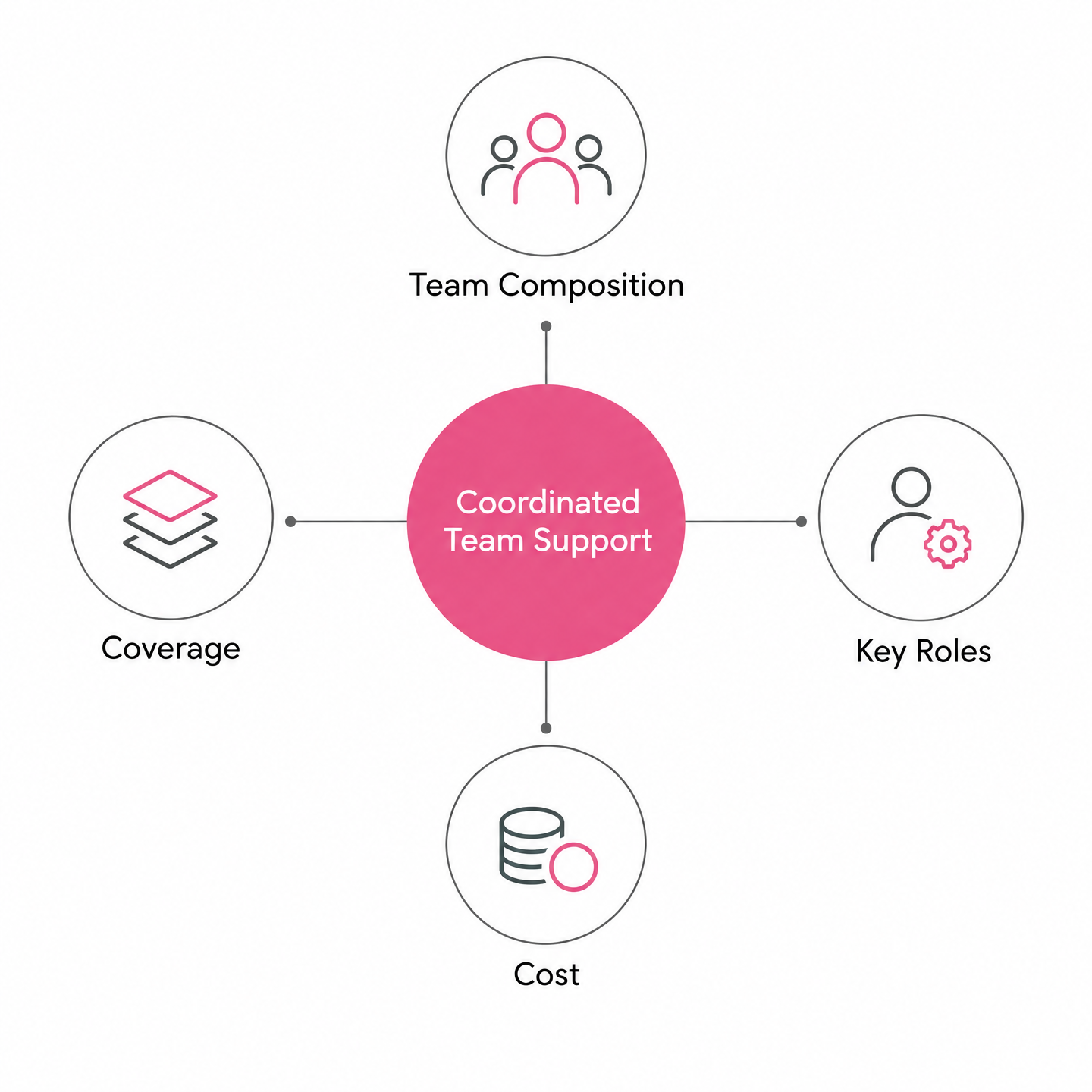
Who Sits on the Team, and What Do They Actually Do?
Team composition varies by provider, but the core principle is coordination around a single plan. A lead coach typically owns the daily rhythm and accountability. Additional support may include nutrition guidance, routine-building assistance, and practical life management. The value is coordination, not headcount. Multiple people working from different scripts helps no one.
What Does This Cost, and Will Insurance Touch It?
Team-based packages typically run higher than solo coaching. Because this is nonmedical support, plans almost never cover it in-network. Your realistic path is out-of-network reimbursement, and even that varies plan to plan. Before committing to any provider, clarify billing practices and what documentation they provide.
| Feature | Tier 3 – Integrated Team Coaching |
|---|---|
| Team | Coordinated support across multiple roles |
| Support | Structured, multi-person accountability |
| Best for | High-complexity, high-relapse-risk cases |
| Coverage | Out-of-network reimbursement at best |
| Pros | Shared plan, distributed responsibility |
| Cons | Highest cost, rarely in-network |
Skip this tier if you're stable and mainly want structure. The expense only pays off when the risk is genuinely high. For most people stepping down from treatment, a lighter level of support handles the job. When the situation calls for it, though, we can help you build a coordinated team tailored to your needs and the level of care that makes sense for your recovery.
Tier 4: Hybrid Virtual and In-Person Coaching (Provider D)
Most tiers lock you into one delivery mode. This one bends. Tier 4 pairs steady virtual check-ins with scheduled face-to-face visits, so your support shows up where the risk actually lives.
That flexibility is the whole point. A hybrid sober coach after rehab can handle your routine accountability over video, then meet you in person for moments that screens can't cover. A wedding with an open bar. A tense family holiday. Your first stretch back around coworkers whose social life still revolves around drinking.
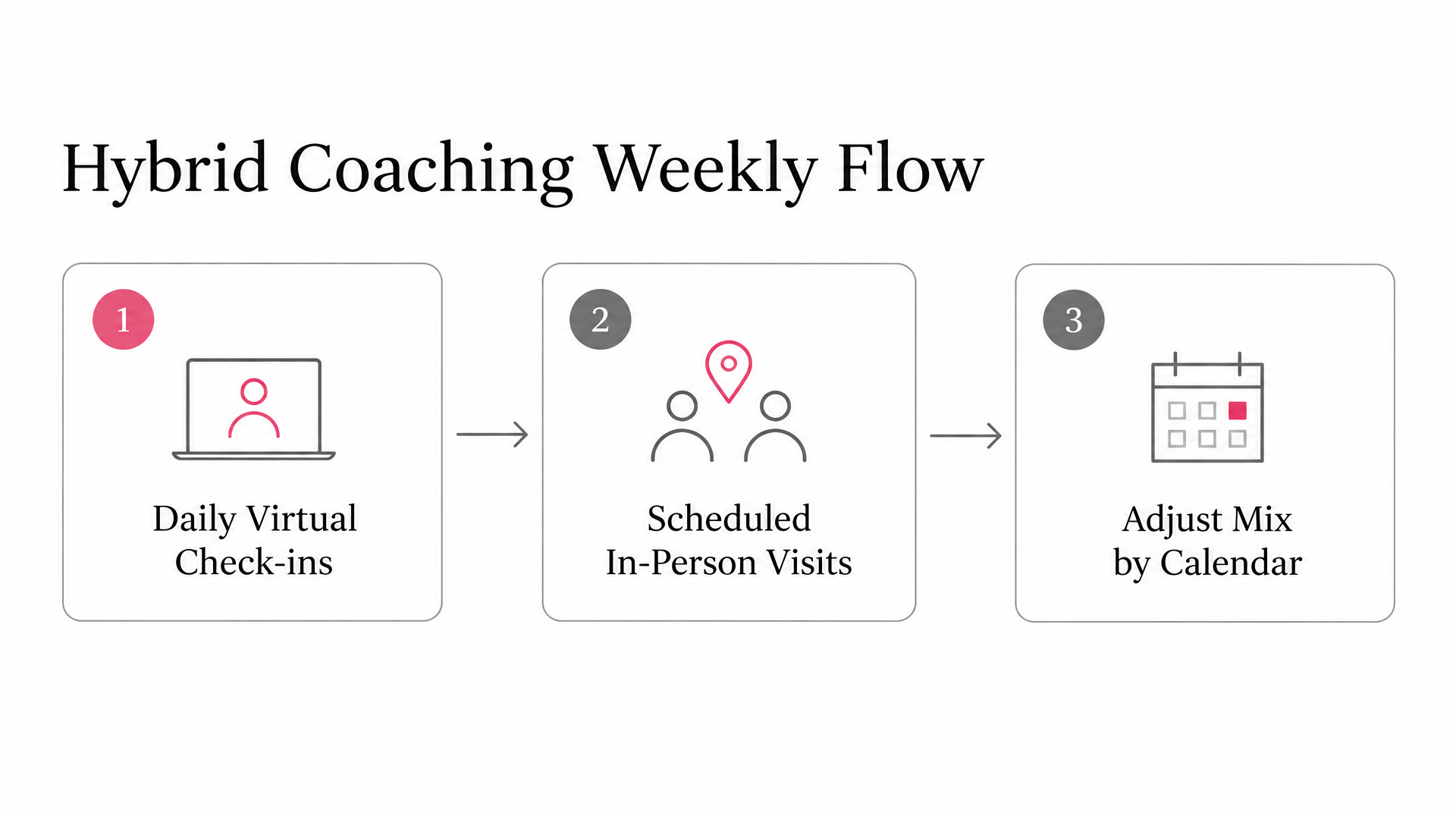
How Does the Virtual and In-Person Split Actually Work?
Providers in this tier usually anchor the week in virtual contact and reserve in-person hours for known trigger events. The exact mix depends on your calendar, not a fixed package.
We build the split around your real exposure points. A client with a stable home but a high-pressure social schedule leans heavier on scheduled visits. Someone steady in public but shaky at home flips that ratio.
What Drives the Cost Difference?
In-person hours cost more than virtual ones. Travel time, scheduling, and physical presence all carry a premium, so the more face-to-face support you add, the faster the price climbs.
Coverage gets tricky here. Some plans fund home health or community support services, and a hybrid arrangement sometimes maps onto those benefit categories. It's worth asking your insurer directly before assuming the in-person piece is out of pocket. Nonmedical coaching often falls outside what carriers reimburse, so confirm the category language first.
Geography matters too. In-person visits only work inside a provider's service area or travel radius, so a strong virtual coach three states away can't cover your sister's wedding.
| Factor | Hybrid Tier 4 Model |
|---|---|
| Delivery | Virtual anchor + scheduled in-person visits |
| Best for | Situational triggers: work events, family gatherings |
| Cost driver | In-person hours carry the premium |
| Coverage angle | Check home health / community support benefits |
| Limitation | Bound by travel radius and service area |
Skip this tier if your triggers are purely at-home and predictable. A home-based companion covers that cheaper. Hybrid earns its cost when your risk moves around with you.
Tier 5: High-Intensity Support—Sober Living Combined with Coaching and Companionship
The most intensive level of support combines residential stability with active coaching and companionship. This arrangement fits people who aren't ready for full independence yet and need the environment itself to carry the routine.
This is the heaviest version of support after rehab. Rather than returning home right away, you live in a sober environment while working with coaches and, if needed, a companion who provides support during vulnerable moments. That means the structure, accountability, and daily rhythm are built into where you sleep, eat, and start each morning.
One thing we're clear about: this is nonmedical support. We provide coaching, companionship, and a sober-living environment. We do not run detox, manage medications, or deliver clinical treatment. Any medical care comes from outside professionals.
Who Needs Sober Living with Active Coaching Support?
This combination fits people leaving residential care who still feel shaky in an unstructured day. If going straight home means empty hours, old triggers, and no one tracking the early warning signs, a structured living setting with coordinated support can hold the routine until independence feels realistic.
We see this work best as a bridge, not a permanent arrangement. The goal is to build the habits that let you step down to lighter support.
Skip this level if you already have a stable home, a supportive household, and a manageable daily routine. Paying for round-the-clock structure you don't need is exactly the overspending this framework helps you avoid.
What Does the Sober Living and Coaching Combination Actually Cover?
Our sober living home in Newport Beach can be paired with personalized coaching and everyday companionship, arranged around your specific needs. Services are flexible and can be adjusted as you progress, with support tapering as you gain independence.
Here's the honest part. Residential nonclinical support rarely gets reimbursed the way inpatient treatment does. Most clients fund intensive post-rehab arrangements out of pocket or through savings, so confirm what your specific plan allows before you commit.
| Intensive Support Combination | Details |
|---|---|
| Best for | People needing structure before full independence |
| Key features | Sober-living residence, personalized coaching, companionship options |
| Pros | Highest structure; coordinated support in a stable environment |
| Cons | Typically out-of-pocket; more than most clients need long-term |
Want the cost breakdown first? Our guide on what a sober coach actually costs walks through where the money goes.
Tier 6: Flexible Pay-As-You-Go Coaching (Provider F)
Most tiers ask you to commit upfront. This one flips the model. You buy a block of coaching credits and spend them however your week actually unfolds: a full session here, a few crisis texts there, an emergency check-in when a trigger hits out of nowhere.
For some people, a pay-as-you-go sober coach after rehab is the cleanest answer to the session-cap problem. Instead of burning a fixed benefit on a rigid schedule, you draw down credits only when you use them. That keeps spending tied to real need, which is the whole point of matching support intensity to coverage.
How Does Credit-Based Coaching Actually Budget?
Each credit maps to a unit of contact. A longer in-person visit costs more credits than a quick text thread. You decide the mix.
The honest appeal here is predictability of total cost paired with flexibility of use. You know what the block costs. You control how fast you spend it.
Before you buy, pin down four things with the provider directly:
- The credit schedule and bulk discounts. Ask what one credit buys and whether larger blocks drop the per-credit price. Vague pricing is a red flag.
- HSA/FSA eligibility. Nonmedical coaching often doesn't qualify for tax-advantaged reimbursement the way clinical care does. Confirm in writing before assuming it counts.
- Minimum commitment and rollover. Do unused credits expire at month-end, or carry forward? Expiring credits quietly erase the flexibility you paid for.
- Expected spend patterns. Holidays, anniversaries, and family events tend to drive heavier use. Plan a buffer for those windows.
Where We Fit
We're not a credit-vending platform, and we won't pretend to be one. Our approach is to build a support plan around your real exposure, then flex the intensity as you stabilize. If a flexible structure fits your budget, we can talk through how our coaching, companionship, and sober-living options scale up or down.
| Provider | Model | Best for | Watch for |
|---|---|---|---|
| Provider F | Pay-as-you-go credits | Variable, self-directed need | Expiring credits, HSA/FSA gaps |
| MADE Recovery | Planned, flexible intensity | Matching support to real risk | Nonmedical scope by design |
Skip the credit model if you need steady, predictable contact every week. A set schedule serves you better there.
Tier 7: Insurance-Aligned Coaching Packages (Provider G)
Insurance-aligned packages make a tempting promise: a set number of sessions, pre-negotiated with major carriers, billed straight to the insurer so the cost counts toward your out-of-pocket maximum. On paper, that's the cleanest way to pay for a sober coach after rehab without touching the session-cap trap other tiers fight.
Here's where we have to be straight with you. Most of what we do is nonmedical support. Coaching, companionship, and sober-living structure usually sit outside what carriers reimburse directly, because insurers pay for clinical treatment, not accountability check-ins. A package that bills cleanly to your plan almost always rides alongside a licensed clinical service, not the coaching itself.
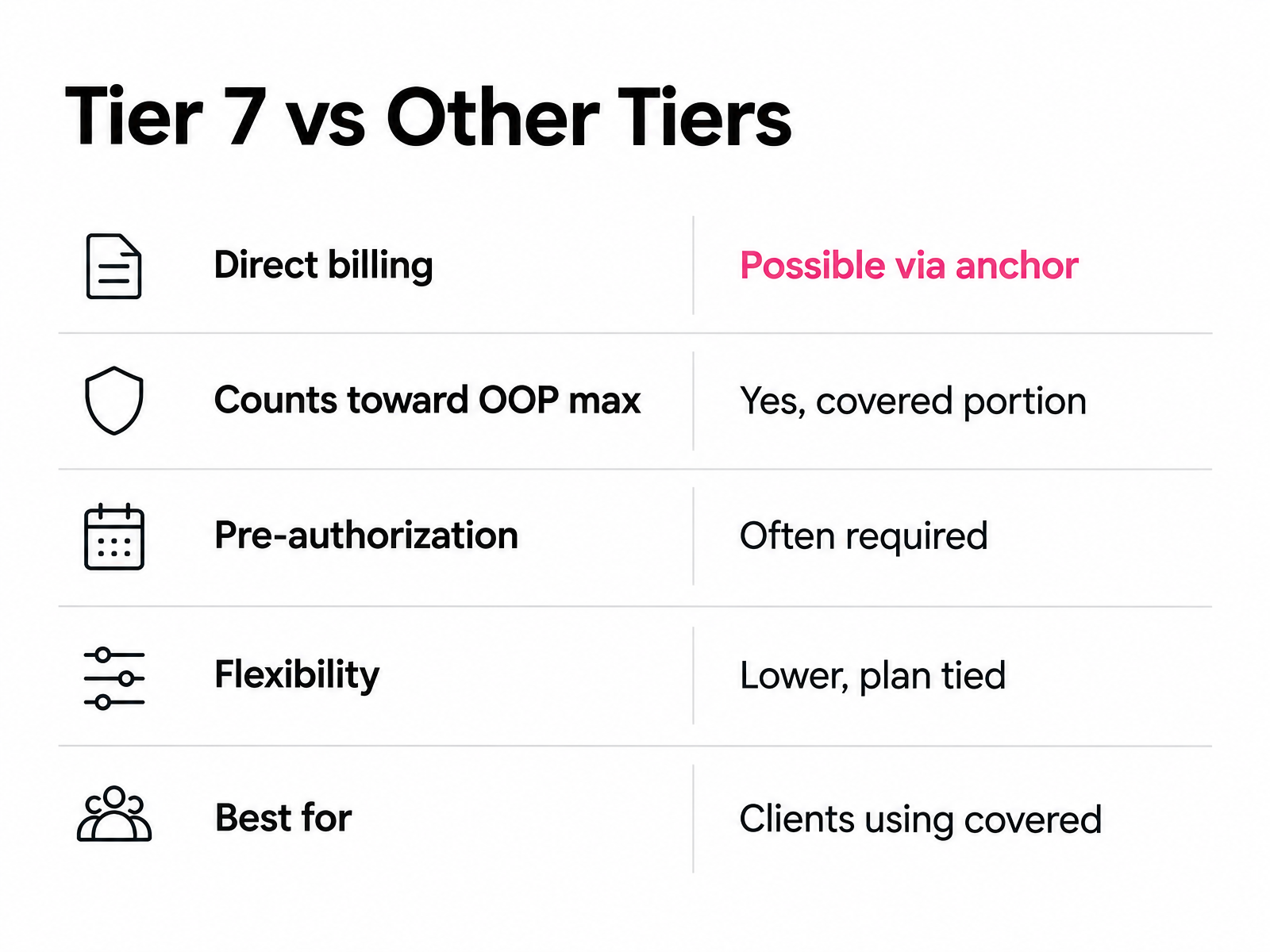
Direct Billing Only Works When a Covered Service Anchors It
Think of this tier as a bridge, not a standalone product. If your coaching connects to an outside clinician who bills for therapy or medication management, those visits may route through your plan while the companionship piece stays private-pay. We coordinate with that provider; we don't become them.
Pre-authorization is the other catch. Carriers that fund any part of post-rehab support often require approval before the first visit. If your paperwork describes one service while the actual support looks like another, reimbursement can get messy fast.
How This Tier Compares
| Factor | Insurance-Aligned Package (Tier 7) | Private-Pay Coaching (Tiers 4–6) |
|---|---|---|
| Direct billing | Possible, only via a clinical anchor | None |
| Counts toward OOP max | Yes, for covered clinical portion | No |
| Pre-authorization | Often required | Not needed |
| Flexibility | Lower, tied to plan rules | Higher |
| Best for | Clients already using covered treatment | Clients wanting speed and control |
Skip this tier if your coaching stands alone with no clinical component attached. You'll spend weeks chasing authorizations for a service your plan was never going to cover. For everyone else, pairing it with existing covered care can shrink what you pay out of pocket.
MADE Recovery: Tailored Team-Based Coaching
The thing we keep coming back to is match, not maximum. A sober coach after rehab only helps if the support fits both your real risk and what your plan will actually cover. So we built our coaching around tiers that move with you, instead of locking you into one fixed package.
Our framework ties each level to where the risk actually lives. For some people that's the kitchen at 9 p.m. For others it's a work trip with a minibar, or the first weeks back in a shared house. We match the service to the setting rather than selling you more hours than your week needs.
How Do We Taper Support Without Leaving a Gap?
Our stance is straightforward: the goal is independence, so support should shrink on purpose. We start heavier when early recovery is fragile, then step down as your own routines take hold. Tapering isn't us pulling back to save money. It's the point.
That gradual step-down keeps support available when it matters most. We pace the intensity so you have coaching during the moments that count, not just in the early days when everything feels manageable. Spreading support across your timeline can help you use your resources wisely, but coordinating benefits or managing coverage is work you'll handle with your insurer. If you want the breakdown of what each level of contact actually costs, we lay it out in what a sober coach actually costs.
| Companion service | Where support shows up | Best fit |
|---|---|---|
| Home-based coaching | Daily life, the house, local triggers | Early reentry with a stable place to live |
| Travel companion | Trips, events, high-risk settings away from home | Known trigger moments on the calendar |
| Sober-living companion | Inside a structured residence | Not ready for full independence yet |
One thing we stay clear on: all of this is nonmedical support. We provide coaching, companionship, and sober-living structure. We don't diagnose, detox, or manage medication. If you need clinical care, we help you line that up alongside what we do, not in place of it.
Choosing the Right Tier: Decision Guide
Choosing a tier starts with an honest inventory, not a brochure. The right sober coach after rehab is the one whose intensity matches both your relapse risk and the ceiling your insurance sets. Get that pairing wrong and you either overbuy support you don't need or run dry at week six.
That ceiling is real and measurable. Many insurance plans cap therapy-style visits each year, and non-medical coaching gets squeezed by the same math, so your tier choice is really a budget decision wearing a clinical costume.
Run This Five-Point Inventory Before You Shop
Score yourself on each variable. The honest answers route you to a tier.
- Relapse risk. Fresh out of detox with a fast relapse history points high. Stable after months of outpatient work points low.
- Desired intensity. Daily check-ins versus a weekly call. Be realistic about what your week actually demands.
- Budget and coverage. A plan capping you at 20 visits burns out fast if you need daily contact. Out-of-pocket sessions add up quickly.
- Insurance status. Confirm whether your coaching counts as covered care or lands outside the plan entirely.
- In-person need. Known trigger events, travel, or an unstable home push you toward companion or living tiers.
Match Your Score to a Tier
High risk plus low independence lands you in team-based or sober-living tiers. Moderate risk with a demanding schedule fits hybrid coaching. Low risk with a tight budget fits pay-as-you-go.
| Your profile | Fitting tier | Why it fits |
|---|---|---|
| High risk, needs structure built in | Sober living + companion | Routine lives where you sleep |
| Trigger events, travel, work pressure | Hybrid virtual + in-person | Shows up where risk lives |
| Steady, variable weekly needs | Pay-as-you-go credits | Spend tracks real use |
Before you sign, compare the provider's contract, insurance language, and actual day-to-day services. If those three don't match, ask for clarification in writing before you rely on reimbursement or assume the package is protected.

Switching Tiers Is Expected, Not Failure
Can I move down a tier? Yes, and you should. The goal is independence, so stepping down as your routines hold is the plan working, not falling short.
What if I move up after a setback? Also normal. Risk rises around major events, job changes, or a rough stretch at home. Add intensity for the window, then taper again.
How fast should tapering happen? There's no fixed clock. Let your real stability drive it, not a calendar. For a closer look at what each level runs, this breakdown of sober coach costs is a useful next read.
References
[1] Common Insurance Coverage Gaps Across Levels of Care - Leavitt Group - https://www.leavitt.com/santamaria/blog/common-insurance-coverage-gaps-across-levels-of-care
[2] Their Physical Therapy Coverage Ran Out Before They Could Walk Again - https://kffhealthnews.org/health-care-costs/physical-occupational-therapy-visit-session-cap-limit-prior-authorization-aca/
Frequently Asked Questions
If my insurance caps recovery coaching at 20 visits per year, how do I avoid running out in the first month?
Do not treat the cap like permission to schedule everything immediately. Ask where support is most necessary, reserve some sessions for predictable risk points, and use private-pay or lighter-contact options only when the clinical benefit has limits.
Can I switch between coaching tiers mid-recovery, or am I locked into the level I start with?
You are not locked in unless the provider's contract says you are. Ask up front how changes are handled, whether pricing adjusts mid-cycle, and what notice is required before stepping into a lower or higher level.
What happens if my sober living provider's insurance coverage doesn't match the services they actually deliver?
The safest move is to make the provider define each service in writing before you enter the program. Your contract should distinguish housing, coaching, transportation, case management, and any outside clinical care so there is less room for confusion later.
Does hybrid virtual-in-person coaching qualify for home health benefits under my insurance plan?
Use your insurer's own benefit language. Ask about the service category, provider credentials, documentation requirements, and whether the care must be ordered or supervised by a licensed clinician.
If I buy pay-as-you-go coaching credits, what should I confirm with the provider before the first purchase?
Look for the rules that affect the real value of the credits: what counts as a billable contact, whether different contact types use different amounts, how cancellations work, and whether unused credit remains available when your needs slow down.
Why would team-based coaching cost more than solo support if both cover the same hours per week?
You are paying for coordinated oversight, not just face time. A team model has to keep multiple roles aligned around one plan, which adds planning, handoff, and communication time behind the scenes.
Can MADE Recovery bill my insurance directly for coaching services?
In most cases, no. MADE Recovery provides nonmedical recovery support, so direct insurance billing for coaching is usually not available unless a separate covered clinical provider is involved.