3 Family Roles That Prevent Relapse in the First 60 Days
August 16, 2026

Key Takeaways
- The first 60 days after treatment carry the highest risk. Cravings peak, and the structure that held someone up in rehab is gone the day they walk out.
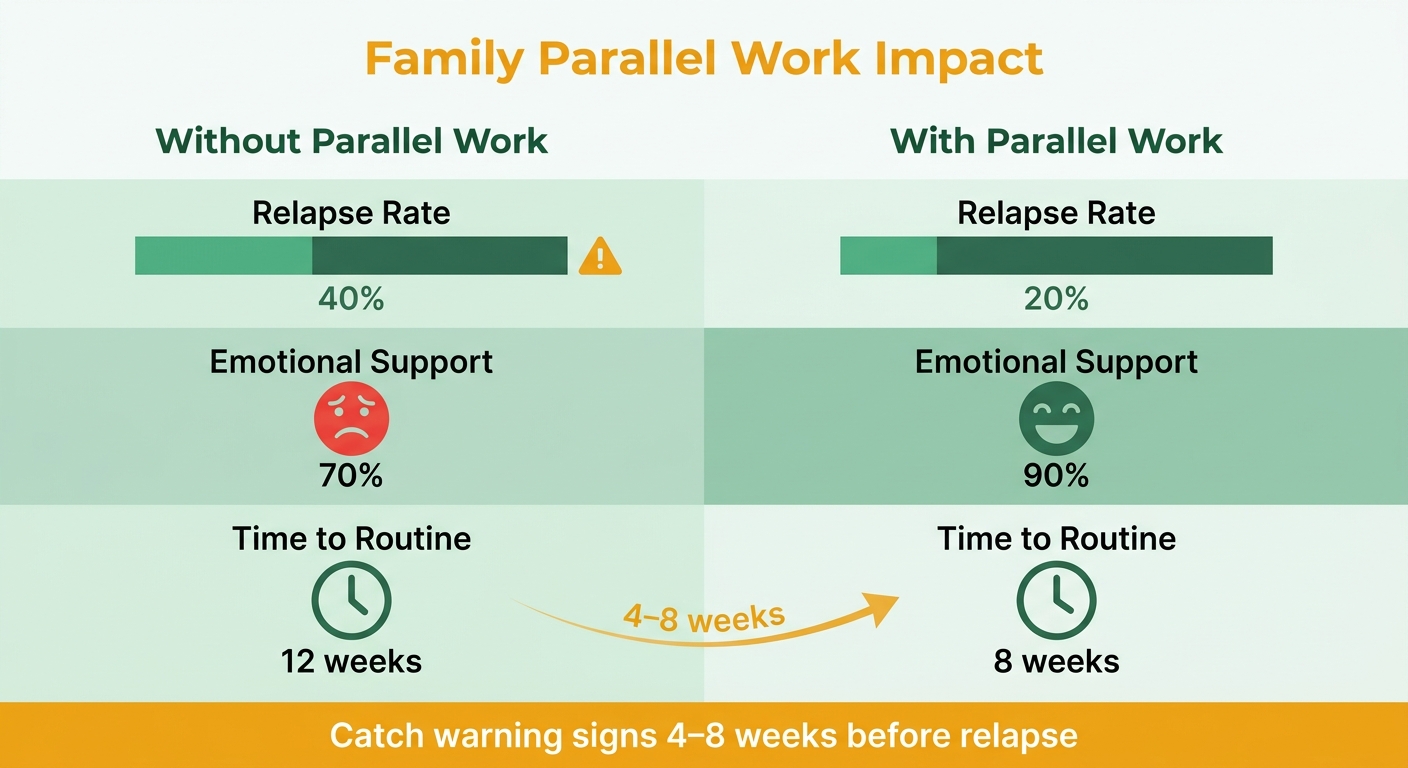
- Family therapy pushes long-term sobriety toward 65%, against roughly 41% for individual therapy alone. Families are the most underused piece of the plan.
- A high-conflict home doubles relapse risk. Enabling behaviors add another 50% on top of that.
- Families run three roles: accountability anchor (3-5 hours weekly), routine partner (5-7 hours weekly), and early-warning observer (daily, low effort).
- Relapse usually starts weeks or months before the first drink, as emotional withdrawal that a watchful family can catch early.
- The routine partner role is the hardest and the most important. It fills the dead zones where cravings creep in.
- Family support groups teach relatives to read relapse as a multi-stage process, not a single moment of failure.
Quick Summary
The first 60 days after treatment are where recovery either takes root or comes apart. Cravings peak. Old routines pull hard. The scaffolding that held someone up in residential care vanishes overnight. In our work, the family is the most underused resource in that window. When we bring families into the process, they stop being bystanders and start being partners in the handoff.
That shift changes what relatives are looking for. Learn to read the early signs of a slip, and you can step in long before a physical relapse. Keeping household tension down matters, because high-conflict homes raise relapse risk, and naming enabling patterns helps steady the house. Family therapy folded into the recovery plan tends to produce better long-term outcomes than individual treatment alone.
What families should track in the first 60 days
Your job for two months is to hold three roles: the accountability anchor, the routine partner, and the early-warning observer. Each one maps to a real relapse driver. Each carries a different time cost and difficulty.
| Family Role | Time / Week | Difficulty | Why It Prevents Relapse |
|---|---|---|---|
| Accountability anchor | 3-5 hrs | Moderate | Provides ongoing accountability during the most vulnerable weeks |
| Routine partner | 5-7 hrs | Hard | Fills the "dead zones" where cravings creep in |
| Early-warning observer | Daily, low effort | Hardest emotionally | Catches emotional relapse before it becomes physical |
The observer role depends on knowing how recovery moves. Under the five rules of recovery, shifts like isolation, skipped meetings, and slipping self-care are clinical warning signs, not personality quirks.
The first 60-day family checklist
Start here. These items cover the three roles and give the aftercare plan somewhere to live day to day.
- Read the personalized aftercare plan together and assign who owns each daily check-in, so accountability has a name attached.
- Learn the three stages of relapse (emotional, mental, physical) so you catch warning signs early instead of reacting to a crisis.
- Audit the home for enabling patterns that can quietly undermine long-term sobriety.
- Build one non-negotiable daily anchor with your loved one, a morning walk or a shared meal, to replace the structure treatment provided.
- Join a family support group so you carry the emotional load somewhere other than the person in recovery. Splitting roles across the family keeps any one person from burning out.
- Treat a slip as information, not failure. Clinicians who frame relapse as a multi-stage process keep the plan adaptive instead of letting it fall apart at the first deviation.
When to ease off
Not every family should run all three roles at full throttle. If your loved one moved into structured sober living, the external accountability is already there, so lean into the observer role instead of over-scheduling them. Push too hard and the home itself becomes the stressor.
Families that do well tend to treat setbacks as data. When a family holds that stance, the aftercare plan stays flexible past the first hard week, which is exactly when rigid plans tend to break.
Why Family Roles Matter in Recovery
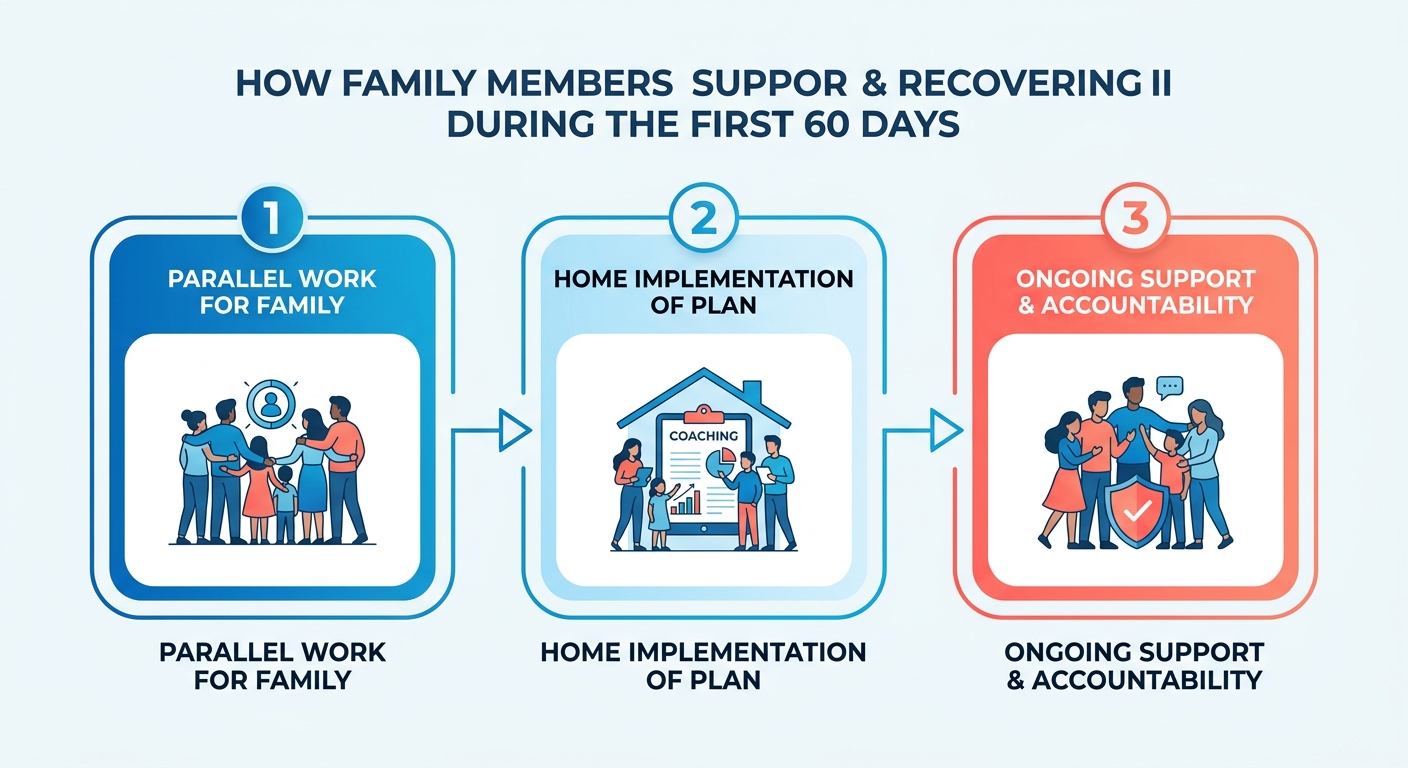
The person leaving treatment has changed. The home they walk back into often hasn't. That gap is why family roles decide so much in the first 60 days. Getting into outside support networks lets relatives do their own parallel work before their loved one is even back through the door. When the family commits to that growth, they stop being the one variable that never moved.
This brings the recovery plan to the kitchen table. Give parents, partners, and siblings a place to process their own experience, and they can hold their roles without burning out. How you split those roles matters as much as filling them.
How much does family involvement actually move the needle?
A lot, and the numbers hold up. A randomized trial in India found that dyadic relapse prevention beat individual work on both drinking days and family dysfunction scores. The same pattern shows up in retention. When a partner or parent stays engaged through the handoff from treatment to home, people stick with aftercare longer and drop out less. Engagement isn't a nice-to-have. It's the difference between a plan that lives on paper and one that runs in the house.
The relapse-rate numbers look messy at first glance. One Indonesian rehab study reports rates reaching 90% within six months, while Geisinger's clinicians work with the more familiar 40-60% range. The higher figures tend to come from settings with little structured family support. That gap is roughly the size of what an engaged family adds.
What a recovery caregiver actually does
A caregiver is the family member who owns the daily plan. Not the fixer. The liaison. They track the plan, watch for early warning signs, and loop the coach in when something shifts. Families running daily check-ins saw fewer relapse incidents.
- Run a short daily check-in to catch behavioral shifts, which often come before physical relapse.
- Keep alcohol out of the home and off the holiday table, since old cues reinforce use behaviors.
- Watch for isolation and skipped meetings as clinical warning signs, not simple mood shifts.
- Connect with peer support networks to manage your own stress and hold healthy boundaries.
Where caregivers get stuck
The biggest trap is trying to fix instead of support. Dr. Joseph L. Smith says it plainly in Syracuse's family guide: "A lot of times, caregivers want to focus on and fix and help the individual." The instinct backfires.
Mismatched expectations do real damage too. When someone skips a family event for a meeting and hears "aren't you better now?", that pressure feeds guilt and shame. When the plan is working, the meeting takes priority. That's the structure holding, not a snub.
The Importance of Family Therapy in Recovery
Coming back into the home takes systemic adjustment. Family education programs close the gap between the client's clinical progress and the household's daily habits. When relatives can recognize early behavioral shifts, they can offer real support before those patterns escalate.
Skip that work and you often recreate the exact environment that fed the substance use in the first place. Unresolved household tension shapes recovery outcomes directly. It shows up in the small stuff: a parent who overcompensates, a spouse who dodges the hard conversation, a relative who plays down how serious the process is.
Why family therapy outperforms individual treatment
Family-involved treatment works because it builds accountability into the home, not just the clinic. When relatives understand how recovery progresses, they can address warning signs before they escalate. Individual therapy focuses on the person in recovery. Family therapy restructures the whole environment they return to.
The clinical case is straightforward. Research comparing treatment models shows family-inclusive approaches lead to better outcomes, including less substance use and improved household functioning, than standard individual care.
The gender piece matters too. Female participants reported a stronger influence from family climate on relapse than males did. For them, family intervention isn't optional. It predicted outcomes more than treatment duration did.
When the family becomes the trigger
Without their own education, families tend to treat recovery as a switch that's either on or off, rather than an ongoing process. Pushing a loved one to put social obligations ahead of recovery activities can trigger guilt and shame, and both are significant drivers of relapse.
Addiction specialists agree that unchanged family roles keep the dysfunctional system alive: the rescuer, the enabler, the over-protective spouse. The person in recovery has new tools, but the family keeps handing back the old script. They return to an unchanged home, and relapse becomes the path of least resistance.
What family support groups actually teach
Al-Anon and groups like it aren't therapy-lite. They teach you to spot the stages of relapse before your loved one does. Emotional relapse starts with meeting avoidance and poor sleep. Mental relapse shows up as romanticizing past use or testing boundaries. By the time you see physical relapse, two earlier intervention windows have already closed.
They also teach communication that supports without micromanaging. "What came up at your meeting today?" opens a real conversation. A yes-or-no question closes one. The open version tells you how the person is actually coping.
Real-world support during hard moments is what holds the line. Research suggests motivation is a primary predictor of sustained recovery, and structure, accountability, and companionship reinforce it. If the family can hold space for honest answers without judgment, they become part of the scaffolding that keeps the plan standing.
Implementing a Relapse Prevention Plan

A relapse prevention plan is a written map of triggers, coping steps, and crisis contacts that the family helps run day to day. Family support groups give relatives the training to read and apply that plan, not just file it away.
In the first 60 days, active family involvement in prevention steadies the home. A structured plan gives everyone a concrete protocol when stress spikes, which heads off the two usual failure modes: micromanaging and emotional withdrawal.
What a first-60-days plan should include
A solid plan covers triggers, coping skills, a crisis contact list, and a tapering schedule for support. The Marlatt and Gordon framework breaks it into concrete skills you can reinforce at the kitchen table.
- Map high-risk situations and rehearse refusal skills so your loved one has a scripted response before the pressure hits.
- Write down coping steps for cravings, including urge surfing, so an urge becomes a wave to ride out rather than an emergency.
- Set up stimulus control at home by removing alcohol and old paraphernalia, cutting the environmental cues that reawaken use.
- Build a taper plan for support, easing daily check-ins toward weekly ones only as stability grows, never all at once.
How families spot triggers before the drink
Reading early warning signs means understanding that recovery is ongoing. As educational resources on relapse point out, behavioral changes come well before physical use. Post-acute withdrawal symptoms can last up to two years, so families need to stay observant long after the first weeks home.
- Keep a consistent daily check-in so emerging problems get addressed before they compound.
- Screen for HALT states (Hungry, Angry, Lonely, Tired), the basic unmet needs that quietly raise relapse risk.
- Treat any slip as information, not failure, and feed what you learn back into the plan instead of reacting with blame.
What family support groups add
These groups train you to hold the liaison role without burning out, which is the piece most plans miss. Peer support helps families work through recovery with shared experience and coping strategies instead of theory.
- Show up to a group so you get perspective from families who have run the same 60 days.
- Protect your own regulation. A calm liaison keeps the check-ins steady when conflict would otherwise spike.
Skip the taper if instability is still high. Hold daily contact until the plan proves itself.
References
[2] How Family Dynamics Impact Relapse Risk - IKON Recovery Centers - https://www.ikonrecoverycenters.org/how-family-dynamics-impact-relapse-risk/
[3] Relapse Prevention: The Framework, the Skills, and What Actually Works - https://archangelcenters.com/therapies/relapse-prevention/
[4] What Role Does Family Play in Drug Relapse? - https://www.promises.com/addiction-blog/what-role-does-family-play-in-drug-relapse/
[5] Relapse Prevention and the Five Rules of Recovery - PMC - NIH - https://pmc.ncbi.nlm.nih.gov/articles/PMC4553654/
[6] Ultimate Guide to Family Relapse Prevention - https://www.ikonrecoverycenters.org/ultimate-guide-to-family-relapse-prevention/
[7] What to Say to Someone Who Relapsed: A Family Guide - https://baartprograms.com/resources/blog/guide-on-family-relapse
[8] What Family and Loved Ones Should Know About Relapse - https://onlinegrad.syracuse.edu/blog/what-family-and-loved-ones-should-know-about-relapse/
[9] How to Find Strength & Solutions After Relapse - https://www.theblanchardinstitute.com/relapse-in-the-family-how-to-find-strength-solutions-together/
[10] An Exploration of Risk and Prognostic Factors - https://www.researchgate.net/publication/379823638_Family-Based_Contributors_in_Relapse_and_Relapse_Prevention_Among_Patients_with_Substance_Use_Disorder_An_Exploration_of_Risk_and_Prognostic_Factors
[11] The relationship between family support factors and ... - https://www.researchgate.net/publication/389491188_The_relationship_between_family_support_factors_and_substance_abuse_relapse_an_updated_literature_review
[12] (PDF) Family Member Involvement in Relapse Prevention ... - https://www.researchgate.net/publication/44678562_Family_Member_Involvement_in_Relapse_Prevention_Improves_Alcohol_Dependence_Outcomes_A_Prospective_Study_at_an_Addiction_Treatment_Facility_in_India
[13] The Effect of Family Support on the Relapse of Drug Abusers - https://www.researchgate.net/publication/397703401_The_Effect_of_Family_Support_on_the_Relapse_of_Drug_Abusers
[14] The Role of Social Support in Substance Addiction Recovery - https://www.researchgate.net/publication/385016156_The_Role_of_Social_Support_in_Substance_Addiction_Recovery_A_Systematic_Review
Frequently Asked Questions
1. How do I know if my family member is experiencing emotional relapse versus just having a bad day?
Emotional relapse shows consistent patterns over days or weeks: isolation from support meetings, declining self-care, defensiveness about recovery topics, and disrupted sleep. A bad day is temporary and does not include meeting avoidance or the specific behavioral clusters that clinicians identify as stage-one warning signs.
2. What if my loved one refuses daily check-ins because they feel micromanaged?
Frame check-ins as support rather than surveillance by asking open questions like "What came up at your meeting today?" instead of yes-or-no accountability questions. If resistance continues, shift to the observer role and watch for meeting attendance and self-care patterns without forcing structured conversation.
3. Can family roles prevent relapse if the person in recovery lives in sober housing instead of at home?
Yes, but shift emphasis to the observer role since structured housing already provides accountability. Families should monitor emotional withdrawal during visits or calls and maintain the routine partner role during home visits, while avoiding redundant oversight that creates friction with housing rules.
4. How long should families maintain the routine partner role before scaling back involvement?
Maintain active engagement through the initial two-month transition, then gradually adjust based on stability indicators like consistent meeting attendance and self-care. Scaling back prematurely during the early stages of post-acute withdrawal removes vital structure before the individual's internal coping mechanisms have fully solidified.
5. What should I do if I catch a relapse warning sign but my loved one denies any problem?
Document what you observed without confrontation, share it with their recovery coach or therapist, and continue the observer role. Denial is common during mental relapse stages, and external accountability from clinical professionals often breaks through resistance better than family pressure alone.
6. Do all three family roles require separate people or can one person handle multiple roles?
One person can manage all three initially, but splitting roles across family members prevents caregiver burnout and maintains consistency when the primary supporter is unavailable. The observer role works best distributed since daily low-effort monitoring from multiple people catches more warning signs than intensive focus from one.