Work the 12 Steps at Home After Residential Care
August 3, 2026

Key Takeaways
- In a 508-person study, having a sponsor roughly doubled the odds of 30-day abstinence at 12 months, with an odds ratio of 2.19.
- Using a home group raised those odds further, to an odds ratio of 3.26 in the same study.
- Regular meeting attendance carried its own measurable benefit, an odds ratio of 1.55 for long-term sobriety.
- Residential treatment reliably helps clients land a sponsor but cannot lift post-discharge meeting attendance or home-group participation.
- The same research found meeting attendance declines after clients leave residential care.
- The two behaviors with the biggest long-term payoff, attendance and home-group use, are exactly the ones a facility can't lock in.
- Transitional coaching from MADE targets that post-discharge gap by building daily routines backed by accountability and consistent human connection.
Where recovery actually gets tested: your living room
Working the 12 Steps at home is where recovery stops being a program and becomes a life. Residential care gives you structure and safety. But the habits that carry sobriety over the long haul are the ones a facility can't install for you. That gap is where daily, home-based support earns its keep.
The reasons aren't guesswork. A study on 12-step involvement points to three pillars: getting a sponsor, planting yourself in a home group, and showing up to meetings. When all three are live, the odds of lasting abstinence climb sharply, because recovery has shifted from a clinical requirement to a daily practice you own.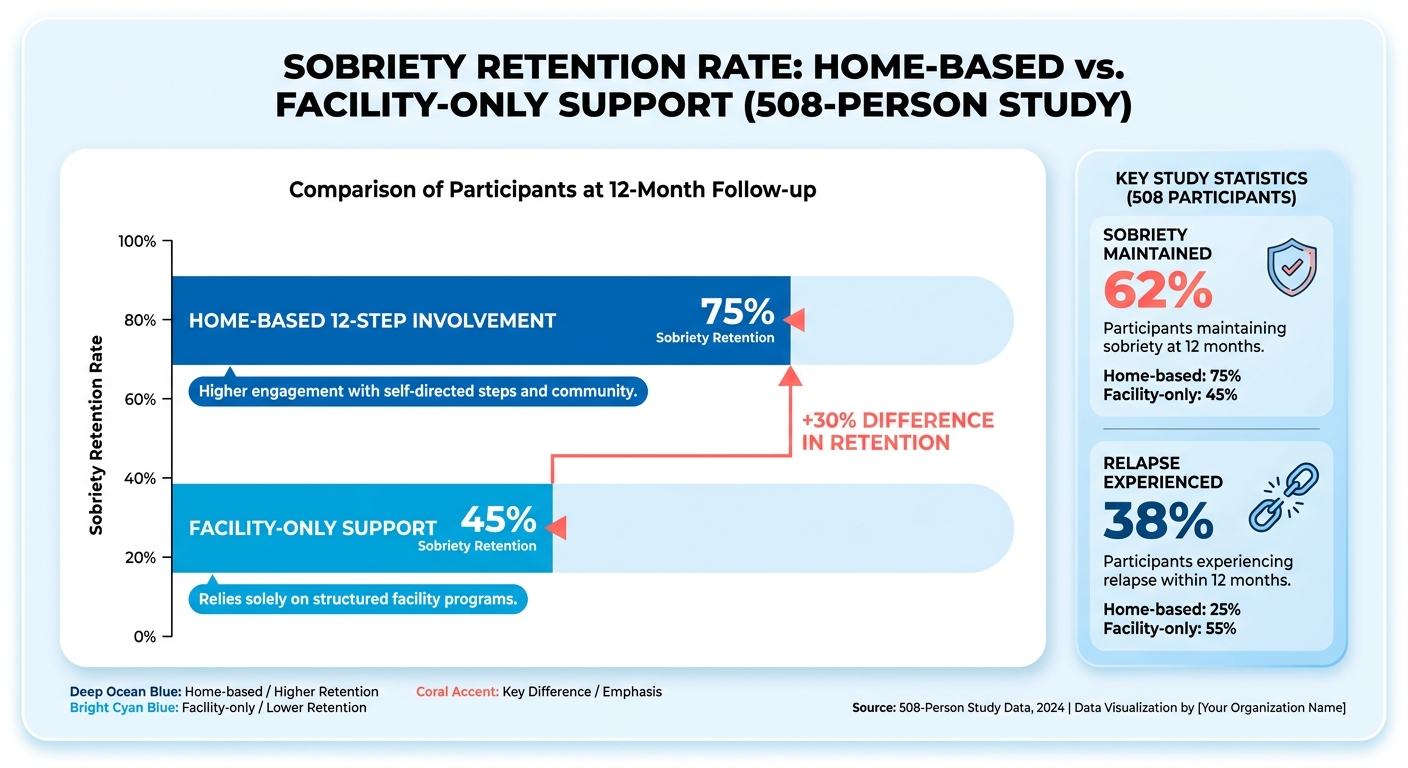
Why home practice outweighs the facility
A treatment center is built for clinical stabilization and a clean introduction to the steps. It can't reproduce your kitchen, your commute, or the community center down the street. Once the walls come down, the ordinary friction of life returns, and the self-directed habits of attending meetings and staying in touch with peers become the real test.
That post-discharge decline isn't a willpower failure. It's a design flaw in the handoff. MADE helps clients build daily routines that lower stress and steady the day, with the accountability and consistent contact that keep those routines breathing. That's the difference between a discharge plan on paper and a routine that survives a hard Tuesday.
The stacking effect is hard to ignore. A longitudinal study of 417 adults in outpatient treatment found that pairing treatment with weekly 12-step meetings produced abstinence odds of 8.09, against 3.54 for treatment alone. More is better. Home is where the "more" happens.
Who this fits, and how it answers isolation
Best fit: anyone with a packed schedule, a triggering home environment, or a sponsor they found in treatment but no routine to actually use them. Online meetings, virtual sponsor calls, and a daily reading habit make the steps portable, so a busy parent or a shift worker can stay engaged without a 90-minute round trip.
Isolation and trigger exposure are the two failure points we see most. A home group and steady contact swing your social circle away from drinking-and-using contacts toward people who support sobriety, which research on AA mechanisms flags as the real engine behind good outcomes. The steps aren't magic. The fellowship and structure are.
One honest carve-out: the 12 Steps aren't for everyone. NIDA notes they provide social support, not medical treatment, and secular alternatives exist. If co-occurring disorders are in the picture, home practice should sit alongside clinical care, not replace it.
Do service work and reading actually move the needle?
Yes, but as durable habits, not one-off acts. A sustained-engagement analysis found service work (OR 2.80) and literature reading (OR 2.92) independently predicted abstinence when held steady at both 6 and 12 months. Build them into your week and they compound.
Reading where you actually stand after residential care
Honest assessment is the starting line for any home plan. Before you map out which step to work next, you need a clear read on where you actually are, not where a discharge summary says you should be. The clients who transition most smoothly tend to start here rather than jumping straight to the mechanics.
Good support for someone leaving treatment begins with a coach asking the uncomfortable questions. What triggers still own you at home? Which relationships pull you toward using? The steps only work as daily practice once you've named those honestly. As the Cumberland Heights step guide puts it, "if you are self-centered, self-serving and self-involved, the odds of actually becoming a better person are pretty low." Self-reflection is the whole game.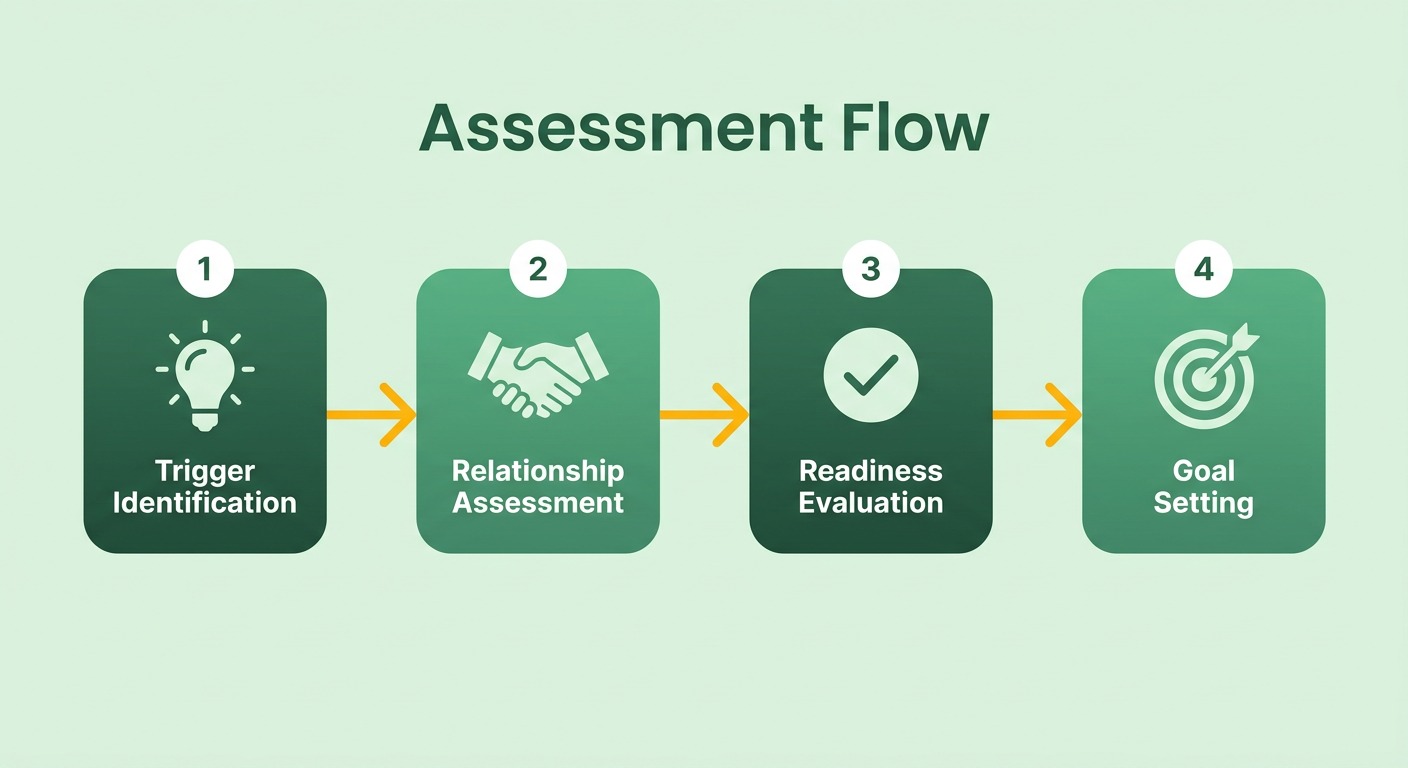
Your stage is behavior, not the calendar
Someone 60 days out who attends meetings and calls a sponsor daily is further along than someone six months out who's isolating. Our coaching opens with a consultation to gauge where you actually stand, so the plan fits your real life rather than a generic timeline.
Worth saying plainly: there's no deadline on the steps. As Willingway notes, people revisit them repeatedly. Certain chapters land differently months later. So we treat assessment as ongoing, not a one-time intake form. As clients grow, the support shifts with them.
Turning steps into a plan your house can hold
A home plan converts abstract steps into scheduled routines tied to your actual environment. Nearly half of U.S. treatment centers use 12-step models, according to American Addiction Centers citing SAMHSA's 2023 survey. But the facility can't follow you home.
A workable plan usually covers:
- Meeting cadence: The classic 90 meetings in 90 days correlates with better psychosocial functioning and self-efficacy. A tailored program folds this into your daily rhythm instead of treating it as pass-fail.
- Daily step work: One reflection tied to a real moment, like Step 10's nightly inventory after a hard conversation.
- Contact points: Who you call, and when. Named, not vague.
- Strength and gap list: What's already solid versus what needs shoring up.
When the spiritual language doesn't fit
You can work the steps without the higher-power framing and still get results. This surprises people. The MAAEZ facilitation approach worked especially well for atheists, agnostics, and people with severe psychiatric problems, per research finding that social and behavior-change mechanisms drive most outcomes, not spiritual factors.
Read that as permission to reframe. The daily behaviors carry the weight, and our coaching centers on accountability, guidance, and real human connection to keep those behaviors consistent. For clients who need it, a dedicated coach or coordinated team means you're not managing that reframing alone.
A weekly rhythm that survives the weekend
A structured home schedule is what turns the steps from an idea into a habit. The most useful support after residential care isn't another lecture on the steps. It's a concrete plan that says what you do Monday morning, who you call Thursday night, and how you handle the weekend when structure disappears. That's the transitional coaching MADE specializes in: customized, team-based support built around the individual, not a one-size-fits-all program.
Here's the gap we keep seeing. Residential programs are good at getting people a sponsor. They can't install the daily routines that keep recovery alive at home. The research agrees: sobriety's longevity leans heavily on maintaining these supportive practices consistently over the long haul. Fold service and reading into your weekly calendar and they act as guardrails against relapse.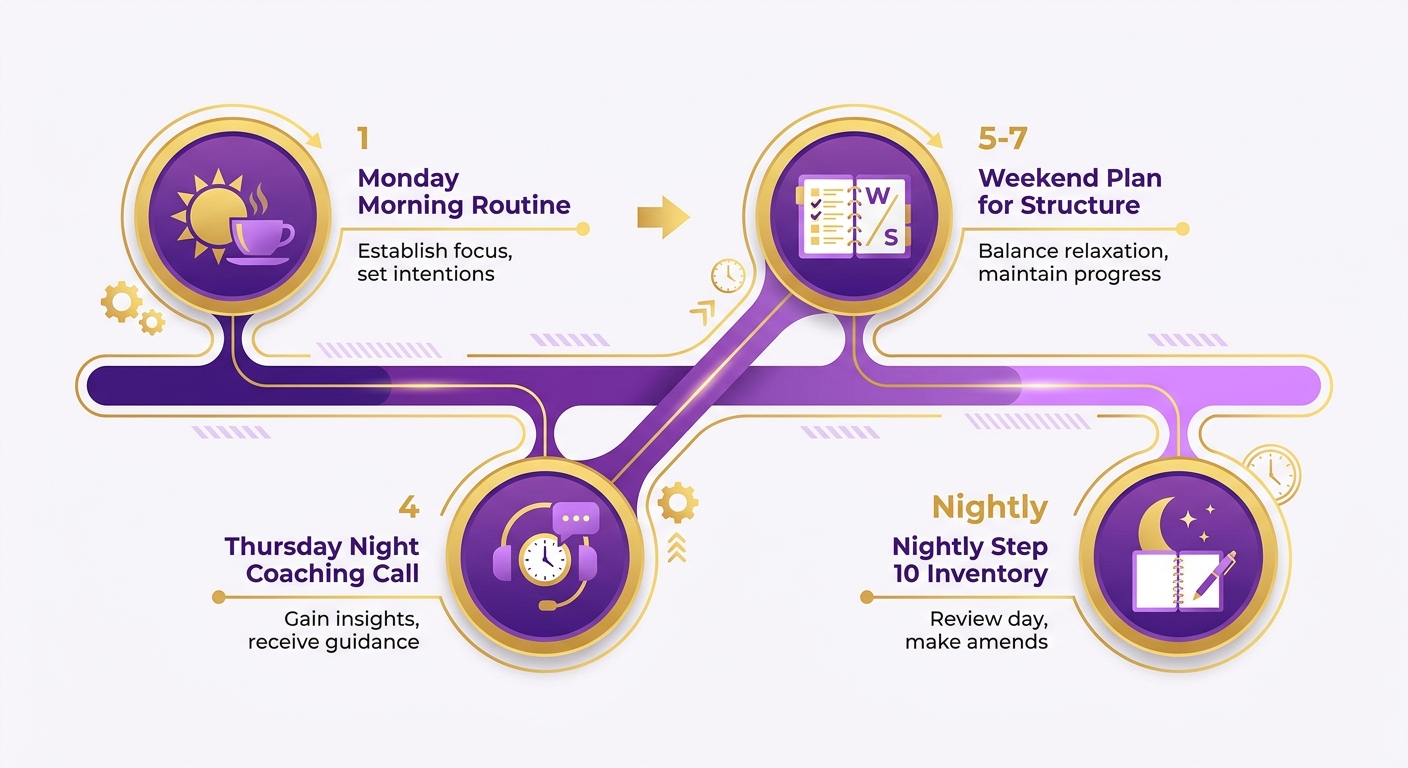
Sponsor versus accountability partner
Your sponsor guides step work. Your accountability partner keeps the schedule honest. Two different roles, and you want both. A sponsor walks you through the steps with lived experience. An accountability partner checks that you actually showed up to the meeting you committed to.
Pick a sponsor who has worked the steps and has time to answer a call. As Rosecrance puts it, "sponsorship turns recovery from something you do alone into something you do together." Recovery isn't meant to be solo, and MADE provides steady, real-world companionship in the moments that matter most.
What a week actually looks like
A workable schedule blends fixed meetings, daily reading, service, and reflection into set time slots. The point isn't cramming activities in. It's a rhythm you can hold for months. The Project MATCH facilitation manual frames early recovery as active participation: showing up, speaking, taking on small responsibilities, not just attending. Consistency beats intensity.
A week that fits real life might mean:
- Daily: 15 minutes of literature reading and a short written reflection
- Weekly: two to three home-group meetings plus your sponsor call
- Ongoing: one service commitment, like setting up chairs or making coffee
Anchoring a home group matters most. It's an environment-based commitment, not an abstract step, and it gives your week a reliable center of gravity.
Self-care belongs on the calendar too
Self-care isn't a reward for good recovery. It's part of the work. Stress is a top relapse trigger, so we schedule rest, exercise, and downtime with the same seriousness as meetings.
Technology fills the gaps. Online meetings cover the nights you can't get out, and a quick text thread with your sponsor keeps contact alive between calls. Recovery is fluid, and a sustainable approach to the steps needs flexibility, so your daily practices can bend with life's demands. A schedule that bends rather than breaks is the one that lasts.
Using the steps to make real decisions
The steps stop being abstract the moment you have to use them to decide something real. Go to that party? Answer the call from an old using friend? Skip your morning reading because work is slammed? This is where daily life after treatment gets tested. A step you can recite means nothing until it shapes the choice in front of you.
They stick when they become part of the routine. Step 10, the daily inventory, becomes a two-minute nightly check: what did I do well, where did I slip, who do I owe an amends. That builds self-reflection into your evening wind-down, so recovery manages stress in real time instead of sitting there as a static set of rules.
Run the principle, not the wording
Push the decision through the principle behind the step, not the exact phrasing. Step 1 asks whether this choice hands control back to the substance. Step 11 asks whether you paused to think before reacting. It's a quick internal check before you act, not a theological debate.
This matters because the steps are fluid, not a checklist you clear once. A coach helps you rebuild a step around your actual home triggers, so Step 4's inventory targets the resentments that live in your kitchen, not a generic worksheet. That keeps the work practical and tied to the room you're standing in.
Turning isolation and triggers into scheduled action
The steps convert two of your biggest risks into a plan. Isolation and triggers are where home recovery quietly falls apart, and the steps answer both with service and connection instead of willpower. Service (Step 12) pulls you out of isolation on the days you least feel like connecting, trading self-absorption for community action. The payoff comes when these become durable daily habits, not one-off good deeds, which is exactly what a home coach helps you build.
Match the step work to how your day breaks down. If mornings are your shakiest window, front-load Step 11 reflection before the inbox opens. If evenings drag you toward old habits, pin Step 12 service calls to that slot. A coach helps you map which steps counter which triggers, then anchor each one to the hour it's needed, so the routine defends the exact gaps where recovery tends to slip.
Reach out before the craving wins
Not after. The steps only build resilience if you use your sponsor and group as a first move, not a last resort.
Watch the drift. In that same study, sponsor use climbed to 67% at six months, then slid to 59% by twelve. That quiet decline is the isolation gap consistent support is meant to close, because active engagement is what aids relapse prevention. One clear rule holds: call before the first drink or use, every time.
Tracking the numbers before they slide
Tracking your recovery isn't busywork. It's how you catch a slide before it becomes a relapse. The pattern the research keeps surfacing is drift: the behaviors that hold early on fade once formal treatment ends, and the fade rarely announces itself. A full-year study of 12-step involvement found the people who held their ground were the ones still doing the same core activities at twelve months that they started at six. Meeting attendance and involvement tend to erode gradually rather than stop outright. Left unmeasured, those quiet declines are where people lose ground.
That drift is exactly why life after residential care needs a scoreboard. The strongest home practice we see runs on a simple habit: track the behaviors that predict staying sober, review them on a schedule, and mark the wins out loud. A coach who tailors this to your home turns a vague "I'm doing okay" into numbers you can act on.
The three metrics that actually matter
Track the three behaviors the research calls the core of long-term recovery: meetings attended, sponsor contact, and home-group participation. The PMC analysis of the same dataset frames these as the linchpins for at least a year after treatment. Count them weekly. If any drops for two weeks running, that's your signal to intervene.
A journal does double duty. Your nightly Step 10 inventory already logs how the day went. Add a one-line tally: meetings this week, last sponsor call, service done. Over a month you get a real trend line, not a gut feeling. We revisit these numbers with clients in ongoing sessions, and as you find your rhythm that support intentionally tapers to build independence.
Small milestones, real celebration
The habits worth celebrating are the ones that quietly compound. The keyword is sustained. A single act of service does little. A weekly one, held for a year, moves the needle. Research on sustained involvement confirms that keeping up these small, daily actions over months is what correlates with long-term success.
So we help clients build durable routines that make sobriety stick, not just chase round-number chip dates. Consistent nightly reading. A home group you never miss. Weekly service that becomes second nature. Naming these turns an abstract step into a finish line you can actually see coming.
A tension in the data is worth being straight about. One analysis found service and reading lose statistical weight when meeting attendance and sponsorship are accounted for together. Another slice of the same numbers found they matter strongly when maintained over time. Both are right. Service and reading pay off as durable routines, not one-off gestures, which is precisely what home tracking is built to protect.
Accountability keeps the numbers honest
Accountability is what stops tracking from becoming self-deception. You report your weekly counts to a sponsor or coach, not just a notebook. When a metric dips, someone asks why before the week is out. That outside check is the difference between noticing a decline and doing something about it.
Fitting the steps into the rest of your aftercare
The 12 Steps work best inside a wider aftercare plan, not on their own. The most durable recovery after residential care combines step work with therapy, peer support, and medication management, because each covers a gap the others leave open. A coach's job is to make those pieces pull in the same direction inside your actual home routine.
The numbers back the pairing. A study of outpatient treatment and 12-step participation showed that combining clinical care with active peer group attendance beats clinical treatment alone by a wide margin. Professional therapy and community support together make a much stronger safety net.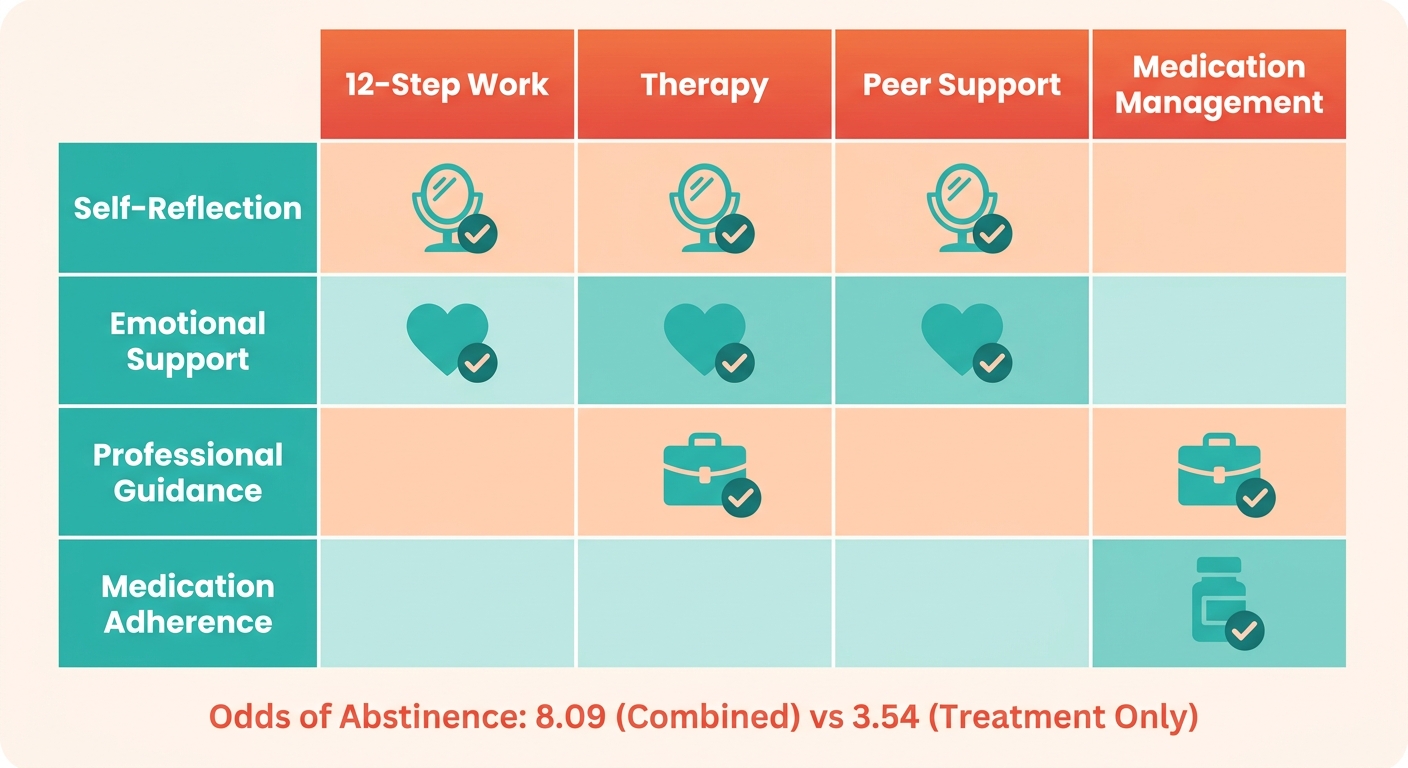
Why the steps need therapy and medication alongside
The steps give you fellowship and structure. They were never designed to treat the medical side of addiction. Peer-led recovery groups provide real community connection, but they don't replace clinical care. Therapy and prescribed medication handle what a meeting can't.
That distinction matters most when mental health and substance use run together. If clinical depression or trauma is present, peer support alone can't address the underlying neurobiology. Specialized groups and integrated treatment plans keep clinical care and peer fellowship working in tandem rather than in conflict.
Keep your prescriber and your sponsor in two separate lanes. A sponsor guides step work. A prescriber manages medication. When a client blurs those lines, one of the two usually gets neglected. We coordinate the schedule so neither drops.
What coordinated looks like at home
One calendar where therapy appointments, medication times, meetings, and step reading all fit together without colliding. Research on post-discharge outcomes shows that without active coordination, engagement in recovery activities naturally declines. A structured schedule is what prevents the drop-off.
A practical week might pair a counseling session with three meetings, a set medication routine, and short daily reading. Professional guidance stresses staying in contact with specialists during this phase, since deep self-reflection can surface hard emotions. We build that contact into the plan rather than leaving it to chance.
Nutrition, exercise, and sleep round it out. These aren't extras. Steady blood sugar and real sleep make you far less reactive to a craving at 9 p.m., which is when most home slips happen.
A crisis plan built around your triggers
A crisis plan names your high-risk moments before they arrive and assigns a response to each. Write down the two or three situations most likely to pull you toward using, then attach a specific action: call your sponsor, leave the setting, or open the literature to a passage that grounds you.
Getting ahead of high-risk situations strengthens your foundation, but only when the response is pre-decided. Keep your sponsor, accountability partner, and a counselor's number in one place. Skip the elaborate binder. A single index card of "if this, then call this" beats a plan you never look at.
References
[1] Why Residential Treatment and the 12 Steps Work Better Together - https://fellowshiphall.com/why-residential-treatment-and-the-12-steps-work-better-together/
[2] Involvement in 12-step Activities and Treatment Outcomes - PMC - https://pmc.ncbi.nlm.nih.gov/articles/PMC3558929/
[3] Find a 12-Step Program For Recovery From Addiction - https://americanaddictioncenters.org/rehab-guide/12-step
[4] 12 Steps to sobriety...and the 12 after that - https://www.rosecrance.org/blog/12-steps-to-sobriety-and-the-12-after-that/
[5] Your Step-by-Step Guide to Making the Most of Your 12- ... - https://www.cumberlandheights.org/resources/blog/your-step-by-step-guide-to-making-the-most-of-your-12-step-program/
[6] The Twelve Steps - https://www.aa.org/the-twelve-steps
[7] New to Working the Steps? Here's What to Do - https://willingway.com/working-steps-what-to-do/
[8] Twelve Step Facilitation Therapy Manual - https://www.niaaa.nih.gov/sites/default/files/match01.pdf
[9] Involvement in 12-Step Activities and Treatment Outcomes - https://www.researchgate.net/publication/234159947_Involvement_in_12-Step_Activities_and_Treatment_Outcomes
[10] Drug treatment and 12-step program participation - https://www.researchgate.net/publication/12677089_Drug_treatment_and_12-step_program_participation_the_additive_effects_of_integrated_recovery_activities
[11] Alcoholics Anonymous and 12-Step Alcoholism Treatment ... - https://www.researchgate.net/publication/10854176_Alcoholics_Anonymous_and_12-Step_Alcoholism_Treatment_Programs
Frequently Asked Questions
1. Can I work the 12 Steps at home if I'm an atheist or agnostic?
Yes. Many secular individuals successfully use the 12 Steps by substituting the traditional concept of a Higher Power with something practical, such as the collective wisdom of the recovery group, the power of the community, or the laws of nature. Because the primary benefits of the program come from peer connection, accountability, and behavioral changes, you do not need to hold specific spiritual beliefs to experience positive outcomes.
2. What's the difference between a sponsor and an accountability partner?
While both roles support your sobriety, they serve different functions. A sponsor is a mentor who has completed the steps and guides you through the therapeutic and reflective work of the program. An accountability partner is a peer who helps you stay consistent with your daily schedule, ensuring you show up to meetings and stick to your routines. Think of a sponsor as your guide for personal growth, and an accountability partner as your teammate for daily logistics.
3. Should I stop taking prescribed medication once I start working the steps?
No. Prescribed medications, including those for mental health conditions or medication-assisted treatment (MAT) for addiction, are medical interventions that should only be managed by a qualified healthcare professional. 12-step groups are peer-led support networks, not medical clinics, and sponsors are not qualified to give medical advice. Your clinical treatment plan and your peer support work should complement each other, running side-by-side to support your overall well-being.
4. How do I know when to reach out for support instead of handling a craving alone?
The best time to reach out is when you first notice the warning signs of emotional or mental distress—such as isolation, irritability, or skipping your daily routines—well before a physical craving becomes overwhelming. Waiting until you are actively fighting an intense urge makes it much harder to pick up the phone. Making a habit of calling a peer or sponsor during minor moments of stress builds the muscle memory you need for major crises.
5. How much better are outcomes when I combine treatment with regular meetings versus treatment alone?
Clinical research shows a massive advantage when professional treatment is paired with active participation in peer support groups. While professional therapy helps you address underlying psychological issues, 12-step meetings provide the daily structure and community reinforcement needed to sustain those clinical gains. Combining both approaches creates a comprehensive network of care that far outperforms clinical treatment on its own.
6. Which recovery behaviors should I track to catch a relapse early?
Focus on tracking your actual engagement levels rather than just checking boxes. Note how often you speak up in meetings, how regularly you connect with your recovery network, and whether you are maintaining your daily self-care and reflection routines. A downward trend in these areas—such as slipping into passive attendance or isolating yourself from your peers—serves as an early warning system, allowing you to adjust your plan before your sobriety is threatened.
7. Is there a deadline for finishing all 12 Steps?
No, the steps are designed to be a lifelong framework for living rather than a course with a final exam. While you will initially work through them sequentially with a sponsor, you will naturally return to various steps throughout your life as you face new challenges, transitions, and relationships. Steps like 10, 11, and 12 are specifically built to be practiced daily to maintain your emotional balance and spiritual growth over the long term.