Why Support Groups Stall Without Coaching, Family Programs, and Daily Structure
August 3, 2026
Key Takeaways
- Support after treatment may be organized in layers: a baseline group, coaching, family involvement, and daily structure. Each layer can reinforce the others.
- Coaching can provide personalized guidance, accountability, and skill practice. Some clients report a smoother handoff from treatment and a firmer grip on sobriety.
- Family involvement can extend recovery into the home environment, where much of daily life occurs.
- Daily routine can serve as a bridge, turning larger recovery goals into repeatable habits.
- Coaching and family sessions often start more frequent and may taper as habits develop. That tapering is typically viewed as a sign of progress rather than a reduction in support.
- When combined, these layers may help make the transition feel steadier, though experiences vary from person to person.
Quick Summary
Adding a coach and involving family can lift engagement, add a second layer of accountability, and help a client feel more grounded after treatment. The exact impact depends on the individual. Many clients say the combined support makes the early weeks feel easier and helps maintain commitment.
| Support Layer | Typical Benefits |
|---|---|
| Baseline support group | Provides peer connection and shared experience |
| Coaching | Offers personalized guidance, accountability, and skill‑building |
| Family involvement | Extends support beyond meetings, fostering a supportive home environment |
| Daily‑routine structure | Helps translate recovery goals into everyday habits |
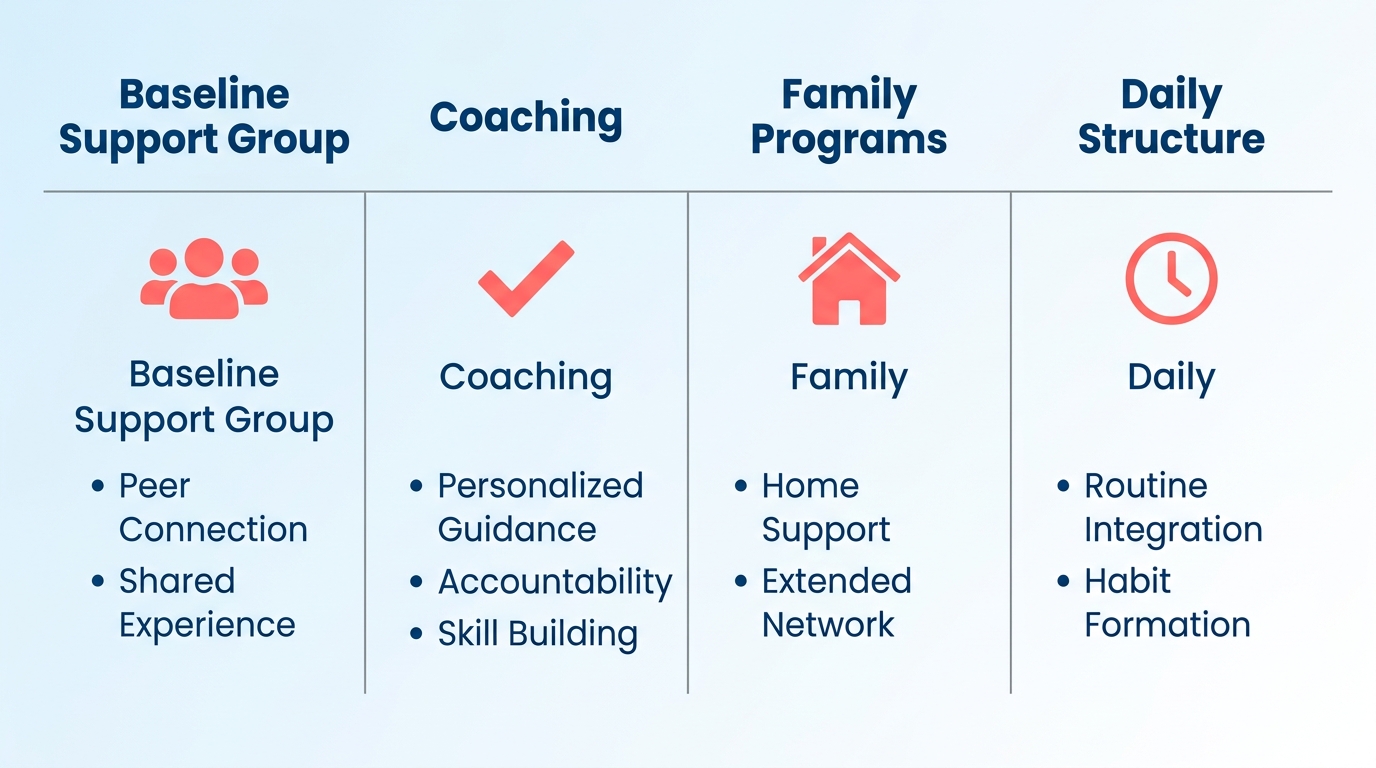 |
Adding layers may increase the overall stability of the system. Daily routine often plays a key role because it converts abstract goals into concrete actions. Family participation can add accountability that persists even when meetings are not happening.
What time and effort should you expect?
Coaching, family sessions, and daily routines often begin with regular contact and may ease off as new habits develop. The schedule is typically built around the client and adjusted as they progress.
- Coaching: Begins with consistent check‑ins that may gradually thin out as independence grows.
- Family program: Involves periodic conversations that flex around the family’s availability and the client’s progress.
- Daily structure: Includes short, repeatable practices—such as a morning plan or an evening reflection—that can fold into the client’s day.
When these elements align, the support group can stay active, members stay connected, and the overall system may resist the drift that sometimes appears after discharge. Treat this as a starting point and adjust the effort to match each person’s current situation.
Why a Coach Keeps the Group From Fading
A coach can add ongoing accountability, goal‑setting, and skill practice that carry the group’s work into everyday life.
Most of what a coach does is small and repeatable: a quick check‑in, one specific behavior goal, and a nudge to problem‑solve when something gets in the way. Bringing family into that loop can help lessons feel less like a “Tuesday‑night idea” and more like part of the household routine.
Who may benefit most from coaching?
People transitioning from detox or residential care, and their families, may find coaching especially helpful.
Leaving intensive treatment can change the schedule that previously supported sobriety. A coach can help rebuild a structured routine and involve family members as partners who watch for progress and reinforce new habits. Addressing several risk factors at once is consistent with some evidence.
What this looks like day to day
- Goal setting each day turns a vague intention into a concrete action.
- Problem solving with a coach can keep a small setback from snowballing into a relapse trigger.
- Skill building such as stress management or communication provides tools to use under real pressure.
When families join the loop, the group’s collective wisdom extends beyond the meeting room, helping maintain engagement and protect the gains made in treatment.
What Family Programs Actually Do
Family programs aim to apply group lessons at home, where accountability and daily practice can either hold up or fall apart.
Coaches may work with families to set shared expectations, identify obstacles that arise under one roof, and rehearse coping strategies together. This complements individual coaching by fostering a home environment where recovery is part of the daily rhythm.
- Goal setting – families might choose one weekly behavior target (e.g., “no alcohol after dinner”) and display it where everyone can see it.
- Addressing obstacles – a brief evening check‑in can surface the day’s friction and help find a quick fix.
- Skill building – techniques such as deep breathing or urge surfing can be modeled, with a family member cueing the practice when tension arises.
When a family program isn’t the right fit
A formal family program may be skipped if the home environment is not safe or family members are unable to engage consistently.
In such cases, some programs may use a short‑term peer‑buddy system that pairs the client with another sober person instead of the family. This can maintain daily accountability without exposing the client to conflict or relapse triggers. Once the home stabilizes, family support can be re‑introduced.
Building a Daily Routine That Sticks
Support groups may lose momentum once the weekly meeting ends, leaving members to manage cravings alone. Anchoring the group’s lessons in a daily rhythm can keep the work going at home and in the community.
The idea is to shrink the group’s core tools into habits small enough to perform every day. When families are involved, that structure spreads across the household and turns loose intentions into a shared plan.
How we build it
Coaches may work with each client to select one simple, measurable behavior to focus on daily, then pair it with regular check‑ins from a coach or team. A typical shape looks like this:
- Morning cue: A short journal entry or visual reminder naming the day’s focus (e.g., “15‑minute mindfulness before work”).
- Midday prompt: A quick text, sticky note, or phone alarm from a coach or peer to pause and check progress.
- Evening wrap‑up: A brief debrief with a family member, coach, or group peer where wins are noted and tomorrow’s cue is set.
Repeating this pattern enough times can allow the habit to run on its own, keeping the group’s teachings present between meetings.
A sample day
- Wake‑up: Write the day’s goal on a visible board or note.
- Lunch: Review it with a family member or coach and adjust if needed.
- Afternoon: Join a short virtual check‑in with your coach to report status.
- Evening: Practice a coping skill from the group, such as progressive muscle relaxation or journaling.
- Bedtime: Log what you completed and set tomorrow’s cue.
Common challenges to routine
- Unpredictable schedules that make a fixed cue hard to keep.
- Vague reminders that fail to trigger the intended action.
- Family tension when accountability feels like judgment.
Strategies to address them
- Flexibility: Attach the cue to any reliable anchor point (e.g., “after my first coffee”).
- Concrete prompts: Use a colored card, phone alarm, or labeled sticky note that names the exact behavior.
- Supportive language: Coach families to frame feedback as collaborative problem solving, aligning with a goal‑focused, non‑stigmatizing style.
With these adjustments, clients may report increased motivation, clearer accountability, and a sense that the group’s momentum carries beyond the meeting.
Why Support Groups Stall
Groups can lose momentum when members encounter cravings or life stress without a concrete plan, and when the group’s framework remains isolated from home life.
Typical gaps include:
- No coaching bridge: Without a coach, members may miss daily check‑ins that translate group goals into steps.
- Missing family link: Families that aren’t engaged may be unable to reinforce skills or problem‑solve at home, limiting the group’s impact to the meeting room.
- No routine: Without a predictable daily rhythm, the group’s tools can revert to once‑a‑week ideas rather than lived habits.
Some research suggests that integrating goal‑focused, non‑stigmatizing coaching into everyday life can improve adoption of evidence‑based practices (see the family coaching overview). Recovery follows a similar principle: a coach supplies the structure that helps the group’s momentum flow through daily life.
A simple loop that can keep a group from stalling
- Set a daily micro‑goal (e.g., “make the midday check‑in”). A coach can help write it on a visible cue.
- Run an evening reflection with the coach or a family liaison to surface obstacles and brainstorm quick fixes.
- Practice a skill such as cognitive reframing or a grounding exercise, reinforced by a family member who models it.
Anchoring the group’s teachings in a routine that families can see and support may help the weekly meeting behave like a continuous habit. Applied consistently, this loop may help reduce relapse triggers and improve attendance. The goal isn’t merely to add a coach or a family program, but to weave them together so the group becomes part of daily life.
Who Leads: Professional Coaching vs. Peer Support
Team‑based coaching can bring a structured, goal‑oriented frame to a support group, while the members’ shared experience creates a safe, empathetic space. Pairing clear coaching direction with peer connection can produce a daily rhythm that holds up through the post‑treatment stretch.
How coaching and peers complement each other
Coaches may build personalized action steps, track progress through regular check‑ins, and hold people to concrete milestones. The group, meanwhile, offers a place to share stories, model coping strategies, and foster belonging that encourages continued attendance.
Depending on individual needs, a person might work with a single coach or a coordinated team. Coaches often set weekly goals (e.g., maintaining a sober routine or focusing on nutrition) and record progress, while group members contribute experience, suggestions, and problem‑solving, keeping the agenda alive both inside and outside the room.
Potential challenges
Typical friction points include maintaining clear communication among coaches, clients, and families, and balancing structured guidance with flexible peer interaction. Many programs address this by defining coach responsibilities early (such as tracking progress and introducing coping tools) and inviting peer contributions like storytelling and community building from the start. Regular check‑ins review progress and adjust plans based on client feedback, and families are often welcomed to join those check‑ins, pulling coaching into the home environment.
Clear roles, open communication, and a leadership approach embedded in daily routines can help the group’s energy continue long after the meeting ends, supporting the transition from detox discharge toward long‑term sobriety.
How We Measure Whether It’s Working
Impact is often viewed through three lenses: engagement, retention, and outcomes, to gauge how sober‑coaching support holds up after treatment and how families experience it day to day.
Engagement
Engagement appears in everyday actions that keep a client tied to their plan. Coaches may monitor attendance at scheduled sessions, the frequency of brief check‑ins by call or text, and how often family‑led practice moments occur at home. These observations help indicate whether a client is actively participating in both individual and family components.
Retention
Retention refers to whether a client remains in the coaching relationship over time. Tracking participation month over month can reveal when someone is maintaining the structure they need and when additional outreach might be beneficial.
Outcomes
Outcomes connect the daily rhythm to lasting change. Qualitative signals often include:
- Sustained sobriety – staying alcohol‑ and drug‑free, as reported in regular coaching conversations.
- Skill application – confidence in using coping strategies introduced by the coach.
- Family feedback – observations from families about how the home program supports their loved one.
Because steady communication is essential, occasional logging gaps can occur. When they do, broader weekly summaries are used until the habit stabilizes, ensuring a clear view of progress.
Keeping these signals in view allows real‑time adjustment of coaching goals and demonstrates what extending support into the home can achieve. The result is a more adaptable recovery experience for both clients and families.
What This Looks Like in Practice
Coaching can complement support groups by adding daily structure to the group’s rhythm. When a coach sets up brief check‑ins and concrete goals, participants may carry recovery habits beyond the once‑a‑week meeting.
Our approach often folds in family coaching, a collaborative model designed to align household dynamics with the client’s recovery plan.
A working model
A model that blends peer connection with a coach‑guided daily loop might look like this:
- Targeted daily check‑ins – Coaches may set daily milestones with clients and review progress in sessions, maintaining accountability without feeling intrusive.
- Collaborative family sessions – Sessions can involve family members and reinforce supportive communication at home.
- Coach training – Coaches are typically trained in evidence‑based recovery practices, allowing adaptation to each client’s cultural and logistical reality.
Common obstacles and possible responses
Typical roadblocks include low engagement, stigma around asking for help, and limited resources for long‑term follow‑up. Programs often address these by embedding support into existing family routines and offering flexible, low‑cost coaching options.
- Engagement dip – If attendance slips, coaches may adjust the plan and add support to maintain momentum without adding burden.
- Stigma and privacy – Emphasizing practical habit‑building rather than clinical therapy can make families more comfortable with a coach’s involvement.
- Resource constraints – Virtual options and scalable support can stretch limited resources while keeping care consistent.
Together, coaching, family involvement, and daily structure can help a support group maintain momentum, improve retention, and turn meeting‑room insights into lasting habits.
References
[1] Family Coaching as a delivery modality for evidence‑based ... - https://pmc.ncbi.nlm.nih.gov/articles/PMC5858574/
Frequently Asked Questions
1. What can I do if my family refuses to join the coaching program?
Even when family members decline formal participation, a client can still maintain momentum by pairing with an accountability partner and using the coach’s brief check‑ins. The partner supplies daily encouragement, while the coach reinforces behavioral tracking and obstacle resolution, preserving support without exposing the client to a hostile environment.
2. How does professional coaching differ from peer‑led support in keeping a daily routine?
Professional coaching adds a structured, personalized loop of behavioral tracking, practical coping tools, and accountability that peers alone may not consistently provide. Peer‑led groups contribute empathy and shared experience, while a coach translates those stories into concrete daily actions, helping ensure the habit‑forming routine stays consistent beyond the weekly meeting.
3. Can the daily‑routine structure work for someone with an irregular work schedule?
Clients with shift work can anchor cues to reliable daily events—such as the first coffee break or bedtime—rather than a fixed clock time. Coaches help identify these anchor points and adjust reminders, while family members reinforce the chosen cue, allowing the routine to flex without losing the habit‑building loop.
4. How does tapering coaching sessions affect my accountability?
Tapering sessions does not eliminate accountability; it shifts responsibility onto the client’s established habits and family support. As daily cues become automatic, the coach’s role transitions to periodic audits, ensuring any emerging gaps are addressed before they develop into relapse triggers.
5. Is it necessary to have all four support layers, or can a group succeed with fewer?
While each layer—group, coach, family, routine—can strengthen recovery, a program may still function with three components if the missing piece is compensated elsewhere. For example, intensive daily coaching can partially substitute for family involvement, though omitting both reduces the bridge that translates meeting insights into everyday behavior.
6. What signs indicate I’m ready to reduce the frequency of coaching?
Clients typically show readiness to scale back coaching when they consistently meet daily micro‑goals, can self‑initiate obstacle resolution without prompts, and report confidence using recovery tools independently. Coaches look for these patterns in regular check‑ins before proposing longer intervals between sessions.