Why Sober Coaches Fix Your Sleep and Meals Before Anything Else
October 1, 2026

The short version, before anything else:
- Sleep problems are common in alcohol use disorder treatment.
- Sleep disruption can last months or years into recovery.
- Early recovery often brings poor sleep and weak follow-through.
- Sleep and meal routines usually break first after discharge.
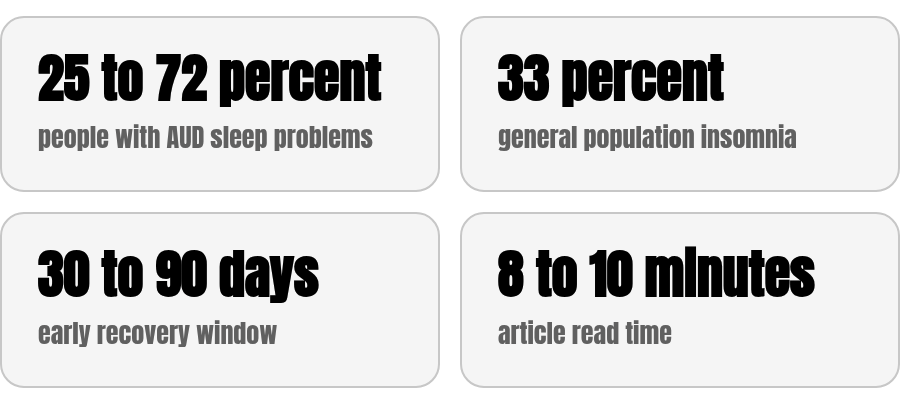
- Insomnia is common in the general population, too.
- A sober coach helps rebuild daily routines around sleep and meals.
Why sleep falls apart first after discharge
Sleep problems are one of the most underrated relapse risks in early recovery. SAMHSA’s brief on sleep and substance use disorders puts the range at 25 to 72 percent among people with alcohol use disorder in treatment. That is not a side note. It is the ground where coaching either holds or loses the week.
The first weeks after discharge are often when sleep and meal patterns crumble fastest. Most people already know they should eat and sleep on a schedule. The breakdown shows up when real life pushes back. A sober coach is most useful when the problem is not knowledge, but follow-through. That window is exactly what coaching after rehab is designed to work inside.
Why the sequence matters when sleep is broken
Most aftercare conversations jump straight to triggers, craving management, and coping skills. In practice, that order is backwards for a lot of clients. SAMHSA notes that sleep disturbances can persist for months or years into recovery and correlate with relapse to substance use. So a coach who starts with sleep and meals is not doing soft wellness work. They are addressing a relapse driver before asking anyone to white-knuckle a craving.
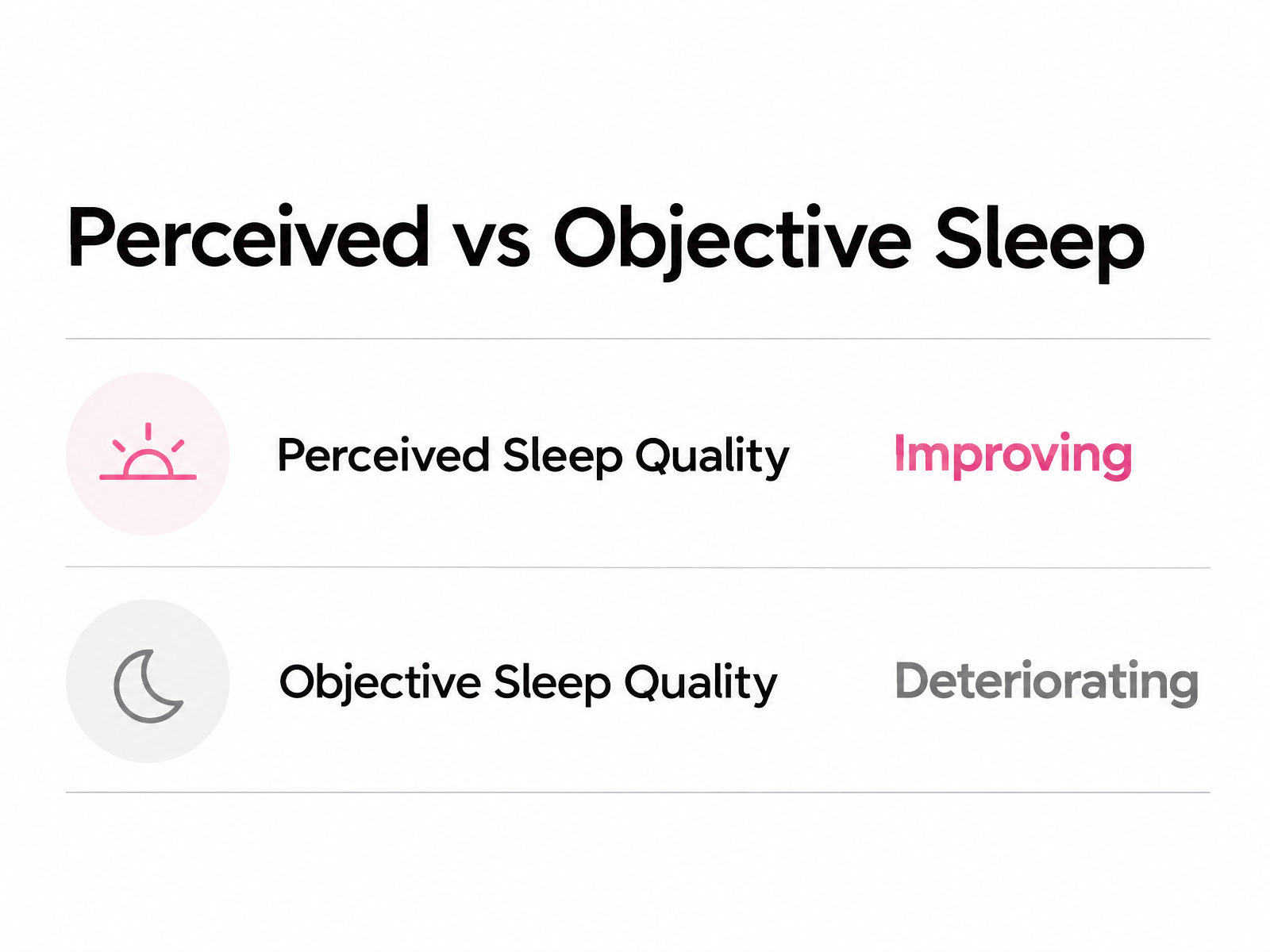
There is another problem: people in early recovery often misjudge their own sleep. The same brief points out that some patients overestimate both quality and duration. In one study, objective sleep quality deteriorated while participants believed it was improving. That is a good reason to include nutrition guidance and routine building as practical anchors instead of relying on self-report alone. Structure has to sit inside the work from the start.
Who should read this, and who can skip it
This guide is for people transitioning from detox or residential treatment, and for families trying to figure out what support actually matters after discharge. If you are in the first 30 to 90 days and your schedule feels like it is crumbling, the sleep-and-meal reset layer is probably relevant.
But be honest about scope. Not everyone needs this level of coaching. Plenty of people build solid recovery through therapy, community support, and routines they hold on their own. A sober coach becomes useful in specific high-risk windows, such as leaving treatment or returning to a high-pressure lifestyle. If your sleep is fine, your meals are regular, and your routine holds, you can use this as a reference instead of an intervention.
What you’ll learn and how long it takes
You’ll learn why sleep and meals come before craving work, how MADE Recovery’s coaching model supports that sequence, and what a practical first week looks like.
| Section | What It Covers | Time to Read |
|---|---|---|
| Why sleep and meals come first | The relapse connection and why self-report fails | 2 minutes |
| How the team model works | How coaching and coordinated team support address nutrition and daily routines | 2 minutes |
| What to expect in week one | A realistic reset routine without clinical overreach | 3 minutes |
Difficulty level: Beginner. No clinical background needed. Total read time: About 8 to 10 minutes.
The order we build a recovery routine
Some people in early recovery tell us they slept “fine,” but the clinical picture does not support that. SAMHSA’s guidance on treating sleep problems in recovery notes that some patients overestimate sleep quality and duration on questionnaires and in sleep logs. That gap is exactly where coaching becomes useful. A coach sees the mismatch between the self-report and the actual routine.
We treat the first stretch of sober coaching after rehab as a stabilization window, not a motivational sprint. A sober coach is a nonclinical recovery support role, not a therapist and not a replacement for clinical care. The job is implementation. We help someone rebuild a daily sequence of sleep, meals, movement, and connection, then hold that sequence until it feels ordinary.
Self-reported sleep is the weakest data we get
Sleep problems are common enough in the general population. In early recovery, the bigger issue is that a person may not know how broken their sleep actually is. A sleep log is only as good as the person filling it out. Someone can record seven hours in bed and still wake up wrecked.
That is why we watch the pattern across days instead of relying on a sleep diary alone. A coach sees how the routine actually plays out. If a client reports solid sleep but is eating at odd hours or struggling to start the day, we have better information than memory. We adjust from what the pattern shows, not from what the client recalls.
Stability comes before craving work
There is an order we have come to trust. Sleep loss and irregular meals make emotional regulation harder, and craving work collapses without emotional regulation. We do not ask someone to practice refusal skills while running on three hours of sleep and an empty stomach. We stabilize the baseline first.
The team model matters here. Many coaching arrangements ask one person to carry accountability, emotional support, relapse prevention, and family coordination all at once. Our approach splits that load. Coaching starts with the first-stage baseline: sleep, meals, movement, and connection. Once that baseline holds for several days, the craving and boundary work has something solid to stand on. This is not a soft add-on. It is the load-bearing layer.
Where coaching actually starts
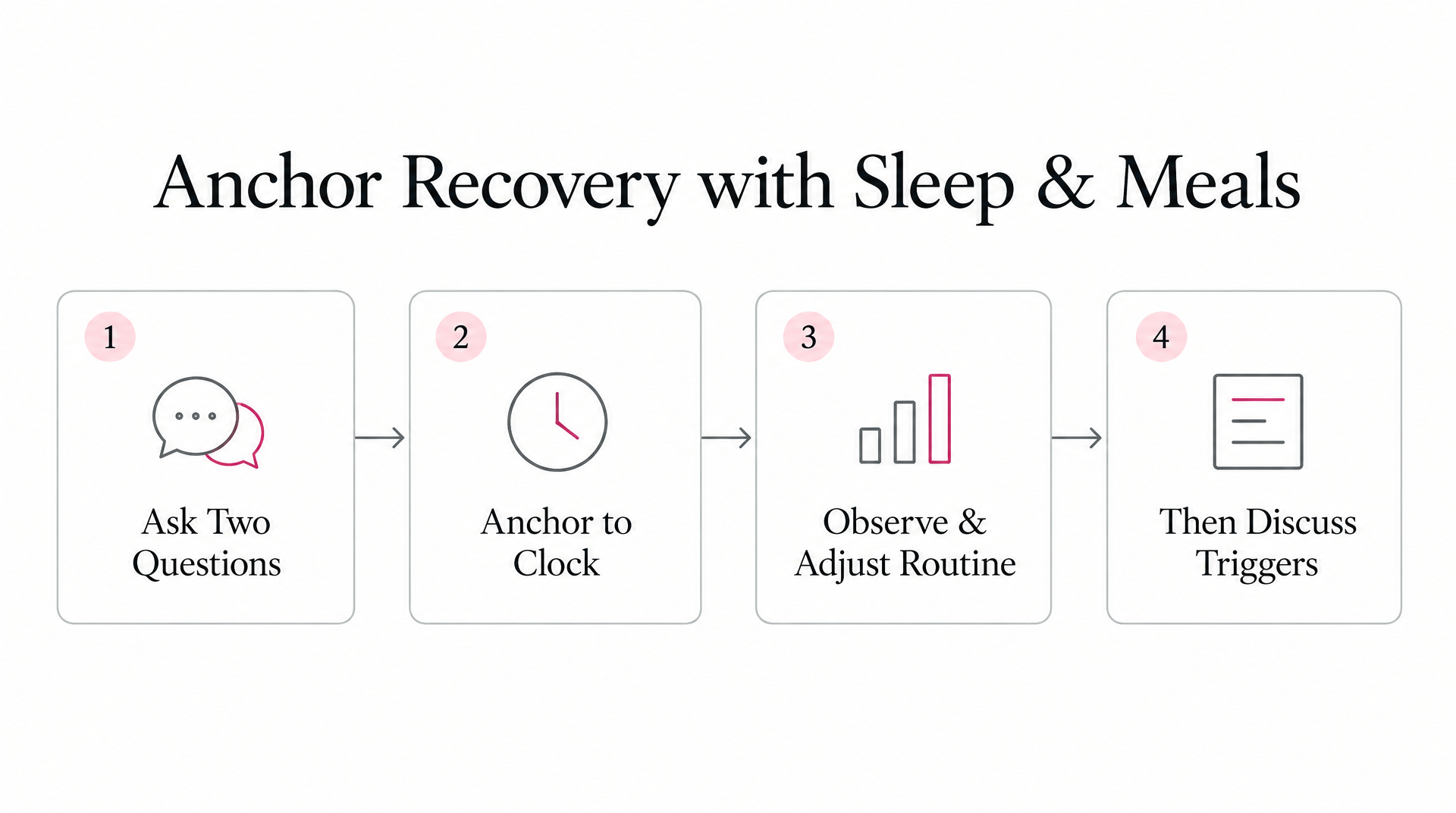
In our experience, sober coaching after rehab does not start with a craving conversation. It starts with two questions: what did you eat yesterday, and what time did you actually fall asleep? We go there first because sleep and meals are the only recovery habits we can anchor to the clock before someone is ready to talk about triggers.
Leaving residential or detox care is a fragile stretch. The schedule that held everything in place disappears, and even a strong aftercare plan can get lost in the first week home. That transition window is where a coach earns their keep, not by teaching new information but by making daily routines observable and consistent during the move out of structured care.
Why sleep and meals come before craving work
A body that is under-slept and under-fed does not have the bandwidth for urge management. We sequence stabilization first, not as a wellness add-on, but as the platform under every other recovery skill.
Sleep problems do not resolve the week someone stops drinking or using. SAMHSA notes that sleep problems can persist months or even years into recovery. That makes the first week a baseline, not a waiting period. If many everyday adults are already sleep-compromised, someone early in recovery usually arrives with an even larger deficit.
What the first week looks like
We treat the first week as a baseline, not a set of goals. A dedicated coach or coordinated team can track observable patterns while keeping the broader recovery plan in view. The aim is to see the clock and the plate clearly before we touch triggers or coping skills.
The first week may include:
- Planning meals around healthy eating habits instead of leaving food to chance
- Building an evening wind-down that doesn’t rely on a drink, a drug, or a screen
None of this requires motivation. It requires an outside person helping you observe the baseline and adjust the environment. That is exactly what the first stage of coaching is for.
What the daily work looks like
The core of sober coaching after rehab is not a craving worksheet. It is a second person watching your sleep and meal times closely enough to notice the schedule slip before you do.
Our team makes that work explicit. Every program includes guidance on healthy eating and routine building alongside sober coaching, so clients do not have to piece those anchors together alone. The days after discharge are when everyday structure can disappear fastest, and regular meals and sleep are often among the first routines to slide.
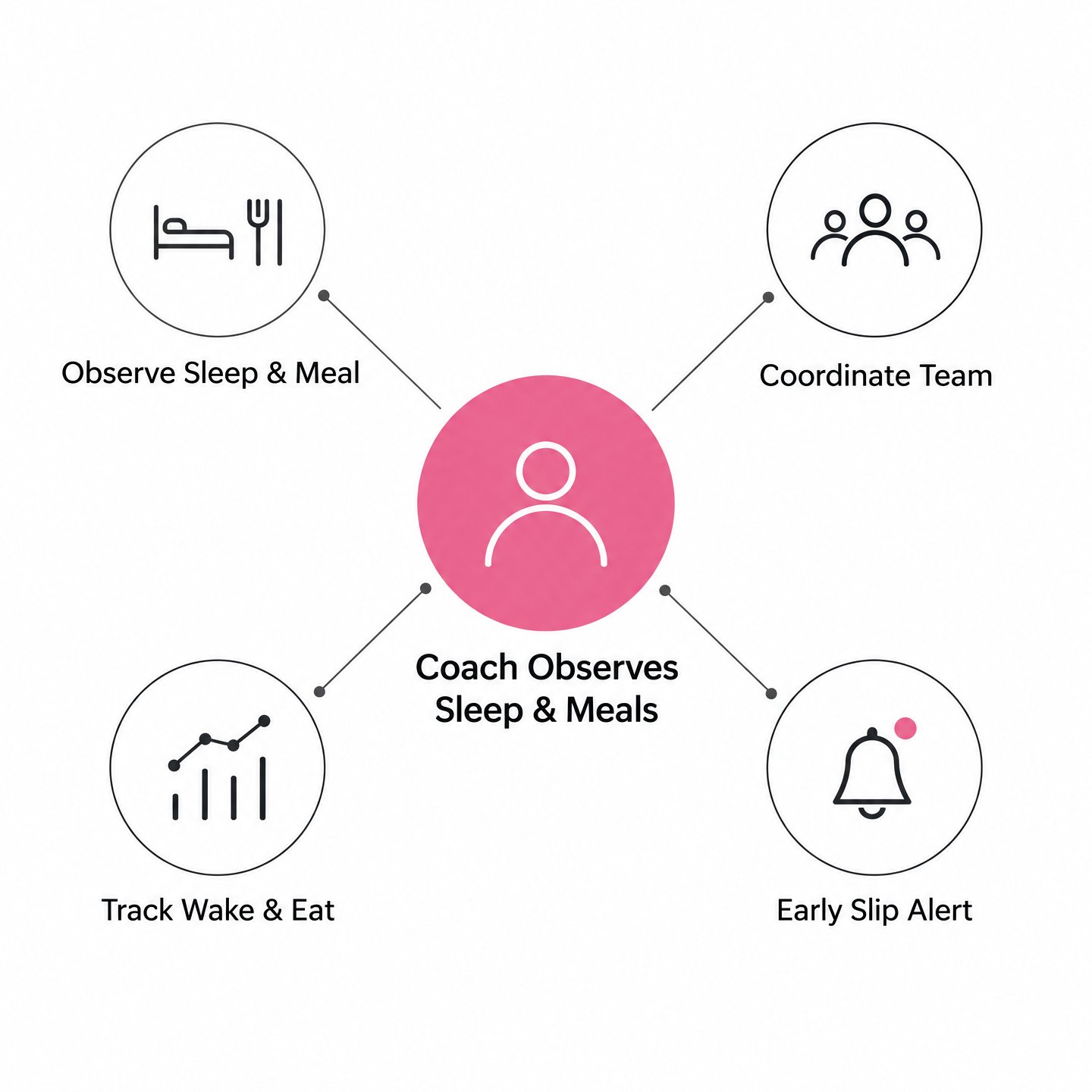
How we build sleep and meal anchors into coaching
The job is narrower than a therapist’s, and that narrowness is the feature. A sober coach commonly helps build a realistic daily routine around sleep, meals, movement, appointments, and support meetings. In our coaching, nutrition and routine building sit alongside accountability and practical guidance rather than being handled as separate clinical work.
Our day-to-day check-ins look like this:
- A planned wake time and first meal time, agreed on the day before
- A check-in during vulnerable hours: evenings, weekends, travel days
- Coordination with your treatment team when one exists, with clear privacy boundaries
We are not diagnosing anything. The coach’s job is to make the routine observable enough that a slip shows up in a day, not a month.
Why we look at observable anchors
A federal brief on sleep and substance use discusses why sleep problems in recovery deserve attention. A simple “how did you sleep?” may not capture what is actually shifting.
So we ask for observable anchors instead of adjectives. We look at what time you woke, when you first ate, and whether the day held a predictable rhythm. We compare those against the previous week. When an anchor slips, we can bring it up early, before the day unravels. That sequence is the core of the coaching model.
When coaching is not a substitute for medical evaluation
We do not use coaching as a substitute for medical evaluation. If someone shows signs of sleep-disordered breathing, or their sleep problem appears tied to a medication, we ask their prescribing clinician to weigh in before we adjust habits. That is not a habit problem a coach should own.
For clients in early recovery, we keep returning to sleep and meal anchors. Not because other recovery work doesn’t matter, but because a stable daily rhythm makes that work possible.
What we’ve learned to do early
In sober coaching after rehab, one of the most useful early moves is to treat sleep and meal patterns as a primary focus in the first weeks, not a side task. That sequencing matters because people leaving structured care often overestimate how well they are sleeping. A coach who relies on self-report alone misses the early warning signs that a schedule is slipping.
MADE Recovery’s coaching is built around team-based support and routine building, with nutrition guidance as part of the program. Depending on the level of care, a client may work with a single coach or a coordinated team. Either way, the routine itself becomes the signal.
Stabilize sleep and meal anchors before craving work
A practical starting point is observable anchors, not insight work. A fixed wake time, a first meal within an hour of waking, and a last meal that doesn’t collide with insomnia. The coach’s job is to watch the clock, not interrogate the feeling. Sleep loss has a direct line to relapse risk, and SAMHSA guidance shows sleep problems can last months or years into recovery. That means early coaching wins come from consistency, not complex relapse prevention worksheets.
Three anchors a coach may set in the first week:
- Wake time that stays within a 30-minute window every day, including weekends.
- First meal eaten within 60 minutes of waking, even if appetite is low.
- Evening cutoff for caffeine and heavy screen use, set at least two hours before bed.
These are follow-through problems, not knowledge problems. A sober coach is most useful when the gap is doing the thing consistently, not understanding why it matters.
Use a coordinated team to reinforce daily anchors
A single coach asking “How did you sleep?” gets a filtered answer. For clients who need a higher level of care, a coordinated team can split the work: one coach focuses on daily routines, meal timing, and the practical anchors of the day, while the sober coach uses those observations to adjust the plan. This isn’t about adding staff for show. It is about matching monitoring intensity to the known blindness of self-report.
That split also keeps early coaching narrow. The sober coach doesn’t become a dietitian or a sleep specialist. They use the routine and nutrition support to make one small change at a time. That approach fits the broader shape of MADE Recovery’s coaching: stability first, then more demanding recovery work as clients regain independence.
Know when to step aside
Best practice is also recognizing what coaching cannot fix. If a client shows insomnia that persists beyond the first few weeks, or symptoms like snoring, gasping, or severe daytime sleepiness, the practical step is to refer out to a medical provider. Those are red flags for sleep apnea and other treatable conditions. A sober coach should not try to solve those with sleep hygiene tips alone.
MADE Recovery’s role is to support the routine, not to manage medication or diagnose a disorder. Staying in that lane keeps the early work clean and effective.
When the schedule slips
The most common misstep we see in early coaching is treating a broken sleep schedule or skipped meals as a footnote while everyone waits for the “real” craving work. In our experience, the sleep-and-meal reset is the real work. If a client says they slept “okay” but their meal times have drifted two hours later in a week, we do not wait for a craving episode to act.
We approach this as a debugging problem, not a motivation problem. We don’t start with a lecture about sleep hygiene. We start with what changed between Tuesday and Thursday.
What are we actually troubleshooting when sleep and meals slip?
We are troubleshooting the gap between a plan made in treatment and the first week home. A client often knows exactly what to do. The hard part is doing it when a stressful call, a family argument, or an unstructured Saturday shows up.
Common failure points we watch for:
- Nighttime wakefulness treated with over-the-counter sleep aids, which often backfire.
- Skipped breakfast leading to evening overeating and a later bedtime.
- Weekend collapse, where Friday and Saturday look nothing like the weekday routine.
None of these are knowledge problems. Each one shows up as a schedule change we can see before the client feels it.
How do we stop a sleep fix from becoming its own problem?
We push back when a client reaches for an over-the-counter sleep aid as the default answer. SAMHSA’s guidance warns that many OTC sleep medications are not a good long-term fix. They can disrupt the natural sleep cycle and cause morning grogginess, daytime sleepiness, and impaired alertness and judgment.
There is also a measurement trap. People in recovery can believe their sleep is improving while the objective picture says otherwise. That gap is why we track actual wake-up times and meal logs inside the team model. A sleep-and-nutrition coach can notice the drift that a self-report misses.
When is coaching not the right fix for sleep and meals?
Some sleep problems need clinical attention, not coaching. SAMHSA notes that insomnia symptoms occurring two or three nights per week for a month or more warrant an insomnia diagnosis. Snoring, gasping for air, or pauses in breathing also point to possible sleep apnea and need a medical workup.
We stay in our lane here. We do not adjust medications, diagnose sleep disorders, or manage detox. If a client is on methadone or buprenorphine and reports disrupted sleep, we coordinate with the prescribing team because the medication itself may be part of the picture.
| Coaching territory | Escalate to clinical care |
|---|---|
| Bedtime drifts later each night, no gasping or pauses | Snoring, gasping, or breathing pauses |
| Meals slide late and energy crashes | Insomnia two or three nights a week for a month or more |
| OTC sleep aids become the nightly default | Sleep disruption tied to methadone or buprenorphine |
| Self-report says "fine" but schedule data shows drift | Consistently poor sleep after routine fixes |
The right question is not whether sober coaching after rehab helps with sleep and meals. It helps most when the schedule is wobbling but the person does not need a sleep study or medication change. When the wobble crosses that line, we say so plainly.
Tools worth using, and when to skip them
The mismatch between perceived and measured sleep is one of the least discussed findings in recovery sleep research. That gap is why the right support after detox or residential treatment is not more education. It is practical structure: observable routines, regular meals, and external accountability that can make the transition more stable before cravings become the main conversation.
Our approach stays deliberately practical. MADE Recovery’s coaching includes nutrition guidance and routine building as part of a tailored program, so the early work focuses on steady meals and consistent daily rhythms rather than a long list of tools. If a client is settling into a stable routine, we do not pile on extra tasks. The goal is to make the routine boring enough to stop noticing it.
How do sleep and meal routines fit into coaching?
A sleep log used in this kind of aftercare can mirror the fields in the SAMHSA brief: total time in bed, time of sleep onset, number of awakenings, and total time awake, recorded immediately on waking. The important part is not the log itself. It is that a coach reviews it against what the client reports in conversation. If the numbers drift while the person says everything is fine, that gap becomes part of the coaching conversation.
| Field | What It Exposes |
|---|---|
| Time of sleep onset | Whether falling asleep is trending later |
| Number of awakenings | Fragmented sleep that self-report often misses |
| Total time awake | Low sleep quality despite enough time in bed |
| Total time in bed | Time spent lying down without sleeping |
MADE Recovery’s coaching includes nutrition guidance and routine building, which can help anchor meals and daily rhythms around a stable schedule. The same principle applies: a clock is harder to argue with than a feeling. Treating sleep as a side issue is a mistake.
How do you vet a coach before letting them into your routine?
A coaching resource is only useful if the coach is safe to have near a fragile routine. A short, blunt screening conversation helps. Ask what training they have, whether they are bonded and insured, how they handle relapse risk, and how they coordinate with a therapist or treatment team. Reject any coach who:
- Promises guaranteed sobriety.
- Discourages therapy or minimizes mental health concerns.
- Blurs boundaries around money, relationships, or control.
- Pressures you to use only their services.
Families can treat the vetting process as part of building a safe recovery support system. A coach who cannot describe their scope clearly will struggle to hold the daily structure when things get hard.
When should you skip the tracking tools?
Skip detailed sleep logging if the routine is already stable and meals are anchored within the same hour each day. Tracking then becomes another task that creates anxiety instead of reducing it. Once a stable pattern holds, coaching can shift from minute-level tracking to maintaining the routine, unless sleep remains fragmented or a medication side effect is in play. At that point, a medical provider should be consulted.
If sleep problems persist, a referral for an objective sleep study may be more useful than another week of self-tracking.
The bottom line on sleep, meals, and sober coaching after rehab
People often misread sober coaching after rehab as a craving intervention. The pivot point usually sits earlier. If someone has not anchored sleep and meals, the rest of the coaching plan has nothing stable to hold onto.
Some people leave structured care and try to tackle triggers, relationships, and work stress all at once. We see that order fail more often than not. MADE Recovery’s coaching programs weave nutrition guidance and routine building into team-based support, so sleep and meals become early anchors rather than add-ons.
The next step is one anchor, not a full overhaul
After discharge, the fastest way to gain traction is to pick a single daily anchor and make it observable. That could mean a fixed bedtime, a protein-containing breakfast within an hour of waking, or a meal time that does not drift later each day.
We tell people to choose the anchor they are most likely to keep, not the one that feels most impressive. If mornings are hard, start with dinner and a wind-down time instead. Holding one line builds the pattern that later craving work depends on.
For families, the useful move is similar. Watch the kitchen and the bedroom before asking how someone is feeling. A skipped meal or a drifting bedtime will tell you more than a mood report.
If someone is medically unstable or entering acute withdrawal, that is a clinical emergency, not a coaching case. We do not provide medical services, and we say so before anything else.
Once stabilization is in place, coaching can move to the next layer of recovery support. The first stage stays simple: name the anchor, make it visible, and let a coach hold the line until it becomes automatic.
References
[1] What Is a Sober Coach? | Benefits, Costs, and How to Choose One - https://futuresrecoveryhealthcare.com/alcoholism/what-is-a-sober-coach/
[2] [PDF] Treating Sleep Problems of People in Recovery From Substance Use ... - https://library.samhsa.gov/sites/default/files/sma14-4859.pdf
Frequently Asked Questions
1. Can a sober coach still help if my sleep and meals are already stable?
A coach can still help, but you may not need intensive support if your sleep and meal patterns are already stable. Strong therapy, community support, and consistent routines may be enough. Coaching becomes more useful during specific high-risk windows, such as leaving treatment or returning to a high-pressure lifestyle.
2. What should family members watch for in the first week after treatment?
Watch for schedule drift rather than relying only on how the person says they feel. A wake time that slides later each day, a skipped first meal, or weekends that look nothing like weekdays can signal that the transition home is destabilizing. These changes often appear before the person notices them.
3. How is a sober coach different from a therapist when sleep problems surface?
A sober coach handles implementation: agreed wake times, meal anchors, evening check-ins, and routine adjustments. A therapist addresses underlying clinical issues. MADE Recovery’s coaching stays in that nonclinical support role and coordinates with treatment providers when sleep-disordered breathing or persistent insomnia appears.
4. Are over-the-counter sleep aids a safe shortcut in early recovery?
They are not a good long-term fix. SAMHSA guidance notes many over-the-counter sleep medications can disrupt the natural sleep cycle and cause next-day grogginess, daytime sleepiness, and impaired judgment. A coach focuses on building an evening wind-down routine instead of reaching for these aids as the default.
5. When should sleep problems be escalated to a medical provider instead of coaching?
Escalate when sleep problems point to a medical condition, such as snoring, gasping, pauses in breathing, or severe daytime sleepiness. If disrupted sleep is tied to medication, coordinate with the prescribing clinician. A sober coach supports the routine but does not diagnose or manage those issues.