Why Al-Anon Meetings Miss the Post-Rehab Transition Window
August 16, 2026
Key Takeaways
- Relapse starts weeks before someone picks up again. Emotional shifts, sleep collapse, and dropping attendance do not wait for next week's meeting.
- Structured aftercare cuts relapse rates by 30% compared with unstructured peer support. The difference is coaching timed to high-risk moments.
- Only 36% of families discharged from adolescent treatment programs stay engaged in continuing care.
- Clients with strong recovery capital, stable housing, transportation, social support, and internal motivation, self-initiate aftercare. Those who lack those resources need help most and are least likely to show up.
- Weekly meetings miss warning signs like collapsing sleep, unmanaged stress, and creeping isolation. By the time someone mentions them at a meeting, the pattern is already set.
- Families often assume attendance equals progress. It does not. Outcomes depend on support when vulnerability surfaces, not on a fixed schedule.
Why the First Month Home Is Different
The drop from 24/7 clinical structure to home life hits hard. Families expect a smooth return. Instead, someone tries to rebuild routines without the scaffolding that held them steady for 30, 60, or 90 days. Without real-time monitoring, small shifts, like skipping breakfast, staying up past midnight, and avoiding check-ins, compound before anyone notices.
The Engagement Paradox
Research on recovery capital shows that participants with high confidence and strong support networks report self-initiated aftercare engagement. They have the internal and external resources to follow through. But a separate study of adolescents found that continuing care participation drops off sharply post-discharge.
The difference is baseline resources. People with strong personal and environmental assets navigate the transition better. Those without them struggle to maintain engagement on their own. Proactive, team-based support bridges that gap by providing external structure when the client cannot generate it themselves.
Families searching for support groups focus on attendance. But structured aftercare programs reduce relapse rates by delivering targeted guidance during high-risk moments, not by scheduling another meeting for next Tuesday.
Comparison of Support Options: Al-Anon Meetings, MADE Recovery, and Others
Families find dozens of meeting schedules and fellowship descriptions. What they do not find is a clear answer about timing, which option works best in the first 30 days home, when relapse risk peaks and structure matters most.
The options fall into three camps. Al-Anon and similar peer fellowships offer weekly meetings built around shared experience and the Twelve Steps. Outpatient programs run structured therapy sessions, usually two to three times per week. We built MADE Recovery to fill the gap: customized, team-based coaching, real human connection, and family coordination during the window when most people either stabilize or slide back.
What Each Option Actually Delivers
| Feature | Al-Anon / Peer Groups | Outpatient Programs | MADE Recovery |
|---|---|---|---|
| Contact frequency | Weekly meetings | 2-3x/week sessions | Tailored check-ins |
| Response time | Next meeting | Scheduled appointment | Consistent, real-world support |
| Family involvement | Separate meetings | Limited coordination | Integrated coaching |
| Structure level | Self-directed | Therapist-led curriculum | Personalized plans |
| Best for | Long-term fellowship | Clinical need | Post-discharge transition |
Al-Anon gives families a place to process their own experience without managing the person in recovery. That is valuable. But it is not designed to monitor daily behavioral shifts or intervene when routines start to falter. Research on assertive continuing care shows that individuals receiving active outreach and home-based support maintain connection to care at much higher rates than those left to navigate recovery independently. Weekly touchpoints miss the critical daily changes that happen between sessions.
Outpatient programs offer clinical depth but require the person to show up consistently. Practical obstacles and scheduling conflicts reduce adherence during the chaotic first month home, when people struggle to bridge the gap between appointments.
Our approach pairs a dedicated coach or coordinated team with the family to build structure before problems compound. We help establish routines, spot pattern changes, and adjust plans as clients progress rather than waiting for the next scheduled session. This ongoing coordination keeps everyone aligned as clients reintegrate into daily life, without anyone feeling alone in the process. We provide consistent, real-world support during the moments that matter most, so isolation and missed steps get attention as they emerge.
Choose peer groups for sustained community once you are stable. Choose outpatient if clinical need justifies the commitment. Choose us if you are in the first 30 to 60 days and need someone watching the details while you figure out what normal looks like again.
How Post-Rehab Transition Support Actually Works
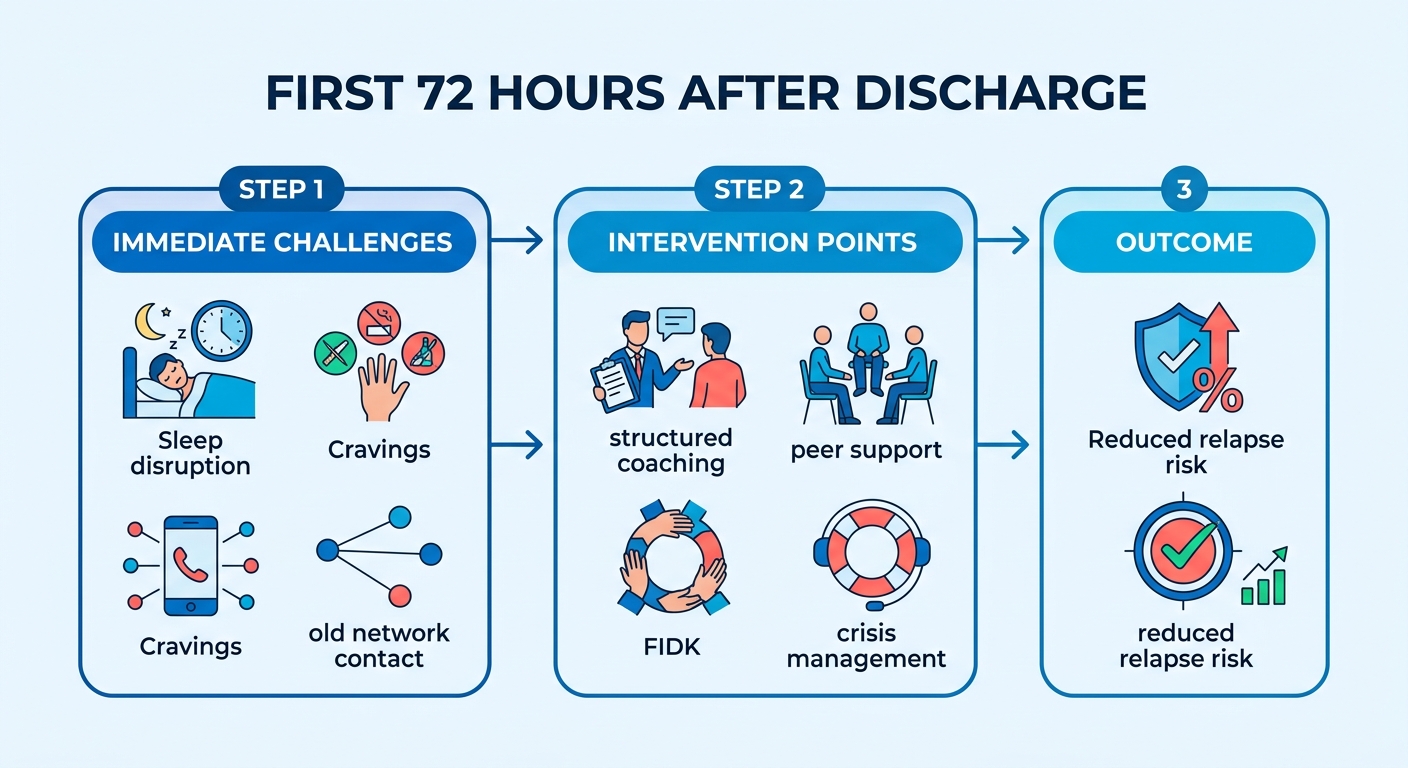
We built our program to address the gap between clinical discharge and independent recovery. When someone leaves treatment and enters the first 72 hours at home, the highest-risk window for relapse, they face immediate challenges: disrupted sleep, cravings at unpredictable hours, and contact from old networks. Al-Anon offers valuable peer connection, but it follows a weekly meeting format that does not address the real-time volatility of those early days.
Our approach provides flexible, customized support that adapts to where clients are in their recovery journey. We offer both virtual and in-person coaching, meeting clients in their own environment rather than requiring them to travel to a fixed location. Our team-based model means clients can receive assistance from a single dedicated coach or a coordinated team, depending on the level of care needed during the transition from treatment back into everyday life.
What Transitional Coaching Actually Includes
Consistent contact during the early phase helps establish accountability before patterns destabilize. Our coaches provide ongoing support during critical moments, so clients do not feel alone when challenges surface. This active engagement allows us to identify and address behavioral and emotional changes as they emerge, preventing minor setbacks from escalating.
Routine building creates the foundation for long-term stability. We help clients establish daily routines that reduce stress and promote balance, anchoring sleep schedules, meal times, and healthy habits into a consistent pattern. Clients who maintain structured routines report better outcomes than those without consistent daily frameworks.
Family coordination keeps everyone aligned without letting relatives slip into management mode. We have seen well-meaning families take over their loved one's recovery, tracking meetings, monitoring phone calls, and interrogating behavior, and that control dynamic backfires. Our team assists families in managing recovery pathways while helping them maintain supportive participation without micromanaging. We bridge the gap between leaving treatment and living independently, helping families understand their role in the process.
Support That Evolves With Recovery Progress
Recovery needs shift over time, but many aftercare programs deliver the same format throughout. Our programs are fully tailored to each individual and evolve as client needs change, with support intentionally tapering as independence grows.
Early recovery requires structure and stability. We focus on helping clients rebuild the fundamentals: healthy eating habits that support physical healing and emotional balance, consistent sleep patterns, and daily routines that create predictability. We do not introduce complexity here. We stabilize what treatment already built.
Mid-stage recovery shifts toward skill-building. Physical stability improves, so we move toward emotional and social recovery work: repairing relationships, returning to work or school, and handling conflict without substances. We help clients find passions and build community connections that make sober living feel full and meaningful.
Late-stage transition prepares clients for independence. We review what strategies worked, what did not, and what situations still feel challenging. As clients gain confidence and demonstrate consistent progress, our support gradually reduces to encourage self-sufficiency. Those who need additional time receive extended support until the foundation holds.
| Support Model | Contact Frequency | Format | Family Role | Responds to Crises |
|---|---|---|---|---|
| Al-Anon Meetings | Weekly (fixed schedule) | Group, peer-led | Family attends separately | Not designed for crisis response |
| Outpatient Programs | 2-3x weekly (fixed schedule) | Group therapy sessions | Limited family involvement | Clinical hours only |
| MADE Recovery | Customized and flexible | 1-on-1 coaching, virtual or in-person | Coordinated family guidance | Consistent coach availability |
When Al-Anon Works and When Coaching Fills the Gap
Al-Anon meetings work well once someone has stable attendance patterns and a peer network. The fellowship model, shared experience, long-term mentorship, and working the steps, builds resilience over months and years. But in the immediate post-treatment period, before those patterns exist, a come-to-us model assumes the client can already manage logistics independently. Studies show that traditional meeting-based models face practical barriers during early recovery, including scheduling conflicts and the social anxiety of walking into a room of strangers when emotional regulation is still fragile.
We see Al-Anon work best as the second layer of support, not the only one. Clients who combine structured transitional coaching, for accountability and real-world guidance, with weekly meetings, for peer connection and spiritual growth, report stronger outcomes than those relying on either alone. Families who actively participate help reinforce these outcomes, provided there is professional support to help maintain healthy boundaries.
Peer fellowship becomes the sustainable long-term foundation once someone stabilizes, with consistent routines, regular meeting attendance, and peer connections forming. Structured coaching builds the bridge between clinical discharge and that stability, providing companionship and guidance during the moments that matter most.
What to Actually Do
Families searching for support groups often find meeting schedules, but not clear answers about what works best during the first month home. The weekly fellowship format works well for long-term community, but it does not address the real-time volatility of the earliest days or the shifting needs across the entire transition arc.
Weekly meetings don't reach the highest-risk window
The riskiest moments do not follow a meeting schedule. They coincide with acute physical recalibration that makes getting to a meeting feel impossible. Al-Anon and similar groups assume you can show up on a fixed schedule, but the barriers that block attendance peak when you need support most.
Individuals without strong social networks face higher barriers to sustained engagement with traditional peer support formats. When someone does not have the stability to reach a meeting on their own, proactive, home-based support closes that gap by bringing the structure directly to them.
Match the support to the phase
Recovery needs shift by phase. A structured progressive plan protects stability in the first stretch, rebuilds skills in the next, and strengthens relapse prevention in the final phase. Al-Anon delivers the same undifferentiated format throughout. A support model that maps to these phases is structurally better matched to the transition than a one-format group.
| Recovery phase | What's needed | Weekly meetings | Team-based coaching |
|---|---|---|---|
| Days 1-14 | Physical recalibration, safety planning, medical coordination | Fixed meeting time, self-transport required | Home visits, flexible scheduling, real-time contact |
| Days 14-30 | Emotional challenges, family therapy, routine building | Peer support only | Individualized coaching, family coordination |
| Days 30-90 | Social recovery, relapse-prevention practice | Generic house policies | Customized coping strategies, gradual taper |
Families often ask about involvement. While active family participation improves outcomes, clinical teams warn against families taking on the role of recovery managers. A trained coaching team helps navigate this boundary, providing objective guidance that peer groups are not structured to offer.
What we recommend
If you are evaluating options for the post-rehab transition, start by asking what the first two weeks require. Al-Anon and similar fellowships offer strong long-term community. We built our service to fill the gap they were not designed for: the narrow, high-risk window when most people either stabilize or slide back. Our team provides flexible, customized support that adapts to where clients are, home visits when they cannot travel, real-time contact when cravings surface, and family coordination to rebuild trust without overstepping.
Medication-assisted treatment combined with behavioral therapy shows significantly higher retention rates than behavioral therapy alone. Multimodal approaches work. The evidence supports proactive, individualized support during the transition. Once someone stabilizes and builds their recovery infrastructure, weekly peer meetings become the right fit. Before that point, the format matters.
You can learn how we assist families in planning detox and treatment pathways and coordinate care as clients reintegrate, or reach out to discuss your specific situation. Recovery is not meant to be done alone, especially during the critical transition period.
References
[1] Life After Rehab: First 90 Days Guide - https://trustsocal.com/blog/life-after-rehab-first-90-days
[2] The First 90 Days of Recovery - https://archangelcenters.com/recovery/first-90-days/
[3] Relapse Prevention Tips That Work: Evidence-Based ... - https://woodlakecenter.com/relapse-prevention-tips-that-work-evidence-based-strategies-for-long-term-recovery/
[4] What Families Should Expect When Transitioning Home ... - https://windwardway.com/rehab-blog/transitioning-home-after-rehab/
[5] The effect of assertive continuing care on ... - https://www.researchgate.net/publication/6594330_The_effect_of_assertive_continuing_care_on_continuing_care_linkage_adherence_and_abstinence_following_residential_treatment_for_adolescents_with_substance_use_disorders
[6] Recovery post treatment: plans, barriers and motivators - PMC - https://pmc.ncbi.nlm.nih.gov/articles/PMC3573929/
Frequently Asked Questions
1. What happens if someone misses Al-Anon meetings during the first month home from rehab?
Missing meetings during early recovery often signals deeper issues like physical exhaustion from withdrawal or logistical challenges. Without structured outreach, a drop in attendance frequently precedes complete disengagement from continuing care, particularly for individuals who lack a strong baseline of personal and environmental resources.
2. Can families attend Al-Anon meetings while also using professional coaching services?
Combining both approaches produces stronger outcomes than either alone. Professional coaching handles real-time crisis response and routine building during the volatile first 30-60 days, while Al-Anon provides long-term peer fellowship and spiritual growth once stability exists. The two serve different phases rather than competing.
3. How do coaches detect relapse warning signs that weekly meetings miss?
Coaches monitor daily behavioral patterns between sessions rather than relying on self-reported updates at scheduled gatherings. By observing shifts in daily routines, communication frequency, and stress levels in real time, coaches can identify early indicators of distress before they become a full relapse.
4. What qualifies as "high recovery capital" that predicts whether someone will seek aftercare independently?
Recovery capital refers to the sum of personal, social, and community resources a person can leverage to sustain recovery. Individuals with abundant resources, such as stable living environments, reliable logistics, and strong personal motivation, are better equipped to navigate the logistics of aftercare independently, whereas those with fewer resources require external support to bridge the gap.
5. Do structured aftercare programs work better than peer support for everyone leaving treatment?
Structured programs offer significant advantages during the immediate post-discharge phase by providing tailored guidance when vulnerability is highest. While peer support is highly effective for long-term maintenance, structured coaching is better suited for the initial months when establishing daily routines and receiving real-time guidance are critical.
6. What should families do if their loved one refuses both meetings and professional support after discharge?
Refusal often stems from the overwhelming exhaustion and anxiety of early recovery. Proactive, home-based support can lower this barrier by meeting the individual in their own environment, while professional guidance helps families establish healthy boundaries and avoid the counterproductive dynamics of micromanagement.
7. How long should someone continue structured coaching before transitioning fully to peer meetings?
The duration varies, but support typically tapers over a two-to-three-month period as independence grows. The process begins with establishing basic daily stability, moves toward developing interpersonal skills, and concludes with preparing for full self-sufficiency. Coaching contact is gradually reduced as the individual demonstrates consistent progress.