When Your Caregiver Burns Out, Structure Collapses: Why Supporting the Supporter Protects Sobriety
August 15, 2026

Key Takeaways
- Caregivers supporting someone re-entering community life reported significantly higher psychological distress than those in stable recovery settings (p < 0.001).
- Between 65 and 70 percent of people relapse within three months of completing treatment, matching typical caregiver burnout cycles.
- Caregiver collapse rarely signals weakness; it reflects sustained strain without adequate support.
- Early recovery places the heaviest demands on caregivers.
- Timing, not addiction severity, drove the sharpest distress differences.
- The everyday scaffolding caregivers maintain breaks down once vigilance becomes unsustainable.
- When caregiver-built structure collapses, triggers multiply and relapse often follows.
Why Supporting Caregivers Matters
When a family member stabilizes after treatment, their caregiver often hits the wall. We see this repeatedly: the partner, parent, or sibling who held everything together during crisis collapses when the immediate danger passes. That collapse isn't weakness. It's the predictable result of sustained strain without support. Research tracking caregivers of people with substance use disorders found those supporting someone transitioning back to community life reported significantly higher psychological distress than caregivers in stable, long-term recovery settings (p < 0.001). The difference wasn't the severity of the addiction. It was the timing. Early recovery demands the most from caregivers when they have the least left to give.
The Mechanical Link Between Caregiver Collapse and Relapse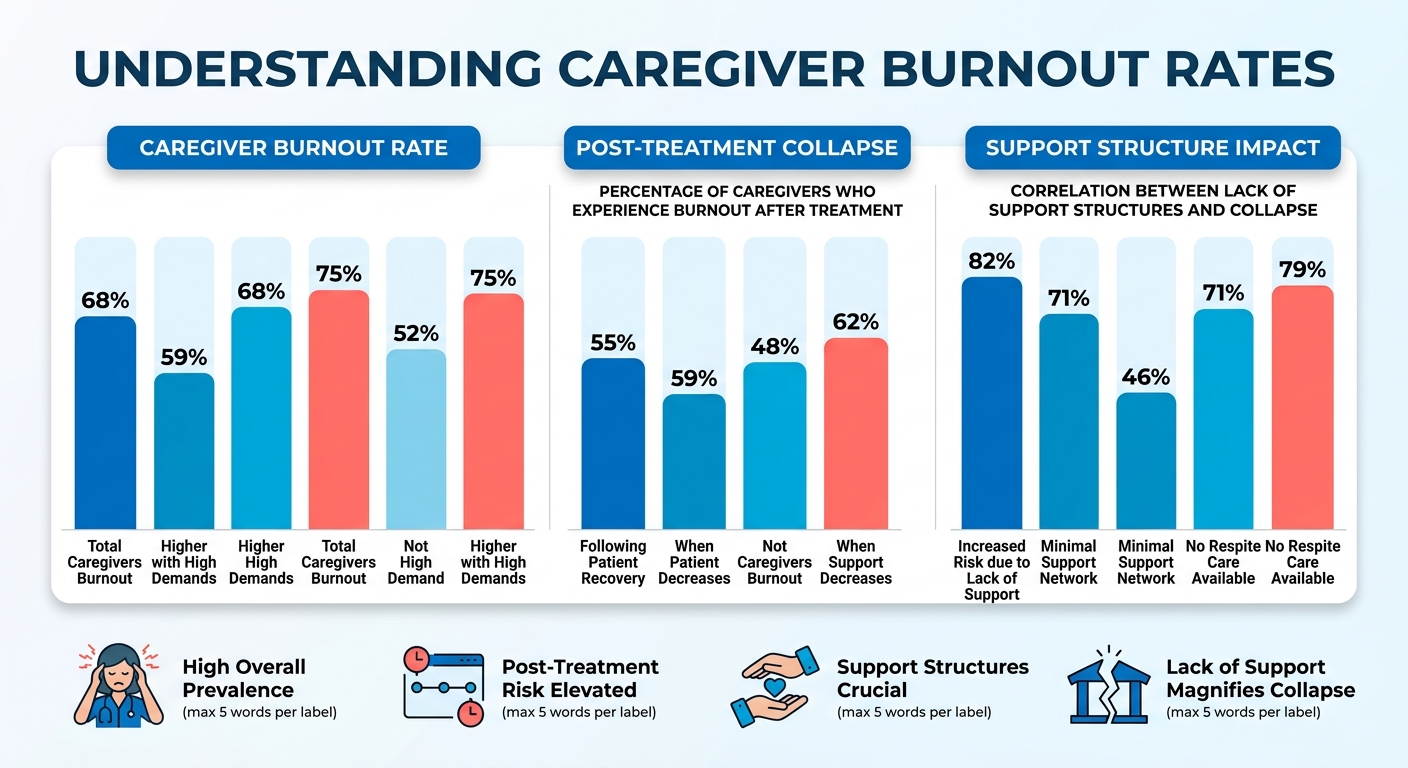
Approximately 65-70% of people relapse within three months after completing treatment. That timeframe isn't random. It maps directly to caregiver burnout cycles. When we dig into what actually happens during those three months, the pattern becomes clear: caregivers exhaust their reserves maintaining structure - meal schedules, transportation to meetings, monitoring triggers, managing household chaos - then hit a breaking point where they can no longer sustain vigilance. The structure collapses, triggers multiply, and relapse follows.
One integrative review of caregiver burden examined 1,198 studies and found caregiver burden in substance use contexts consistently rated moderate to severe. Worse than many chronic disease caregiving scenarios. The difference comes down to behavioral unpredictability and social stigma. Caring for someone with diabetes means managing blood sugar and medication. Caring for someone in early sobriety means managing emotional volatility, financial crises from past decisions, and social isolation from friends who don't understand addiction. Healthcare systems routinely screen for caregiver stress in cancer or dementia contexts but systematically overlook it in addiction recovery, leaving families to figure out support on their own.
What Caregiver Burnout Actually Looks Like in Recovery Households
The research identifies both objective burden - tangible life disruptions like missed work, depleted savings, lost social connections - and subjective burden, the emotional reaction: guilt, resentment, grief. In our work with families, we watch both forms compound. A parent covering rent for an adult child in recovery while working extra shifts to afford it experiences objective burden. The same parent lying awake at 2 AM wondering if they're enabling or supporting experiences subjective burden. Studies tracking this dual burden found stress, behavioral problems of the person in recovery, stigma, and financial crises all feed the cycle. But stigma stands out as uniquely destructive because it prevents caregivers from seeking help.
When caregivers report their experiences, they describe chronic stress and emotional exhaustion from instability caused by their loved one's substance use. They take on additional responsibilities - parenting their partner's children, managing legal fallout, covering debts - while neglecting their own health needs. The load keeps growing because recovery isn't linear. Each near-miss or setback resets the caregiver's stress response. Research confirms what families already know: when caregivers are overwhelmed, burnout negatively affects both the caregiver and the person they're supporting.
Why Healthcare Gaps Make This Worse
Clinical settings focus treatment on the individual with substance use disorder, then discharge them with aftercare instructions that assume a stable, resourced support system at home. That assumption breaks down for roughly 91 million caregivers worldwide affected by a family member's drug addiction. Yet evidence shows that improving caregivers' quality of life directly enhances treatment outcomes for the person in recovery. The implementation gap is stark: we have proof that supporting caregivers works, but clinical protocols rarely include them in aftercare planning.
This is where structured caregiver support during the first three months can prevent the collapse-relapse cycle. Transitional coaching that involves families in the recovery process can help distribute responsibilities more evenly and ensure caregivers maintain their own stability alongside the person in recovery.
Who Benefits Most from Structured Caregiver Support
Families where one person carries the entire support load face the highest risk. Often a spouse or parent. Research tracking risk factors for caregiver psychological distress identified larger family size, economic strain, and being unmarried as predictors, but the underlying pattern is resource isolation. If the caregiver has no one to share tasks with, no financial cushion for unexpected costs, and no social network that understands addiction, burnout isn't just likely. It's mechanical.
Families transitioning someone from residential treatment back home need this support most urgently. The person in recovery is relearning how to manage triggers in their actual environment; the caregiver is simultaneously learning what level of involvement helps versus enables. A structured stress-management program showed participants reported improvements in vitality and mental health alongside reductions in anxiety and caregiver burden after just nine weeks of education, stress management, and problem-solving work. Those gains aren't abstract. They translate to caregivers who can maintain structure long enough for the person in recovery to build their own.
Recognizing Caregiver Burnout
In our experience supporting families through early sobriety, we watch partners and parents cycle through the same warning signs weeks before they collapse. The 44-year-old mother who checks her daughter's breathing each morning because "I'm scared to get out of bed because I don't want to find my daughter dead" isn't overreacting. She's exhibiting the chronic hypervigilance that precedes full burnout.
Caregiver support erodes gradually, then all at once. Over 60% of caregivers report burnout symptoms, but the timeline matters more than the statistic. The operational complexity of early recovery is immense: managing medication schedules, tracking behavioral changes, and absorbing emotional volatility all fall on the household. This load isn't tied to the historical severity of the substance use. It reflects the sheer volume of clinical and logistical roles that collapse onto family members during the handoff to daily life.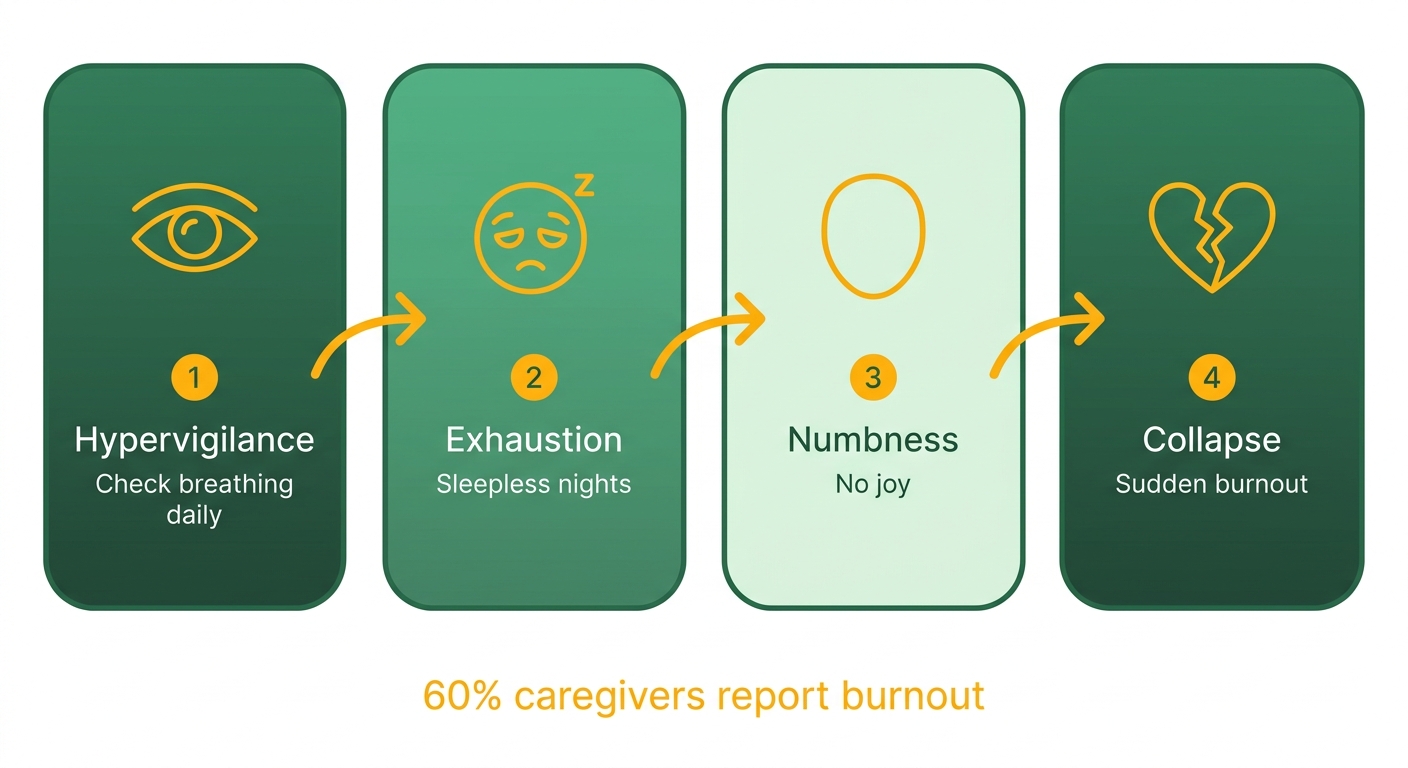
Physical Signals Before the Crash
Your body telegraphs burnout before your mind admits it. Persistent fatigue that sleep doesn't touch. Headaches that cycle through afternoons. Changes in appetite and sleep patterns that you rationalize as temporary stress. One 80-year-old spouse caregiver pushed through these signs until she required hospitalization, at which point her husband's recovery structure immediately failed.
We see caregivers dismiss physical symptoms as personal weakness. That framing is backwards. Research tracking caregivers of people with substance use disorders found they face higher rates of anxiety, depression, and chronic health problems than the general population. The body isn't failing you. It's reporting structural overload.
Emotional Exhaustion and Detachment
Compassion fatigue hits differently than gradual burnout. Where burnout accumulates over months, compassion fatigue can strike suddenly after a traumatic caregiving event - an overdose scare, a violent episode, a midnight hospital run. You feel emotionally numb where you used to feel invested. The 38-year-old sister who said "I know it sounds cold, washed my hands of him... I've lost a brother because of drugs and substance use" wasn't being cold. She was describing the relational death that happens when emotional reserves hit zero.
Recovery from compassion fatigue typically takes less time than recovery from full burnout, but only if you catch it. Many caregivers wait until crisis before seeking help, turning a manageable intervention into a systemic collapse.
When Healthcare Systems Miss the Signs
The evidence shows that supporting caregivers improves treatment outcomes for the person in recovery, yet healthcare providers routinely overlook caregiver distress in clinical encounters. A qualitative study found caregivers lamenting "there is no education...no support groups" despite widespread addiction prevalence. The disconnect isn't accidental. It's systemic neglect.
Our take: this gap between evidence and practice is where relapse risk concentrates. When caregivers burn out during early recovery, the stretch when relapse risk runs highest, the timing isn't coincidental. Caregiver collapse and client relapse move in lockstep because they're mechanically linked. You can't maintain the structure someone needs for sobriety when you're running on empty.
The Single-Caregiver Breaking Point
One person cannot provide all necessary support for a loved one in recovery. That's not opinion. It's mechanical reality. Recovery requires treatment, peer support, family support, and ongoing care. When one caregiver tries to fill all those roles, emotional depletion creates unhealthy dependency that sabotages the very sobriety you're protecting.
We see this pattern play out predictably. Caregivers move from managing discrete problems - a missed appointment, a tense conversation - to systemic crisis: grief over lost relationships, perpetual dread, financial strain, family impact mitigation. That transition point, when single-caregiver structures break, is when families who expand their support network to include professionals and peers see outcomes improve. The fix isn't working harder. It's splitting recovery roles so no single person carries the structural load.
Recognizing burnout isn't self-awareness. It's a decision that protects both you and the person depending on you. Skip the guilt. Address the mechanics.
Practical Support Strategies for Caregivers
The caregivers who make it through early sobriety intact are the ones who built support structures before they hit the wall. The spouse who joins an online group the week their partner leaves treatment doesn't collapse three months later when a setback occurs. The parent who lines up relief during the first post-treatment month doesn't end up hospitalized when the crisis escalates. Structured support prevents collapse, and collapse is what triggers relapse.
The gap between knowing you need help and actually getting it is where most caregivers fail. Waiting for the system to offer solutions is rarely effective. When we work with families transitioning from residential treatment, we start with an initial consultation to assess needs and build a tailored coaching program from there. Our services include intervention and crisis management, helping families plan detox and treatment pathways and manage the recovery process. Knowing where to turn before a crisis escalates is what keeps caregivers steady instead of drowning.
Build Your Support Network Before You Need It
Waiting until you're in crisis to seek caregiver support guarantees you'll be too depleted to follow through. Proactive planning prevents the sudden exhaustion that forces emergency interventions. We tell families to recruit their support team during the treatment phase, not after discharge. Identify two people who can cover for you during appointments, one friend who'll check in weekly without asking about your loved one, and at least one peer-support group you'll attend within the first two weeks home.
Peer groups work because they eliminate the education gap and the isolation simultaneously. A qualitative study of 21 caregivers found that those who attended groups like Al-Anon credited them for relief and understanding. One 50-year-old sister said, "When I go there and dare to start talking about what was happening in my house...they knew my pain." The group didn't judge, didn't require explanation, and didn't expect her to perform competence. That validation is what keeps caregivers showing up when everything else is falling apart.
Our approach includes connecting families to team-based aftercare structures that distribute the load across multiple people. Dividing responsibilities prevents the single-point-of-failure vulnerability that occurs when one person carries the entire emotional and logistical weight. We help families map out who handles medication check-ins, who attends therapy sessions, who manages finances, and who provides social companionship. That division prevents any single caregiver from becoming the bottleneck.
Set Boundaries That Protect Both of You
The caregivers who survive early sobriety are the ones who learned to say no. Managing a loved one's recovery requires significant time and energy, meaning caregivers must actively offload existing tasks to avoid collapse. You can't add "monitor medication compliance" and "attend weekly therapy" and "manage crisis calls" to an already full schedule without removing something. Our team works with families to identify what they'll stop doing - not reduce, stop - to create space for recovery support.
Setting boundaries isn't abandonment. It's the difference between support and enabling. When caregivers differentiate between the two, they maintain stability without reinforcing destructive patterns. We see this play out in practical terms: the partner who stops covering rent arrears but pays for therapy copays, or the spouse who refuses to lie to employers about absences but drives to every doctor's appointment. Those distinctions preserve the relationship while refusing to absorb consequences that belong to the individual in recovery.
The boundaries that matter most are the ones that protect your own health. Prioritizing personal well-being isn't selfish. It is a structural necessity for maintaining long-term support. We work with clients and the families around them to establish daily habits that reduce stress and restore balance. Protecting even one steady part of your own day helps prevent the total erosion of personal identity.
Use Respite Care to Create Sustainable Rhythms
Respite care, temporary relief from caregiving duties, isn't optional for long-term sustainability. Caregivers who use respite services reported lower stress levels and improved emotional health. The mechanism is straightforward: you cannot provide attentive care indefinitely without breaks. Our team-based coaching model builds that relief in from the start. Clients can be supported by a coordinated team rather than a single person, which distributes the load and gives primary caregivers room to breathe.
In practice, respite looks like leaning on coordinated coaching support so the primary caregiver can take a weekend trip. It looks like rotating family members through weekly dinner duty so no one person is always on call. It looks like using professional sober coaching services that taper support as independence increases, giving caregivers permission to step back without guilt.
The timing matters more than the duration. Research on family caregiving in chronic conditions shows that regular short breaks maintain caregiver health better than infrequent long ones. A predictable weekly three-hour window allows caregivers to maintain social connections, attend their own medical appointments, or simply rest without guilt. We encourage families to coordinate team-based support early, before exhaustion sets in. That early structure establishes a rhythm - work week, respite weekend, work week - that becomes the new normal rather than an emergency measure.
What Actually Sustains Caregiver Health Long-Term
We build stability during the first post-treatment month, when structure fades and real-world challenges return. Our transitional coaching emphasizes accountability and consistent care so families don't wait until a crisis escalates. Establishing proactive, structured support systems early helps the household remain resilient when the initial enthusiasm of early recovery begins to wane.
Long-term caregiver support requires four interlocking systems: education on addiction mechanics, peer support networks, professional counseling access, and scheduled respite. The transition from clinical supervision to home life represents a high-risk window where caregiver distress peaks. Addressing these needs systematically before the transition occurs prevents the sudden collapse of the home environment.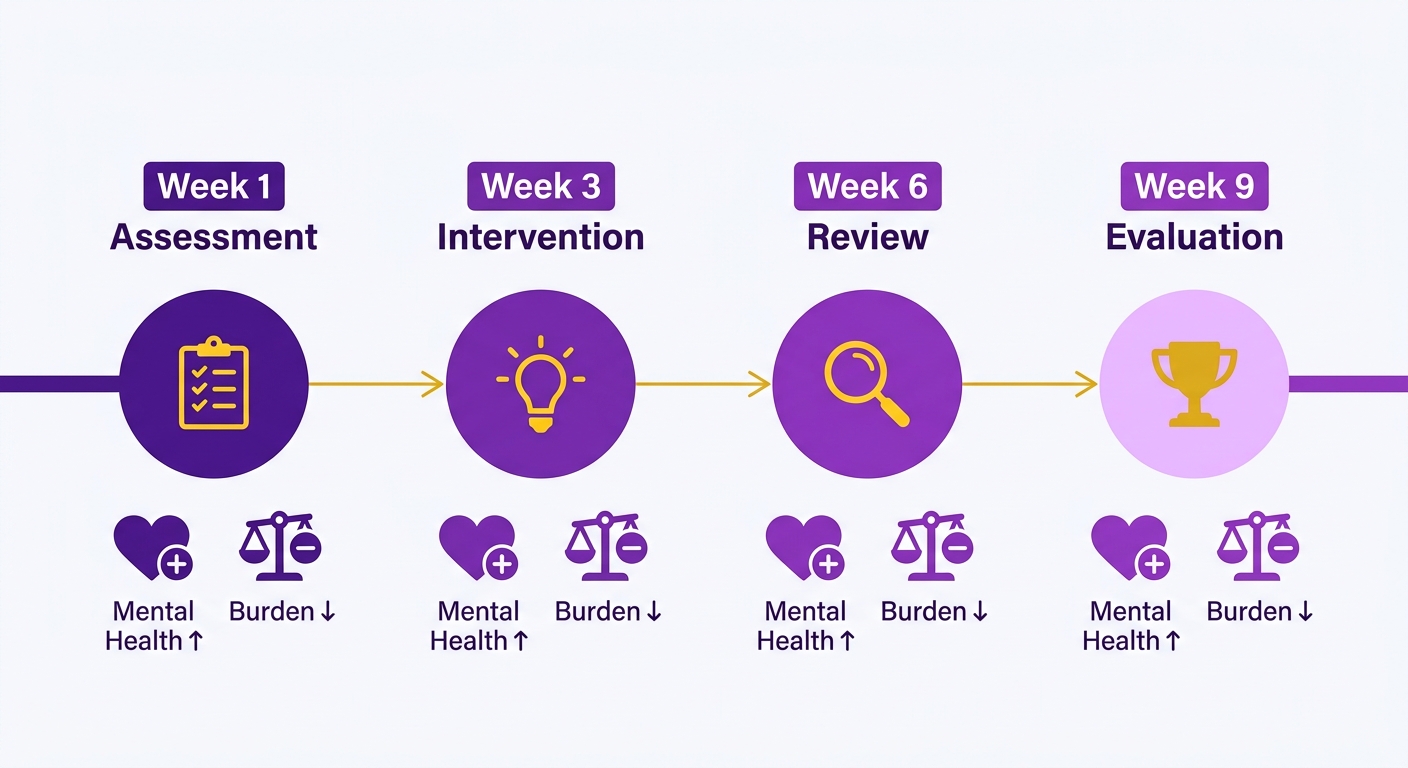
How Ongoing Education Changes Caregiver Outcomes
Caregivers who understand addiction's neurobiological basis make better decisions under pressure. When family members are educated on the physiological drivers of cravings and the cognitive impacts of early sobriety, they can distinguish between intentional defiance and clinical symptoms. This knowledge gap, when left unaddressed, turns manageable stress into chronic crisis.
Applying these educational concepts in real time helps families align their expectations with clinical realities. Understanding what recovery timelines actually look like, rather than relying on idealized hopes, allows caregivers to assist in reintegration without falling into enabling behaviors. When this guidance is integrated into daily routines early on, it functions as a preventive shield rather than emergency damage control.
Why Peer Support Networks Outlast Professional Counseling
Individual therapy schedules run in weekly or biweekly slots, but caregiver strain rarely respects a calendar. Caregivers connected to Al-Anon or similar groups tend to maintain stability longer than those relying solely on one-on-one sessions. Peer networks provide something professional counseling cannot: immediate, round-the-clock validation from a community that shares the same lived experiences, removing the need to constantly explain or justify one's struggles.
The mechanics matter. Group meetings happen weekly, creating a predictable check-in cadence. They're free, removing the financial barrier that stops caregivers from seeking help. And they normalize the experience. Caregivers learn their exhaustion isn't weakness but a predictable response to sustained strain. This shared foundation carries families through, providing a reliable safety net rather than forcing them to scramble once they're already in crisis.
When to Layer Professional Support on Top of Peer Networks
Peer groups handle most routine stress. Professional intervention becomes necessary when caregivers exhibit clinical anxiety or depression, when family dynamics include abuse, or when the caregiver has their own substance use history. A therapist trained in family systems can address what Al-Anon can't: individual trauma, relationship repair, and psychiatric referrals when needed.
The mistake is treating professional counseling as the first line of defense. Given the vast global scale of families affected by substance use, clinical systems cannot absorb every caregiver through one-on-one therapy alone. Peer support must handle most of the emotional load, while professional therapy is reserved for the subset requiring specialized clinical intervention. Trying to reverse that order quickly exhausts both family finances and clinical resources.
How Team-Based Coaching Structures Distribute Caregiver Load
Single caregivers burn out because they carry everything: daily check-ins, crisis response, household management, emotional support. Our programs offer support from a single dedicated coach or a coordinated team, depending on the level of care needed. Coaching can include coordination with nursing support, grocery shopping, meal prep, and day-to-day life management, so the primary caregiver leads without carrying every task alone.
Managing the transition back to community life demands a coordinated team effort rather than heroic individual sacrifice. That's why we build customized packages that evolve as needs change, then intentionally taper support as clients find their rhythm and gain independence. Recovery is strongest when support extends beyond one exhausted person, and the infrastructure for that distribution needs to be in place before discharge day arrives.
References
[1] Caregiver Burnout: What It Is, Symptoms & Prevention - https://my.clevelandclinic.org/health/diseases/9225-caregiver-burnout
[2] Understanding Caregiver Burnout and Compassion Fatigue - https://www.caregiveraction.org/understanding-caregiver-burnout/
[3] How to Prevent Caregiver Burnout: A Practical Guide - https://agingcarematters.com/resources/preventing-caregiver-burnout/
[4] Prevent Caregiver Burnout With These 8 Strategies - https://www.flintrehab.com/caregiver-burnout/
[5] Caregiver burnout symptoms and support - http://wellness.go365.com/medicare/articles/caregiver-burnout-symptoms-support
[6] “I can't live like that”: the experience of caregiver stress ... - PMC - https://pmc.ncbi.nlm.nih.gov/articles/PMC7809821/
[7] Caregiving in Addiction and Preventing Burnout - Recovered.org - https://recovered.org/addiction/caregiving-in-addiction
[8] Burden and Psychological Distress in Caregivers of ... - https://www.mdpi.com/2078-1547/14/2/24
[9] How to Cope With the Fear of Relapse After Rehab - https://www.banyantreatmentcenter.com/family/loved-one-in-recovery-depends-on-me/
[10] Exploring Maria and the Challenges of Addiction Caregiving - https://www.caregiveraction.org/exploring-maria-and-the-challenges-of-addiction-caregiving/
[11] Crushed by Caregiving: The Growing Burden on Families ... - https://www.researchgate.net/publication/399774289_Crushed_by_Caregiving_The_Growing_Burden_on_Families_of_Individuals_with_Substance_Use_Addiction
[12] A Stress-Busting Program for Family Caregivers - https://www.researchgate.net/publication/26652751_A_Stress-Busting_Program_for_Family_Caregivers
[13] An Integrative Review of Measuring Caregiver Burden in ... - https://pubmed.ncbi.nlm.nih.gov/32496400/
[14] (PDF) Caregiver Burden for Families of Drug Addicts - https://www.researchgate.net/publication/359867002_Caregiver_Burden_for_Families_of_Drug_Addicts_A_Comprehensive_Account
Frequently Asked Questions
1. How can I tell the difference between normal caregiving stress and actual burnout?
Normal caregiving stress is temporary and usually relieved by rest. Actual burnout is systemic depletion. It shows up as a persistent inability to recover your energy, paired with emotional detachment or numbness, often called compassion fatigue. If you feel constant hypervigilance and disconnected from your own needs, you've moved past simple fatigue into structural burnout.
2. Is setting boundaries with my loved one the same as giving up on them?
No. Setting boundaries is a protective measure that preserves the relationship. It distinguishes between supporting a loved one's growth and shielding them from the natural consequences of their actions. For instance, you might offer to drive them to support group meetings while refusing to cover legal fees from active use. This keeps you involved in their recovery without reinforcing destructive patterns that threaten sobriety.
3. Why is addiction caregiving harder than caring for someone with a chronic illness?
Addiction caregiving carries unique challenges because of behavioral unpredictability and intense social stigma. Unlike managing a structured medical condition like cardiovascular disease, which mainly involves tracking physical metrics and medication schedules, addiction recovery requires navigating emotional volatility, past financial fallout, and social isolation. The lack of public understanding often leaves caregivers without the community support networks available in other health crises.
4. What should I do first if I'm already burned out and in crisis?
If you are already in crisis, your immediate priority is triage. Stop trying to manage every detail yourself and delegate at least one urgent task to an outside party. Reach out to a local helpline, attend a peer support meeting immediately for perspective, and temporarily pause any non-essential household responsibilities. Professional recovery coaches can also step in to conduct an objective assessment and coordinate immediate relief so you can rest.
5. Why does relapse cluster around the three-month mark specifically?
The three-month mark represents a critical transition where the initial structure of formal treatment begins to fade and real-world stressors return in full force. During these first 90 days, family members often maintain an unsustainable level of vigilance to keep the household stable. When that temporary energy is exhausted, the daily scaffolding supporting the individual's sobriety can suddenly weaken, allowing environmental triggers to resurface before the individual has fully developed their own coping mechanisms.
6. Can one dedicated family member successfully handle recovery support alone?
Attempting to manage a loved one's recovery single-handedly is structurally unsustainable. Sobriety requires a multi-faceted network of clinical care, peer fellowship, and practical daily support. When a single family member tries to meet all of these needs, they inevitably face exhaustion, which can lead to an over-reliant dynamic that hinders the individual's progress. Distributing tasks among family members, friends, and professionals ensures a more resilient support system.
7. How often should I take breaks, and does duration matter?
Consistency is far more important than duration when it comes to caregiver rest. Research indicates that frequent, scheduled micro-breaks are much more effective at preventing cumulative stress than waiting months for a long vacation. Establishing a predictable weekly block of personal time allows your nervous system to reset and helps you maintain your own social and medical needs. Integrating these breaks into your routine early on prevents them from feeling like emergency measures.