Support Groups Teach *Detachment*, Not Who Books the Next Appointment
August 26, 2026
Key Takeaways
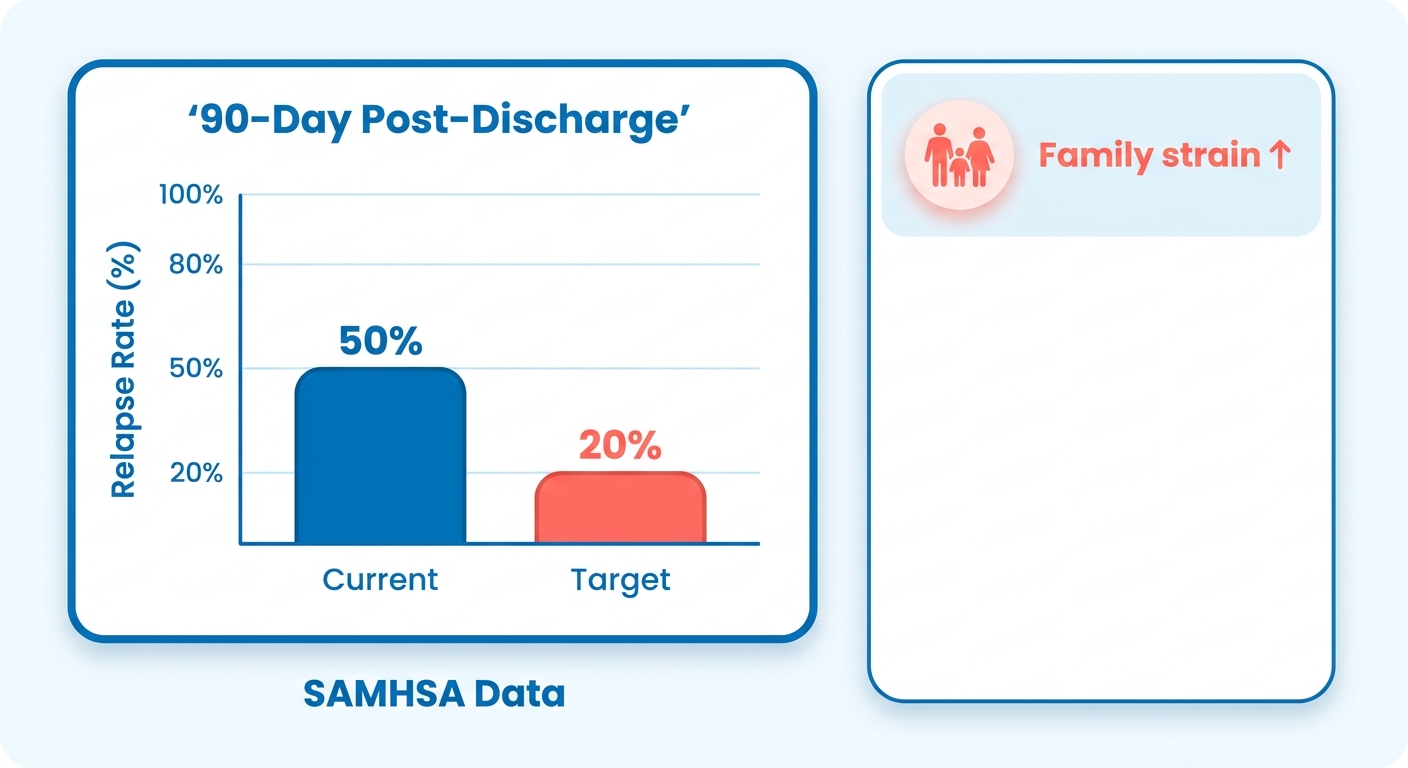
- Between 40 and 60 percent of people relapse within 90 days of leaving treatment. That window strains families.
- Detachment means emotional distance, personal responsibility, and self-advocacy. It is not abandonment.
- Good family support groups teach healthier relationships, not call schedules.
- Groups that build real detachment often produce clients who self-book coaching later.
- Al-Anon frames detachment as neither kind nor unkind. No judgment, no condemnation.
- The old family reflex of control, covering shifts, making excuses, and paying debts reinforces substance use.
- Research treats partner enabling as learned behavior that sustains drinking or drug use. Detachment reverses it.
Why detachment is the skill that holds recovery together
Detachment often decides whether recovery holds after discharge. SAMHSA data shows early recovery strains families, which is why support groups for families of drug addicts work on relationships instead of daily logistics.
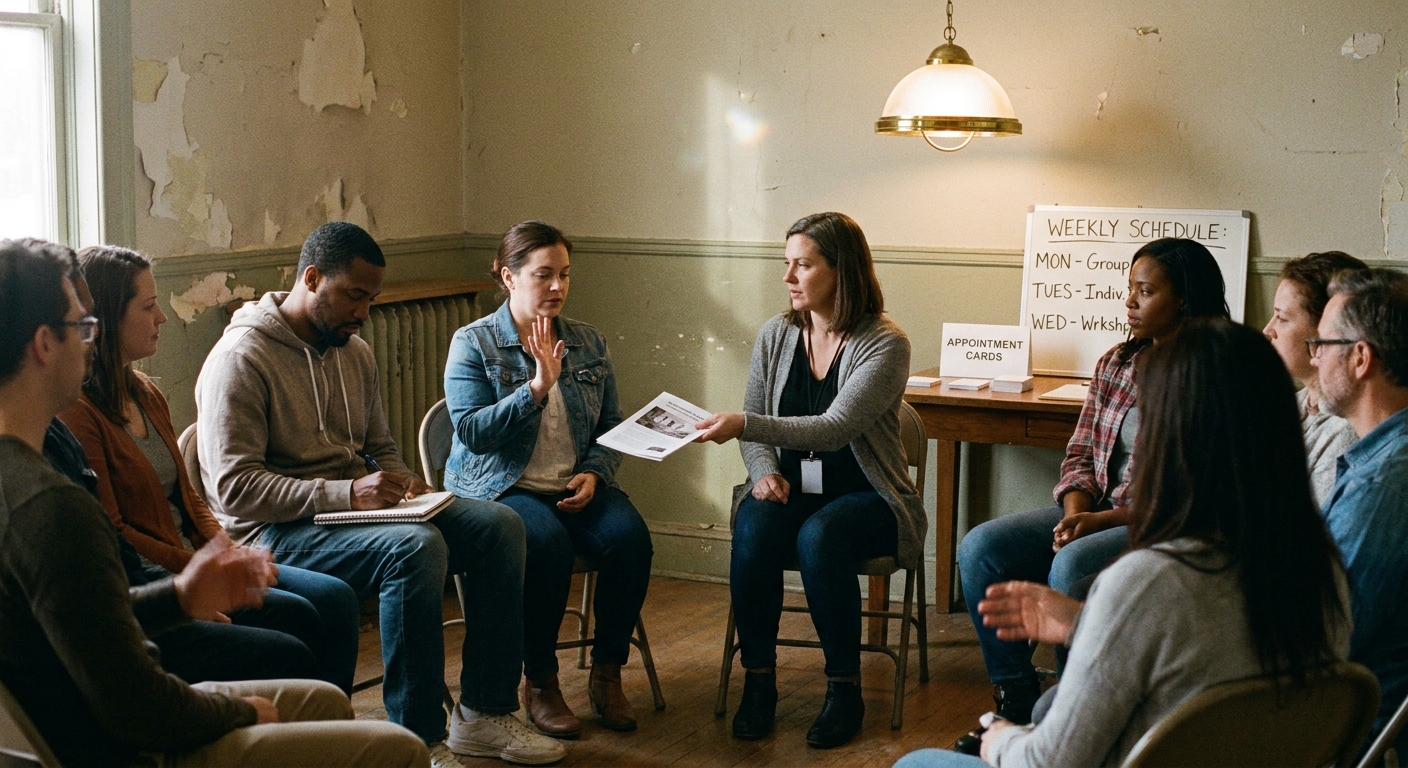
We see the split every week in aftercare. Groups that push personal accountability produce people who act on their own. Groups stuck on administrative details produce people who wait to be told what to do next.
What detachment actually means in recovery
In practice, detachment means separating your emotional state from the actions of someone in active recovery. Al-Anon literature frames it as removing judgment and condemnation from the relationship, so family members can step back without guilt.
The old reflex is control, usually shown by managing another person's responsibilities for them. Research on partner enabling treats these protective moves as a learned set of behaviors that quietly prolong the cycle. Detachment flips that. It stops family members from depending on what someone else does to feel okay.
Where the sources disagree, and how we split the difference
The sources do not agree on how much distance is right. Hazelden Betty Ford argues detaching with love should now mean staying connected with clear boundaries. A counseling-recovery piece argues it means letting the addict face consequences and physically leaving unsafe situations.
Our read: detachment sits on a spectrum, and risk sets the dial. No danger? Stay connected and coach engagement. Violence or active crisis? Distance is the boundary. Skilled involvement and enabling are not the same thing, and teaching people to tell them apart is much of the job.
Why the first self-booked appointment is the real milestone
The clearest sign detachment has landed is behavioral. A client stops asking "who books my appointments" and books their own. Co-dependency runs on impaired autonomy and an undeveloped self, so a client who self-initiates support is redirecting caretaking energy back to recovery.
We treat that as a meaningful proxy for autonomy, one that abstract "detachment scores" miss. It mirrors how our coaching tapers on purpose: support drops gradually as clients find their rhythm. Al-Anon holds the largest knowledge base on affected family members for a reason. Mutual-help builds coping skills, then people carry them out the door.
Here's a compact roadmap for piloting a detachment-focused group.
| Step | Goal | Time Investment | Difficulty (1-5) | Key Resources |
|---|---|---|---|---|
| 1. Set boundaries | Stop enabling behaviors | Week 1-2 | 2 | Al-Anon materials |
| 2. Teach the spectrum | Match distance to risk | Week 2-3 | 3 | Facilitator guide |
| 3. Model self-advocacy | Shift from gatekeeper reliance | Week 3-4 | 3 | Peer facilitators |
| 4. Practice self-booking | Client schedules own coaching | Week 4-5 | 4 | Booking system |
| 5. Track adherence | Confirm autonomy holds | Week 5-6 | 4 | Attendance log |
Total launch time: 4 to 6 weeks. Primary outcomes: more member self-reliance, less facilitator burnout, since the group stops being the single gatekeeper.
Families usually show up first. They often seek help before the person in active addiction does. Our transitional coaching helps families plan detox and treatment pathways, then supports clients as they reintegrate.
Building a group that's designed to graduate people
A detachment-focused group is built backward from its exit. The goal is not a full room every week. It is members who eventually leave the group entirely. With support groups for families of drug addicts, leaning too hard on the group can recreate the enmeshment that blocks recovery.
That reframe changes every logistical choice below. If the group's job is to teach a self-care skill, success looks like graduation. Research on mutual-help groups shows peer-led environments work by setting new coping norms, not by managing logistics. Our coaching runs on the same mechanism, building a clear path toward self-sufficiency.
Who belongs in the room
Target three profiles: recent detox graduates, family members, and peer mentors. Mixing them is deliberate. Relatives of people facing addiction often carry serious psychological distress, which is why they tend to reach for support early.
Peer mentors anchor the room. They model what letting go actually looks like. A family member watching someone six months ahead stop making excuses learns faster than from any handout.
Keep groups to 8-12 people. Smaller than that stalls. Larger dilutes the mentoring.
The leadership model that teaches detachment
Rotate co-facilitators. A single fixed leader trains the room to wait for permission, which is the exact pattern we want to dissolve. Two rotating facilitators, ideally one clinician and one peer, model shared responsibility instead of hierarchy. Peer-leadership circles push it further. Members take turns opening the reflection segment. The message lands without a lecture: you're already capable of leading yourself.
How a 90-minute session runs
Build every session on three pillars: reflection, skill practice, and autonomous planning. Roughly 30 minutes each.
- Reflection (0-30): Members name where they tried to control instead of care. The Al-Anon line anchors it: "You didn't cause it, you can't control it, and you can't cure it."
- Skill practice (30-60): Rehearse a boundary. Practice letting someone face a consequence without rescuing.
- Autonomous planning (60-90): Members fill out a Self-Scheduling Worksheet and update a Daily Routine Tracker. This is where the group hands the pen back, reinforcing self-directed scheduling.
Through all of it, facilitators help members read the safety of the home. Stable environment? Keep connection with clear limits. Safety compromised? Physical distance becomes necessary. Support adapts to the immediate risk while still pushing gradual independence.
Hybrid, budget, and return
Run it hybrid. In-person builds peer bonds. A virtual option keeps access open and quietly hands members responsibility for showing up.
Budget stays lean. Two facilitators, a room or a video license, and printed worksheets put cost per participant in the low tens of dollars per session. Funding often comes from treatment-center partnerships or sliding-scale contributions.
Measure return by graduations, not attendance. A member moving to independent recovery planning is the whole point of the model.
Facilitating detachment: tools, techniques, and how you ask the questions
The fastest way to teach detachment in a meeting is to change the grammar of the questions. When a member asks about managing someone else's schedule, redirect to the member's own boundaries. That shift moves the room from external management to personal agency.
Every tactic below is built around self-initiated action. Because codependency often involves enmeshment and blurred boundaries, taking charge of your own scheduling works as a practical sign of recovery that standard assessments tend to miss.
Conversation starters that shift "who does X?" to "how can I do X?"
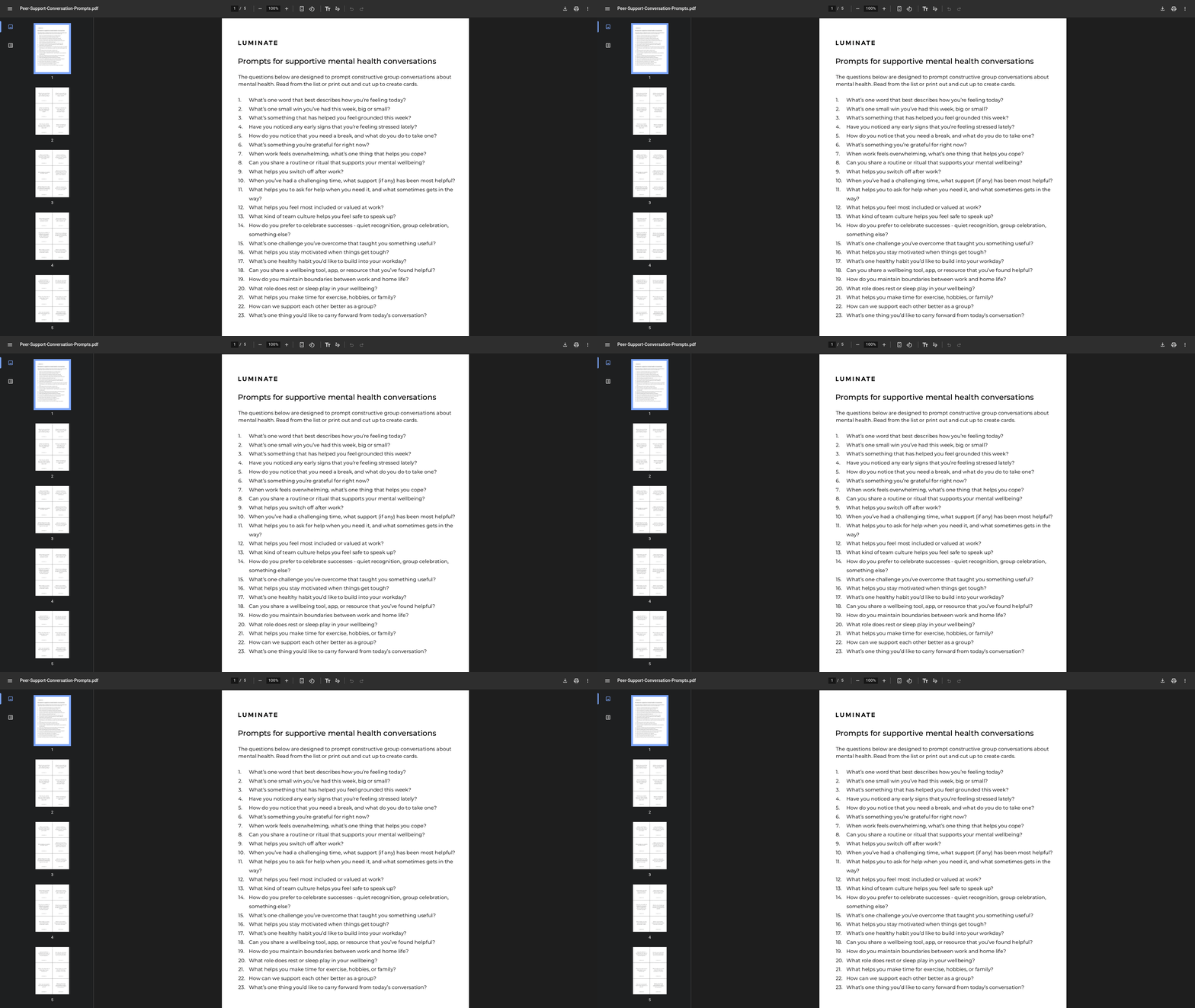
Swap ownership language for self-directed language. The prompts we rotate: "What's one thing here you can control?" and "If no one else acted, what would you do first?" These pull participants off the habit of waiting on someone else's move.
We also name enabling directly. Research indicates enabling is a set of learned patterns, and learned patterns can be unlearned. Replace them with self-focused actions, and family members start pointing their energy at their own growth.
How the role-plays build autonomy
Two exercises do the heavy lifting. The Appointment-Planning Role-Play has members practice working scheduling systems on their own, so they can manage a calendar without a family member doing it for them. The Boundary-Setting Scenarios rehearse saying no to the requests that used to trigger caretaking.
We watch for early codependency signals in session, like one member handling every logistical task for the group. That over-reliance replicates the dynamic we're trying to undo. A team-based coaching approach spreads responsibility out, keeping the focus on individual accountability instead of letting one person carry the whole group's logistics.
The point is simple: stop routing decisions through the group, start acting independently.
When to preserve connection instead of stepping back
Where you stand on the detachment spectrum depends on risk. Stable home? Keep connection with firm boundaries. Any threat of physical or emotional harm? Stepping back completely is the necessary call.
For members clinging to dependency, rotating group responsibilities and keeping a transparent decision log stops any one person from becoming the fixer. Facilitators have to watch this in themselves too. Handling scheduling for members reinforces the dependency the group is trying to dismantle. Encouraging self-management does the opposite.
Measuring success and scaling without breaking the model
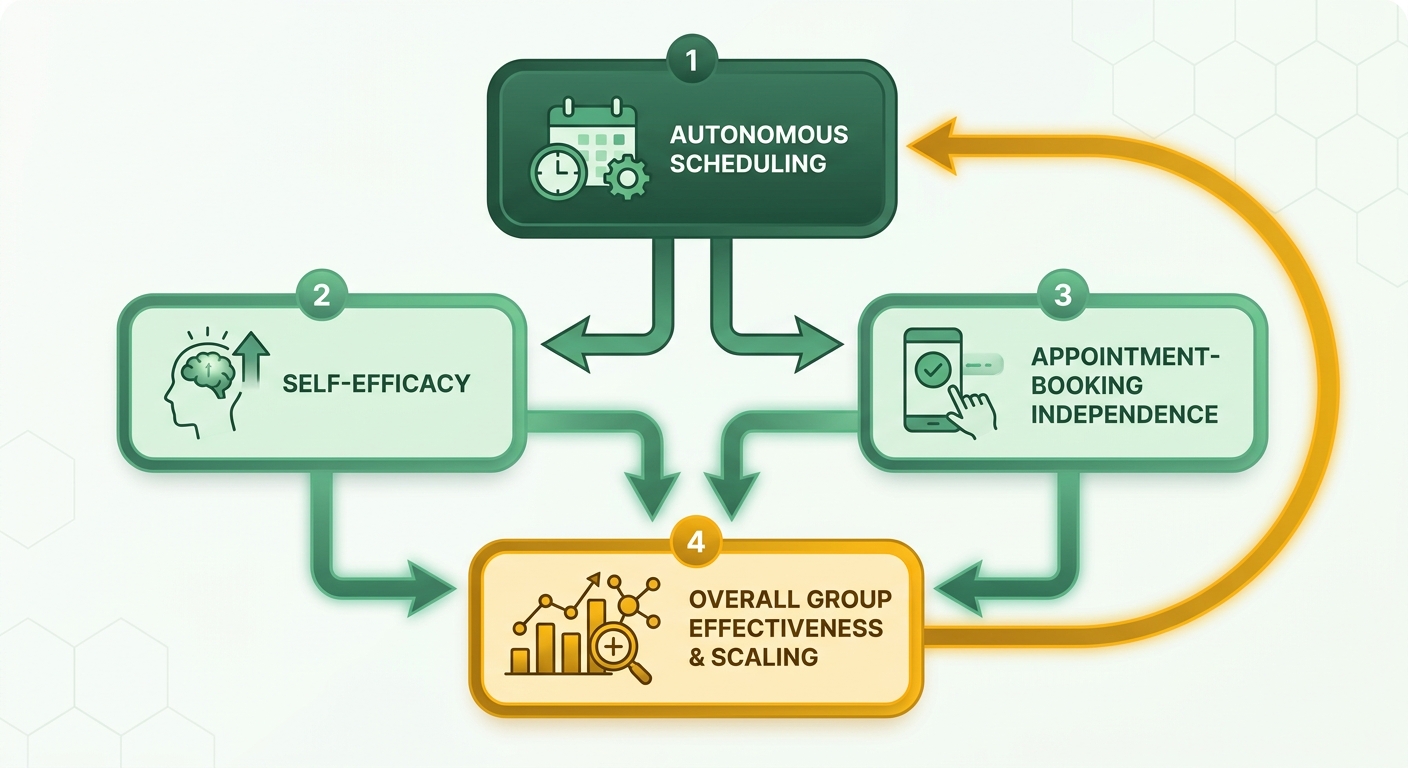
The single metric that matters most in a detachment-focused group is autonomous scheduling: how often members arrange their own follow-up sessions. Track it and you can tell whether the group is building independence or turning into a new crutch.
For families managing a loved one's recovery, a few signs point to progress. Rising self-efficacy. Less administrative reliance. More stability at home. And a gradual drop in attendance, which usually signals graduation, not disengagement.
Collecting the data without adding overhead
Keep collection light or facilitators will quietly stop doing it. Simple inputs work best: a brief check-in at the start and again later on, a look at who's scheduling unprompted, and short notes on who initiated each request.
Tracking those self-initiated actions gives you concrete evidence of personal agency. Paying attention to who takes the lead on scheduling turns an abstract idea like detachment into something you can actually count.
That reflects a core principle of recovery coaching: as people build capacity, external support pulls back to make room for self-reliance. If members increasingly lead on their own schedules, the facilitation is working. If it stalls, the structure may still be enabling passive behavior.
What happens when you scale
Scaling works when independence rises faster than headcount. When a self-booking milestone keeps members engaged on their own terms instead of the facilitator's, growth stays sustainable. MADE's team-based model fits this: clients can work with a single coach or a coordinated team depending on the level of care needed, so support flexes with demand.
Here's the cost-benefit that convinces stakeholders. As members take over their own scheduling, facilitator hours per client drop. Programs serve more families with the same staff while client independence goes up.
Close the loop every cohort. Review how members are progressing, find where autonomous booking stalls, and rewrite those specific sessions. The group that measures graduation gets better at producing it.
References
[1] Detaching with Love Updated for Families - https://www.hazeldenbettyford.org/articles/detachment-with-love-gains-new-meaning
[2] Detachment for Surviving Addiction - https://www.counselingrecovery.com/blog-san-jose/detachment
[3] Healthy Detachment | Caring Without Losing Yourself - https://www.bhavatherapygroup.com/blog/healthy-detachment-caring-without-losing-yourself/
[4] The Importance of Detachment - https://www.marrinc.org/blog/importance-detachment/
[5] Detachment From a Family Member With Alcoholism - https://www.verywellmind.com/understanding-detachment-63295
[6] Co-dependency and Enmeshment — a Fusion of Concepts - https://www.researchgate.net/publication/359882300_Co-dependency_and_Enmeshment_-_a_Fusion_of_Concepts
[7] (PDF) Mutual-Help Groups for Affected Others - https://www.researchgate.net/publication/391482617_Mutual-Help_Groups_for_Affected_Others
[8] Partner Enabling of Substance Use Disorders - https://www.researchgate.net/publication/247510280_Partner_Enabling_of_Substance_Use_Disorders_Critical_Review_and_Future_Directions
Frequently Asked Questions
1. Is detachment the same as giving up on my loved one?
Detachment is not abandonment. It shifts focus from controlling choices to managing your reactions and well-being. By stepping back, you let them face natural consequences, which is often necessary for recovery.
2. How do I know when to stay connected versus physically step away?
The decision to keep connection or create distance depends on safety. If there is no immediate threat of harm, you can stay engaged while maintaining firm boundaries. If the situation becomes volatile or unsafe, physical separation is necessary to protect your well-being.
3. Why do families often seek help before the person using does?
Family members often feel the disruptive effects of addiction first-hand, which drives them to seek coping strategies early. Support groups help them address stress and learn healthier communication, creating support before their loved one enters formal treatment.
4. What group size works best for teaching detachment?
An optimal group size balances active participation with individual attention. A mid-sized group gives enough voices to share experiences without overwhelming the session, so newer members can learn from those further along.
5. Why rotate facilitators instead of having one consistent group leader?
Rotating facilitators prevents the group from relying on one authority figure for direction. By sharing leadership among clinicians and peers, the group models accountability and encourages members to own their recovery process.
6. What's the risk of staying in a support group too long?
Remaining in a support group indefinitely can create new dependency, where members rely on the group dynamic rather than using coping skills in daily life. The goal is to equip participants with tools to navigate relationships independently outside the meeting room.
7. How can a group measure success without adding paperwork?
Success can be measured by behavioral shifts, such as members taking the initiative to manage follow-up care. By noting who coordinates next steps on their own, facilitators can track progress without lengthy surveys or administrative overhead.