Sober Coaches Work Outside the Clinic Room Where Relapse Triggers Actually Live
October 2, 2026

In short: Most people who relapse do it in the first three months after discharge—at home, in the car, at work events, not in therapy offices. Warning signs often appear weeks before relapse: poor sleep, skipped meals, and dropping out of contact. By then, someone is already sliding. Sober coaching fills the gap between discharge and standing alone in your kitchen at 9 PM. It is not about learning new recovery concepts—you got those in treatment. It is about having someone show up when your plan starts to fall apart.
Why Sober Coaching Outside the Clinic Matters
Relapse risk spikes after leaving structured care. The problem is not insight. You know what you are supposed to do. The problem is returning to the environment where using became normal: your apartment, your commute, your friend group, the corner store where you used to stop.
A sober coach works in that gap. They meet you where triggers actually live instead of waiting for a weekly appointment.
Clients leave residential treatment with solid discharge plans. They attend their first outpatient sessions. Then Wednesday night hits, and the plan starts to crack. The kitchen where they used to drink. The drive that always ended at the bar. The group text about Friday. Real-world support reaches into those moments.
Where Relapse Actually Happens
Relapse follows routine. It shows up where old habits, stress, access, and privacy overlap. Not always in dramatic moments. Sometimes it is walking past the liquor aisle, sitting in the same car after work, or hearing the same argument that used to end in using.
MADE Recovery matches coaches to clients based on where specific risks show up. Someone returning to a high-pressure sales job needs different support than someone managing family dynamics at home. The coach is not teaching new recovery ideas. They are keeping structure in place until daily routines stop requiring active willpower.
The Accountability Gap Clinic Models Can't Fill
Outpatient care runs on fixed intervals—once a week, maybe twice. But relapse often starts before conscious cravings. Sleep slips. Meals get inconsistent. Contact with sober peers drops off. These patterns build vulnerability before you are actively thinking about using.
Clinic appointments catch these changes later. A coach working in your daily life catches them while they are forming. Clients reach out during high-risk moments—late at night, staring down a trigger, needing someone to walk them through the next ten minutes. That is not therapy. It is real-time accountability when it matters.
Early recovery fails on execution, not knowledge. You know you should go to meetings, set boundaries with old using friends, and practice stress management. Knowing and doing are separate projects. Coaches close that gap by showing up during vulnerable hours—evenings, weekends, travel days—when decision fatigue is high and support systems are thin.
Who Benefits Most From Outside-the-Clinic Support
Not everyone needs this. Many people build solid recovery with therapy, meetings, and consistent routines. Sober coaching becomes useful during specific high-risk windows that clinic care cannot cover.
Newly discharged patients face the sharpest shift. Leaving structured treatment feels liberating and destabilizing at the same time. Even with good clinical care and a strong aftercare plan, that transition window is vulnerable. Coaches help maintain momentum while you build a support system that does not require constant supervision.
People returning to high-pressure lifestyles need accountability where the pressure actually hits. Demanding careers, frequent alcohol exposure, travel-heavy schedules. You cannot rehearse these situations in a therapy office. A coach helps you manage them as they happen.
Families often need guidance that goes beyond the patient's individual therapy. MADE Recovery coordinates with treatment teams when appropriate, helps families communicate during transitions, and provides updates that keep everyone aligned. Accountability reporting helps loved ones support recovery without turning every conversation into surveillance.
The most effective intervention happens when clients think they need it least—when self-care is slipping but cravings have not started, when routines are loosening but relapse feels distant. That is where outside-the-clinic support prevents crises instead of responding to them.
The Role of Sober Coaches in Everyday Settings
We work in the places your discharge plan lists but cannot control: your apartment after dark, the grocery aisle where old purchases happened, the family dinner where everyone else is drinking. A sober coach bridges the gap between what you learned in treatment and what you face when you are alone with the triggers that matter.
Clinical planning gives you the map. Coaching helps you follow it when your body, mood, social pressure, or environment pushes the other direction. We see clients who can explain their relapse prevention plan perfectly but freeze when a craving hits during the commute. That is where coaching happens—in the moment, in the setting, before the decision becomes a relapse.
In-Home Support During the Transition
Home is where early recovery gets personal. We provide sober companionship at home during the stretches between appointments when you are rebuilding routines from scratch. Coaches help you build structure around sleep, meals, and movement—not by lecturing, but by being there while you practice the plan.
One family noted their son managed a move to a new city and school because coaching was present during the actual transition, not just available by phone. The difference is witnessing the moment someone reaches for a coping skill versus hearing about it later. In-home companionship means we are there when you are restocking the fridge without alcohol for the first time, or figuring out what to do with the free time you used to fill with using.
Some clients need full-day support at first. Others schedule check-ins for specific vulnerable windows. We match intensity to your risk profile and adjust as you gain stability. The goal is scaffolding that holds until your own routines become automatic.
Community-Based Coaching in Social Settings
Your social circle does not pause for your recovery timeline. We accompany clients to events where alcohol is present, helping you practice refusal skills while the pressure is real. We provide companionship at social events, helping you manage the moments that challenge sobriety in real time.
Grocery shopping, coffee with a friend, dinner with family—these are the settings where isolation breaks or recovery gains traction. We help normalize the awkwardness of explaining why you are not drinking. We help you figure out which relationships need boundaries and which can grow.
Family dynamics often derail early sobriety. We facilitate conversations between clients and loved ones, clarifying expectations and teaching family members how their support helps versus harms. When a parent does not understand why their child cannot "just have one," we are there to translate recovery language into terms that make sense to everyone at the table.
Travel Support and Practical Coordination
Travel concentrates triggers: disrupted sleep, unfamiliar places, airports, hotels, business dinners, limited access to usual supports. We provide sober travel companionship for individuals who need support during trips that could challenge sobriety—whether that means getting to treatment, returning home, or traveling for work or family obligations.
We can travel to meet you within the United States or internationally and accompany you throughout your journey, with practical support and accountability along the way. For clients who need it, we coordinate the trip and help plan next steps, keeping safety as the priority.
The best outcomes come from layered support, not maximum intervention. We coordinate with your treatment team, keeping everyone aligned on your progress and risk factors. The right level of support keeps you stable and moving forward—not dependent, but not falling back into the patterns that brought you to treatment.
Designing a Personalized Outside-the-Clinic Coaching Plan
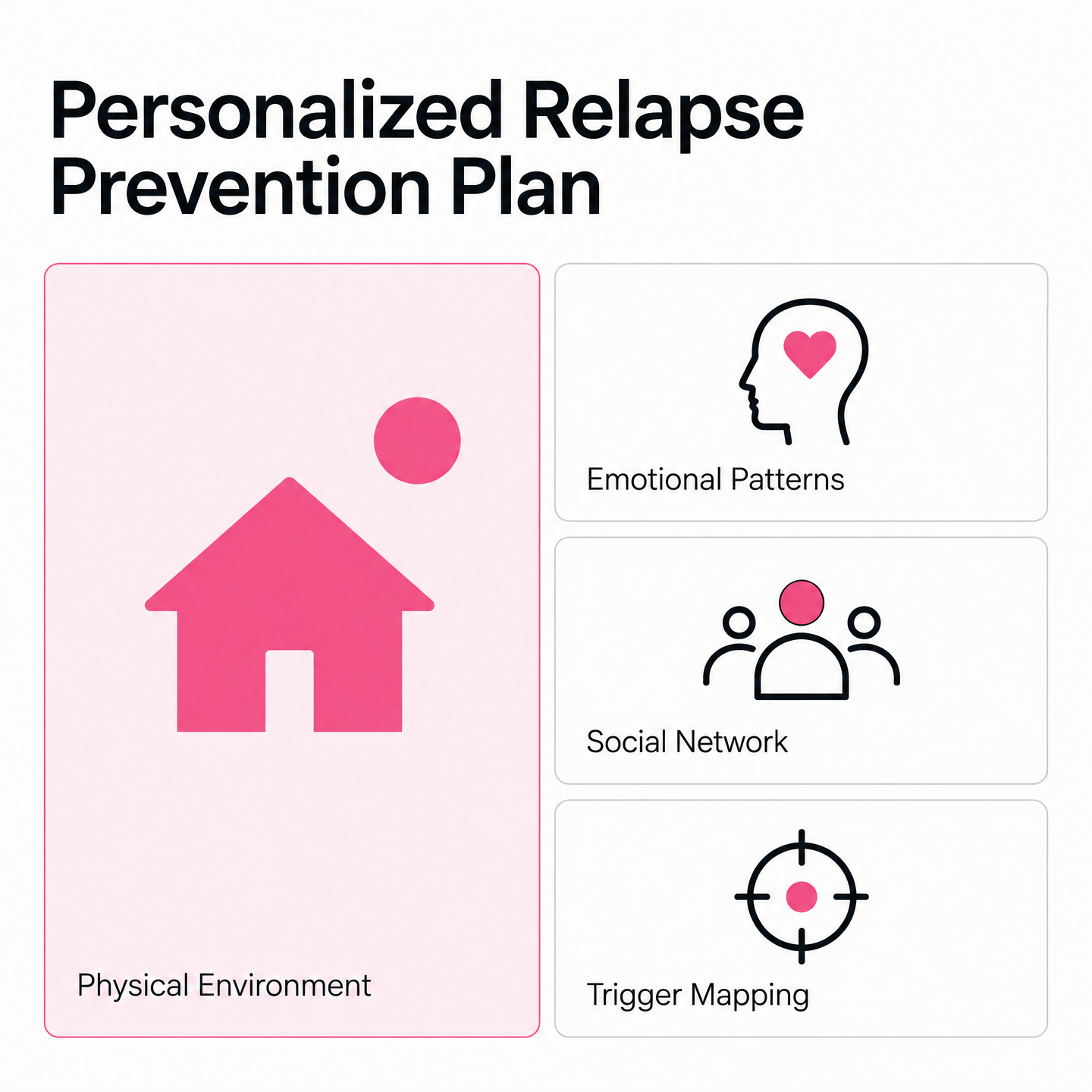
We start every coaching plan by mapping your specific relapse risks. Not a generic checklist. A detailed picture of when, where, and with whom triggers are most likely to show up. We look at your physical environment, emotional patterns, and social network: who still uses, who supports sobriety, who falls somewhere in between. This is the difference between a plan that sounds good in a counselor's office and one that works when you are alone in the kitchen and your old routine starts calling.
From that initial consultation, we build specific, measurable goals that target your highest-risk windows. Recovery coaching emphasizes building new routines around the hours when structure falls apart—evenings, weekends, travel days. If your discharge plan says "attend meetings," our coaching plan gets concrete: which meeting, what time, who you contact before and after, what you do if the plan gets disrupted. Action tied to your actual triggers, not abstract recovery principles you already learned.
Check-In Frequency Follows Trigger Intensity
The right check-in cadence scales to how often you encounter high-risk situations. Someone transitioning back to a demanding career with frequent work dinners may need a tighter early schedule, then reduced contact as routines stabilize. Someone living alone, where isolation is the primary trigger, may benefit more from in-person visits during vulnerable evening hours. We offer both virtual and in-person coaching, depending on when and where your relapse risk is highest.
We adjust frequency based on what is working. If you are hitting your daily structure goals and cravings are manageable, we pull back. If you are struggling or reporting increased intrusive thoughts about using, we increase contact and tighten accountability. The goal is not maximum supervision. It is the minimum level of support that keeps you stable while you build independent routines.
Integrating Nutrition and Sleep as Relapse Prevention
Poor self-care is one of the earliest warning signs. Skipping meals, irregular sleep, neglecting movement—these create the restless, irritable state that makes cravings harder to manage later. Our coaching includes guidance on healthy eating habits that support physical healing, emotional balance, and daily energy. We help you establish routines that reduce stress, restore balance, and build resilience. Not wellness trends. Scaffolding that keeps recovery from becoming fragile.
We work with you to identify the tracking approach that fits your life—journal, text updates, regular conversations. The tool matters less than the pattern it reveals. When sleep, meals, or routine start slipping, we address it early instead of waiting for a crisis.
Building Accountability That Actually Works
Accountability in a coaching plan is not surveillance. It is pre-agreed friction points that slow down impulsive decisions. Texting your coach before entering a bar for a work event. Calling your designated contact before visiting a friend who still drinks. Scheduling a virtual check-in before a known high-stress trigger. Some clients include a family member in the communication plan when that support is appropriate.
The key is making accountability automatic, not optional. We work with you to create protocols that put space between impulse and action, giving you time to use the relapse prevention skills you already know.
Team-Based vs. One-on-One Coaching Models
We structure sober coach support two ways: one coach who becomes your consistent guide, or a coordinated team that covers different environments and time windows. Both work. What matters is matching the structure to where your relapse risk actually lives.
When a Team Model Covers More Ground
A single coach cannot be present overnight, at your office midday, and at your family dinner that evening. Team-based coaching solves this by assigning multiple professionals who hand off coverage across shifts. One coach might handle weekday mornings and work transitions, another covers evenings and weekends, a third steps in for travel or high-stress events.
Coordination matters. When coaches stay aligned on your plan, the handoff is invisible to you, but the continuity is real. If you struggled at a work event Tuesday, the coach covering Thursday evening can revisit that trigger before the next similar situation.
Families can receive updates in team models, which shifts monitoring from surveillance into shared support. When your parents or spouse get information tied to coach observations rather than raw data, they move from anxious watchdogs to calibrated partners who understand what is actually happening in your week.
When One Coach Builds Deeper Trust
The trade-off with a team is that you are building rapport with multiple people instead of one. For some clients, that dilutes the relationship that makes accountability work. A one-on-one coach learns the specific cadence of your emotional patterns: the tone of voice when you are about to isolate, the way you rationalize skipping a meeting, the small changes that usually mean stress is building.
Early recovery fails on follow-through, not knowledge. A single coach who has watched you manage many difficult evenings knows which coping skills you will actually use versus which ones you abandon under stress. That depth is harder to replicate across a team, especially when triggers are subtle and build gradually.
One-on-one coaching works best when your highest-risk windows cluster in predictable patterns: late evenings at home, specific workdays, recurring social situations. If your danger zones are scattered—early mornings, midday work stress, late-night friend groups, weekend travel—a team that can physically show up in those different environments becomes necessary.
Choosing Between the Two
We guide clients through this by mapping their trigger profile first. If you are returning to a high-pressure career with unpredictable hours and frequent travel, team coverage provides structure where a single coach cannot be. If your relapse risk centers on specific times and places—evenings alone at home, Sunday afternoons when boredom hits—a one-on-one relationship often delivers better results because the coach becomes fluent in your exact patterns.
Budget and scheduling matter too. Team models typically cost more because you are paying for coordinated professional coverage, but they also reduce the risk of losing all support if one coach becomes unavailable. One-on-one coaching requires less coordination overhead but assumes your coach can reliably cover your highest-risk hours.
After multiple relapses, you need more support layers, not more self-criticism. If you have been through treatment before and relapse happened during a specific transition—leaving detox, returning to work, moving cities—a team that covers those exact environments prevents the same gap from opening again. If relapse came from a breakdown in daily accountability rather than environmental triggers, a one-on-one coach with consistent check-ins may provide the structure you actually need.
Practical Tools Coaches Use Outside the Clinic
We rely on a small set of practical tools to keep clients accountable when cravings hit outside scheduled sessions. The gap between "I know what to do" and "I am doing it right now" is where many relapses happen. The tools we use close that gap in real time.
Secure Communication for Crisis Moments
When a client texts because they are standing in a parking lot fighting the urge to use, the platform does not matter as much as speed and privacy. We use secure messaging because it delivers messages quickly and keeps communication protected. Video check-ins happen when a client needs to see a face, not just read a text. Research on relapse prevention shows how isolation and neglected self-care intensify risk, so our job is to interrupt that spiral before it gathers momentum.
We respond as quickly as possible during high-risk moments. That immediacy matters because cravings are temporary. If we can help someone get through the acute moment, the crisis often becomes manageable.
Crisis-Response Scripts That Work in Real Environments
We help clients develop quick-action strategies they can use without needing to think through complex decision trees. One is urge surfing, a technique from mindfulness-based relapse prevention where clients observe the craving as a physical sensation—tightness in the chest, restlessness in the legs—and let it rise and fall without acting on it. Another is the 5-4-3-2-1 grounding exercise: name five things you see, four you can touch, three you hear, two you smell, one you taste. Basic, but it works because it forces your brain to focus on sensory input instead of the craving narrative.
The goal is not to eliminate every urge. Occasional brief thoughts about using are normal in early recovery. The goal is to have clear strategies that prevent one thought from turning into a relapse.
Habit-Tracking Tools That Surface Patterns Before Relapse Starts
Daily behavior tracking—sleep quality, meal timing, meeting attendance, exercise, mood—can reveal patterns clients do not see themselves. If someone's sleep schedule starts sliding or they stop attending meetings, we step in before the pattern becomes harder to reverse. Those small changes are often the first visible signal that recovery needs more structure.
Tracking itself creates accountability. Knowing someone will check in on the small daily choices helps clients stay honest about behaviors that add up to relapse risk.
Digital Tools and Their Limits
Apps help, but they do not replace human contact. Real-world support matters more than session count, especially for younger clients who often plateau with structured content alone. Digital tools extend support into moments when we are not physically present, but they work best paired with regular check-ins.
Skip the gamified sobriety apps that reward streaks and badges unless that style genuinely motivates you. For most clients, pressure to maintain a "perfect" streak creates anxiety that backfires during a slip. We focus on tools that track process goals—did you go to your meeting, did you call someone today—rather than outcome goals, because process goals are actionable and less punishing after a setback.
Measuring Progress and Adjusting Support Over Time
Progress in sober coaching is measured by daily follow-through, not by whether life becomes trigger-free. The question is whether you are responding to risk differently than before: reaching out sooner, leaving high-pressure settings earlier, maintaining structure when stress rises, using support before a craving becomes a decision.
We review what is working and what is not. If in-person evening support stabilized the first phase, we may shift to fewer check-ins and more independent accountability. If travel, work stress, or family conflict reintroduces risk, we adjust the plan rather than treating the setback as failure. Coaching is meant to be responsive because recovery outside the clinic is not static.
What You Can Do This Week
If you are newly discharged or feeling unstable, start by mapping your highest-risk windows. When are you most vulnerable—evenings alone, work stress, social events, travel? Write it down. Then decide if your current support structure actually covers those hours. If it does not, that is the gap sober coaching fills.
MADE Recovery uses support as scaffolding: strong enough to protect the vulnerable transition, flexible enough to adapt to real life, temporary enough to help you build confidence in your own routines. As stability grows, the coach steps back and your recovery structure takes the lead.
References
[1] Sober Coaching: How It Works, Key Benefits,… - Caron Treatment Centers - https://www.caron.org/addiction-101/treatment-advice/sober-coaching
[2] Sober and Recovery Coaching and Monitoring - Hazelden Betty Ford - https://www.hazeldenbettyford.org/relapse-prevention/connection-recovery-coaching
[3] What Is a Sober Coach? | Benefits, Costs, and How to Choose One - https://futuresrecoveryhealthcare.com/alcoholism/what-is-a-sober-coach/
[4] What is the Role of Sober Coaches in Addiction Recovery? - Carrara - https://carraratreatment.com/what-is-a-sober-coach/
[5] Relapse Prevention and the Five Rules of Recovery - PMC - NIH - https://pmc.ncbi.nlm.nih.gov/articles/PMC4553654/
[6] Peer Recovery Support Services and Recovery Coaching for Substance ... - https://pmc.ncbi.nlm.nih.gov/articles/PMC12811009/
[7] Relapse Prevention (RP) (MBRP) - Recovery Research Institute - https://www.recoveryanswers.org/resource/relapse-prevention-rp/
[8] [PDF] A Systematic Review of Peer Recovery Support Services and R - https://www.mass.gov/doc/mgh-recovery-coach-report-submitted-to-recovery-coach-inbox/download
Common Questions
1. Do sober coaches replace therapy or clinical treatment?
No. Sober coaches provide nonmedical recovery support in everyday environments—homes, social events, travel—where triggers actually occur. They work alongside clinical care, not instead of it. Coaches help you execute relapse prevention strategies between appointments, while therapists and clinical providers continue to address diagnosis, treatment planning, trauma work, medication needs, and deeper therapeutic goals.
2. How long does someone typically work with a sober coach after leaving treatment?
It depends on the client's risk profile, home environment, schedule, and existing support system. Coaching intensity usually starts higher during the transition out of structured care, then scales down as daily routines become more reliable. Some clients need companionship during large blocks of the day at first; others only need targeted check-ins around the situations most likely to destabilize them.
3. Can family members receive updates about a client's progress during coaching?
Yes, when the client agrees and the coaching plan calls for it. Updates are most useful when they help loved ones understand patterns, progress, and support needs rather than turning family members into watchdogs. Coaches can also help families communicate more clearly so encouragement, boundaries, and expectations do not become another source of stress.
4. What happens if a craving hits outside normal business hours?
Coaching is designed for the moments when scheduled clinical care is not available. Depending on the plan, clients may use secure messaging, calls, or video check-ins to get support during a high-risk moment. The immediate focus is practical: slow the decision down, use a grounding or relapse-prevention tool, change the environment if needed, and reconnect the client with their support structure.
5. How does coaching differ for someone returning to a high-pressure job versus someone living alone?
The plan follows the trigger profile. A client returning to a demanding job may need support around work events, travel, stress management, and alcohol-exposed professional settings. A client living alone may need more structure around evenings, meals, sleep, isolation, and unplanned downtime. Both clients receive accountability, but the timing, format, and focus of that accountability look different.