Rebuild Friendships, Work, and Purpose After You Leave Treatment
August 30, 2026

Key Takeaways
- Rebuilding after rehab moves through five stages: daily routine, safe circle, old friendships, work re-entry, and purpose, roughly in that order.
- The active transition usually runs three to six months before independence feels normal.
- Purpose keeps building long after that.
- Difficulty peaks in the first month, then eases as routines settle.
- Stage one is small and unglamorous: wake and sleep cycles, meals, and check-ins in the first week out.
- Old friendships get sorted between months one and three, when you redraw boundaries and decide who stays.
- Work re-entry spreads across months two through six. Structure, disclosure calls, and pacing matter more than a same-day return to full-time.
- The stages overlap. Treat the timeline as a rough order, not fixed gates.
Quick Summary
There's a gap after rehab almost nobody names: the stretch between leaving treatment and feeling like yourself again in a job, a friendship, or a Tuesday night with nothing scheduled. This maps that stretch step by step, so you know what's coming before you're in it.
Think of it as the stage between "I finished treatment" and "I have a life I want." Not detox. Not a 28-day program. The daily work of rebuilding friendships, work, and purpose, with support that tapers as you steady.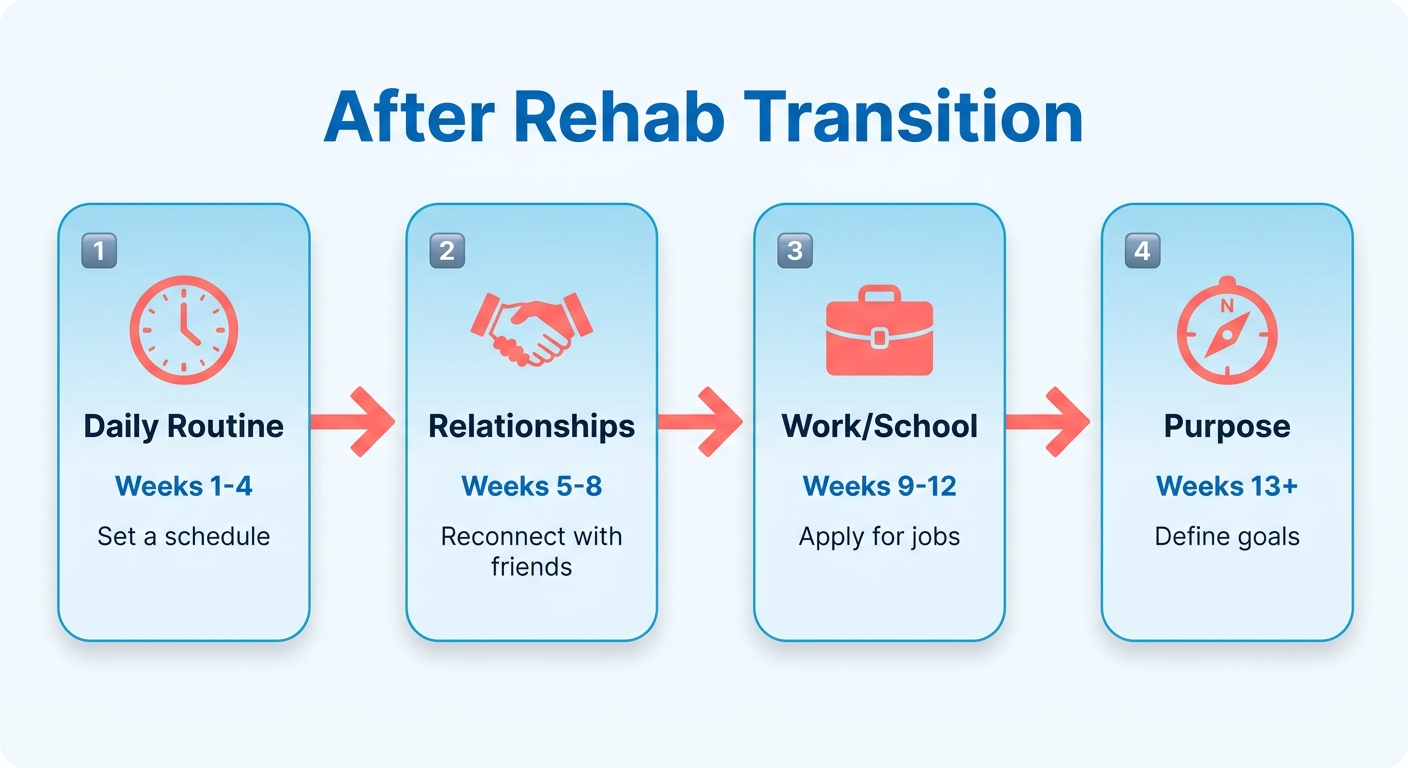
What does rebuilding life after rehab actually involve?
Five moves, starting with your daily routine and ending with purpose and self-sufficiency. Each stage gives the next one something to stand on, so skipping ahead usually backfires.
| Stage | Focus | Rough Timeline |
|---|---|---|
| 1. Routine | Wake/sleep cycles, meals, check-ins | Week 1 |
| 2. Safe circle | Family and peer accountability | Weeks 1–4 |
| 3. Old friendships | Reset boundaries, decide who stays | Months 1–3 |
| 4. Work re-entry | Structure, disclosure choices, pacing | Months 2–6 |
| 5. Purpose | Hobbies, mentorship, self-direction | Ongoing |
These phases are fluid. You'll probably be sorting out social boundaries while you're still nailing down your daily habits. Use the sequence to decide where your energy goes, not as a checklist you have to complete in order.
How long does it take, and how hard is it?
Give the active transition several months before self-reliance feels like second nature. Purpose-building runs well past that.
The hard part sits up front, in the first few weeks, and eases as your habits go automatic. The difficulty isn't the tasks themselves. It's doing them while your energy, sleep, and confidence are still coming back online.
The balance between accountability and connection is what makes or breaks this phase. Pure accountability feels like a second treatment center. Pure connection with no structure leaves you drifting. You need both, and the mix shifts as you get stronger.
What do you need before you start?
- A stable living space free of alcohol and substances
- A medication and health plan confirmed with your prescriber
- At least one trusted person willing to do brief daily check-ins
- An honest read on your old friendships: Who supports sobriety and who doesn't
- Willingness to let support taper as you build self-sufficiency
Skip the aggressive work-and-social sprint if your routine isn't holding yet. Chasing a new job or repairing every relationship in week two tends to overload people who still need sleep and steady meals first. Get the foundation solid, then build outward.
Why the first 90 days decide the rest
The first 90 days after treatment are where most people lose the thread. Detox and residential care hand you structure, meals, and a schedule. Then you walk out and the scaffolding is gone. That drop-off is exactly where relapse risk climbs, and it's why we built our coaching around this stretch instead of the treatment episode itself.
We see the same thing over and over: clients leave treatment clinically stable but socially stranded. They know how to stay sober in a controlled setting. They don't yet know how to hold a job, rebuild a marriage, or sit through a friend's birthday without a plan for the moment someone offers a drink. Treatment answers "how do I stop." This phase answers "how do I live."
Why the transition phase decides long-term recovery
Social reintegration, not willpower, predicts who stays sober. The research on relapse prevention keeps landing on one factor above the rest: functional social support. People with real connection to work, family, and sober friends stay in recovery longer. People who reintegrate in isolation don't.
That's the gap we work inside. Accountability alone turns into surveillance, and people rebel against it. Connection alone with no structure lets old patterns creep back before anyone notices. We pair the two on purpose, so you have someone checking in and someone in your corner.
What this phase actually solves
It solves the problems the discharge paperwork never mentions:
- The friendship problem: which old relationships you keep, which you rebuild, and which you let go. Some friendships from your using days can't survive your sobriety, and pretending otherwise is a common early mistake.
- The work problem: re-entering a job or starting one, with the accountability to show up and the flexibility for a hard day.
- The purpose problem: the flat, "now what" feeling once the crisis is over and nobody's clapping for you anymore.
If you finished treatment last month and already feel unmoored, that's not failure. That's the stage nobody prepped you for. Our crisis work starts here too. We help families plan detox and treatment pathways and support the move back into daily life, because the people at home need guidance to manage recovery alongside you.
What you need in place first
Before you start rebuilding, a few things have to be in place. Not gear you buy. The setup that keeps the transition from collapsing in week three.
You need a stable place to sleep, at least one accountable relationship, a way to fill your daytime hours, and a coach or team that talks to you more than once a week. Miss any of these and the rest gets shaky fast.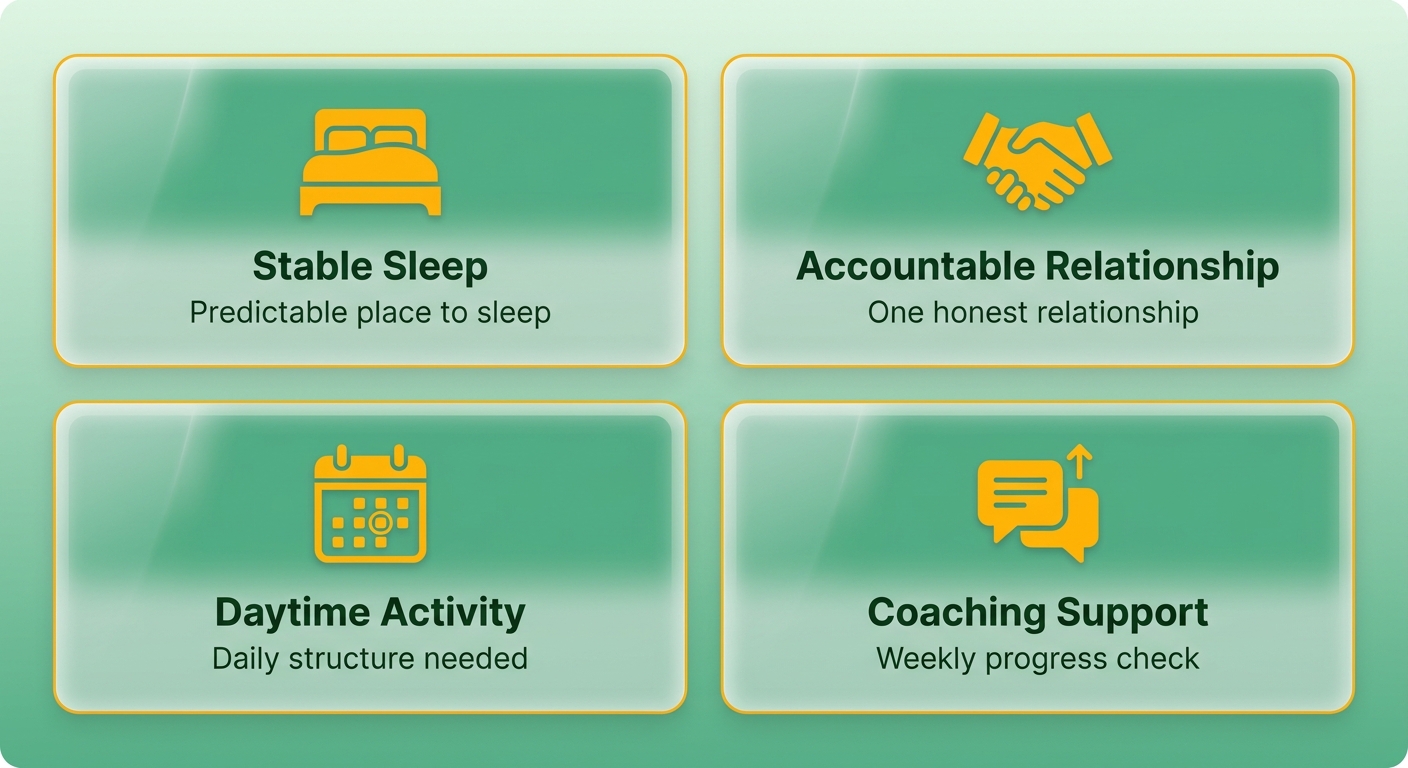
The four load-bearing walls
Housing, one honest relationship, a rough daily structure, and regular contact with someone tracking your progress. Everything we teach about work and friendships gets built on top of these.
Stable housing: A predictable place to sleep, ideally free of active use. You don't need perfect. You need consistent.
One accountable relationship: A single person who knows where you are and will notice if you go quiet. Social support is one of the strongest predictors of staying in recovery, so this matters more than any app or worksheet.
A daytime anchor: Work, volunteering, school, or a scheduled routine. Empty afternoons are where old patterns creep back in.
Regular coaching contact: More than a weekly check-in. We lean on frequent, tapering touchpoints so accountability stays high while you're most fragile.
Do you have to repair every relationship first?
No. Trying to fix everything at once is a common way to stall. Start with the relationships that are safe and supportive. Old friendships tied to using can wait, or end.
Separate the people who help your recovery from the people who quietly threaten it. If a friendship only worked around drinking or using, you're allowed to step back from it without a dramatic goodbye.
For families, that means setting clear household expectations and communication habits early, so the home supports these new patterns from day one.
Hold off on the deep relationship-repair work until housing and your daily anchor are steady. Do it too early and you're negotiating hard conversations with no ground under your feet.
The three parts running at once
Life after rehab has a shape, even when it doesn't feel like one from the inside. Naming the moving parts beats flailing at everything at once.
Three components run in parallel: accountability, connection, and structure. Most people leave treatment strong on one and weak on the other two. The job is to keep all three loaded at once, because when one drops, the other two rarely hold on their own.
Why one mentor isn't enough
Team-based coaching: a support model where more than one person tracks your progress and stays in contact, so no single relationship carries the whole weight of your recovery.
The solo-mentor model breaks down fast. One person gets busy, gets sick, or hits a rough patch of their own, and suddenly your only tether is gone. We build a small team around you on purpose. A coach handles daily accountability. Peers handle the human side. Family gets its own guidance so the home you return to isn't a minefield.
We work with family members to help them understand their role in this new setup, turning the home from a source of anxiety into a place you can actually rest.
How accountability and connection balance each other
They pull in opposite directions, and that tension is the point. Accountability without connection feels like parole. Connection without accountability feels nice and changes nothing.
Accountability is the check-in, the honest answer about how last night went, the coach who notices when you go quiet. It keeps you honest when motivation dips.
Connection is the friendship rebuilt, the coworker who knows your name, the Tuesday night that fills itself. It gives you a reason to stay honest.
Chase either one alone and you stall. Clients who only get accountability white-knuckle their way to month four and quit. Clients who only get connection drift back toward old company. This phase works when both run together, which is exactly why one coach isn't enough and one friend isn't either.
How we run it, step by step
Rebuilding happens in a set order, and the sequence matters more than the speed. Your day first, then your relationships, then work, then purpose. Here's how we run the transition phase with clients.
Don't try to fix everything in week one. Pick the first step, get it steady, then move to the next.
Set up the daily structure first
Build a repeatable daily rhythm before you touch anything else. Wake time, meals, movement, and a fixed check-in with your coaching team. This is the foundation everything else sits on.
Write the schedule down. Share it with the person tracking your progress. We ask clients to fill the empty daytime hours first, because unstructured time is where old patterns creep back in. A boring, predictable day is a win at this stage.
Rebuild relationships without slipping
Sort your relationships into three buckets before you re-enter them. People who support your recovery, people who are neutral, and people tied to old use. Then decide, with your team, who you contact and when.
Repairing trust at home takes time and consistency, not one big apology. Show up when you say you will. Small, reliable actions rebuild more than grand gestures.
For old friendships built around substance use, we help you set firm, direct boundaries. When family dynamics get tricky, our coaches guide you through the conversations that keep old triggers from resurfacing, so everyone adapts to the new routine.
Move into work and purpose
Add work and meaning only after routine and relationships hold. Start part-time or with volunteering if a full job feels like too much. Purpose grows from doing, not from waiting to feel ready.
Tie each new commitment back to your team check-ins. When work stress spikes, that's exactly when accountability and connection need to stay loaded together. Rushing into a demanding job with a shaky routine is the most common way we see this phase stall.
What works, and what pulls you back
The best moves in this phase come down to one thing: protecting your progress without smothering the spontaneity that makes a sober life worth staying in. Get the balance wrong in either direction and the transition stalls.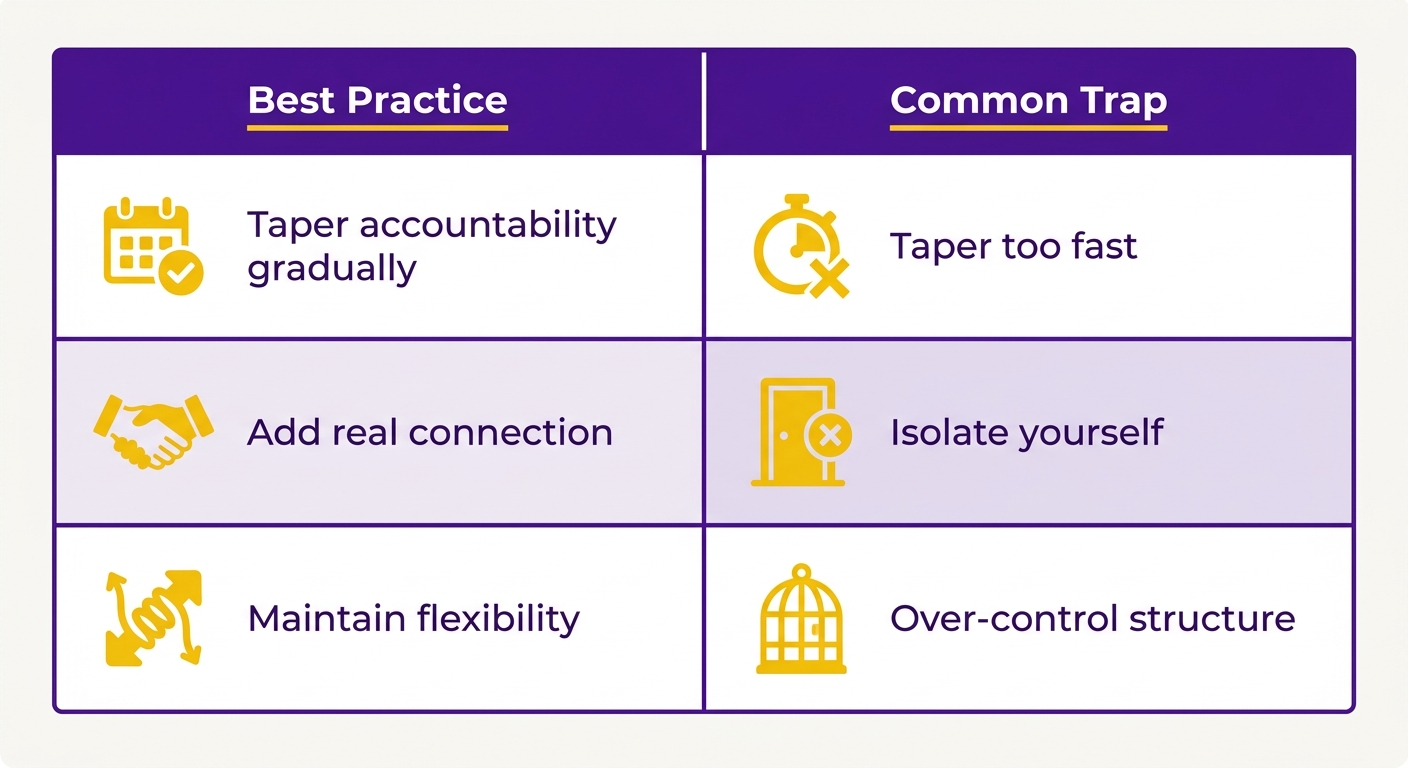
Tighten your grip on people, loosen it on the schedule
Taper accountability as you steady, add real connection as you go, and never let structure become a cage.
Start by front-loading contact. In the first weeks, more check-ins beat fewer. As your daily rhythm holds, we space those out on purpose, so you build the muscle of choosing sobriety without a coach in your ear.
Then trade some accountability for connection. Early on, your team tracks you. Later, a friend catches you before you drift. That handoff is the whole point of the phase. If you're still leaning only on paid support at month six, something's off.
The pitfalls that stall recovery
The big ones: isolating, keeping old using friends "just as friends," and treating a single relationship as your entire support system. Each one looks manageable until it isn't.
Isolation is the quiet killer. You feel steady, you skip a check-in, then a week goes by. We watch for silence more than for slips, because silence usually comes first.
Old friendships are the other trap. Some can survive your recovery; many can't. Be honest about which ones only ever met you around a drink. You don't owe a using friend your sobriety, and you can grieve that loss without reopening the door. For families, our coaches offer strategies to rebuild trust gradually, built on consistent daily actions rather than one big emotional reconciliation.
Quick tips that hold up:
- Name your risky hours. Most people have a specific window when cravings peak. Fill it on purpose.
- Keep one honest person on speed dial. Not your coach. A peer.
- Skip the all-or-nothing week. Fix one thing at a time. Overhaul everything at once and the whole structure buckles.
Balance accountability with human connection, and the phase does its job.
When it wobbles: quick fixes
Most setbacks in this phase aren't relapses. They're smaller failures that snowball if you don't catch them: a schedule that collapsed, a friendship that turned toxic, a job start date that landed before you were steady. Here's how we work through the common ones.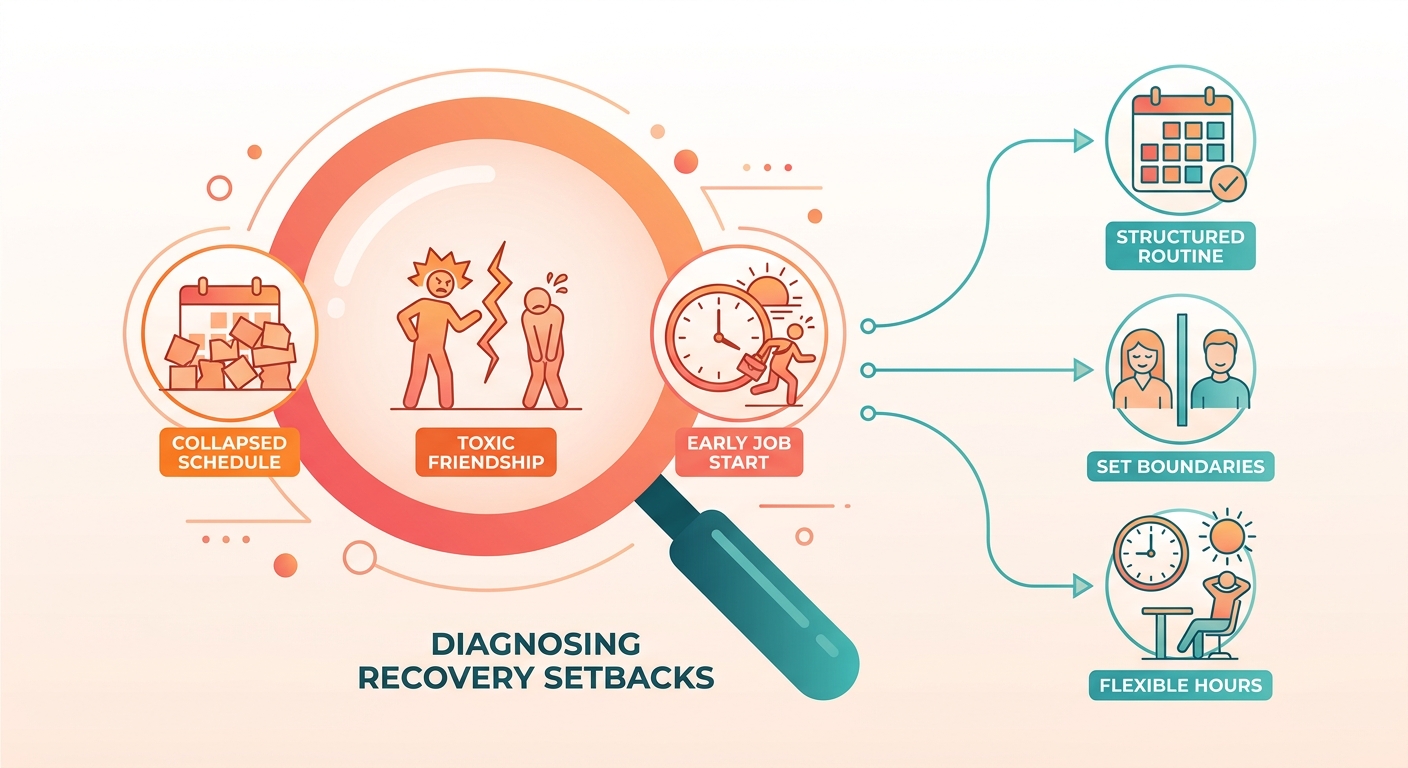
Find the symptom you're living, then run the fix.
Why my structure fell apart in week three
The usual cause: you tapered accountability faster than your routine could hold on its own. The check-ins dropped, the empty hours came back, and old patterns filled them.
The fix is to reload contact temporarily, not to call it failure. Because our support is built to taper as clients find their rhythm, it can also be dialed back up when a routine needs shoring up, then eased off again more gradually. If the schedule keeps breaking at the same time of day, that slot is your real problem. Fill it with something fixed and social, not another solo hour.
Don't skip ahead to work or dating while the base is broken. Every step above structure gets shaky when the foundation wobbles.
How do I handle old friends who pull me back?
Sort your circle by how they affect your sobriety. Put your energy into the people who actively support your growth, cut contact with the indifferent ones, and stay out of the settings that are an immediate risk.
Old friendships tied to using are the most common trigger we see in the first months. You don't owe every old contact a place in your new life. Some relationships need a real break while you build strength; some need a boundary conversation; a few can come back later on your terms.
When a friend won't respect your sobriety, that's your answer. Protecting your recovery isn't cold. It's the whole point.
Families often struggle with anxiety here. If you're watching a loved one work through these social shifts, our coaches can help you set healthy boundaries of your own, so you support their independence without enabling old habits. The first step is just reaching out.
What if I feel isolated even when the plan is working?
Loneliness after treatment is normal, not a warning sign. You traded a full using life for an emptier sober one, and connection takes months to rebuild. Add one recurring social anchor, then wait. The gap fills slower than you want, but it fills.
What I'd actually tell you to do
Life after rehab isn't one leap. It's a sequence of small, steady moves through a phase treatment rarely covers: your daily rhythm first, then relationships, then work, then purpose. That order holds because each stage gives the next one ground to stand on.
The gap between finishing treatment and feeling like yourself again is real, and it's survivable with the right support loaded around it. Accountability, connection, and structure running together. Not one carrying the whole weight.
Your next steps after treatment
Start with the smallest thing you can hold. Pick your daily structure, get it steady for a week, then add one honest relationship you can be accountable to. Don't touch work or purpose until those two feel reliable. Rushing the sequence is what pulls most people back.
Then widen the circle on purpose. Rebuilding friendships after rehab often means letting go of the people tied to your old patterns and making room for connections that don't ask you to drink. That's slow, awkward work. It's also the part that makes staying sober worth it.
If you're rebuilding who you are, not just what you do, that's the work our coaches walk through with you. Finding passions, building community, creating a life you actually want to stay sober for.
What if you're the family, not the client?
Families need their own plan. The person coming home can't carry the whole reintegration alone, and neither can you. A structured re-entry plan sets expectations before anyone walks through the door, so old triggers don't ambush the first week.
At MADE, we coordinate the people around you into a consistent safety net so your environment supports your growth. When you're ready to build a foundation that lasts, our team is here to walk you through every step.
This phase decides more than the 28 days before it. Build your day, protect your relationships, and keep a team in contact that tapers as you steady. That's the work. Start it now.
References
[1] Rebuilding Your Life and Finding Purpose After Addiction | RCA - https://recoverycentersofamerica.com/blogs/rebuilding-your-life-and-finding-purpose-after-addiction/
[2] Repairing Relationships After Returning Home From Treatment - https://www.iaffrecoverycenter.com/blog/repairing-relationships-after-returning-home-from-treatment
[3] How to Navigate Old Friendships After Completing Drug Rehab - https://www.novarecoverycenter.com/recovery/old-friendships-after-rehab/
[4] Not like it used to be, but a new life: Social reintegration of ... - https://pubmed.ncbi.nlm.nih.gov/40716238/
[5] Role of Social Support in Relapse Prevention for Drug ... - https://www.researchgate.net/publication/343193788_Role_of_Social_Support_in_Relapse_Prevention_for_Drug_Addicts
[6] The Role of Social Support in Substance Addiction Recovery - https://www.researchgate.net/publication/385016156_The_Role_of_Social_Support_in_Substance_Addiction_Recovery_A_Systematic_Review
[7] The role of functional social support in treatment retention ... - https://www.researchgate.net/publication/11403903_The_role_of_functional_social_support_in_treatment_retention_and_outcomes_among_outpatient_adult_substance_abusers
[8] Effect of social support on substance abuse relapse in a ... - https://www.researchgate.net/publication/222564690_Effect_of_social_support_on_substance_abuse_relapse_in_a_residential_treatment_setting_for_women
Frequently Asked Questions
1. Can I go back to work immediately after leaving treatment?
Returning to work too quickly can overwhelm your coping skills before they are fully established. Employment reintegration is best approached gradually, typically starting after your daily routines and core relationships are stable. Beginning with volunteer work or part-time hours allows you to test your limits without risking burnout.
2. How do I know which old friends to keep and which to let go?
Evaluate your relationships based on how they affect your recovery. Prioritize people who respect your boundaries and support your healthy habits, while stepping away from those closely tied to your past substance use. You do not need to explain or justify your decision to distance yourself from relationships that threaten your progress.
3. What should I do if I feel lonely even though my recovery plan is working?
Feeling isolated is a common part of early recovery as you transition away from old social circles. This quiet period is an opportunity to discover new interests and build a healthier community. Introducing a single, consistent weekly activity—like a class or a support group—can help you gradually establish meaningful connections.
4. Why choose team-based coaching over a single mentor?
Relying on a single individual for support creates a single point of failure if they become unavailable or overwhelmed. A team-based approach distributes this responsibility, ensuring you always have access to guidance while preventing any single relationship from becoming strained under the weight of your recovery.
5. What happens if my daily structure collapses a few weeks in?
If your daily routine falls apart, it is often a sign that you need to temporarily increase your level of external support. Rather than viewing this as a setback, use it as data to adjust your plan. Identify the specific hours where your structure fails and proactively schedule engaging, low-stress activities during those times.
6. I'm the family member, not the person in recovery—what should I do?
Family members should establish their own support systems and clear household guidelines before their loved one returns. This proactive planning helps prevent old codependent patterns or conflicts from resurfacing. Our coaching services offer dedicated guidance for families to help them navigate this transition constructively.
7. Do I have to complete each recovery stage before starting the next?
Recovery milestones are fluid and often progress in parallel rather than as strict, linear steps. However, attempting to take on major responsibilities like a new career or intense relationship repair before your basic daily habits are stable can compromise your progress. Ensure your sleep, meals, and basic accountability are secure before expanding your focus.