Helping a Recovering Addict: How Support Should Shrink as Independence Grows
July 31, 2026

Key Takeaways
- A tapered coaching plan lowers the risk of hidden dependency. The client keeps their own decision-making muscle while still answering to structured accountability.
- Support that stays too intense too long teaches people to check with a coach before every choice. That's a dependency pattern, not recovery.
- Cut support too fast and relapse tends to follow, usually when a fresh life problem shows up and the coping tools aren't in place yet.
- Clients juggling co-occurring mental-health diagnoses, shaky housing, or thin finances tend to do best under a gradual taper.
- The taper usually runs in phases: frequent safety contacts first, then weekly skill-building, then low-intensity check-ins and referrals into community.
- Coaching intensity should track skill milestones, budgeting, employment, housing stability, so support matches what the client can actually handle.
Related Video
Watch: Transcending addiction and redefining recovery: Jacki Hillios at TEDxBoulder by TEDx Talks
The trap of support that never loosens
The hard part of this work isn't showing up for someone in early recovery. It's knowing when to step back. As coaching intensity drops, the accountability structure stays. The client always has a point of contact. What changes is the frequency, and it changes in step with real skills: budgeting, holding housing, using coping strategies under pressure. When the intensive phase ends, the client keeps getting low-intensity check-ins and community referrals from their coach or team. Contact stays. Dependence doesn't.
What goes wrong when support is too heavy or too light
Too heavy, and the client starts running every decision past the coach. That feels like engagement. It's actually a new dependency wearing a healthier costume. Too light, and old patterns come back fast, usually the first time a real challenge lands and there's no scaffolding to catch it.
Who gains the most from tapering
Clients with co-occurring diagnoses, unstable housing, or limited money tend to benefit most. Moving from a structured treatment setting into ordinary life means managing environments that look nothing alike, and a slow reduction in support keeps people from dropping out during that jump.
How the phases usually run
- Initial phase: Frequent contact, focused on safety planning and crisis management.
- Skill-building phase: Weekly sessions that bring in budgeting, employment goals, and a daily routine.
- Transition phase: Fewer check-ins as confidence builds, with occasional community group participation.
- Maintenance phase: Periodic group meetings or alumni gatherings, sometimes with the client taking a leadership role.
Coaches track progress through ordinary conversation, watching for days sober, appointments the client set up on their own, and how steady they sound making decisions.
The point of phasing it this way is simple. Shrink the support as independence grows. Give people what they need today without building something they can't walk away from tomorrow.
Building the self-management habits that actually stick
When people search for drug addicts help, they picture one big fix. Self-management isn't one skill. It's a stack of habits that build as coaching contact tapers off. What we see hold up over time is pairing concrete goal-setting with a gradual pullback in coach-led contact, so momentum stays while the client starts trusting their own footing. Work on psychological independence points to future orientation, responsibility, and self-control as strong predictors of life satisfaction in recovery, and those threads run through every milestone we set.
Each taper point ties to a competency you can actually see demonstrated. Once it's there, weekly intensive calls give way to lower-frequency check-ins. The client leans on the skills they built instead of on constant supervision.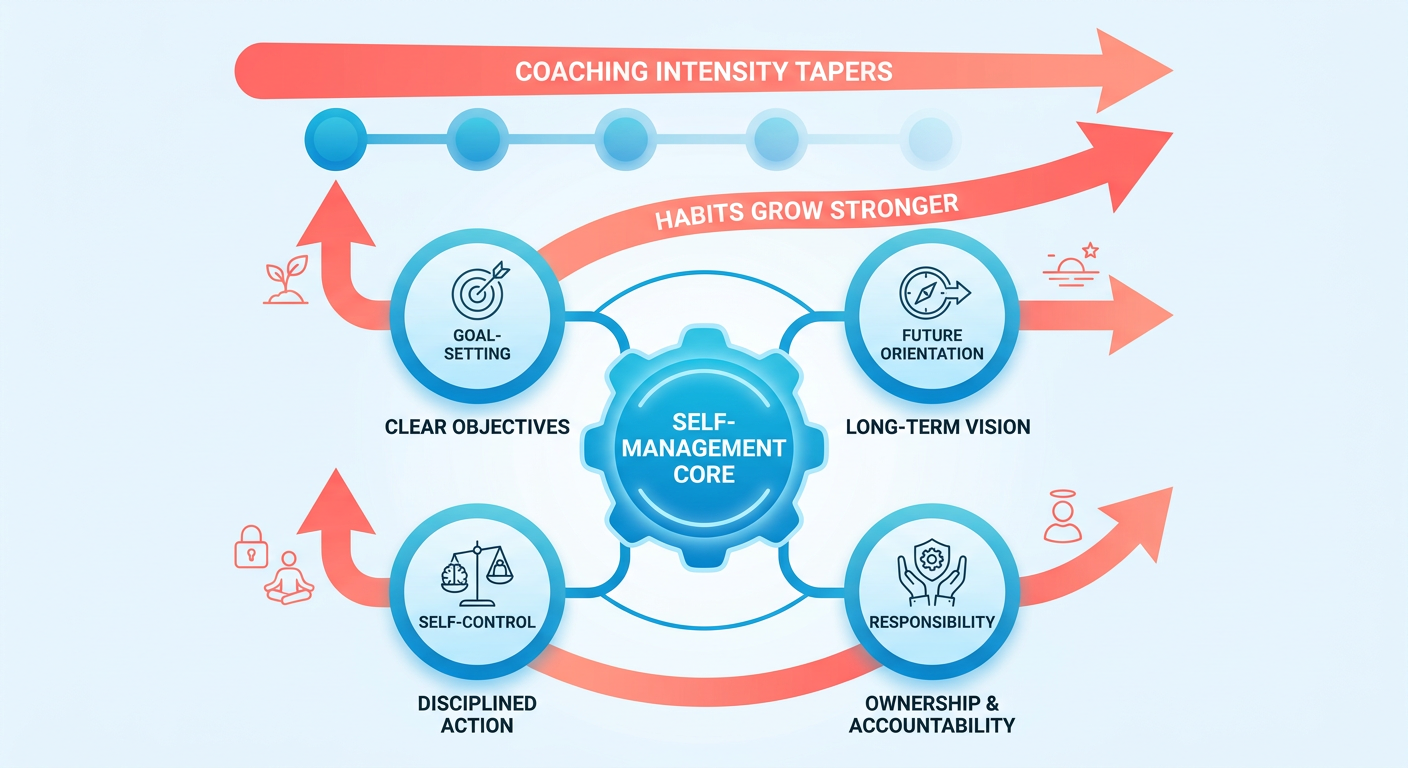
Setting goals a client can own
Every phase starts with clear, trackable goals the client can manage without someone looking over their shoulder.
- Specific: a concrete target, like "save $200 for rent."
- Measurable: a simple log or spreadsheet to record progress.
- Achievable: matched to the resources and circumstances the client actually has.
- Relevant: tied to something bigger, for example, "stable housing supports sobriety."
- Time-bound: a realistic deadline, reviewed together.
Anchor each goal to what the client personally wants and they have a reason to own the outcome. When one's met, we mark it in a short check-in, then introduce the next competency, slightly bigger than the last. The coach's role stays lean while the client's confidence widens.
The problem-solving tool that keeps relapse at arm's length
Cravings and stress triggers need repeatable steps, not improvisation in the moment. A three-step worksheet keeps it simple:
- Identify the trigger ("argument with roommate").
- Challenge the automatic thought ("I can't cope without using").
- Replace it with a coping action ("call my coach, practice deep breathing").
If a client stalls on a step, we pause the taper and add support until the skill feels solid. Safety first. The taper waits.
Emotional regulation that fits a shrinking safety net
Mindfulness and self-care are the glue holding a taper together. We ask clients to schedule short grounding breaks three times a day, using a breath-count app or a quick body-scan. Alongside that, a self-care checklist covering sleep, nutrition, movement, and social connection gets reviewed at each check-in. When the checklist lights up with several concerns, the coach steps in for a brief call. A safety net, not a return to full-time coaching.
Communication runs in the background. Families get periodic progress updates, and any collaborating therapist stays looped in on major milestones. Everyone touching the case knows the current level of support and can adjust quickly when something shifts.
The phased reduction works best when demonstrated skills drive the decrease, not the calendar. We evaluate each milestone through direct observation and the client's own progress logs. If a newly introduced habit won't hold, the team keeps contact steady and reinforces it before moving on. That protects against relapse while respecting the independence the client is earning.
Loosening the safety net without cutting the rope
With support for recovery, the first real decision is pace: how fast can the net loosen without leaving someone adrift? At MADE we let the coaching team step back as the client shows more stability. Accountability stays put. Autonomy gets room to grow.
Independence here isn't a slogan. It means the client can run daily life, keeping a household going, handling personal finances, using stress-reduction techniques, without constant oversight. We read those milestones as signals that someone's ready for the next level of reduced support.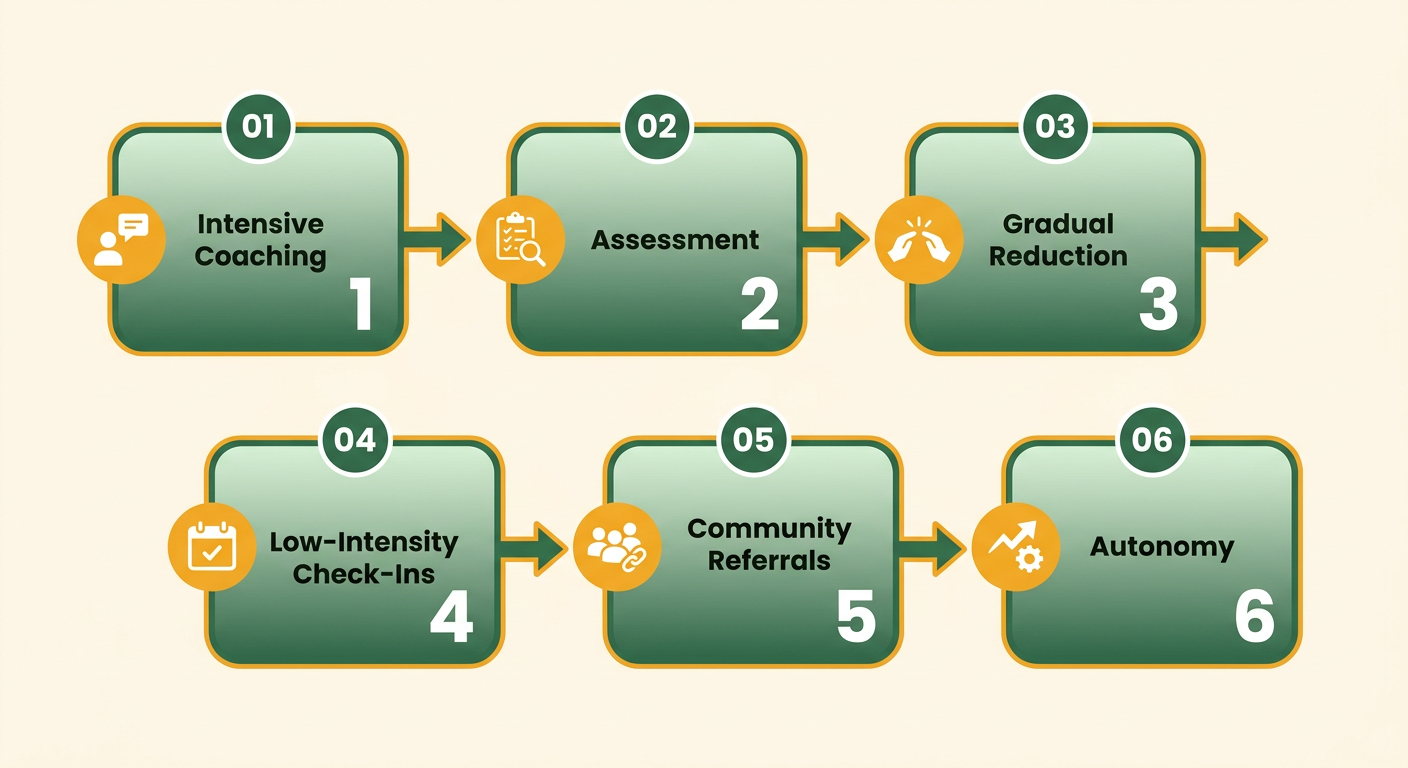
Demonstrated progress guides the pace, not a preset schedule. When a client consistently holds logistical stability, reliable transportation, a structured daily routine, we look at the next reduction phase. Letting the client set the pace this way avoids pulling support too early and keeps hidden dependency from creeping in.
How we watch progress
- Regular check-ins: Coaches meet on a schedule that reflects the current level of support, reviewing practical goals and anything new coming up.
- Collaborative goal review: Coach and client look at wins in areas like nutrition, routine, and stress management, then adjust the plan.
- Team communication: The coaching team shares updates internally so everyone stays aligned and can move fast if a concern surfaces.
What happens when someone slips mid-taper
Even a gradual reduction needs a plan for setbacks, and it needs to be light and agreed on ahead of time. After a lapse, the protocol bumps contact frequency back up and brings the primary coach back into focused conversation. This step-up gives a safety net without throwing out the whole tapering trajectory.
What the crisis response looks like
- Immediate alert: Clients reach out through a dedicated contact method, which triggers a fast response from their coach.
- Prompt check-in: A short video or phone call gets scheduled within a tight window to address triggers and safety.
- Escalated support: If the situation calls for it, additional clinical resources come in, and the taper schedule gets reviewed.
With this plan built in, support scales back only after real signs of independence show up, and there's always a responsive net underneath. It lowers relapse risk, respects the client's agency, and adapts as the person gets stronger.
Keeping independence once the coaching quiets down
A phased handoff swaps high-frequency coaching for scheduled check-ins tied to measurable milestones. The client keeps accountability while running more of their own life.
We start by mapping milestones that reflect daily stability and self-reliance. Hold those for a stretch and the weekly intensive call becomes a bi-weekly "accountability huddle" with the coach or a member of the support team. Because it's a dedicated coach or a coordinated team on the other end, the call feels supportive, not supervisory. That matches the independence pieces, future orientation, responsibility, self-control, that sit at the center of recovery. If a setback hits, the coach revisits the plan and temporarily raises contact until things steady out. This is how you resolve the apparent contradiction between "ongoing support" and "less assistance": the type of support changes, the presence of it doesn't.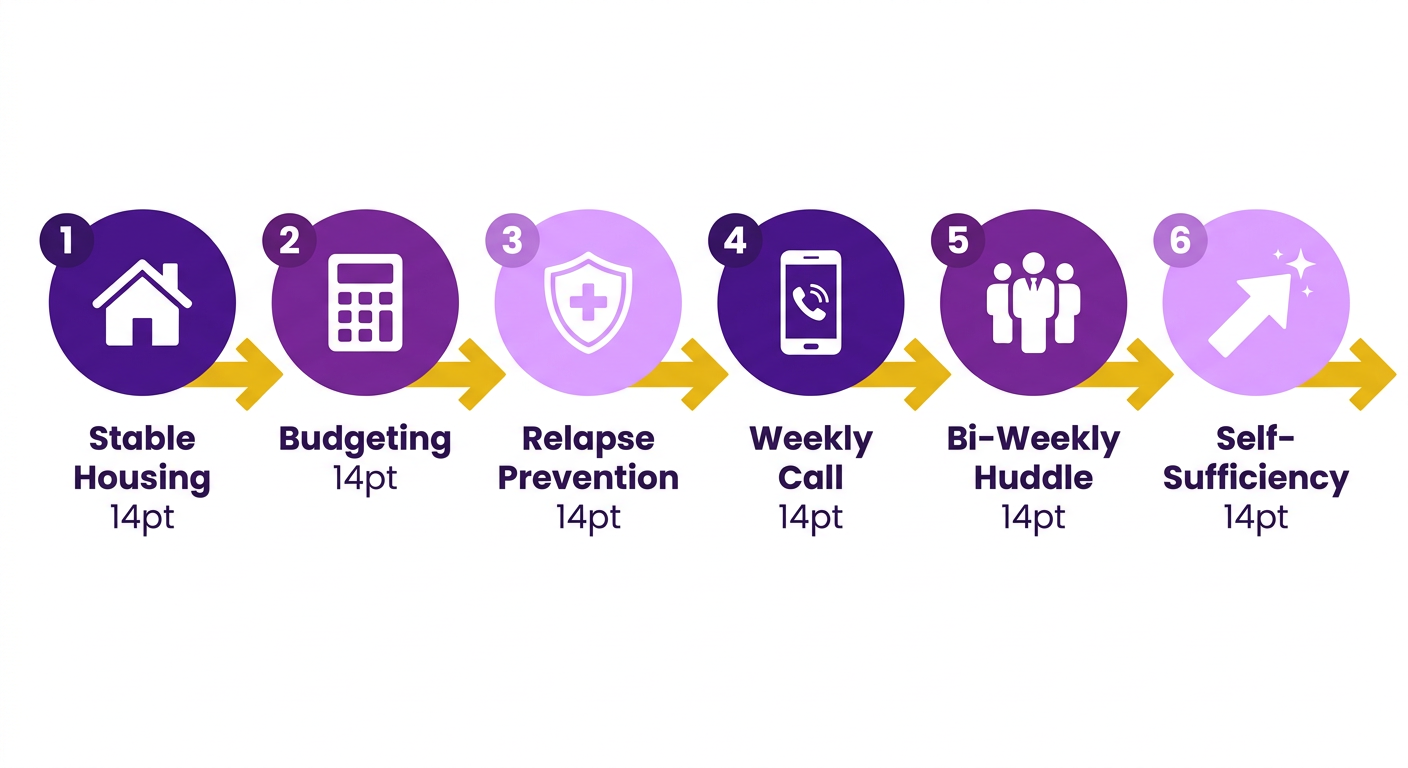
What keeps growth going after the handoff
Routine self-care, ongoing skill-building, and community engagement go into a structured plan the client reviews on their own, so progress continues without daily prompts.
- Scheduled check-ins: 30-minute video calls every two weeks, focused on goal review and problem-solving.
- Self-management logs: Brief daily entries tracking mood, cravings, finances, and sleep. The logs feed the next session.
- Education milestones: Short modules on employment readiness, financial literacy, or legal rights, each tied to a concrete output like a résumé draft or a budget.
- Community linkage: Referrals to local sober-support groups, vocational training, or housing agencies, in line with MADE's emphasis on community connection.
Anchor each practice to a measurable indicator and the taper stays tied to real competence instead of a date on a calendar.
When to pause or reset the taper
We pause the reduction whenever a client's core independence pieces wobble, a relapse, losing housing, a spike in unmanaged cravings.
When that happens, coach and client review the obstacle together and figure out whether it came from an environmental stressor or a gap in coping skills. That distinction matters, because many people are working against structural barriers that have nothing to do with their effort. Support has to mirror real-world capacity, not an ideal one. Once stability returns, the phased handoff resumes, and the support curve keeps bending to fit the client.
The moments where recovery usually gets tested
Plenty of the drug addicts help questions we field turn into "okay, what now?" the moment the intensive phase ends. The toughest stretches tend to line up exactly with the handoff points, where the team passes the reins to the client's own routine. The job is to keep accountability alive while the net shrinks, so cravings, enabling, and emotional swings don't slip by unseen.
Managing cravings as support tapers
Pair mindful awareness with concrete self-care that fits the client's current independence. A quick body-scan or five-minute breath-focus can interrupt a sudden urge without the time-intensive meditation that works better once a stable routine is in place. When coping skills hold up, we move from daily check-ins to weekly "craving-review" huddles, and the client logs triggers and practices the micro-tools on their own.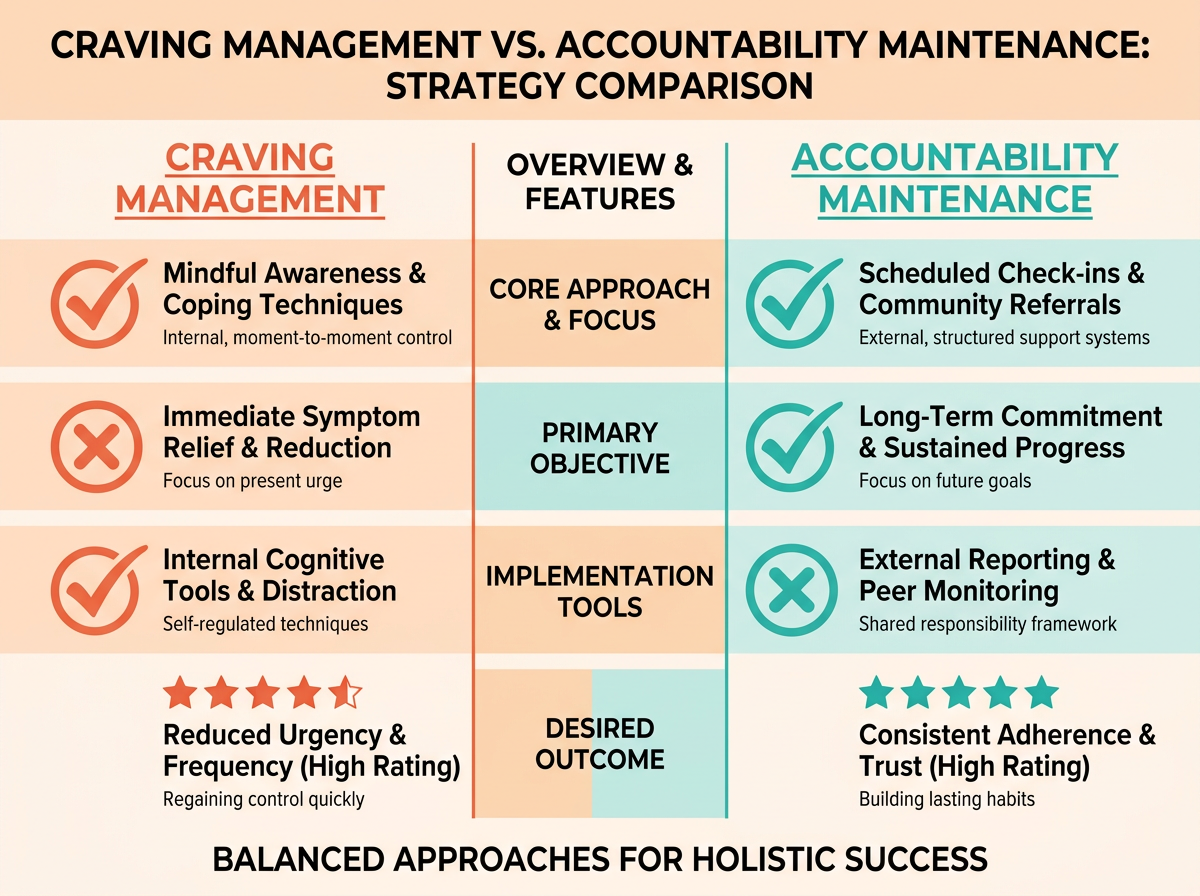
- Grounding pause: 30 seconds of deep breathing, naming five sights, four sounds, three textures, two smells, one taste.
- Trigger journal: capture the time, place, emotion, and what was happening before the craving. Review weekly.
- Physical reset: a quick walk, a stretch, a splash of cold water to break the loop.
If someone's still in early stabilization, we bring mindfulness in slowly. Piling it on too fast just overwhelms.
Not enabling while the coach steps back
Set clear boundaries that turn "help" into "responsibility." We name specific decision zones, daily scheduling, medication adherence, social commitments, where the client acts on their own, with the coach as a sounding board rather than the one making the call. When a client starts running every small choice past the coach, we redirect the task back to them with a quick responsibility reminder.
- Define decision zones: list what the client owns versus what the coach monitors.
- Use accountability prompts: short texts ("Did you schedule your grocery run today?") that nudge self-action.
- Run boundary reviews every two weeks to adjust how involved the coach is.
We hold daily logistical help only as long as the client keeps meeting the decision-zone criteria. Pull it before that and you've built dependence, not readiness.
Where emotional balance fits the handoff
Emotional regulation is what holds the taper together. We teach short stress-reduction loops, brief progressive muscle relaxation, gratitude micro-notes, scheduled emotional check-ins, that the client can run without a coach on the line. Practiced daily, they keep the internal compass steady even as outside contact thins out.
- Micro-gratitude: one thing you're grateful for each morning.
- Progressive release: a 2-minute body relaxation before bed to ease cortisol spikes.
- Emotion-rating scale: a 1-10 daily self-score. Discuss the outliers at the next huddle.
If someone's still working through severe anxiety or trauma, we keep a brief therapist-led session in the mix. Self-regulation alone won't carry that weight, and pretending it does is how people get hurt.
Folding in peer support
MADE's community connection adds low-intensity, peer-led accountability that complements the coach's step-back. Once the primary coach reduces contact, the client can join a peer-support group that meets monthly, keeping community connection without reintroducing heavy oversight. Someone who's got budgeting and housing handled can still call a trusted peer for a quick "what's your plan for tonight?" That keeps a net in place while honoring autonomy.
Three core habits sustain the rest: craving micro-tools, boundary contracts, and emotional loops. Once those run on their own, the coach can safely pull back, because the client has both the internal skills and the peer resources to keep going.
References
[1] The Power of Support for a Self-Determined Life - https://driftwoodrecovery.com/blog/independence-in-recovery-the-power-of-support-for-a-self-determined-life
[2] (PDF) Nonclinical Addiction Recovery Support Services - https://www.researchgate.net/publication/232997964_Nonclinical_Addiction_Recovery_Support_Services_History_Rationale_Models_Potentials_and_Pitfalls_1
[3] Transcending addiction and redefining recovery: Jacki Hillios at TEDxBoulder by TEDx Talks - https://www.youtube.com/watch?v=gzpTWaXshfM
Frequently Asked Questions
1. What should a coach do if a client experiences a mental‑health crisis during the taper?
A mental‑health crisis requires immediate coordination with clinical professionals. The coach facilitates a warm handoff to a licensed therapist or psychiatrist, ensuring the client's safety plan is active. While the coach remains a supportive contact, clinical care takes precedence, and the coaching taper is paused until the clinical team confirms the client is stabilized.
2. Can the taper schedule be accelerated for a client who quickly masters required skills?
If a client consistently meets skill milestones for at least two consecutive weeks, the taper can be accelerated by shortening the upcoming phase by 25‑30 %. The coach documents the faster pace in the MADE dashboard, ensuring the client still receives a brief safety check before each reduced‑frequency contact.
3. How does family involvement fit into the shrinking‑support model without creating dependency?
Family members become supportive observers rather than decision‑makers by signing a clear boundary agreement that outlines specific topics they can discuss with the client. During bi‑weekly coach calls, the family receives a concise progress summary, allowing them to reinforce independence without stepping into the client’s daily problem‑solving role.
4. What technology tools does MADE provide to help clients track self‑management milestones between check‑ins?
MADE’s mobile app features a secure digital dashboard where clients log daily metrics in under five minutes. The platform automatically visualizes these trends over time and sends automated alerts to the coaching team if key indicators drop, allowing for proactive outreach before a crisis occurs.
5. How are relapse events handled without completely resetting the taper progress?
When a relapse occurs, the coaching team conducts a detailed review of the event to identify the specific triggers and vulnerability factors involved. The client revisits their relapse-prevention plan to adjust coping strategies. Once stability is re-established, the taper resumes at the prior level, preserving earned progress while reinforcing long-term resilience.
6. What criteria determine when a client is ready to move from weekly coaching to peer‑support group meetings?
A client transitions to peer-support meetings once they demonstrate consistent self-advocacy and active engagement in local recovery communities. The coach facilitates this transition to provide a collaborative, community-based layer of accountability that complements the final stages of the formal coaching taper.