6 Emotional Letdowns After Rehab Nobody Warns You About
September 23, 2026

Why Emotional Letdowns After Rehab Matter
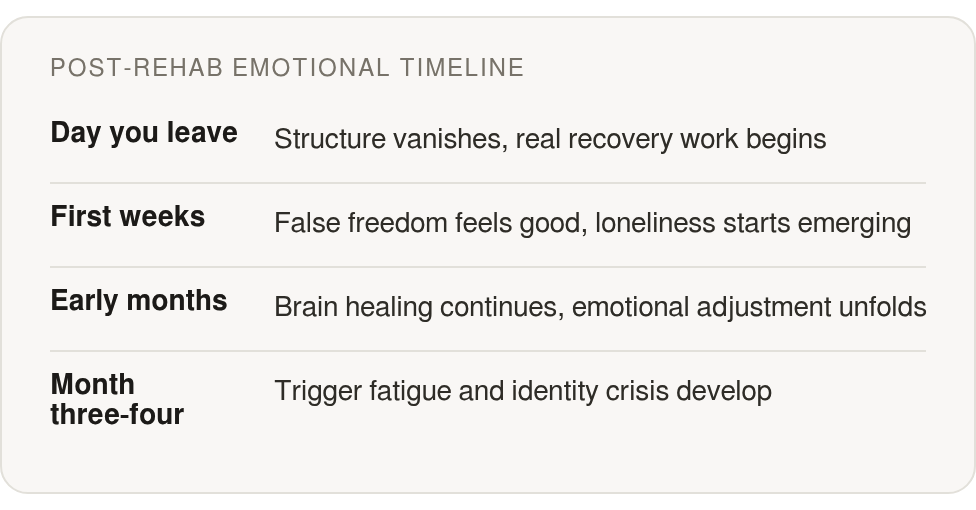
The hard part of recovery starts when you leave treatment. That sounds backward, but it can undo months of progress. A social worker at Mirmont Outpatient Center says it plainly in a piece on depression after rehab: "once a person leaves rehab, the real work has to begin." We see it often. People walk out feeling steady, then hit a wall nobody warned them about.
Catching those dips early protects sobriety. Emotions drive relapse more than cravings do, and the feelings that surface after treatment tend to be sharper than people expect. Your brain is still healing. Naming what's happening takes some of the power out of it.
Why does leaving structure hit so hard?
Rehab runs on structure. Set schedules, a team checking in, no idle hours. That structure isn't just comforting. It helps regulate a nervous system that cannot do it alone yet.
Look at the collision. The treatment bubble takes your full-time agenda, and post-acute withdrawal symptoms can last a long time. So the moment you lose your structured team is the moment your brain is least equipped to steady itself. The support disappears while the biological need is still active.
That gap is why we build a personalized aftercare team around each person. Coaching, companionship, and a plan for the empty hours bridge the space between treatment and independent living. We can't guarantee the dips won't come. We can make sure you're not facing them alone.
What's the dangerous myth about feeling "fine"?
The most dangerous belief after treatment is that feeling good means the work is done. It isn't. When difficult emotions show up instead of the relief someone hoped for, the swing can feel like proof something broke. Mood moves fast in early sobriety, shifting from gratitude to frustration and back inside a single day.
Nothing broke. Depression and mood swings in early sobriety are common, not failure. The UKAT guide frames emotional turbulence after rehab as a sign your internal systems are coming back online. But that reframe only helps if someone catches the shift before it spirals into isolation.
Which red flags signal a letdown turning into relapse risk?
A normal dip becomes a relapse risk when it stops moving and starts closing you off. Watch for these in yourself or someone you support.
- Hopelessness, worthlessness, or persistent sadness that lingers or interferes with daily function. This is the point to reach out for professional support.
- Pulling away from calls, meetings, and the people on your support list. Addiction feeds off isolation.
- Reading the empty schedule as freedom while dodging every new responsibility. Two faces of the same lost structure.
- Feeling anxious about wanting relief, then anxious about the anxiety. That feedback loop is where a trained team interrupts what self-management alone can't.
- Skipping the routines and check-ins that held you steady in treatment.
Catching one of these early is the difference between a rough week and a return to old behaviors.
Key Takeaways
- Post-acute withdrawal symptoms can persist for a long time, right when the structured support of rehab disappears.
- Emotions drive relapse more than cravings do, which makes the mood swings of early sobriety a sharper threat than most people expect.
- Depression and mood swings after treatment often signal that your internal regulatory systems are working again, not that recovery has failed.
- A normal dip becomes a relapse risk when it stops moving and starts closing someone off through isolation and skipped routines.
- The relief of leaving treatment masks how much scaffolding vanishes at once, since substance use used to fill the entire day.
Letdown #1‑2: False Sense of Freedom & Loneliness
The first letdown sneaks up disguised as good news. You leave treatment feeling lighter than you have in years, sure the hardest part is behind you. The relief is real. It's also where the trouble starts. Walking out the door can blind you to how much scaffolding just disappeared.
The recalibration nobody spells out keeps running long after the first days home. Your brain is still healing for months, and the emotional adjustment Ashley Addiction Treatment describes runs on its own timeline, often across the early months. The structure you leaned on vanishes right when your nervous system is least equipped to steady itself. That's the trap inside the freedom.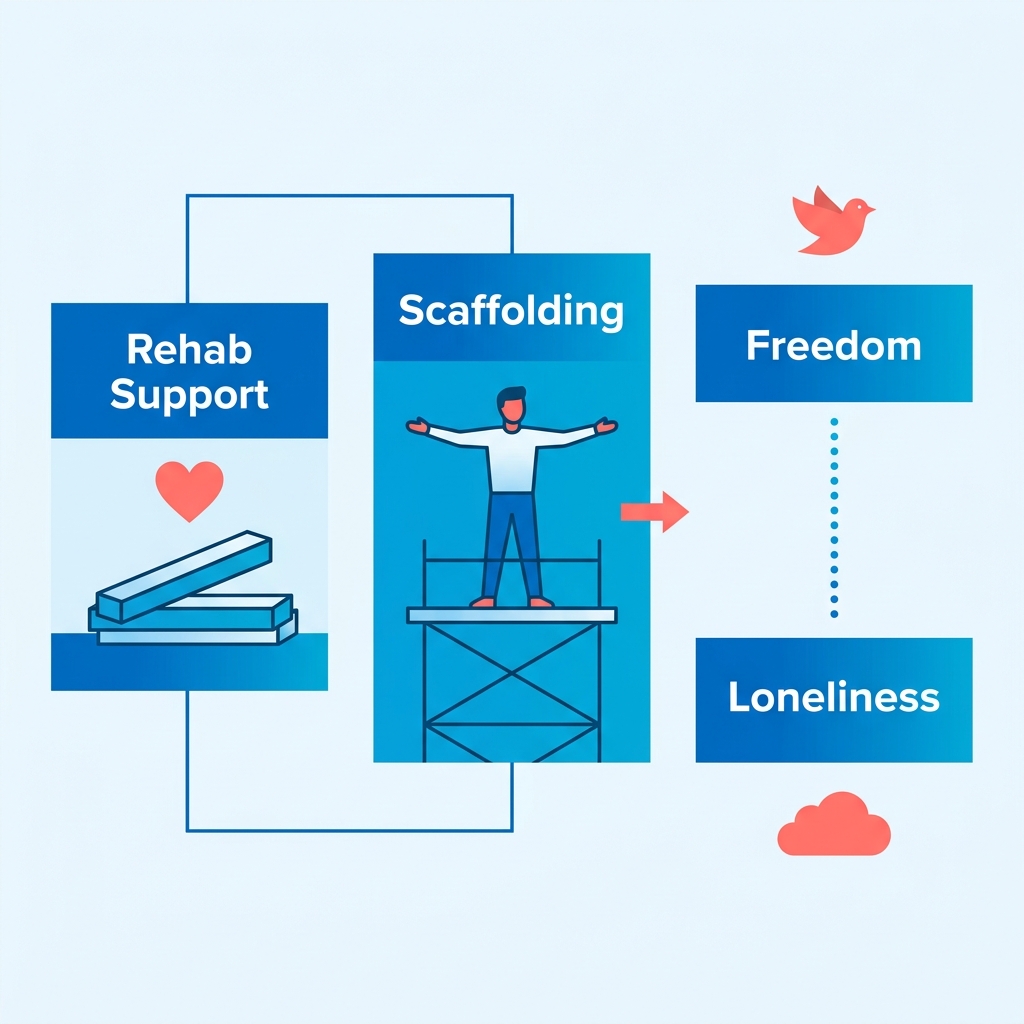
Freedom and an Empty Calendar Are the Same Problem
Substance use once filled your entire day. Sobriety clears that agenda, and the void can read as freedom when it's really exposure. You go from a schedule other people built to hours of unclaimed time, and idle time is where anxious thoughts breed, as the UKAT guide points out.
We see this in the first weeks home almost every time. The optimism is genuine. It just isn't a plan.
- Notice when "I've got this" starts replacing your daily routine. Confidence is healthy. Skipping structure because you feel fine is the early warning sign.
- Rebuild a schedule before you think you need one. A planned day protects you during the early months, when moods swing without warning.
- Name the feeling instead of numbing the boredom. Journaling emotional patterns helps you catch a dip before it turns into a craving.
Loneliness Is the Bill for Losing Your Group
In rehab you had people around you all day. Group therapy, peers who got it, staff checking in. Then it stops. That fading community is one of the most common post-rehab emotions the UKAT team lists, and it hits hardest when you don't have sober friends at home or you've relocated somewhere new.
This is the part we built our aftercare model to catch. Self-management works until the isolation itself becomes the trigger, and a single person rarely spots their own spiral. Structured check-ins and coaching calls give you contact that doesn't depend on how motivated you feel that morning.
- Schedule real human contact into your week, not just when you're struggling. Regular check-ins interrupt loneliness before it settles in.
- Find one sober connection in your actual geography. If you've moved, a local support group or coach fills the gap fast.
- Watch for a low mood that persists day after day. Ongoing hopelessness that interferes with daily life is a signal to reach out for clinical support, as Ashley's clinicians note.
Freedom and loneliness are two faces of the same lost structure. A personalized team keeps the scaffolding up while you learn to build your own. If you're mapping out that transition, our recovery blog covers the practical steps in more detail.
Letdown #3‑4: Overwhelming Responsibility & Unmet Support Expectations
The cruelest timing in recovery: the moment you lose your treatment team is the moment your brain still needs one most. People recovering from substance misuse can experience post-acute withdrawal for a long time, including brain fog, racing thoughts, and trouble focusing, as Main Line Health details. Now stack rent, a job, family repair, and doctor's appointments on top of a mind that's still healing.
That's what makes the after-rehab stretch feel crushing. In treatment, someone else held the schedule. Meals, groups, check-ins, handled. The day you walk out, that full-time structure vanishes and you're suddenly managing everything at once. The to-do list can feel bottomless, and the team that used to steady you is a voicemail away, if that.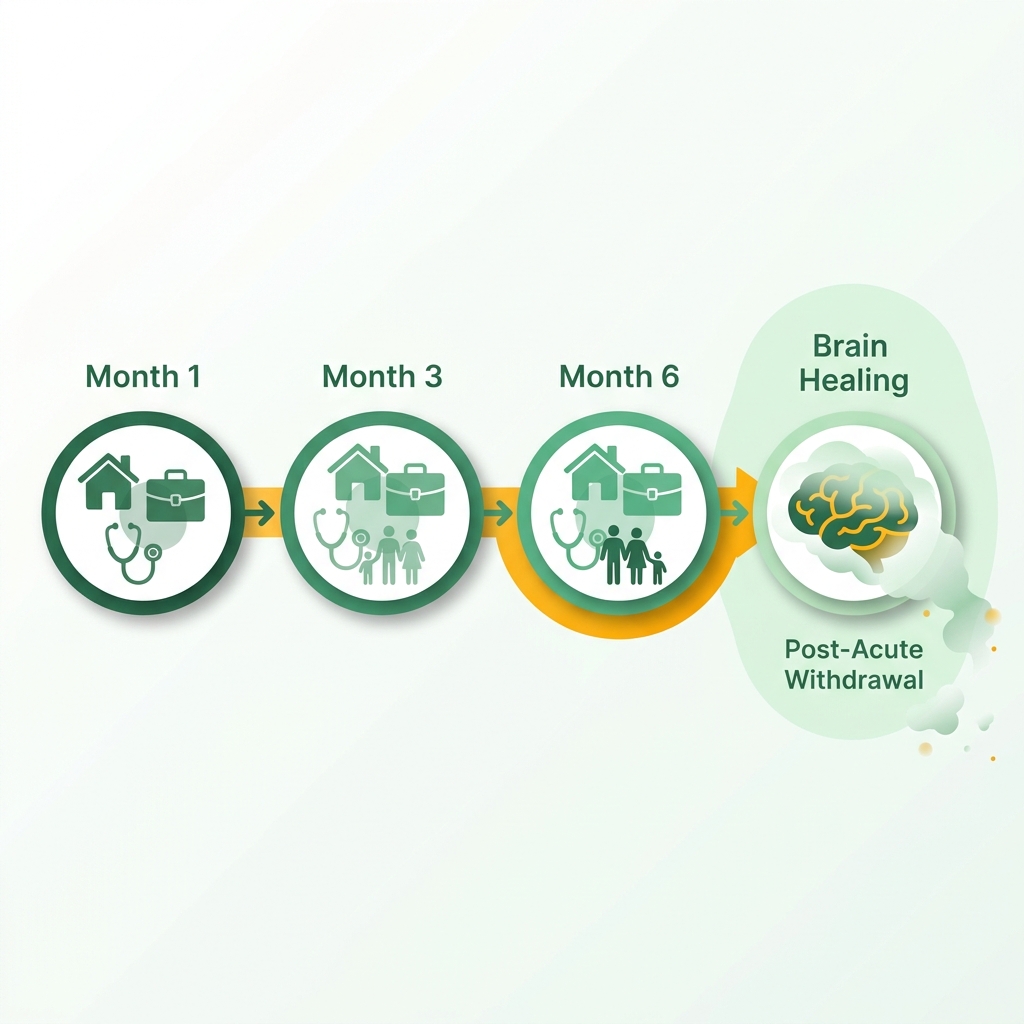
Why does everything feel like too much at once?
Shirley Hickman, a social worker quoted in that same piece, warns that "if you don't introduce any changes, you will revert back to old behaviors." True. But nobody mentions how many changes land in the same week. Work, finances, health, relationships, all demanding attention at once, and the void from a removed daily agenda fills with pressure instead of purpose.
That's where prioritizing beats hustling. You can't fix a year of chaos in a month. Our coaches can help you set up daily routines that lower stress and sort out what deserves your attention first, so the rest can wait without guilt.
- Rank tasks by what protects your recovery first, not by what feels most urgent to everyone else. Rent and a therapy appointment outrank answering every text.
- Block idle time with a plan. Empty hours breed anxious spirals, as UKAT notes about post-rehab routines.
- Say no without over-explaining. Boundaries aren't rejection. They're how you stay standing long enough to help anyone at all.
What happens when the rehab team stops calling?
This is the letdown that breeds real resentment. Many people leave assuming their treatment team will still "be there." Then the scheduled aftercare appointments thin out or lapse, and the silence reads as abandonment. You went from constant contact to fending for yourself, and it stings.
The fix isn't hoping the old team reappears. It's building a support structure that expects the handoff and plans for it. In our experience, a personalized aftercare team can bridge exactly this gap, holding the accountability and check-ins rehab used to provide while you find your footing.
- Set realistic expectations for support levels before you leave treatment, so the drop-off doesn't blindside you.
- Build a call list of people you can reach, so isolation doesn't win. Hickman is blunt: you need people "so that you're not doing it alone."
- Line up coaching or peer support that carries past discharge, not one that ends the day rehab does.
We can't promise a smooth landing. We can help you build a plan so the move to independent living isn't something you face alone. That's aftercare done right, and it's the work our team does every day. You can read more in our recovery blog.
Letdown #5‑6: Trigger Fatigue & Identity Crisis
By month three or four, a different exhaustion sets in. It isn't the raw grief of the first weeks. It's the low hum of never being off duty. Every party invite, every stressful text, every drive past an old spot demands a scan: is this safe? The constant self-monitoring wears people down, and that fatigue is one of the sneakiest letdowns after rehab because it doesn't feel like a crisis. It feels like being tired of your own recovery.
There's a tension clients get stuck in. One school of thought says the goal isn't to eliminate every trigger, since you can't, but to recognize and respond to them with control. Sound advice. But Ashley Addiction Treatment points out that in early recovery, the anxiety about wanting relief can itself become a relapse trigger. Sit with a trigger the wrong way and you feed the loop. Both are true. The difference is whether someone is there to interrupt the spiral before it tightens. That's the job the treatment team held, and the job that vanishes the day you walk out.
Trigger Fatigue Is a Staffing Problem, Not a Willpower Problem
In rehab, a team absorbed part of the monitoring load. Alone, you carry all of it, all day. We help build routines and outside support so you're not the only sensor in the room.
- Run a HALT check before reacting to a hard moment. Hungry, Angry, Lonely, Tired accounts for more "cravings" than people expect, and it's fixable in minutes.
- Keep a trigger toolkit of two or three immediate actions you can reach for without thinking. The 5-4-3-2-1 grounding method works because it pulls you out of the spiral fast.
- Name three people you can actually call. Fatigue lies to you when you're isolated. A second set of eyes catches what you miss.
- Structure the day on purpose. Idle time is where the scanning gets loudest, so a planned schedule quietly lowers the monitoring burden.
The Identity Crisis Nobody Schedules
Once the substance is gone, so is a role that organized years of your life. What replaces it isn't obvious. People tell us they feel unsure who the "new you" even is, and that vacuum can quietly erode motivation.
Language matters here. UKAT draws a sharp line: "Guilt says, 'I did something wrong.' Shame says, 'I am something wrong.'" Guilt can guide you forward. Shame welds you to the label. Rebuilding an identity means trading one for the other.
- Clarify what you actually value, separate from recovery itself. A role built only around "not using" is thin. One built around work, relationships, or creating holds up.
- Try on new roles in a low-stakes setting. Sober living gives people room to experiment with hobbies and responsibilities without the whole world watching.
- Redefine the goal. Emotional sobriety isn't being happy all the time. It's a steady relationship with your own inner life.
Our coaching exists to carry part of this weight with you, so the move to independent living doesn't rest on one exhausted person alone.
Action Checklist & How MADE Recovery Can Support Each Letdown
The gap between leaving treatment and living independently is where most plans fall apart. A checklist won't fix that alone, but it turns a vague sense of dread into concrete moves you can make this week. Here's how we help clients work through each of the six after-rehab letdowns, one action at a time.
The thread running through all of it: the structure you lost in treatment doesn't have to vanish overnight. It can taper on purpose. That's the difference between an abrupt drop and a bridge.
Reality-Check the Freedom, Fill the Empty Schedule
The first two letdowns are one problem wearing two masks. Sobriety strips away the full-time job of using, which Main Line Health describes as leaving a void where your day-to-day agenda used to be. That empty space reads as freedom on day one and loneliness by week three.
- Schedule a weekly reality-check call with a coach. We use these to name where confidence is outrunning your actual footing, before drift sets in.
- Block your week the day you get home. Idle time breeds anxious spirals, so UKAT recommends building days with purpose using a planner.
- Add a sober companion to your daily routine. Our in-home companionship covers the hours when isolation hits hardest, so the quiet doesn't do its work on you.
Share the Load Before Responsibility Buries You
Rent, work, family repair, and appointments all land at once, on a brain still healing. Post-acute withdrawal can run for a long time, as Main Line Health notes, so you're managing everything while your focus is at its weakest.
- Break the to-do list into a coach-supported weekly plan. We help you sequence what matters instead of drowning in all of it.
- Consider our premium sober living placement if home is chaotic. A stable environment takes the household load off while you rebuild.
- Name your real support expectations out loud. Most people assume help will appear and feel abandoned when it doesn't. We build the plan so it's there by design.
Interrupt the Trigger Loop and Rebuild Who You Are
There's a genuine tension in the research. UKAT argues you can't eliminate triggers, so the goal is to recognize and respond to them with control. Sound, until the anxiety about a trigger becomes its own trigger. A trained team is what can interrupt that feedback loop before self-management alone spirals.
- Keep a trigger log. Track what fires, when, and what you did. Patterns you can't see from the inside get obvious on paper.
- Join a sober activity group to explore who you are without substances. Identity gets rebuilt through doing, not thinking.
- Use a sober travel companion for high-stakes trips. Weddings, funerals, work travel. We go with you so a hard day doesn't become a solo test.
As you steady out, our support tapers on purpose. That gradual step-down is how the bridge to independent living holds. If you want help building your version of this plan, reach out to our team.
References
[1] Dealing with the Varying Emotions After Rehab - https://www.ukat.co.uk/help-guides/dealing-with-the-varying-emotions-after-rehab/
[2] The Emotional Side of Early Sobriety | Ashley Addiction Treatment - https://www.ashleytreatment.org/rehab-blog/the-emotional-side-of-early-sobriety/
[3] Blog – Depression after rehab | Main Line Health - https://www.mainlinehealth.org/blog/depression-after-rehab
Common Questions
Is it normal to feel worse after rehab than I did during treatment?
Feeling worse after discharge is common, not a sign of failure. During rehab, structure and a team handle regulation your nervous system can't yet manage alone. When that scaffolding disappears while your brain is still healing, sharper emotions surface. Those mood swings actually signal your internal regulatory systems coming back online.
How do I know when an emotional dip needs professional help versus riding it out?
A dip needs clinical attention when it stops moving and starts closing you off. Persistent hopelessness, worthlessness, or sadness that interferes with daily function is the point to reach out to a professional. Other warning signs include pulling away from calls and meetings, and skipping the routines that held you steady in treatment.
What's the difference between guilt and shame in recovery, and why does it matter?
Guilt says "I did something wrong," while shame says "I am something wrong." Guilt points at a behavior you can act on, so it can guide you forward. Shame attaches to your identity and welds you to the label. Rebuilding a sense of self after treatment means trading shame for workable guilt.
What is a HALT check, and when should I use one?
HALT stands for Hungry, Angry, Lonely, Tired. Run through it before reacting to a hard moment or assuming you're facing a craving. These four states account for more "cravings" than most people expect, and each one is fixable in minutes. It's a fast way to catch a physical need masquerading as an emotional crisis.
How does MADE Recovery's support differ from the treatment team I had in rehab?
MADE Recovery provides nonmedical support: coaching, companionship, sober living placement, and check-ins that carry over past discharge rather than lapsing the day rehab ends. We don't diagnose, detox, manage medications, or replace clinical care. Our role is holding the accountability and structure your treatment team provided, then tapering it on purpose as you steady out.