24/7 Sober Companion vs. Virtual Coaching: When Each One Earns Its Cost
September 3, 2026

Key Takeaways
- A 24/7 sober companion means in-person support around the clock. It costs $500 to $1,500 a day and fits the high-risk first weeks out.
- Virtual coaching runs $75 to $300 an hour, or $800 to $3,000 a month. It fits people with growing independence and stable housing.
- A full month of round-the-clock in-person coverage runs into five figures. It is the most expensive option.
- Team-based hybrid packages mix occasional in-person visits with virtual check-ins. They usually win on cost during the transition-to-community stage.
- You do not have to pick one lane. Smart spending matches support intensity to current relapse risk, then tapers as that risk drops.
- Paperbell's 2026 breakdown puts most hourly recovery coaches between $100 and $175. That is well under intensive live-in rates.
- The right format depends on how much of your daily life still feels unsafe.
The fast version, before the details
A 24/7 sober companion covers you in person around the clock for the first high-risk weeks. A virtual coach checks in remotely for far less money. A team-based package blends the two, which is why it usually wins on cost during the transition-to-community stage. The right fit depends on how vulnerable you feel during the day.
Most people shopping for sober coaching after rehab assume it is one lane or the other. It is not. The smartest spend maps the format to your current relapse risk, then tapers as that risk drops.
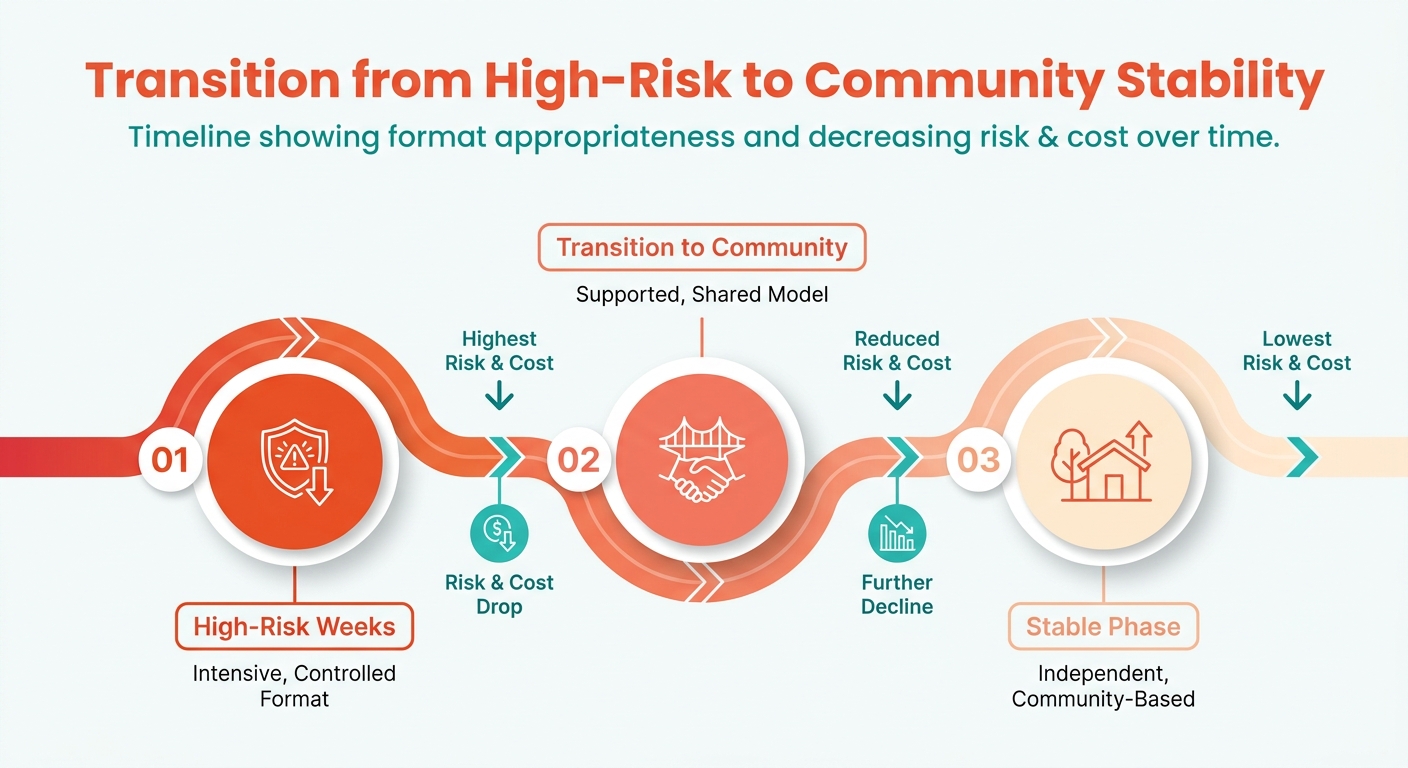
What these three options actually cost
Pricing scales with how many hours of your day the support covers. Live-in companions charge by the day. Coaches charge by the hour or by monthly retainer.
| Support type | Typical cost | Format | Best for |
|---|---|---|---|
| 24/7 sober companion | $500–$1,500/day | In-person, round-the-clock | First weeks out, unstable housing, high relapse risk |
| Virtual coaching | $75–$300/hr; $800–$3,000/mo retainer | Phone or video check-ins | Growing independence, stable environment |
| Team-based hybrid | Custom, tapering package | Occasional in-person + virtual | The transition-to-community stage |
Paperbell's 2026 breakdown shows intensive in-person support commanding premium daily rates, while standard hourly coaching sits at a far lower financial barrier. Run the daily rate over a few weeks, and the math adds up fast. That compounding cost is why so many families look for something else.
Are sober companions and coaches really different?
The sources disagree, and that disagreement affects your budget. Addicted.org treats them as distinct roles: companions handle crisis moments, and coaches handle long-term growth. Paperbell says the labels are basically interchangeable.
Our read: the titles overlap, but the intensity genuinely differs, and intensity is what you pay for. Hiring a companion is not buying a different profession. It is buying constant physical presence. That presence earns its premium when a week-one craving could send you back to detox. It becomes unnecessary once you can get through a Tuesday on your own.
Why the hybrid usually costs less
The flat-rate 24/7 model overspends exactly where most clients land after treatment. Research on telephone-based continuing care found most people in the step-down phase do just as well with lower-intensity remote support.
That is the case for a flexible package. Keep in-person companion hours for the moments that genuinely need them: a first sober wedding, a court date, the first weekend alone. Handle everything else with virtual check-ins at a fraction of the cost.
Clients with stable housing and reliable follow-through can usually skip the daily companion tier. Save that spend for the stretches when your immediate environment creates real relapse risk. A package that shifts with you, instead of billing a flat rate for coverage you have outgrown, is how the money works. As your routine steadies, support steps down and self-reliance takes over.
Feature by feature
The three formats split cleanly on one axis: how much of your day gets in-person coverage. A 24/7 companion puts a person beside you all day. A virtual coach works by phone or video. A team-based package mixes both. That mix makes sober coaching after rehab more affordable during the transition-to-community stage, when your risk is dropping but not gone.
Read the breakdown below against your own week. Which blocks of time feel most exposed to old habits?
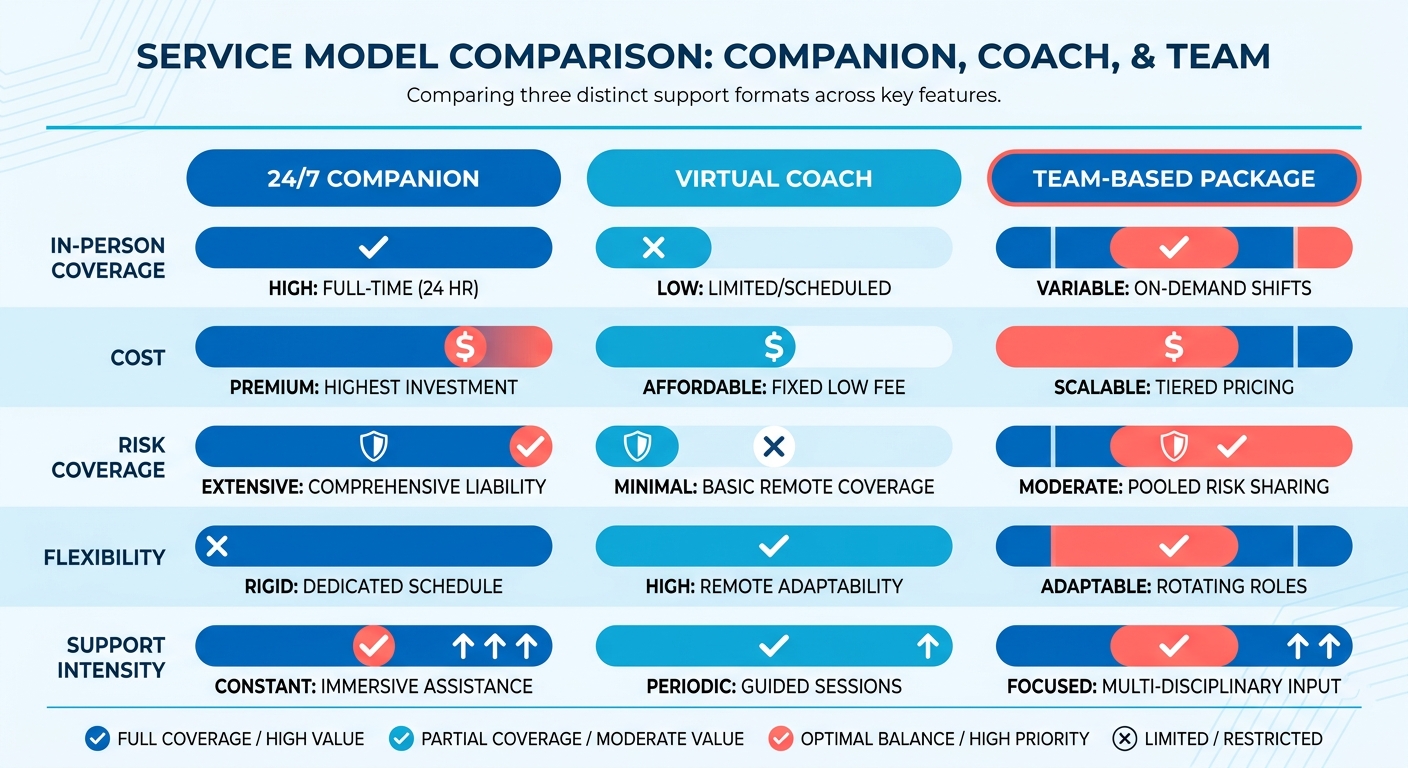
What each format can actually do
In-person intervention is the dividing line. Sober companions offer hands-on support in real time and have been credited with preventing relapse in high-risk moments. A virtual coach cannot walk you out of a bad party. It can help you through one.
Everything else overlaps more than the marketing suggests.
| Feature | 24/7 Companion | Virtual Coach | Team-Based Package |
|---|---|---|---|
| In-person crisis coverage | Constant | None | On-demand for high-risk windows |
| Remote check-ins | Add-on | Core | Core |
| Long-term goal work | Limited | Strong | Strong |
| Clinical license required | No | No | No |
| Cost driver | Days | Hours/retainer | Blended |
| Best fit | First weeks out | Stable step-down | The messy middle |
Look at the license row. Recovery coaches are not required to hold clinical licenses, and that is true across all three formats. You are paying for presence and lived-experience guidance, not therapy. Keep that in mind when you compare quotes.
The logistics gap between the roles
The day-to-day logistics differ more than the job titles suggest. A 24/7 companion often means shift planning, travel arrangements, and, if they stay in your home, coordinating living quarters. Recovery coaching runs on scheduled appointments, with almost no logistical load on you. That gap is a big part of why the pricing diverges so much.
So do not shop by label. Shop by how many in-person hours you actually need.
Where the money goes
Cost tracks coverage hours, full stop. Live-in companions run $1,000 to $4,000+ per day because that rate buys a person's full waking presence, meals, travel, and overnight availability all together. Remote coaching bills the opposite way, charging only for the blocks you book. That is why a single week of intensive live-in support can cost more than a full month of scheduled virtual check-ins.
Here is the trap in the transition stage. Daily-rate prices for constant presence overspend once your crisis risk has faded. Acute cases still need physical supervision. People who have stabilized just need structured touchpoints to hold momentum.
That split is exactly what a blended package solves. You buy in-person coverage only for risky windows and lean on cheaper check-ins the rest of the week. Our packages are built to shift as needs change, scaling back contact hours as you show consistent self-management. For the messy middle, that is the honest answer.
One caveat: if you are in your first week out with an active, high-risk relapse profile, a hybrid may not offer enough security. In that case, a full-time companion is the safer call. The blended approach proves its value during step-down, not on day one.
What each format wins and loses
Every format wins somewhere and loses somewhere else. A 24/7 companion buys crisis coverage but burns cash fast. A virtual coach is cheap and flexible but cannot physically pull you out of a bad room. A team-based package gives up a little of each to hit the sweet spot for transitional recovery.
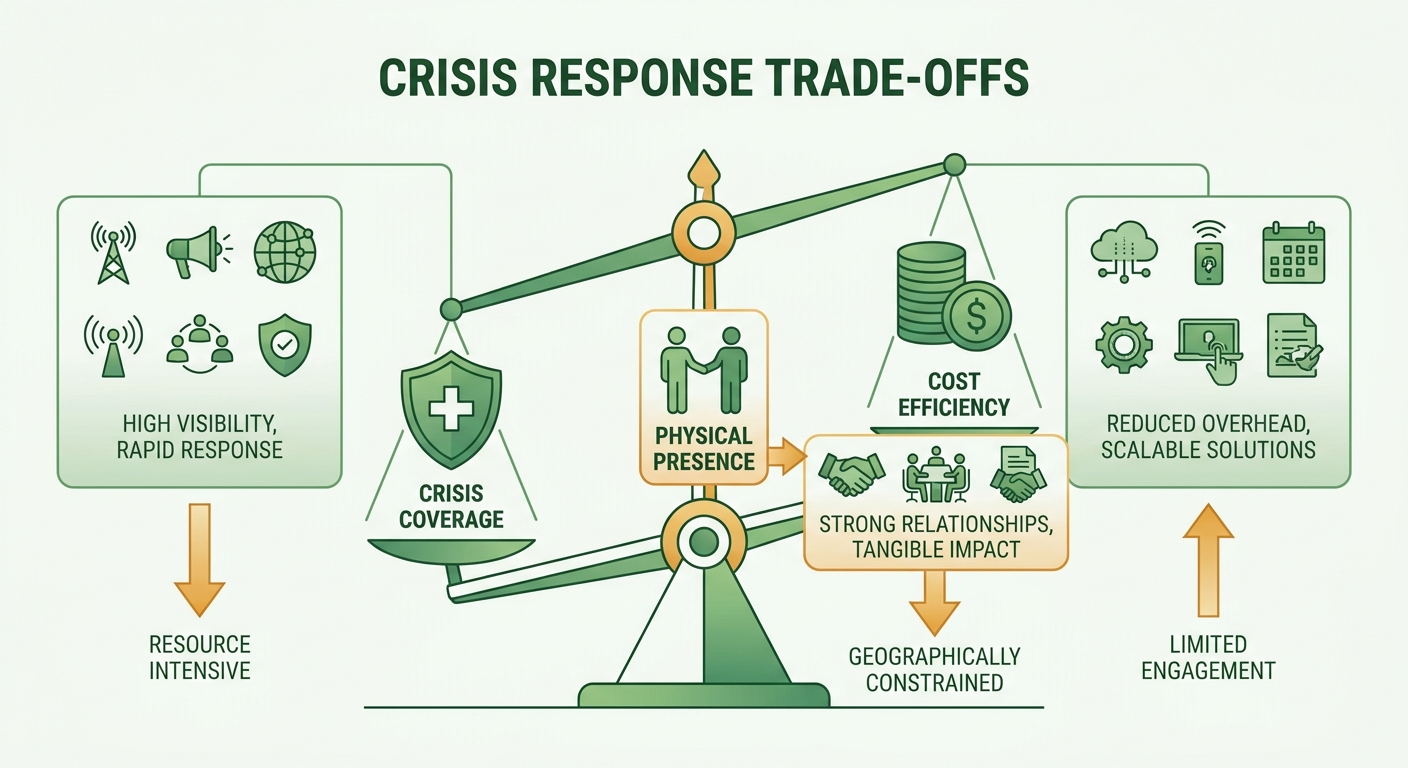
The right choice depends less on a single price tag and more on where you are in recovery. Match the model to your current risk, not to what looked right on day one.
The 24/7 companion at its best and worst
Strength: immediate, hands-on intervention. An experienced professional who is physically present can redirect you in real time during intense cravings. In the first raw weeks out of residential care, that can be worth every dollar.
Weakness: the meter never stops. You pay full crisis rates even on calm afternoons when nothing is at stake. That is the flaw of a flat-rate model during the transition-to-community stage.
Once your daily routine steadies, it is time to move off round-the-clock companionship. Paying for constant supervision after your risk has dropped is overspending, plain and simple.
Where a virtual coach falls short
Strength: cost and reach. Remote check-ins let you spend only on the hours that matter, and many clients keep a standing weekly slot rather than open-ended coverage. Sessions run by phone or video, so scheduling bends around your life.
Weakness: no physical backup. A remote coach cannot check your home for hidden substances or step in if a trigger catches you in public. For anyone still facing periods of high vulnerability, that missing presence is a real limit.
A pure virtual model works once your risk is low. It under-serves anyone still walking into weekly danger zones.
Why the team-based package splits the difference
The hybrid model matches spend to risk. It uses occasional in-person coverage for high-risk moments and lower-cost virtual check-ins for everything else. As risk drops, in-person hours taper and so does your bill.
There is a coordination advantage too. Instead of leaning on one person who has to be on-call indefinitely, a hybrid team works from shared communication protocols. Whether you are talking to a coach online or meeting a companion for a weekend event, the team stays aligned on your goals and triggers.
That is where our approach fits. At MADE, we build a customized, team-based package around your current relapse risk, drawing on a dedicated coach or a coordinated team depending on your level of care. As you stabilize, we scale back our involvement and help you move into self-directed recovery.
Who each format is actually for
The right format comes down to one question: how much of your week needs active supervision? A 24/7 companion fits the first weeks out of residential care, when relapse risk is high and constant. A virtual coach fits stable clients who need accountability, not supervision. A team-based package fits the messy middle, which is where most people leaving treatment actually land.
Here is how each format maps to a real profile.
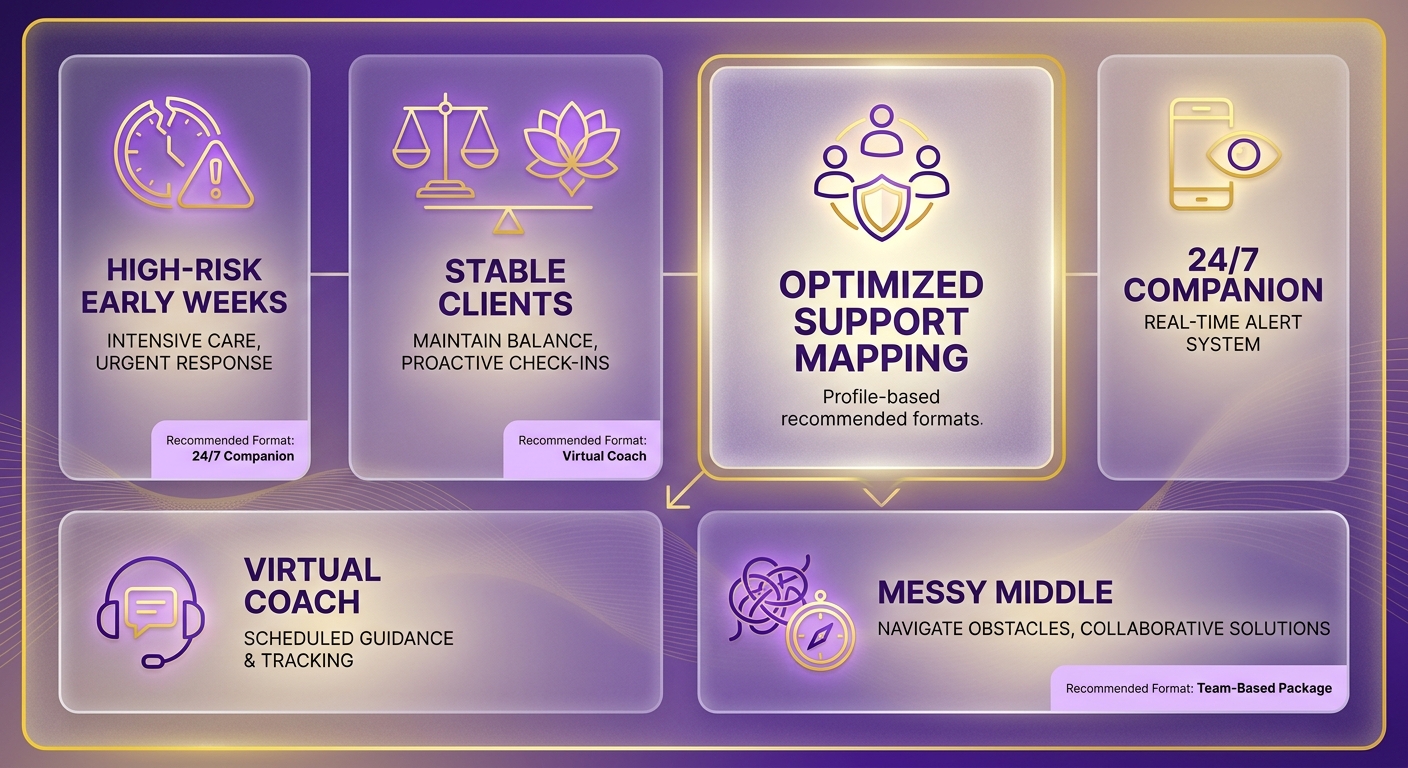
Who needs a 24/7 sober companion
A 24/7 companion suits the highest-risk window: the first days after detox, a return home to a triggering environment, or a single high-stakes event like a wedding or a court date. Physical presence matters here because someone by your side can intervene in the moment in a way a phone call cannot.
As the most intensive tier, it earns its cost when a bad hour could undo months of progress. It stops earning that cost the moment your high-risk windows shrink to a handful of hours a week.
We would steer you off the flat-rate live-in model once you are sleeping through the night, consistently meeting your daily obligations, and managing your triggers on your own. Paying for constant presence you no longer use is the most common overspend we see.
Who's a good fit for a virtual coach
A virtual coach fits stable clients who need structure and honesty, not physical intervention. Sessions run remotely, so coaching flexes around work and family. Many clients meet weekly at first, then move to biweekly or monthly check-ins as their confidence grows.
This is where the accountability-and-purpose work shines. At MADE, coaching is built on fundamentals like passion discovery, personal empowerment, and mentorship, helping clients reconnect with meaning and rebuild a life worth staying sober for. That is growth work, and it does not require someone in the room.
Skip a virtual-only setup if you are still facing acute cravings you cannot ride out on your own. When you need immediate physical redirection, remote support will not be enough.
Why the transition stage belongs to a team-based package
The transition-to-community stage is exactly where a blended package beats both pure models on cost. As the need for constant supervision fades, keeping a full-time companion becomes wasted money. Our approach is simple: match support to your current risk, then reduce contact hours as you build confidence.
That is the model we use. We blend occasional in-person coverage for genuine high-risk moments with lower-cost virtual check-ins for everything else, and we adjust the mix as you stabilize. It mirrors what the research and the field already agree on: high-risk cases need in-person intensity, and most people do well with remote support.
| Client profile | Best fit | Why |
|---|---|---|
| First 2 weeks post-detox | 24/7 companion | Constant, unpredictable risk |
| Stable, working, wants accountability | Virtual coach | Growth over supervision |
| Stepping down, risk dropping unevenly | Team-based package | In-person on demand, virtual for the rest |
Focus less on the job titles and more on the actual hours of engagement. The main driver of both cost and outcome is your level of active contact. Buy only the intensity your current stage needs, and you protect your budget while still getting the safety you need.
What I'd actually recommend
The best format for transitional support is the one that matches your current risk and scales its cost down as you stabilize. A 24/7 companion wins the first high-risk weeks. A virtual coach wins once you are stable. For the messy middle, a team-based package usually wins on both safety and spend.
That middle stage is the one most people underestimate. You are out of residential care, back in your own kitchen, back near old triggers. You do not need someone beside you all day anymore, but a weekly phone call is not enough either. Pay a flat 24/7 rate here, and you pay for hours you no longer need.
Which option should you pick?
Match the format to your week, not to a sales pitch. The short version:
| Your situation | Best format |
|---|---|
| First days out of detox, high-trigger home | 24/7 companion |
| Stable, needs accountability only | Virtual coach |
| Transitioning to community, risk dropping | Team-based package |
| Single high-stakes event (court, wedding) | 24/7 companion, short term |
We built our model around that third row. We staff a mix of in-person on-demand support and remote check-ins, then scale the physical coverage hours down as you gain stability. You pay for coverage you actually use, and the plan flexes with your needs instead of locking you into a flat daily rate.
When you should skip a team package
A blended model is not right if you are in active crisis. If your home is highly triggering and you need continuous supervision to stay safe, get a full 24/7 companion first and plan to step down later. A tapering package assumes your baseline risk is already dropping.
The same goes for the other end. If you have held stability for several months and only need light accountability, a virtual coach covers you for less.
For everyone in between, the flexible route is usually the best fit. Contact us to talk through your situation, and we will build the right sober coaching program for you or your loved one, adjusting our involvement as you build lasting self-reliance.
References
[1] Sober Coach vs Recovery Coach (2026): What They Do, Cost & How ... - https://paperbell.com/blog/private-recovery-coach/
[2] Sober Companion and Recovery Coach: Professional Support for ... - https://www.addicted.org/after-treatment/support-programs/sober-companion-and-recovery-coach/
[3] (PDF) The Effectiveness of Telephone-Based Continuing Care ... - https://www.researchgate.net/publication/8034002_The_Effectiveness_of_Telephone-Based_Continuing_Care_for_Alcohol_and_Cocaine_Dependence
Frequently Asked Questions
1. Does insurance cover a 24/7 sober companion or virtual coaching?
These services are almost always paid out of pocket because they do not fall under traditional clinical healthcare. Unlike licensed therapists or psychiatrists, peer support specialists and companions focus on day-to-day accountability and practical lifestyle guidance. Because they do not diagnose conditions or bill using standard medical codes, insurance providers generally do not cover these programs.
2. Can I switch from a 24/7 companion to virtual coaching partway through recovery?
Yes, switching between levels of care is often encouraged as you build confidence. A structured hybrid plan lets you reduce physical supervision as your daily routine becomes more secure, shifting your budget toward remote check-ins. This helps you pay for intensive coverage only when it is truly necessary.
3. How much does a full month of 24/7 in-person coverage actually cost?
Because round-the-clock care requires dedicated, continuous staffing, a full month of live-in support is a major financial commitment. When a professional is dedicated entirely to one client, the daily rates quickly exceed the cost of standard outpatient programs or long-term remote coaching. That is why many families use full-time companions only for short, high-risk windows before moving to a hybrid model.
4. Is a sober companion the same as a recovery coach?
The terminology in the recovery industry is often used loosely, but the practical difference is physical proximity and immediate crisis management. A companion is physically present to help navigate real-time triggers in your environment, while a coach typically works through scheduled sessions to help you set and reach long-term lifestyle goals. Focus on the specific hours of physical presence you need rather than the title itself.
5. What if my relapse risk drops unevenly instead of steadily?
Recovery is rarely linear, which is why a rigid, single-format plan often fails. A hybrid model lets you scale physical support up or down as needed. If you have a difficult social obligation or a highly stressful week, you can schedule temporary in-person accompaniment, then return to standard remote check-ins once the pressure eases.
6. When should I avoid a team-based hybrid package?
Avoid a hybrid package if you are in early detox or experiencing active, severe cravings that require continuous, line-of-sight supervision. In those cases, a dedicated 24/7 companion is necessary. If you have maintained solid sobriety for several months and only want a professional to review your weekly goals, a standard virtual coaching arrangement is more appropriate and cost-effective.
7. Can a virtual coach handle a craving or triggering event?
A virtual coach is highly effective at helping you build coping strategies and de-escalate stress over the phone. However, they cannot physically step in to remove you from an unsafe environment or manage immediate logistical crises in your home. If you are still highly susceptible to impulsive decisions during cravings, having an in-person companion remains the safest option.